

Live updates (closed)
 Add ToI as a Preferred Source on Google
The Times of Israel liveblogged Tuesday’s events as they unfolded.
Trump on Iran war: ‘We’ve already won in many ways, but we haven’t won enough’

President Donald Trump looks to the crowd as Rep. Tom Emmer, R-Minn., House Speaker Mike Johnson of La.,, Rep. Steve Scalise, R-La., and Rep. Lisa McClain, R-Mich., applaud at the Republican Members Issues Conference, Monday, March 9, 2026, at Trump National Doral Miami in Doral, Fla. (AP Photo/Mark Schiefelbein)
US President Donald Trump characterizes the war with Iran as a “short-term excursion” from his economy-focused domestic agenda, again acknowledging that the ongoing conflict is spiking costs for Americans back home.
“We took a little excursion because we felt we had to do that to get rid of some people,” he says in remarks at a Republican congressional fundraising event in Florida, apparently referring to Iran’s leaders.
He again claims Iran would have obtained a nuclear weapon within two weeks had the US not targeted its nuclear sites last year.
Commenting on the ongoing operations, Trump says, “Together with our Israeli partners, we are crushing the enemy in an overwhelming display of technical skill and military force.
He says Iran’s drone and missile capability is being “utterly demolished” and that 46 Iranian navy ships have been sunk.
“The terrorist leaders are gone or they’re counting down the minutes until they will be gone,” Trump says amid speculation that the US and Israel will try and target Iran’s newly elected supreme leader Mojtaba Khamenei after killing his father Ali in the war’s opening strike.
“We had leaders and they’re gone. They had new leaders and they’re gone. And now nobody has any idea who the people are that are going to be the head of the country… and we will not relent until the enemy is totally and decisively defeated,” Trump says.
“We’ve already won in many ways, but we haven’t won enough,” Trump adds.
He recalls meeting the parents of the first American casualties of the war, claiming, “They all said one thing to me: ‘make sure you win’.” Prime Minister Benjamin Netanyahu, during the war against Hamas in Gaza, said the parents of fallen soldiers offered him near-identical messages when he visited them.
Trump says Iran was “always a dark cloud hanging over — not only Israel, which was gonna get wiped out,” adding that Iran was also “looking to take over the Middle East.”
The US president touts the assistance provided by Arab countries that have been targeted as part of Iran’s retaliation for the US and Israeli strikes. “They could have gone toward their side… [but] they really went with our side, and they’ve helped us. They’ve been a big force.”
Responding to criticism of the varying justifications that the administration has provided for launching the war when it did, Trump again claims that if the US and Israel didn’t strike, “Within a week, [Iran was] going to attack us.”
Pentagon briefers reportedly acknowledged to Congressional staffers that the US does not have intelligence indicating that Iran was planning to preemptively attack the US.
Trump has also said that he had a “feeling” Iran was going to attack first.
No reports of impacts, injuries in latest Iran missile attack on Israel — medics
There are no reports of direct impacts or injuries in the latest Iranian ballistic missile attack on Israel, medics say.
A small number of missiles were launched in the attack, setting off sirens across northern Israel.
Concurrently, sirens sounded in the Kiryat Shmona area on the northern border following rocket fire from Lebanon.
Trump threatens to hit Iran’s electricity production sites if Tehran blocks global oil supply

US President Donald Trump dances as Rep. Tom Emmer, R-Minn., House Speaker Mike Johnson of La., Rep. Steve Scalise, R-La., and Rep. Lisa McClain, R-Mich., applaud at the Republican Members Issues Conference, Monday, March 9, 2026, at Trump National Doral Miami in Doral, Fla. (AP Photo/Mark Schiefelbein)
US President Donald Trump says the US has held off on targeting certain electricity production sites in Iran but will do so if the Islamic Republic doesn’t cooperate.
“We’ve left some of the most important targets for later, in case we need to do it,” Trump says during a press conference in Florida on the Iran war.
“If we hit [those targets], it’s going to take many years for them to be rebuilt. [The targets have] to do with electricity production and many other things. We’re not looking to do that if we don’t have to,” Trump says.
Getting more specific regarding when he’d be prepared to target electricity production sites, Trump says, “I will not allow a terrorist regime to hold the world hostage and attempt to stop the globe’s oil supply. If Iran does anything to do that, they’ll get hit at a much harder level. I will take out those targets… that I mentioned just before.”
“We’ll take them out so quickly [that] they’ll never be able to recover. If they want to play that game, they’d better not play that game,” Trump says.
He argues that the war will neutralize the threat Iran poses to global shipping and oil supply. “The result will be lower oil prices, oil and gas prices for American families.”
“During this brief disruption, the United States is offering political risk insurance to any tankers operating in the Gulf,” Trump announces, adding that the US is also waiving certain oil related sanctions to reduce prices.
“When the time comes, the US Navy and its partners will escort tankers through the straight if needed,” Trump says.
“We’re ahead of our initial timeline by a lot,” he claims.
The president reiterates that he wants to be involved in selecting Iran’s next leader.
“We don’t want another president that maybe wouldn’t be willing to do what I’m willing to do — for the good of the world, for the good of our nation. [We don’t want] to be stuck with the situation in five years or 10 years from now,” Trump says.
He asserts Iran during the previous rounds of nuclear talks effectively refused to give up building a nuclear weapon by insisting on maintaining the right to enrich uranium at high levels.
After the US struck Iran’s nuclear sites last year, Tehran sought to build a new site that was protected by granite, Trump claims, adding that the regime also accelerated its missile production in the interim.
He says Iran’s conduct before Operation Epic Fury “was very quickly approaching the point of no return, and the United States found it intolerable.”
Trump: ‘Iran war going to end soon; if it starts up again, they’ll be hit harder’
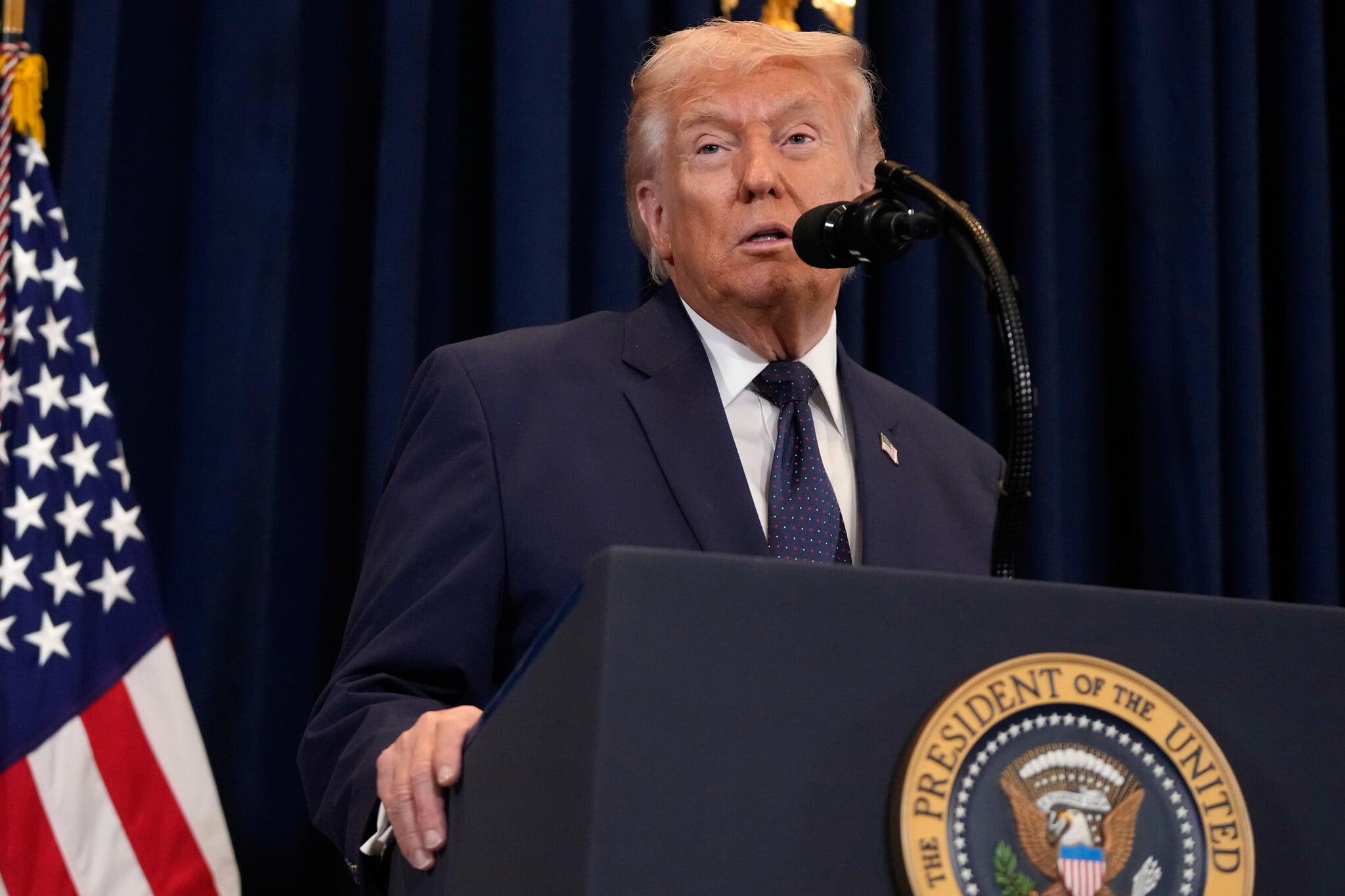
US President Donald Trump speaks at a news conference, March 9, 2026, at Trump National Doral Miami in Doral, Florida. (AP/Mark Schiefelbein)
US President Donald Trump suggests the war with Iran is soon wrapping up, while albeit refraining from giving a specific timeline.
“We’re getting very close to finishing that too,” Trump says of the war during a press conference.
“It’s going to be ended soon,” he later adds. “And if it starts up again, they’ll be hit even harder.”
Pressed whether “soon” means in a week, Trump responds, “No, but I think soon.”
A reporter points out that Trump is saying the war is nearly over, even though his defense secretary has said it’s just beginning.
“So which is it?” the reporter asks.
“You could say both,” Trump responds.
“It’s the beginning of [Iran] building a new country,” Trump says, while adding that the Islamic Republic’s military has been decimated.
Asked what more he wants to see before ending the war, Trump says Iran must have leaders who don’t try to develop a nuclear weapon.
Iran has insisted that it does not seek such capabilities, but the US has accused Tehran of lying.
Trump says he’ll be prepared to end the war, “When basically I can see that they will no longer have any capacity whatsoever for a very long period of time of developing weaponry that could be used against the United States, Israel or any of our allies.”
He reiterates his claim that Iran was planning on “taking over the Middle East” and destroying Israel.
“We stopped it with good timing. We’re very proud to be involved in this.
Rocket sirens triggered in Safed, nearby Galilee towns amid barrage from Lebanon
Rocket sirens sound in Safed and nearby towns in the Galilee amid a rocket barrage from Lebanon.
There are no immediate reports of injuries or damage.
Hezbollah has fired many dozens of rockets at northern Israel, as well as several long-range projectiles at central Israel, in the past week.
Trump: US-made missile reportedly used in Iran school strike could’ve been fired by another country

US President Donald Trump speaks during the Republican Members Issues Conference at Trump National Doral in Miami, Florida, on March 9, 2026. (SAUL LOEB / AFP)
US President Donald Trump is pressed during a press conference on new findings indicating that the strike on an Iranian elementary school that reportedly killed over 150 people was carried out by an American-made Tomahawk missile.
Trump says he’s not familiar with this development but claims the US sells Tomahawk missiles to other countries, apparently suggesting that it could have been Israel behind the strike — something that initial reporting has not suggested.
He also suggests Iran could have gotten its hands on a Tomahawk missile and launched it at the school.
When pressed further on his basis for that claim, Trump responds, “I just don’t know enough about it.
“It’s something that I was told is under investigation… whatever the report shows, I’m willing to live with that,” he adds.
Trump says he’d like the next leader of Iran to come from inside the country
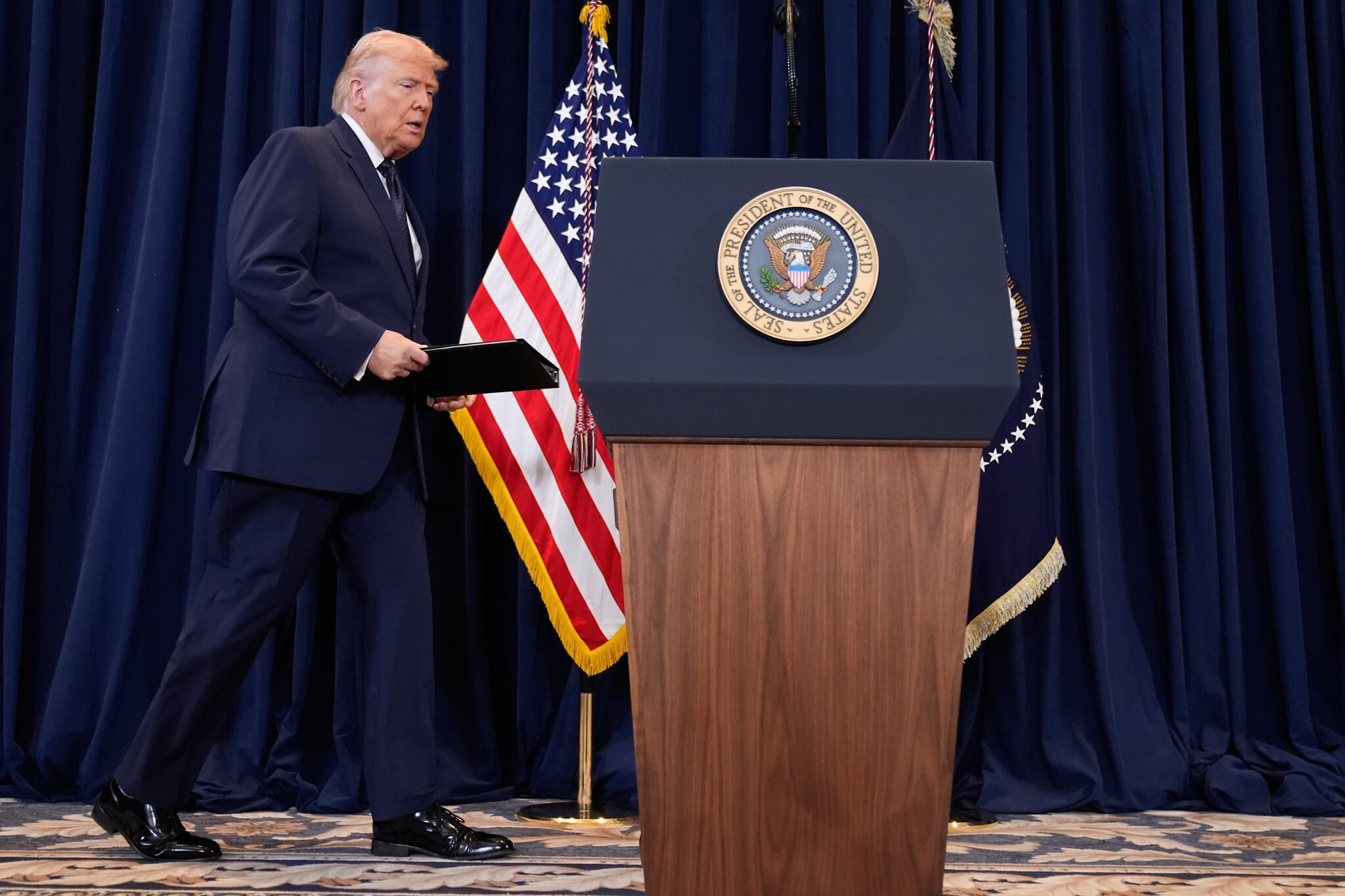
US President Donald Trump arrives to speak at a news conference, Monday, March 9, 2026, at Trump National Doral Miami in Doral, Fla. (AP Photo/Mark Schiefelbein)
US President Donald Trump declines to say that he has put a target on the back of Iran’s new supreme leader, Mojtaba Khamenei.
“I don’t want to say that,” Trump says during a press conference on the Iran war. “I don’t want to say whether or not he does because that would be inappropriate.”
However, he acknowledges that he’s not encouraged by what he’s heard so far about the new leader.
“We think it’s going to lead to more of the same problem for the country. So I was disappointed to see their choice,” Trump says.
Asked whether he’d want the leader of Iran to be someone from inside or outside the country, Trump responds that he “likes the idea of internal” because it has “worked well” in Venezuela.
He says that after the Iraq war, there were attempts to clear house completely, which led to the rise of ISIS. “We don’t want that.”
He again dismisses the son of Iran’s pre-revolutionary shah due to his not having been in the country for decades.
“We have a formula that’s been very good so far, and I think it will continue to be good,” Trump says, apparently endorsing the idea of finding someone from within the regime to take over and work with the US.
Trump in January pledged to assist Iranian protesters who were gunned down en masse for demonstrating against the regime.
He is pressed on whether he’d be betraying them by making a deal with a new leader of the same regime.
“Will I help them? I’d like to if they can behave, but they’ve been very menacing,” Trump says before praising the Iranian people.
“I’d love to help them, but they have to be in a system that allows them to be helped, and right now they’re in a system that only allows failure,” he says.
Asked whether he and US Vice President JD Vance see eye-to-eye regarding the war, Trump admits that Vance “philosophically… was maybe less enthusiastic.
“But he was quite enthusiastic, [and] I felt it was something we had to do,” Trump adds.
Americans expect gasoline prices to keep rising after Iran strikes — poll
Most Americans think gasoline prices are going to rise in the coming months following US President Donald Trump’s decision to launch military strikes on Iran, and many expect a protracted conflict, according to a Reuters/Ipsos poll that closed on Monday.
Some 67 percent of respondents in the four-day poll – including 44% of Republicans and 85% of Democrats – said they expect gas prices in the U.S. to get worse over the next year. Sixty percent of Americans expect US military involvement in Iran will “go on for an extended period of time,” according to the poll.
The latest Reuters/Ipsos poll finds that just 29% of Americans approve of the strikes — just two percentage points more than the figure from the last poll conducted in the hours immediately following the start of the military campaign. Both polls had margins of error of about 3 percentage points.
The latest poll underscores the political risks Trump brings to his Republican Party ahead of the November midterm elections when Democrats hope to seize control from Trump’s party of at least one chamber of Congress.
Some 64% of poll respondents – including one in four Republicans and nine in 10 Democrats – said Trump has not clearly explained the goals of US military involvement.
Trump says he discussed Ukraine and Iran conflicts with Putin
US President Donald Trump tells reporters he had a “very good call” with Russian President Vladimir Putin about Ukraine and the conflict in the Middle East.
“There’s tremendous hatred between President Putin and (Ukraine’s) President Zelensky. They can’t seem to get it together, but I think it was a positive call on that subject,” Trump says.
Trump adds that Putin “wants to be helpful” with the Iran conflict.
“I said, ‘You could be more helpful by getting the Ukraine-Russia war over with. That will be more helpful,'” Trump tells reporters in a press conference at his Florida golf club.
A foreign policy aide for Putin said on Monday that Putin proposed an idea for a “quick political and diplomatic end to the Iranian conflict.”
Trump recently has expressed dismay about the ongoing conflict between Russia and Ukraine, which started more than four years ago.
IDF says it destroyed launcher in Lebanon 10 minutes after it fired at northern Israel
The IDF says it destroyed a rocket launcher in Lebanon that was used to target Israeli communities in the north.
The rocket launcher was hit by the IDF within 10 minutes of when it was used to fire at Israel, the army says.
This was the fourth time that the IDF has destroyed a rocket launcher in Lebanon this evening alone, the IDF adds.
Israeli-American brothers guilty of luxury real estate sex-trafficking scheme in US

Tal (left) and Oren Alexander just brokered a record $100-million real estate deal, a Manhattan townhouse bought by their clients, the state of Qatar. (Courtesy Oren Alexander website)
Three Israeli-American brothers have been found guilty of sex trafficking, following a trial that showed they used their high-profile connections in the luxury real estate world to assault women for years.
Oren and Tal Alexander were the founders of the real estate firm Official, which had offices in Miami and New York. Alon Alexander, Oren’s twin, worked at the family’s private security firm.
The brothers used “deception, fraud and coercion” — including the promise of luxury travel accommodation — to engage in sex trafficking as well as drugging, sexually assaulting and raping dozens of women, prosecutors said when they were charged.
Twins Alon and Oren, both 38, and their brother Tal, 39, all face sentences of up to life imprisonment when they are sentenced on August 6.
They used “their wealth and prominent positions in real estate to create and facilitate opportunities” to do so, prosecutors said.
The assaults date from at least 2010 to at least 2021, prosecutors said.
In 2022, Tal and Oren were the subject of a New York Times profile detailing their successful ventures as real-estate high rollers, including the sale of a 24,000-square-foot (2,230-square-meter) Manhattan penthouse for $234 million.
Tal Alexander flaunted a “no days off” lifestyle of constantly showing glamorous residences to wealthy clients.
Prosecutors painted a grim picture of all three brothers luring women to events and parties, then drugging them with cocaine, magic mushrooms and GHB, and assaulting them.
The Alexanders and those in their circle used “social media, dating applications, in-person encounters…and party promoters who would recruit women for these events,” prosecutors said.
One killed, others injured in Iranian attack in Bahrain
Bahrain’s interior ministry says an Iranian attack on a residential area in the capital Manama killed one person and injured others.
“Initial reports indicate one person died and others were injured in a blatant Iranian attack targeting a residential building in the capital,” the ministry says.
UAE says consulate in Iraqi Kurdistan attacked by drone
The United Arab Emirates says that its consulate general in Iraqi Kurdistan was targeted in a drone attack, leaving damage but no casualties.
A foreign ministry statement says the attack “represents a dangerous escalation and a threat to regional security and stability,” adding that “targeting diplomatic missions and premises constitutes a flagrant violation of all international norms and laws.”
The statement did not say where the drone had been launched from and called on local authorities to “investigate the circumstances of this attack to identify those responsible.”
Rubio urges Iraq to protect US embassy after Iran protests
US Secretary of State Marco Rubio urges Iraq’s leadership to keep protecting the US embassy after violent protests over the US-Israeli war on neighboring Iran.
In a call with Prime Minister Mohammed Shia al-Sudani, Rubio “reiterated the importance of the Iraqi government taking all possible measures to safeguard US diplomatic personnel and facilities,” State Department spokesman Tommy Pigott says.
Rubio also “strongly condemned terrorist attacks by Iran and Iran-aligned terrorist militia groups in Iraq, including in the Iraq Kurdistan Region,” Pigott says.
Iran has carried out strikes on Kurdish Iranian militants in Iraq, after US President Donald Trump said he would back an offensive by the groups into Iran.
Trump later backtracked and said he did not support a Kurdish offensive.
Iran holds influence in Iraq, which shares with its neighbor a Shia majority, and protesters have tried to storm the Green Zone, which is home to the US and other embassies as well as key government buildings.
Authorities last week accused demonstrators of firing live rounds that wounded security personnel guarding the area.
In recent weeks, Trump has been warning Iraqi leaders against replacing Sudani with Nouri al-Maliki, who has a close relationship with Iran.
Maliki, a former prime minister whose relationship deteriorated with Washington during the Iraq war, earlier told AFP that he would not withdraw his nomination.
Iran’s Pezeshkian talks with Turkey’s Erdogan after missile intercept
Iranian President Masoud Pezeshkian spoke by phone with his Turkish counterpart Recep Tayyip Erdogan on Monday, after an incoming Iranian missile was intercepted in Turkey’s airspace.
“The Islamic Republic of Iran has always declared its readiness to reduce tension in the region; provided that the airspace, soil and waters of our neighbours are not used to attack the Iranian people,” Pezeshkian says in a statement about the call.
The missile was the second fired from Iran to be shot down in Turkish airspace in five days.
Responding to Trump, Iran’s IRGC says it ‘will determine the end of the war’
Iran’s Islamic Revolutionary Guard Corps says it will “determine the end of the war” in the Middle East after US President Donald Trump said the conflict would end “soon.”
“It is we who will determine the end of the war,” the IRGC says in a statement.
“The equations and future status of the region are now in the hands of our armed forces; American forces will not end the war,” the statement adds.
The IRGC says Tehran will not allow “one liter of oil” to be exported from the region if US and Israeli attacks continue.
‘Death, fire and fury’: Trump threatens Iran with unprecedented force if it blocks oil flow through Strait of Hormuz
US President Donald Trump doubles down on his threat to strike Iran with unprecedented force if it stops the flow of oil through the Strait of Hormuz.
“If Iran does anything that stops the flow of oil within the Strait of Hormuz, they will be hit by the United States of America TWENTY TIMES HARDER than they have been hit thus far,” Trump writes on Truth Social.
“Additionally, we will take out easily destroyable targets that will make it virtually impossible for Iran to ever be built back, as a nation, again — death, fire and fury will reign upon them,” he says.
“But I hope, and pray, that it does not happen!” Trump adds, claiming the threat is “a gift from the United States of America to China and all of those nations that heavily use the Hormuz Strait.”
Trump envoy pans GOP lawmaker for claiming Muslims ‘don’t belong in American society’
US special envoy for presidential missions Richard Grenell criticizes Republican Rep. Andy Ogles for tweeting, “Muslims don’t belong in American society. Pluralism is a lie.”
“Stop attacking the First Amendment to the United States Constitution,” Grenell tweets in response.
Ogles has published a host of Islamophobic posts on X in recent years.
Syria accuses Hezbollah of firing shells into its territory
Iran-backed Hezbollah fired artillery shells into Syria from Lebanon overnight Monday-Tuesday, Syrian state media reports, amid the ongoing conflict between Israel and the Shia terror movement.
Syrian army officials said artillery shells fired from Lebanon landed near the town of Serghaya, west of Damascus, the state news agency SANA reports.
The army accused Hezbollah of targeting Syrian army positions, telling the news agency it observed Hezbollah reinforcements at the Syrian-Lebanese border.
“The Syrian Arab Army will not tolerate any aggression targeting Syria,” the army says in a statement to SANA.
Hezbollah provided military support to former Syrian president Bashar al-Assad, who was overthrown in December 2024 by an Islamist coalition hostile to the pro-Iranian Shia movement.
Since then, its supply routes from Syria have been cut off, and Lebanese and Syrian authorities are trying to combat smuggling across the porous border between the two countries.
Trump aides said urging him to articulate war exit plan; White House denies report

This photo provided by the White House which has been partially blurred, shows US President Donald Trump talking with CIA Director John Ratcliffe, left, Secretary of State Marco Rubio, and White House chief of staff Susie Wiles at Mar-a-Lago in Palm Beach, Florida, during Operation Epic Fury on February 28, 2026. (Daniel Torok/The White House via AP)
Some of US President Donald Trump’s advisers are privately urging him to publicly articulate an exit plan from the Iran war, The Wall Street Journal reports, citing unnamed sources familiar with the matter.
The aides want him to make the case that the military has largely achieved its objectives for the war, WSJ says.
While US officials have at times offered varying lists for the war’s aims, they have generally been the destruction of Iran’s missile program, the destruction of its navy, a halt to Iran’s support for regional proxies and the blocking of Iran from obtaining a nuclear weapon.
The Journal report is forcefully denied by White House press secretary Karoline Leavitt.
“This story is full of crap from anonymous sources who, I can guarantee, are not in the room with President Trump. The president’s top aides are focused 24/7 on ensuring Operation Epic Fury continues to be a tremendous success, and the end of these operations will ultimately be determined by the commander in chief,” Leavitt says.
WSJ says some of Trump’s aides have warned him that a drawn-out war will eat into his support, even if Republicans largely support the strikes against Iran for now.
The concerned advisers have fielded calls from Republicans who have expressed concern about what the war will mean for the upcoming midterm elections, the Journal says.
Accordingly, the aides determined that they needed a more aggressive public messaging plan to sell the war amid rising gas prices, WSJ says.
“The vast majority of Americans support ending the threat posed by the Iranian regime and support killing terrorists, and that’s what President Trump is going to accomplish,” Leavitt says in response to the story.
Polling has shown that a slight majority of Americans oppose the war, with responses largely falling along party lines.
Despite the concern from some of his advisers, administration officials told the Journal that the war was unlikely to end so long as Iran continued attacking regional countries and as long as Israel wanted to continue striking targets in Iran.
Trump won’t stop fighting until he can claim a satisfactory victory, especially when the US has a military advantage, a senior administration official tells WSJ.
The paper cites unnamed people familiar with Trump’s thinking as saying that the president is surprised that Iran hasn’t capitulated amid the unrelenting US and Israeli strikes.
UAE says it’s intercepting missile, drone attack from Iran
The United Arab Emirates says it is intercepting a drone and missile attack from Iran.
“UAE air defenses are currently responding to incoming missile and drone threats from Iran,” the defense ministry posts on X.
Iran’s foreign minister: We’ll continue our missile attacks for ‘as long as it takes’
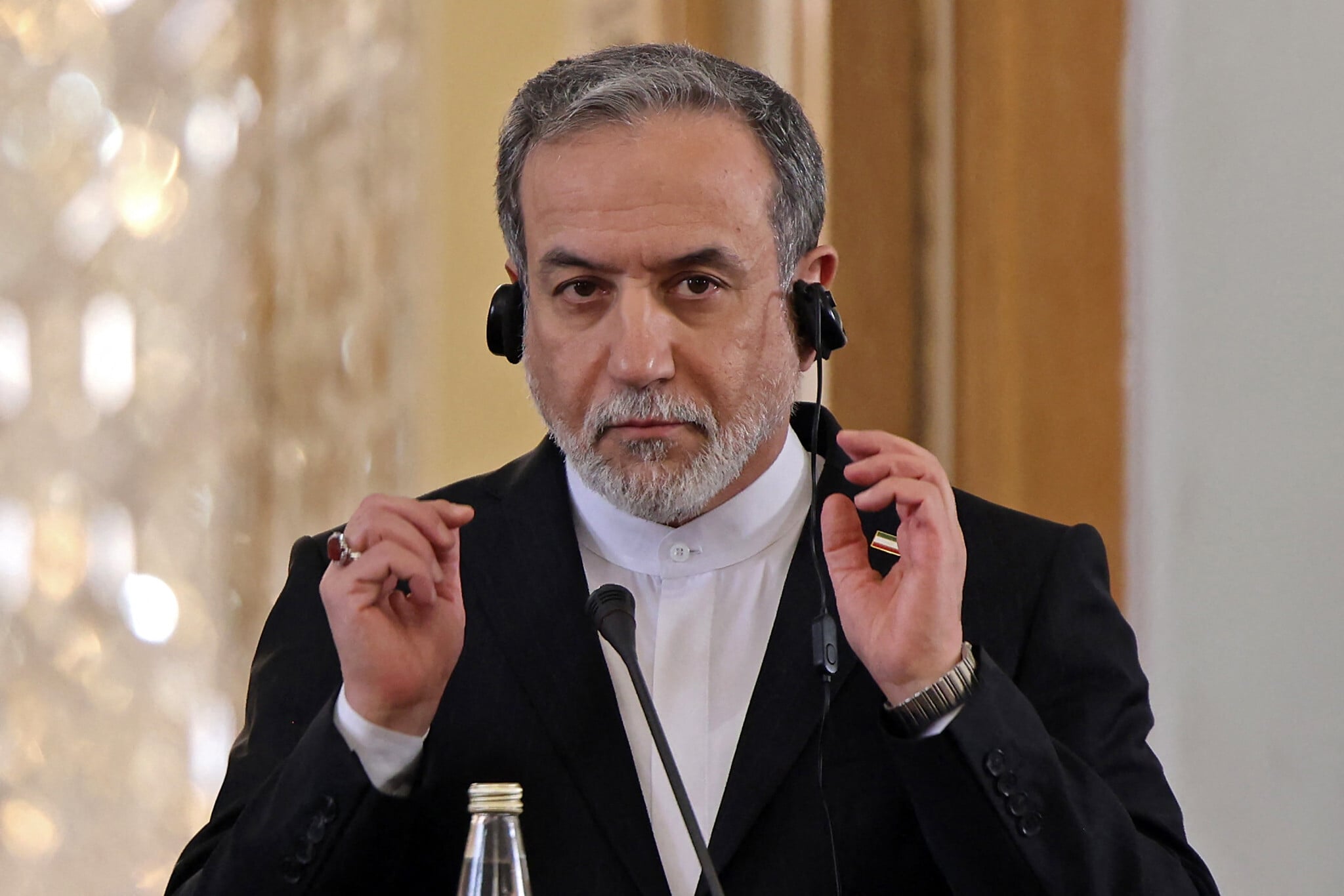
Iranian Foreign Minister Abbas Araghchi attends a joint press conference with his Iraqi counterpart Fuad Hussein, in Tehran on January 18, 2026. (ATTA KENARE / AFP)
Iran’s foreign minister says his country is prepared to continue attacks for as long as necessary and rules out talks after US President Donald Trump said the war with Iran would be over “soon.”
“The firing continues, and we are well prepared to continue attacking them with our missiles as long as needed, and as long as it takes,” Iranian Foreign Minister Abbas Araghchi tells US broadcaster PBS News.
Araghchi says that negotiations with the United States are no longer on the agenda.
“We have a very bitter experience of talking with Americans,” he says, noting that both US attacks on Iran, in June and now, came following unsuccessful negotiations between the countries. Talks are not “on our agenda anymore,” he says.
He claims that the US and Israel “failed” to achieve regime change in Iran in the war’s opening days, and are now “aimless.”
New Mexico investigators search Jeffrey Epstein’s former ranch
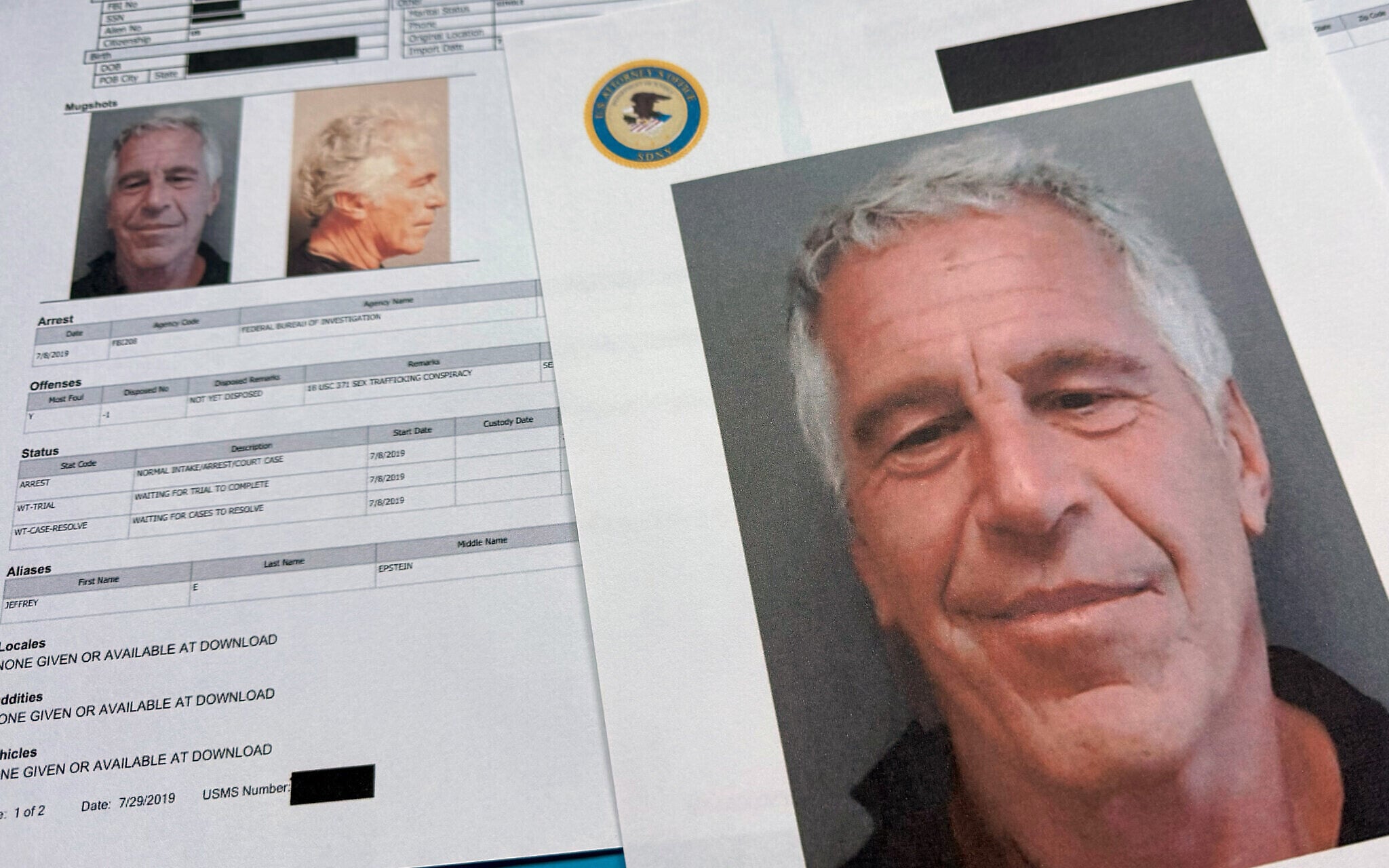
Documents included in the US Justice Department release of files related to disgraced financier and sex offender Jeffrey Epstein are photographed on January 2, 2026. (AP Photo/Jon Elswick)
Investigators in the southwestern US state of New Mexico have begun searching the former high-plains ranch of Jeffrey Epstein, where the late financier and his acquaintances are accused of sexually abusing women and girls, state authorities say.
New Mexico is acting on new information in documents released in January by the US Department of Justice, including an accusation that Epstein ordered the bodies of two foreign girls buried in hills near the secluded property.
The search follows New Mexico Attorney General Raul Torrez’s decision last month to reopen the investigation into the late sex offender’s alleged criminal activities at the ranch 30 miles (48 kilometers) south of the state’s capital of Santa Fe.
“The New Mexico Department of Justice will continue to keep the public appropriately informed, support the survivors, and follow the facts wherever they lead,” it says in a statement.
Yesterday, a Reuters witness heard dogs barking and saw a government vehicle bearing a paw-print symbol, suggesting it was carrying animals, leave the ranch. State police and a county fire and rescue vehicle were also spotted.
New Mexico closed its previous Epstein investigation in 2019 at the request of federal authorities. There has never been a full investigation of the alleged assaults by Epstein, his partner Ghislaine Maxwell and ranch visitors.
Last month, New Mexico became the first US state to launch a legislative “truth commission” to uncover possible public corruption that allowed Epstein to operate in secrecy at the ranch for 26 years before his death in 2019.
Epstein’s estate sold the property in 2023 to Texas businessman Don Huffines.
The new owners are cooperating with the investigation and granted access for the search, the department says.
The January 30 release of millions more files exposed Epstein’s social connections with politicians, business people and scientists whom he invited to the ranch.
Iran-backed militia in Iraq says US strikes kill 4 of its fighters
Four fighters from the Tehran-backed Kataeb Imam Ali militia in Iraq were killed today in airstrikes attributed to the US in the north of the country, the militia announces.
The group says its fighters were killed in an “American aggression” on their position in the Debs district in Kirkuk province.
Germany temporarily pulls embassy staff out of Iraq

German Foreign Minister Johann Wadephul addresses a joint press conference with the Lithuanian foreign minister at the Ministry of Foreign Affairs in Vilnius, Lithuania, January 5, 2026. (Petras Malukas / AFP)
Germany has temporarily pulled staff from its Baghdad embassy out of Iraq because of heightened security risks amid the conflict in the Middle East, a foreign ministry spokesperson says.
“The personnel of the German embassy in Baghdad has now been temporarily relocated from Iraq because of the threat situation,” the spokesperson says, adding that the safety of staff was being continuously assessed.
The embassy remains reachable, though its legal and consular services had already been severely limited for some time due to the security situation, the spokesperson says.
Foreign Minister Johann Wadephul, speaking in Nicosia, Cyprus, late yesterday, said he had discussed the regional situation with US Secretary of State Marco Rubio.
Both condemned what Wadephul called Iran’s “indiscriminate attacks” against countries in the region and urged Tehran to halt them.
Pakistan shutters schools, navy begins ship escorts due to Gulf tensions
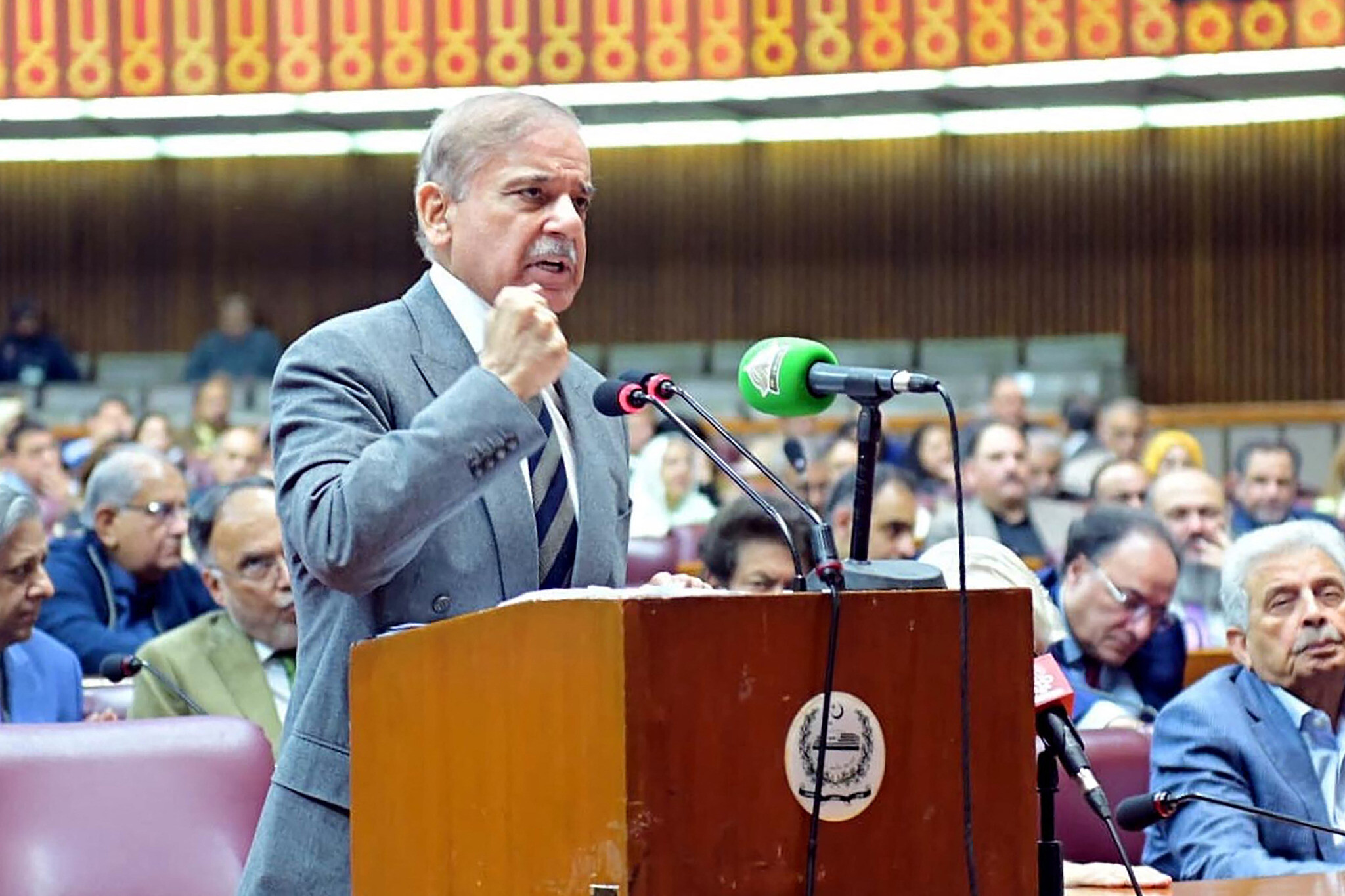
In this handout photograph taken and released by Pakistan's Press Information Department (PID) on November 12, 2025, Pakistan's Prime Minister Shehbaz Sharif addresses parliament session on constitutional amendmen (Photo by HANDOUT / Pakistan Press Information Department (PID) / AFP)
Pakistan’s navy has launched an operation to “counter multidimensional threats” to its national shipping and maritime trade, with concerns about fuel supplies due to the US-Israeli war with Iran.
The country’s military says that navy ships were escorting merchant vessels “to ensure the uninterrupted flow of national energy supplies and the security of sea lines of communication.”
Pakistan, which shares a border with Iran in the southwest, depends on oil and gas from the Gulf and on Friday hiked prices at the pump by about 20 percent, triggering long lines at gas stations across the country.
Prime Minister Shehbaz Sharif yesterday unveiled a raft of austerity measures to save fuel, including shutting government offices for one day a week and ordering 50% of staff to work from home.
Schools were also told to close for two weeks.
The navy was fully “prepared to respond to emerging maritime security challenges”, the Pakistani military says, without elaborating.
191 injured people taken to hospitals over past day due to Iran war — Health Ministry

Illustrative: Patients and medical staff are seen in an underground parking area converted into a treatment ward at Shaarei Tzedk hospital in Jerusalem after many patients were relocated amid the Iran war, March 4, 2026. (Chaim Goldberg/Flash90)
The Health Ministry reports that over the past 24 hours, 191 injured people have been admitted to hospitals as a result of the conflict with Iran.
The figure includes both civilians and soldiers.
Among those treated in hospitals, one is in critical condition, three are in serious condition, two are in moderate condition, and 172 are in good condition.
Ten people have been treated for anxiety. Three have undergone or are undergoing medical evaluation.
The ministry says that since the beginning of the war with Iran on February 28, 2,339 people have been admitted to hospitals, 95 of whom are currently hospitalized.
Among those hospitalized, one person is in critical condition, 11 people are in serious condition, 11 people are in moderate condition, and 69 are in good condition.
Wave of airstrikes hit organization managing Hezbollah’s cashflow — IDF
The IDF says it has completed a wave of airstrikes targeting branches of the Hezbollah-linked Al-Qard al-Hasan association, which is known to be used by the terror group as a quasi-bank.
Strikes carried out by the Israeli Air Force yesterday hit various assets and vaults of AQAH, the military says.
In the past week, a total of some 30 assets of the financial institution were struck across Lebanon, according to the IDF.
Ahead of the strikes, the IDF issued evacuation warnings to Lebanese civilians.
The military says AQAH is used by Hezbollah to store money, manage salaries for its operatives, transfer funds from Iran, and purchase weapons.
צה"ל השלים גל תקיפות נוסף נגד נכסי אגודת "אלקרצ' אלחסן" של את ארגון הטרור חיזבאללה: כ-30 נכסים של האגודה הותקפו בשבוע האחרון
מטוסי קרב של חיל האוויר בהכוונת אמ"ן, השלימו אתמול סדרת תקיפות נוספת נגד נכסים ומחסני כספים של אגודת "אלקרצ׳ אלחסן", ששימשו למימון הפעילות של ארגון הטרור… pic.twitter.com/N4P1RQXnQV
— צבא ההגנה לישראל (@idfonline) March 10, 2026
IDF again warns civilians to evacuate southern Lebanon amid fighting with Hezbollah
The IDF reiterates its warning to Lebanese civilians in all of southern Lebanon to evacuate amid the fighting against Hezbollah.
“Hezbollah’s terror activities are forcing the IDF to act against it with force in the area,” says army spokesman Col. Avichay Adraee.
“Airstrikes are ongoing as the IDF operates with great force in the area. Therefore, for your safety, we once again urge you to evacuate your homes immediately and head north of the Litani River,” he says.
The warning was first issued by the IDF on Wednesday and has been repeated several times.
The military estimates that over 500,000 Lebanese civilians have so far evacuated their homes in south Lebanon.
#عاجل ‼️ تحذير عاجل إلى سكان جنوب لبنان المتواجدين جنوب نهر الليطاني
????إن نشاطات حزب الله الإرهابية تُجبر جيش الدفاع على العمل ضده بقوة في تلك المنطقة.
????الغارات مستمرة حيث يعمل جيش الدفاع بقوة كبيرة في المنطقة. ولذلك وحرصًا على سلامتكم نعود ونناشدكم اخلاء منازلكم فورًا… pic.twitter.com/dppwjsj5j8
— افيخاي ادرعي (@AvichayAdraee) March 10, 2026
IRGC says it targeted US base in Iraq’s Kurdistan region
Iran’s Revolutionary Guards say they have targeted a US base in Iraq’s Kurdistan region.
“The headquarters of the invading US army in Al-Harir Air Base in the Kurdistan region was targeted with five missiles,” the IRGC says in a statement on its Telegram channel.
Turkey’s Halkbank says US agreed to end lawsuit over Iran sanctions
Turkey’s Halkbank says it has reached an agreement with the US Department of Justice to settle a years-long criminal case against the state-run bank over violating sanctions on Iran, amid the US-Israeli war with the Islamic Republic.
Under the terms of a deferred prosecution agreement, the bank “will not admit to any criminal offenses, nor will it pay any judicial or administrative fines,” the bank says on X.
With the court’s approval of the deal, “the criminal case against our bank in the US… will be concluded,” it adds.
Effect on oil markets could be ‘catastrophic’ if Hormuz closure continues — Saudi Aramco chief
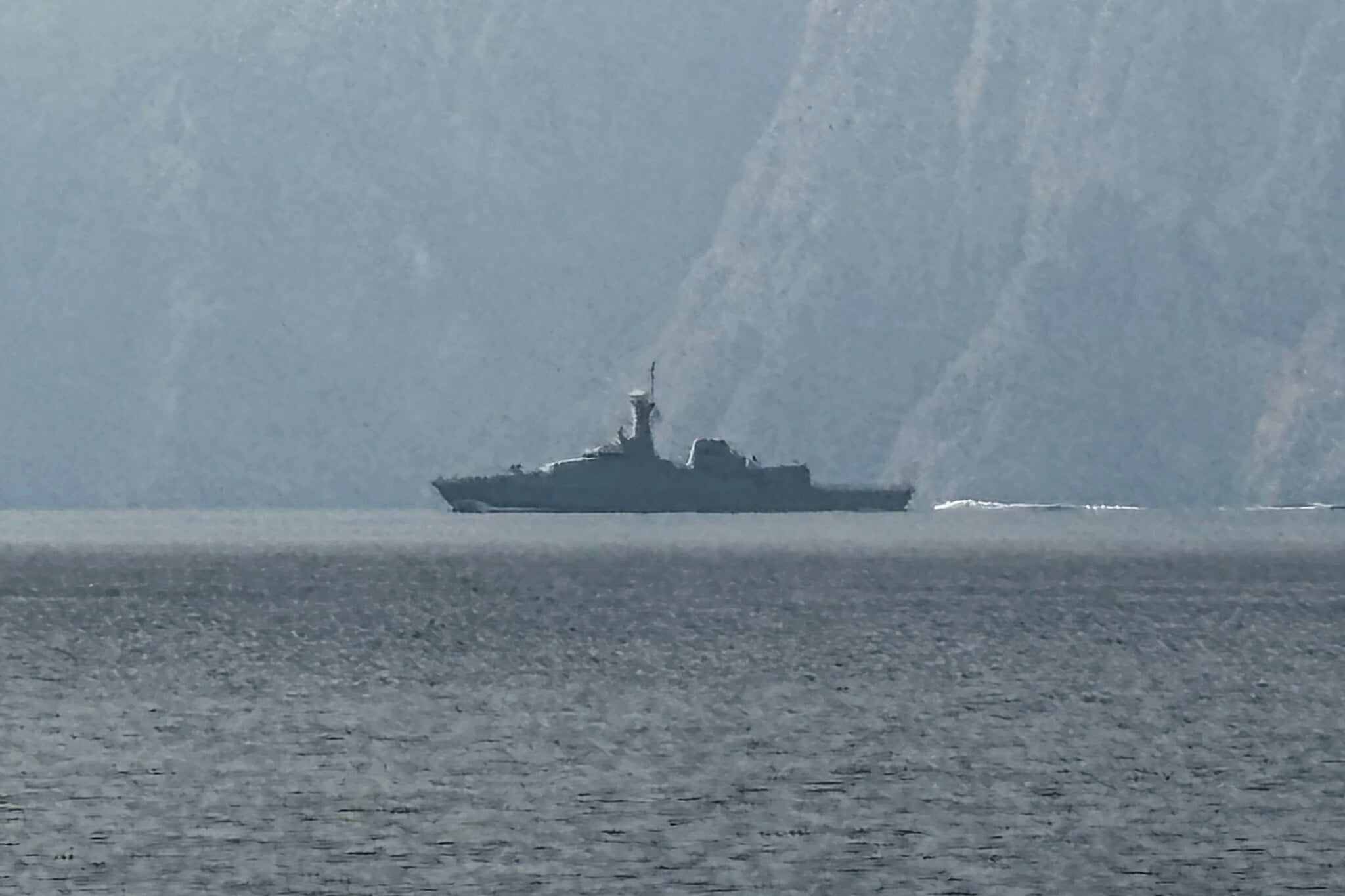
A navy vessel is seen sailing in the Strait of Hormuz, a vital waterway through which much of the world's oil and gas passes on March 1, 2026. (Sahar Al Attar/AFP)
There could be “catastrophic” consequences for the world’s oil markets the longer the disruption from the closure of the Strait of Hormuz goes on amid the US-Israeli war with the Iranian regime, the chief executive of Saudi Arabia’s state oil giant Aramco says in a media call after the company posted its 2025 results.
“While we have faced disruptions in the past, this one by far is the biggest crisis the region’s oil and gas industry has faced,” Amin Nasser says.
Iran’s Revolutionary Guards said earlier in the day that they would not allow “one liter of oil” to be shipped from the Middle East if US-Israeli strikes continue, prompting a warning from US President Donald Trump that the US would hit Iran much harder if it blocked exports from the vital energy-producing region.
Troops killed 3 Palestinian terror operatives who crossed Gaza ceasefire line, IDF says
Israeli troops killed three Palestinians, whom the IDF identifies as terror operatives, after they crossed the Gaza ceasefire line in the Strip’s north yesterday.
According to the IDF, in one incident, four terror operatives crossed the Yellow Line and approached reservists of the 205th “Iron Fist” Reserve Armored Brigade, “in a manner that posed an immediate threat.”
Separately, another operative crossed the Yellow Line and approached forces of the Gaza Division’s Northern Brigade, the military says.
Following their identification, the military says the ground troops “eliminated three of the terrorists in order to remove the threat.”
Turkey says US Patriot system deployed to boost air defense amid Iran war
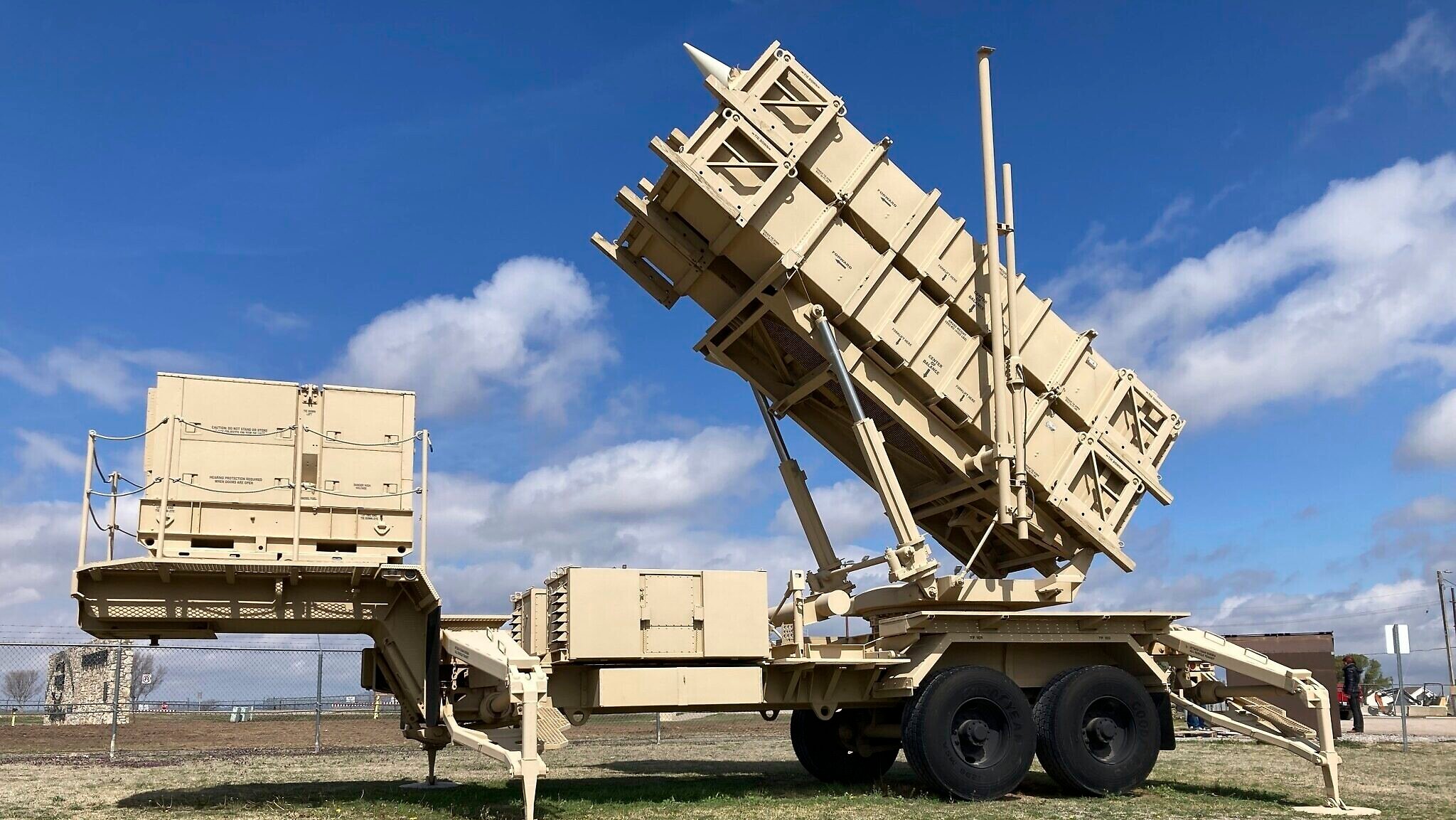
A Patriot missile mobile launcher is displayed outside the Fort Sill Army Post near Lawton, Oklahoma, on March 21, 2023. (AP/Sean Murphy, File)
Turkey’s Defense Ministry says one US Patriot air defense system was deployed to the southeastern Malatya province as part of measures by NATO to boost its ally’s air defenses amid missile threats from the Iran war.
The Kurecik NATO radar base, which provides vital data for the alliance and helped identify two Iranian ballistic missiles heading toward Turkey, is located in Malatya.
In a statement, the ministry says Turkey will continue to cooperate and evaluate regional developments with NATO allies.
IDF issues evacuation warnings for Lebanon’s Tyre and Sidon ahead of strikes on Hezbollah
The IDF issues evacuation warnings for buildings in the coastal Lebanese cities of Tyre and Sidon, ahead of airstrikes against Hezbollah infrastructures.
“The IDF will, in the near future, strike military infrastructure belonging to the Hezbollah terror organization,” says spokesman Col. Avichay Adraee.
Civilians in the area are instructed to distance themselves at least 300 meters (328 yards) from the buildings.
#عاجل ‼️ إنذار عاجل إلى سكان صور وصيدا
????سيهاجم جيش الدفاع على المدى الزمني القريب بنى تحتية عسكرية تابعة لحزب الله الإرهابي
????نحث سكان المباني المحددة بالأحمر في الخريطتيْن المرفقتيْن والمباني المجاورة لها: أنتم تتواجدون بالقرب من مباني يستخدمها حزب الله فمن أجل سلامتكم أنتم… pic.twitter.com/QyG3iaqNqp
— افيخاي ادرعي (@AvichayAdraee) March 10, 2026
PM: End of Iranian regime depends on Iranian people’s will to ‘throw off the yoke of tyranny’
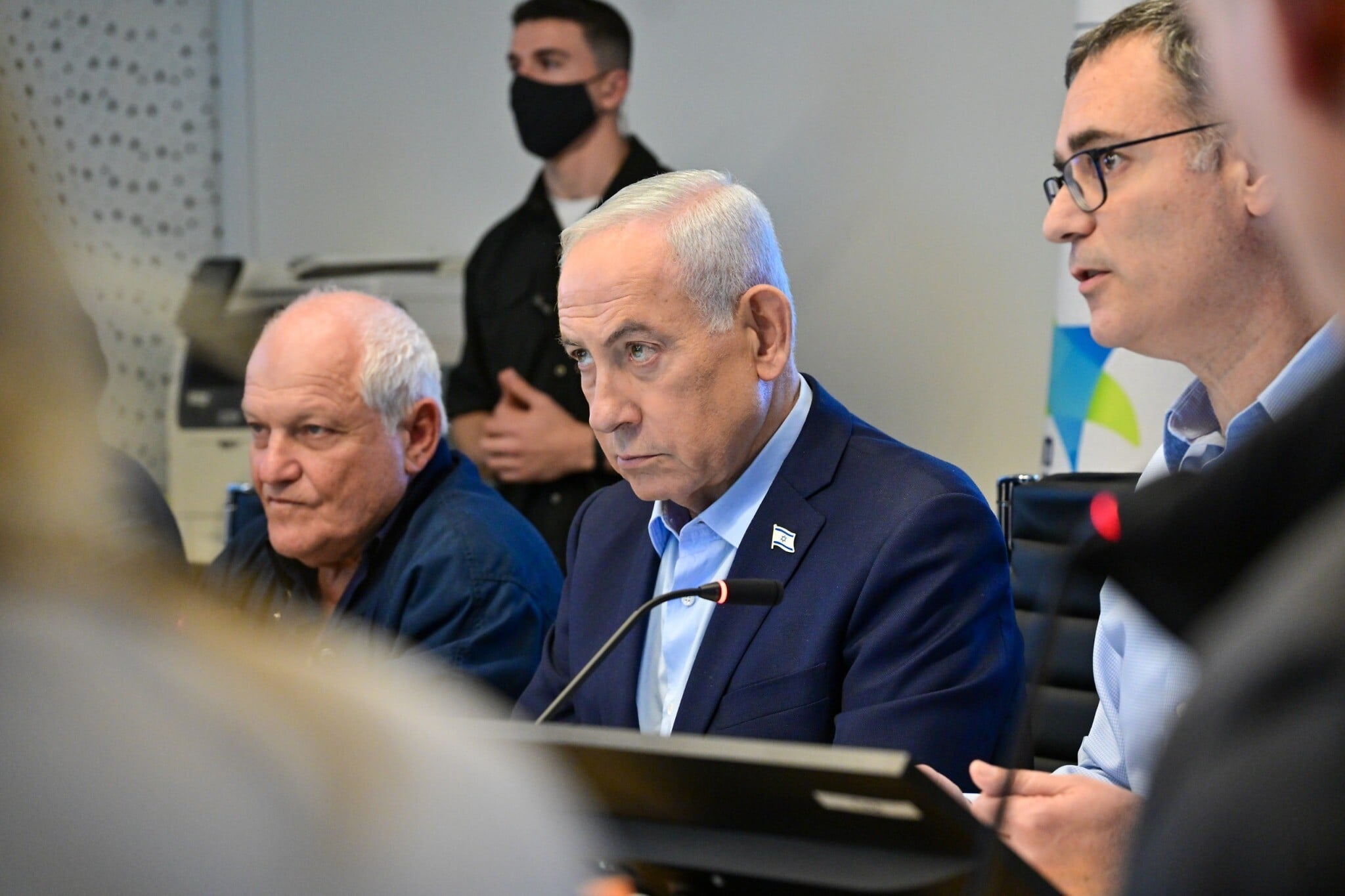
Prime Minister Benjamin Netanyahu visits the National Health Command Center, March 9, 2026. (Kobi Gideon/GPO)
Bringing down the regime in Iran is in the hands of the Iranian people, says Prime Minister Benjamin Netanyahu.
“Our aspiration is to bring the Iranian people to throw off the yoke of tyranny,” says Netanyahu during a visit late last night to the National Health Emergency Operations Center. “Ultimately it depends on them. But there is no doubt that through the actions taken so far we are breaking their bones — and our arm is still outstretched.”
“If we succeed together with the Iranian people, we will bring about a permanent end — if such things exist in the life of nations — and we will bring about change,” says Netanyahu.
He says there is already a “tremendous change” in Israel’s standing in the world.
New Iranian ballistic missile attack on central Israel detected, sirens set to sound
After a lull of 10 hours, a new ballistic missile attack from Iran has been detected by the IDF.
Sirens are expected to sound in central Israel in the coming minutes.
No injuries or direct impacts reported in latest missile attack from Iran
There are no reports of direct impacts or injuries in the latest Iranian ballistic missile attack on Israel, the first in 10 hours.
The missile was intercepted, according to initial military assessments.
Sirens had sounded across central Israel, Jerusalem, and part of the south, sending millions to shelters.
Iraqi airspace must not be used against neighbors, Iraqi PM tells Rubio
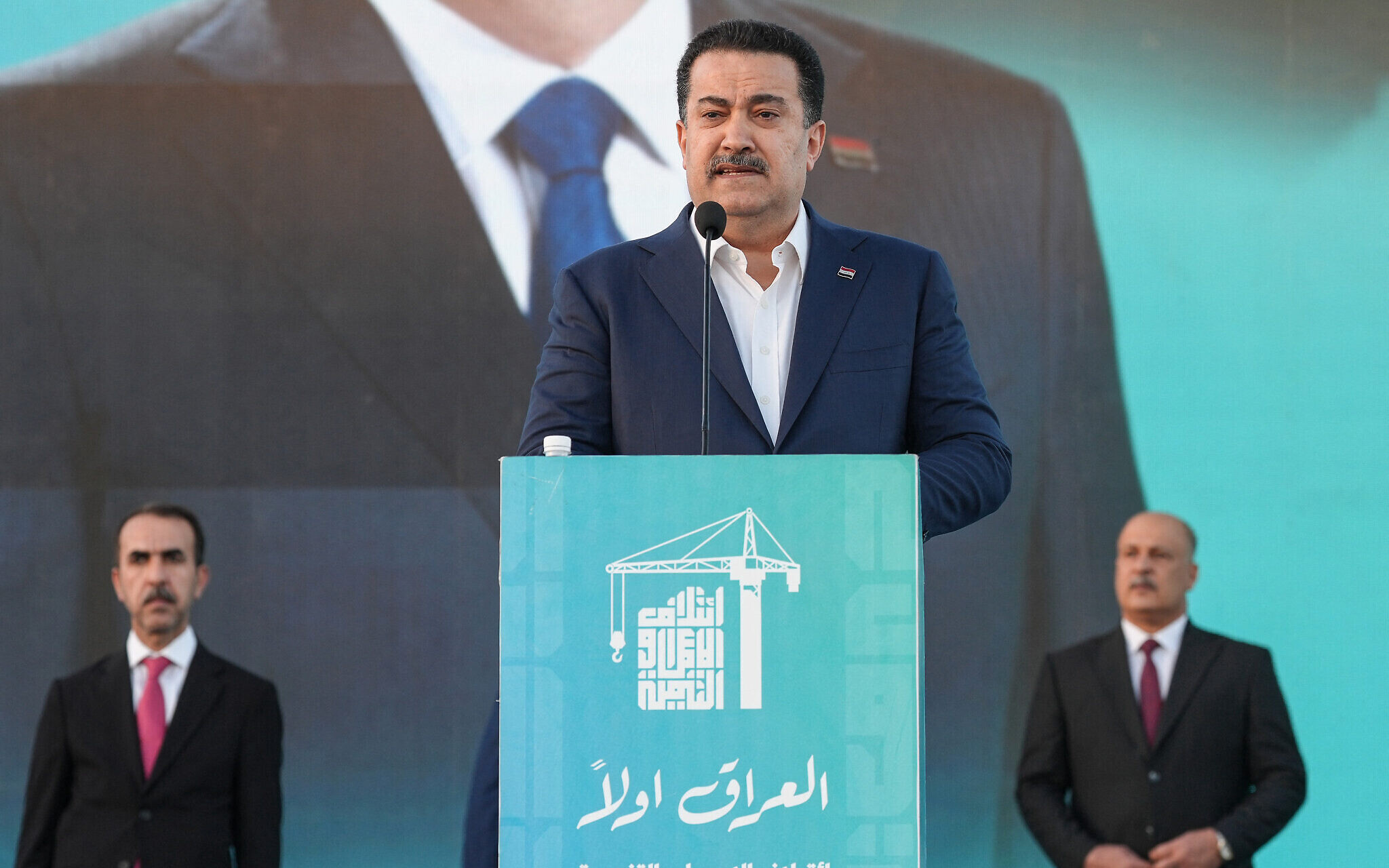
Iraq's Prime Minister Mohammed Shia al-Sudani delivers a speech during a campaign event for the Reconstruction and Development Coalition list ahead of the parliamentary elections, in the central city of Najaf on November 2, 2025. (Qassem al-KAABI / AFP)
Iraq’s Prime Minister Mohammed Shia al-Sudani tells US Secretary of State Marco Rubio that Iraq should not be used as a launch pad for attacks in the war with Iran.
Iraq neighbors Iran, against which the United States and Israel began strikes on February 28. Iraq also borders the Gulf, which the Islamic Republic has hit with missile and drone attacks.
Within hours of the start of the war, fighter jets and missiles coming from every direction filled Iraq’s airspace.
Sudani stresses in a phone call with Rubio “the importance of ensuring that Iraqi airspace, territory, and waters are not used for any military action targeting neighboring countries or the region,” the prime minister’s media office says.
Sudani rejects “any attempt to drag the country into ongoing conflicts,” as well as “violations of its airspace by any party.”
Iraq, long a proxy battleground between Washington and Tehran, was drawn into the war from the outset, with strikes blamed on the US and Israel targeting Iran-backed groups, which in turn have since claimed attacks on US bases in Iraq and the wider region.
US State Department spokesman Tommy Pigott said that Rubio “strongly condemned terrorist attacks by Iran and Iran-aligned terrorist militia groups in Iraq,” including the Kurdistan region.
He urges Iran to take “all possible measures to safeguard US diplomatic personnel and facilities.”
On Saturday, air defense systems intercepted rockets fired at the US embassy in Baghdad.
US air defenses now intercept drones almost daily over Erbil, the capital of Kurdistan, which also hosts a US consulate complex.
Israel ahead of schedule on war goals in Iran, says Israel’s ambassador to France
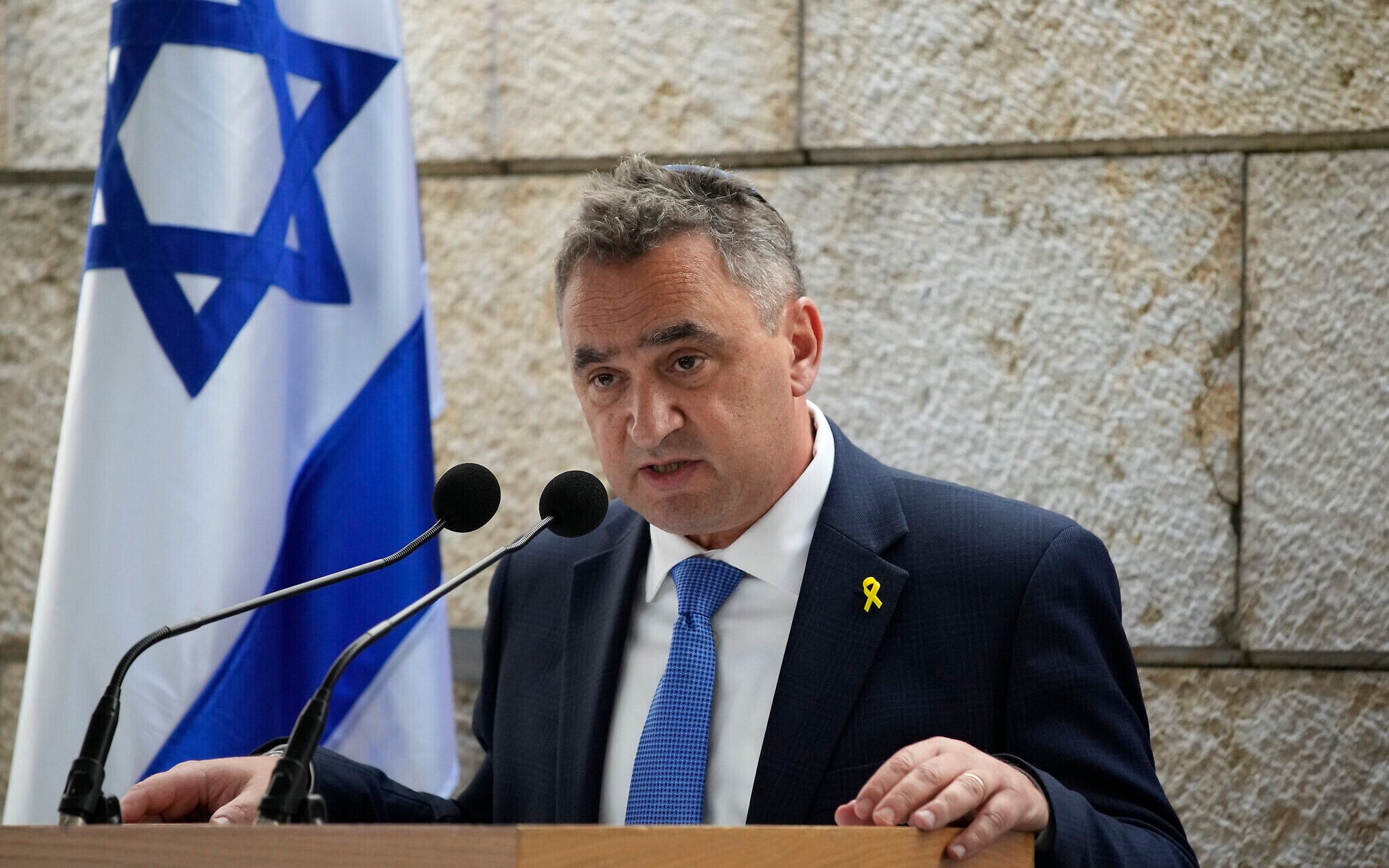
Joshua Zarka, Israel's ambassador to France, speaks during a ceremony commemorating the 11 Israeli athletes killed during the 1972 Munich Olympics at the Paris Olympics in August 2024. (AP Photo/David Goldman)
Israel is ahead of schedule in reaching its war objectives in Iran, such as weakening the regime so that the Iranian people take control of their own fate, Ambassador to France Joshua Zarka says.
In Lebanon, the Lebanese government has not been able to disarm Hezbollah yet, Zarka adds in an interview with French TV station BFMTV, adding he is not aware of any decision from Israel to negotiate an end to its conflict with the terror group.
Middle Eastern countries cut daily oil output — Bloomberg News

Tankers are seen at the Khor Fakkan Container Terminal, the only natural deep-sea port in the region and one of the major container ports in the Sharjah Emirate, along the Strait of Hormuz, a waterway through which one-fifth of global oil output passes, on June 23, 2025. (Giuseppe CACACE / AFP)
Saudi Arabia has lowered oil output by between 2 million and 2.5 million barrels a day, and the United Arab Emirates has cut its output by 500,00-800,000 barrels a day, Bloomberg News reports.
Kuwait has also cut output by half a million barrels a day, and Iraq by about 2.9 million, the report adds, citing people with knowledge of the matter.
Lapid tweets that Kisch should ‘tweet less, do your job’ in spat over schools reopening
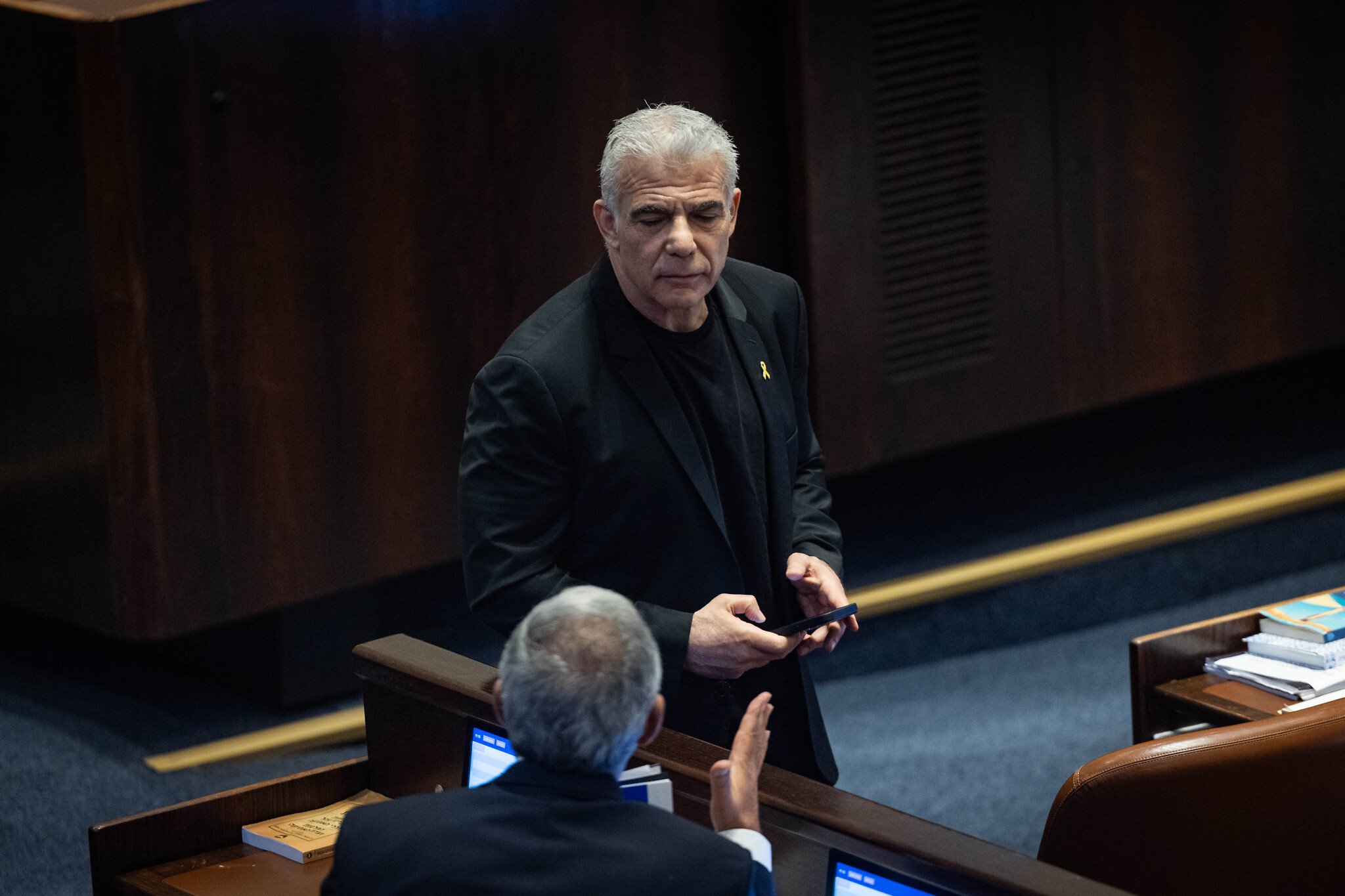
Opposition Leader Yair Lapid on the plenum floor of the Knesset in Jerusalem, July 23, 2025. (Yonatan Sindel/Flash90)
Opposition Leader Yair Lapid posts on X that Education Minister Yoav Kisch should “tweet less and instead do your job,” after the two sparred on social media over Kisch’s aborted plan to reopen schools during the ongoing war with Iran.
The IDF Home Front Command announced on Monday evening that nationwide restrictions amid the war would remain in place, forcing Kisch to walk back an announcement that schools would gradually resume operations.
Ahead of the announcement, Lapid slammed Kisch on X, posting that Finance Minister Bezalel Smotrich had pushed to “reopen the economy too early, without consulting his ministry staff and without coordinating with the education system,” in turn putting pressure on the education minister, who released “an outline for reopening the education system too early, without consulting the heads of teachers’ organizations and the National Parents Association.”
In response, Kisch accused Lapid of not knowing what he was talking about and “spreading lies,” and insisted that work on the outline had been conducted in collaboration with the relevant groups.
Hitting back, Lapid posts this morning that “a few hours after that smug tweet, it turned out I was right about every word, and you canceled the outline and announced that everything is postponed to Sunday.”
“Suggestion: Tweet less and instead do your job. The parents are collapsing,” Lapid adds.
IDF says overnight strikes hit Hezbollah command centers, infrastructure
The IDF says it struck Hezbollah command centers and other infrastructure in the southern Lebanon town of Ansar overnight, from which the terror group launched rockets at Israel.
After the rocket fire last night, and ahead of the strikes, the IDF issued an evacuation warning for residents of the town.
“The Hezbollah terror organization embeds terror infrastructure in civilian areas, thereby endangering the residents of Lebanon. The placement of launchers and firing from civilian areas in Lebanon constitutes a cynical exploitation of Lebanese residents to advance Hezbollah’s terror objectives,” the army says.
It publishes footage showing the strikes.
צה"ל תקף מפקדות של ארגון הטרור חיזבאללה במרחב הכפר ממנו בוצעו שיגורים לעבר שטח הארץ
במהלך הלילה, צה"ל תקף במרחב הכפר אנצר שבדרום לבנון מפקדות ותשתיות טרור של ארגון הטרור חיזבאללה, בתגובה לירי הרקטי שביצע אתמול (ב') ארגון הטרור חיזבאללה לעבר שטח מדינת ישראל ממרחב הכפר.
שעות… pic.twitter.com/arlv4xJEGn
— צבא ההגנה לישראל (@idfonline) March 10, 2026
Second person dies as a result of Iranian cluster bomb strike yesterday
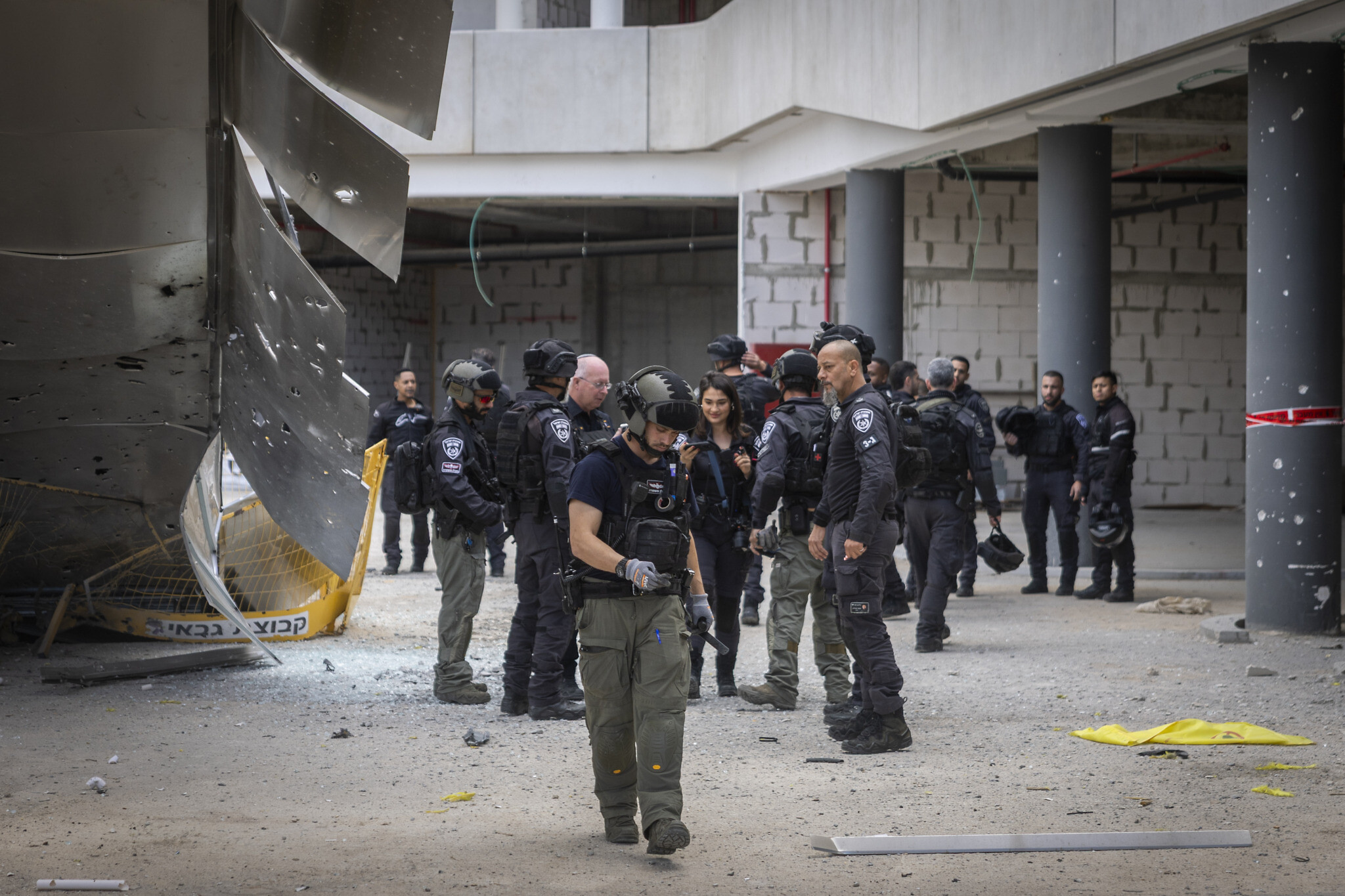
First responders at the scene of a deadly missile impact at a construction site in Yehud on March 9, 2026. (Chaim Goldberg/Flash90)
A second person has died as a result of yesterday morning’s Iranian cluster missile strike in Yehud, Petah Tikva Mayor Rami Greenberg says in a statement.
The strike by an Iranian ballistic missile with a cluster bomb munition killed one person yesterday and injured two others seriously. This morning, the second victim died at Sheba Medical Center, according to Hebrew media.
The two men were working at a construction site in the city of Yehud when the cluster bomb munition struck the area. Both were not in a bomb shelter, according to first responders.
Greenberg says both were Petah Tikva residents and sends condolences to their families. One victim is identified as Rostam Golumov, 61. The second resident’s name has not yet been released.
IDF details killing of Hezbollah operatives in south Lebanon
The IDF says it killed several Hezbollah operatives as troops conduct ground operations in southern Lebanon.
According to the military, in one incident last night, troops of the 769th “Hiram” Regional Brigade identified a cell of Hezbollah gunmen and directed an airstrike against them.
Separately, a group of “suspects who were near IDF troops and posed a threat” were targeted in another airstrike, directed by troops of the 91st “Galilee” Regional Division, the army says.
In the Rab al-Thalathine area — where the 7th Armored Brigade, under the 36th Division, began a raid yesterday — the IDF says the troops detected a group of operatives entering a building near the forces.
“Immediately after the detection, a tank fired at the terrorists and eliminated them,” the IDF says.
And in another incident in the area, the IDF says it struck a building where commanders of Hezbollah’s elite Radwan Force had gathered, along with a weapons depot.
The military deployed troops deeper into southern Lebanon after Hezbollah began attacking Israel last week, saying it aims to “establish a forward defense that will create an additional security layer for the residents of the north.”
Senior EU official says Russia is ‘only’ winner of Iran war, as energy prices spike
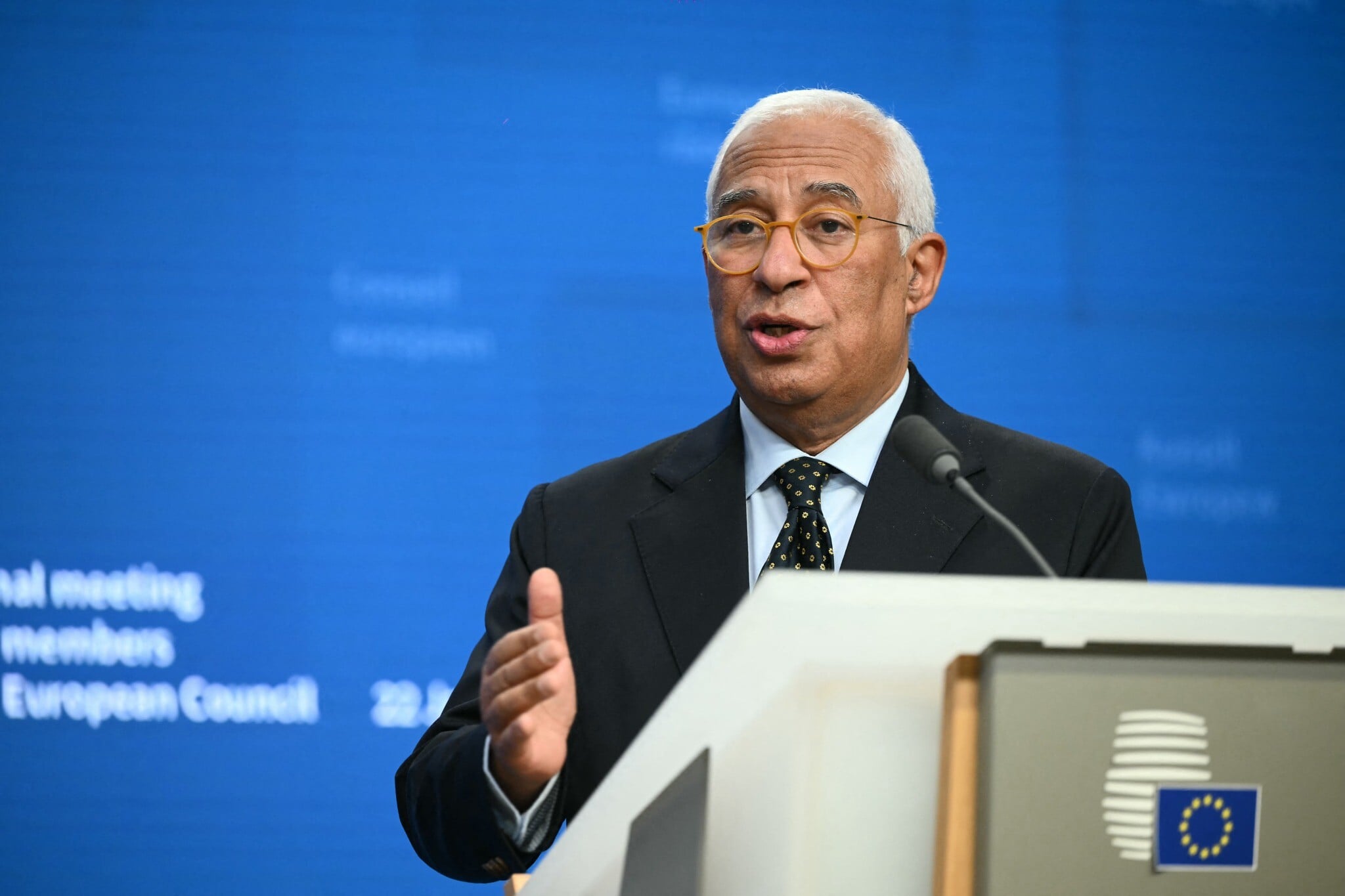
European Council President Antonio Costa delivers a speech for a closing press conference after an emergency meeting of the European Council over US President's Greenland threats, at the European headquarters in Brussels, on January 22, 2026. (NICOLAS TUCAT / AFP)
Russia has so far been the only winner from the war in the Middle East, as energy prices soar and attention for its war against Ukraine has faded, EU Council President Antonio Costa says.
“So far, there is only one winner in this war – Russia,” Costa says in a speech to EU ambassadors in Brussels.
“It gains new resources to finance its war against Ukraine as energy prices rise. It profits from the diversion of military capabilities that could otherwise have been sent to support Ukraine. And it benefits from reduced attention to the Ukrainian front as the conflict in the Middle East takes center stage,” he adds.
Costa stresses the need for the EU to protect the international rules-based order, which he says is now being challenged by the United States, and for all parties in the Middle East to return to the negotiating table.
“Freedom and human rights cannot be achieved through bombs. Only international law upholds them,” he says.
“We must avoid further escalation. Such a path threatens the Middle East, Europe, and beyond,” he says.
Azerbaijan sends humanitarian aid to Iran after being hit by Iranian drone strike

Ilham Aliyev, Azerbaijan president, speaks during a plenary session at the COP29 UN Climate Summit, November 12, 2024, in Baku, Azerbaijan. (AP Photo/Rafiq Maqbool)
Azerbaijan sends humanitarian aid to Iran, appearing to offer an olive branch days after an Iranian drone attack sparked fears of the Middle East war spilling into the Caucasus.
Baku, a close partner of Israel, accused Tehran of “terrorism” after Iranian drones hit an airport and exploded near a school last week, wounding four people in Azerbaijan’s exclave of Nakhichevan, which borders Iran.
Azerbaijani President Ilham Aliyev ordered the armed forces to prepare retaliatory measures, placing them on the highest level of mobilization, and its diplomats were pulled out of the country.
Iran’s military denied launching the drones and accused Israel of staging a provocation.
But in an apparent sign of detente, Azerbaijan’s emergency situations ministry now says it had shipped tons of food and medicine to Iran “following the telephone conversation on March 8 between the presidents of Azerbaijan and Iran.”
Aliyev’s office said earlier that his Iranian counterpart Masoud Pezeshkian had called him on Sunday, promising to investigate the drone attack, which he insisted “had no connection with Iran.”
Aliyev “underlined the importance of investigating the incident” and the two leaders “exchanged views on the development prospects of joint economic projects,” the statement said, in a sign that both sides may be seeking to prevent the crisis from deepening further.
Hitting back at Iranian counterpart in Persian, Knesset speaker demands ‘unconditional surrender’
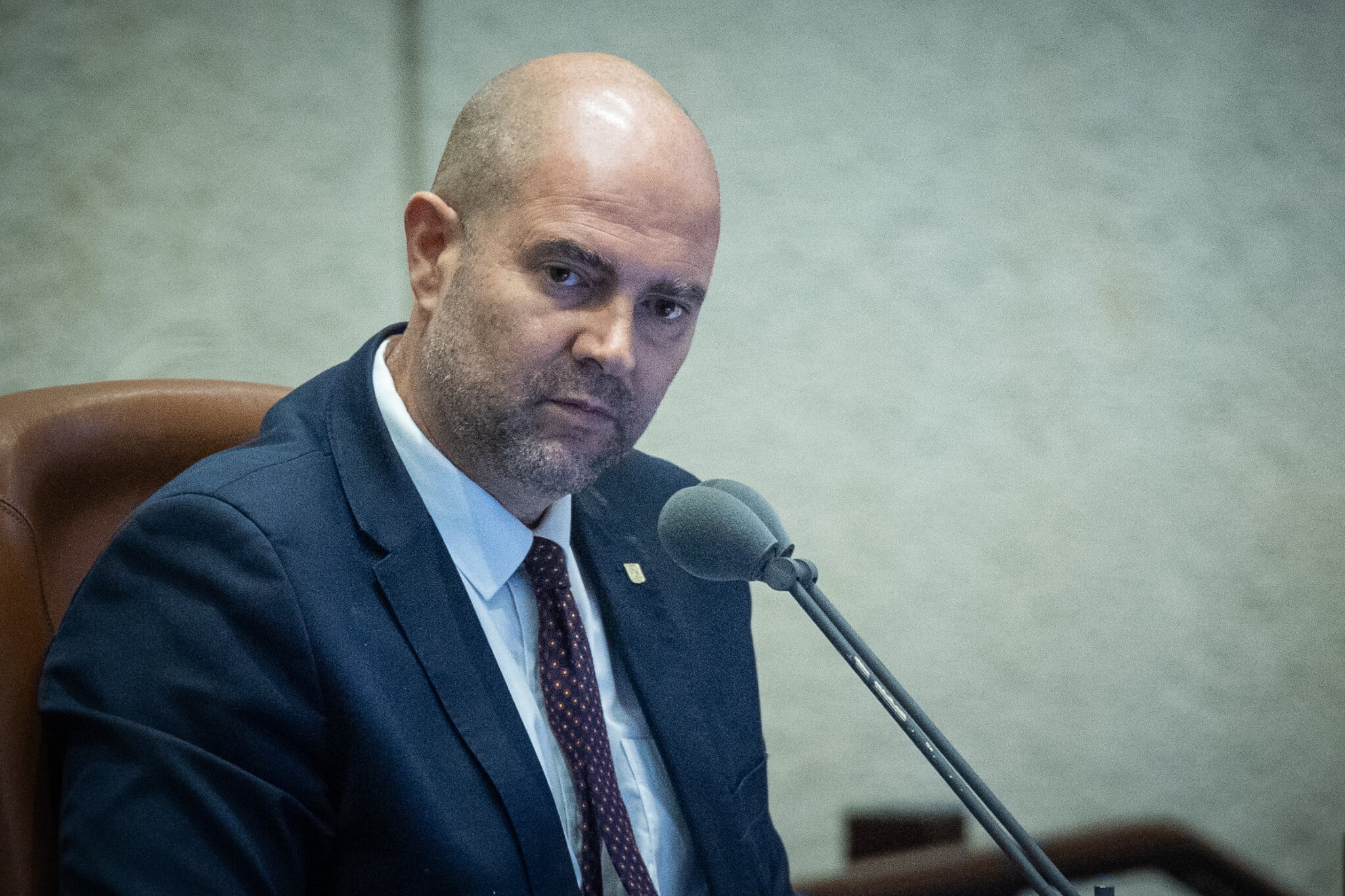
Speaker of the Knesset MK Amir Ohana attends a plenum session at the assembly hall of the Knesset in Jerusalem, January 21, 2026. (Yonatan Sindel/Flash90)
Iranian parliament speaker Mohammad Baqer Qalibaf doubles down on his assertion that Tehran is not seeking an end to the war with the US and Israel, prompting a harsh response from his Israeli counterpart Amir Ohana, who declares that a ceasefire is not on the table.
“We are absolutely not looking for a ceasefire; we believe that the aggressor should be struck in the mouth so that he learns a lesson so that he will never think of attacking our beloved Iran again,” Qalibaf writes in a post on X. “The Zionist regime sees its ignominious existence in the continuation of the cycle of ‘war-negotiation-ceasefire, and then war again’ to consolidate its dominance. We will break this cycle.”
Responding in Persian, Knesset Speaker Ohana declares that “the only thing proposed to you was unconditional surrender.”
تنها چیزی که به شما پیشنهاد شد، تسلیم بیقید و شرط بود. https://t.co/NuOskJen25
— Amir Ohana – אמיר אוחנה (@AmirOhana) March 10, 2026
Addressing Iranian state television on Sunday, Qalibaf had stated that Tehran was not seeking a ceasefire, adding that “aggressors” should be punished.
“If the enemy attacks us from any country, Tehran will respond decisively,” he said.
Reuters contributed to this report.
firm linked to Israeli billionaire settles Dutch graft probe into Congolese mining for $30 million
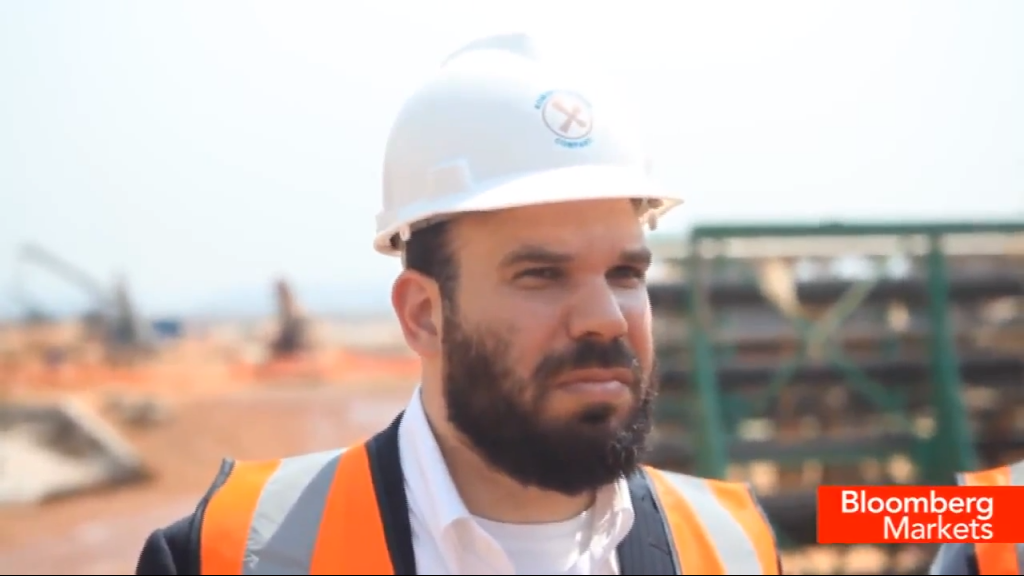
Israeli billionaire Dan Gertler, in an undated screenshot. (Screen capture YouTube)
A former holding company of US-sanctioned Israeli billionaire Dan Gertler will pay $30 million to settle a Dutch corruption probe over mining deals in the Democratic Republic of the Congo, prosecutors say.
In 2018, Dutch investigators had launched a probe into whether Fleurette, a Netherlands-registered firm that served as the holding company for the Gertler group, and Swiss commodities giant Glencore paid bribes to secure copper and cobalt mining rights at below-market prices.
Investigators suspected that tens of millions of US dollars were paid to a top adviser of then-DRC president Joseph Kabila, a close friend of Gertler who ruled the mineral-rich yet conflict-plagued country from 2001 to 2019.
In today’s statement, the Dutch prosecutor’s office says it slapped Fleurette with a fine of 25.8 million euros ($30 million) on March 6.
“By accepting this criminal settlement, the public prosecutor establishes that Fleurette, acting in concert with others, is guilty of bribing foreign public officials in the DRC in connection with the acquisition of mining licences,” the office says.
Lawyers for Fleurette tell AFP that the fine brings the investigation to a close and that the Dutch authorities have confirmed they will not bring any charges against Gertler himself.
Gertler, who continues to wield significant influence in the DRC, was first sanctioned by the United States in 2017 for allegedly cheating the Congolese state of about $1.4 billion in revenues through opaque mining deals.
While US President Donald Trump reversed some of the sanctions just before the end of his first term, Washington put him back on the blacklist in March 2021.
In February 2022, the Congolese state announced it had reached an out-of-court settlement with Gertler, allowing the DRC to recover disputed mining and oil assets valued at more than $2 billion.
Gertler’s profits in the DRC came to light in 2016 with the publication of the so-called Panama Papers.
The Israeli businessman, who spent nearly 20 years acting as a go-between on some of the largest deals struck in the DRC’s notoriously corruption-riddled mining sector, has always denied any suggestion of graft or underhand wheeling and dealing.
UK’s easyJet to hold off on flights to Tel Aviv until at least the winter

Illustrative: An easyJet airliner on the tarmac at Ben Gurion International Airport, August 3, 2013. (Moshe Shai/Flash90)
British low-cost carrier easyJet announces that it will not resume flight operations to and from Tel Aviv’s Ben Gurion Airport until at least the winter.
The low-cost carrier was expected to restart its Tel Aviv route on March 29 after repeatedly postponing a resumption of its flight services. It has now postponed that date again amid the war with Iran.
“We have taken the decision not to operate to and from Tel Aviv this summer as part of our continuous review of our flying programme,” easyJet says in an emailed statement. “We are continuing to closely monitor the situation with a view to resuming flying this winter.”
“All impacted customers booked to travel have been notified in advance and provided with their options which includes a full refund or an alternative flight,” the carrier says.
EasyJet is joining other foreign airlines that have suspended flight services to and from Israel in the coming weeks, after the country’s airspace was closed on February 28 with the outbreak of the war.
IDF confirms killing three more Hamas operatives from southern Gaza tunnel
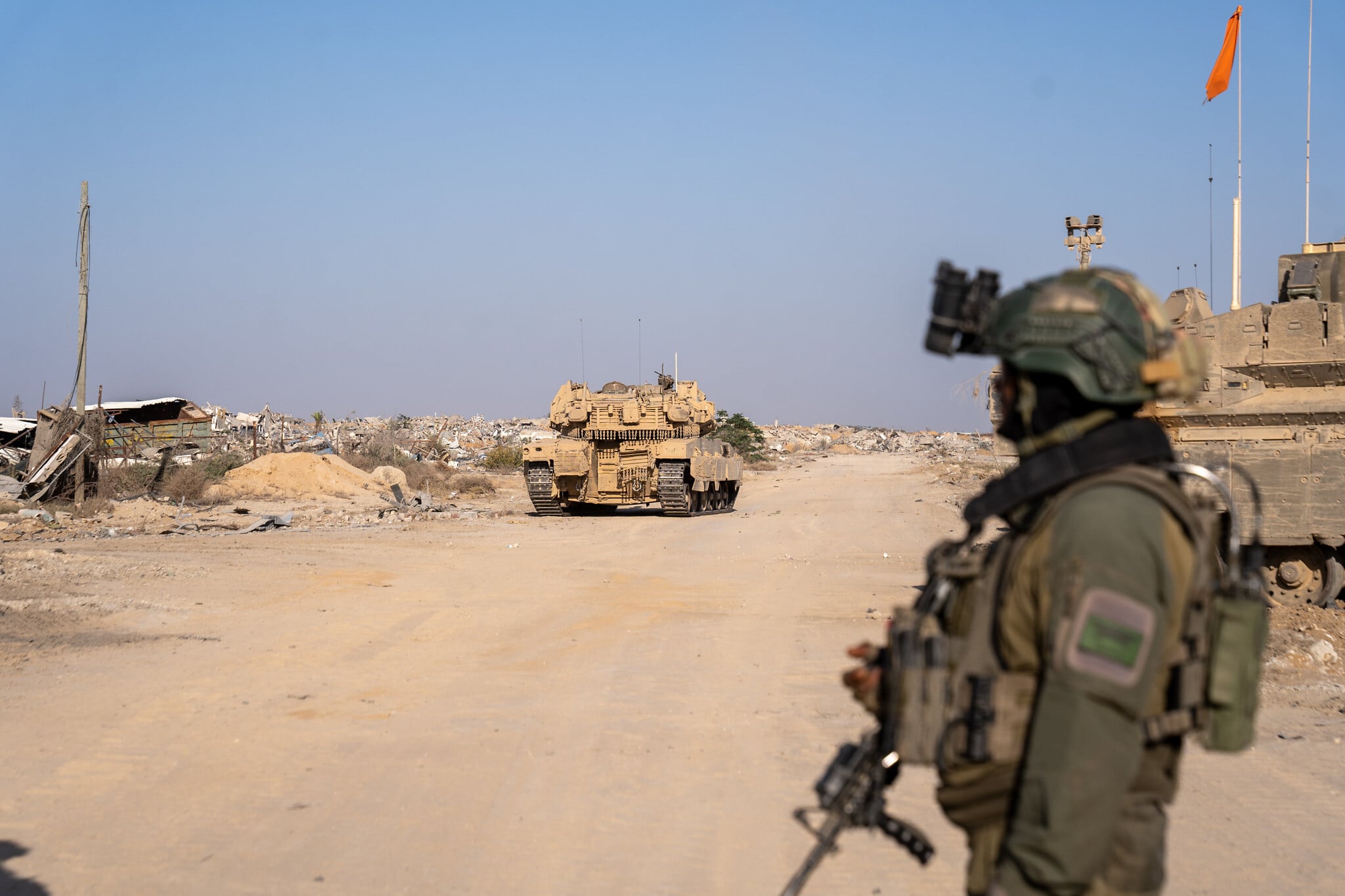
IDF troops are seen in southern Gaza's Rafah, November 23, 2025. (Emanuel Fabian/Times of Israel)
Another three Hamas operatives who were holed up in a tunnel in southern Gaza’s Rafah were confirmed to have been killed, the military says.
Dozens of Hamas operatives were believed to be trapped underground in the eastern Rafah area, on the Israeli side of the ceasefire line, since October. The IDF has reported killing or capturing more than 50 of them in recent months.
According to the IDF, troops of the Golani Brigade carried out searches yesterday in the area and located the bodies of three terror operatives, who it says were killed as a result of “operations conducted along the tunnel route.”
The IDF says it is continuing to operate in the area to kill or capture any remaining gunmen.
IDF operation against Hezbollah won’t necessarily end when Iran campaign does – report
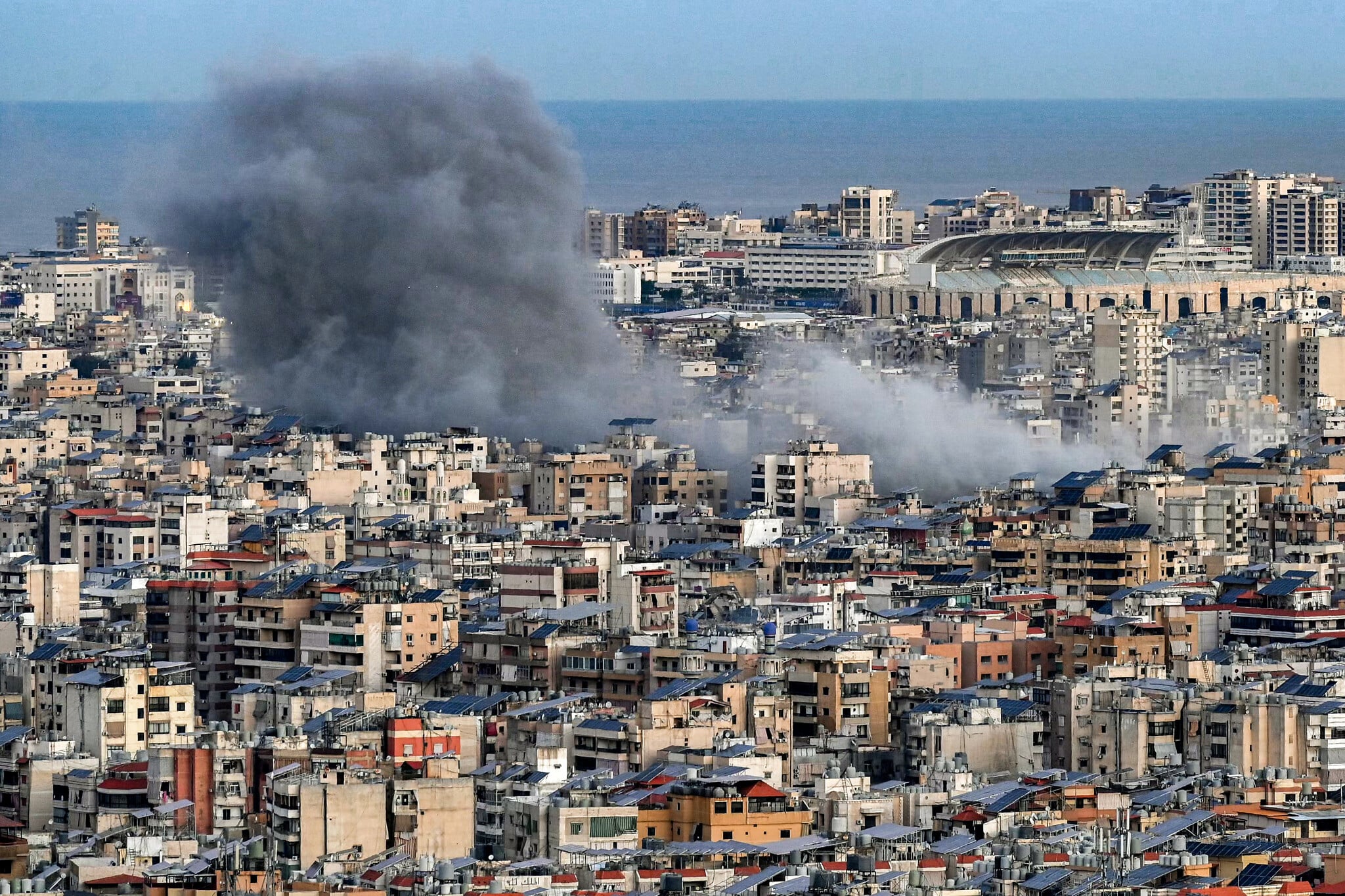
Smoke plumes rise from the site of an Israeli airstrike on Beirut's southern suburbs on March 9, 2026. (Fadel Itani / AFP)
An Israeli campaign against Hezbollah in Lebanon could continue beyond the end of the ongoing US-Israeli air campaign against Iran, the Financial Times reports, citing “people briefed on the discussions.”
The report echoes a similar report from last week in Reuters.
Israel’s aim is “to inflict enough damage [so] that there is not this constant fear of having to evacuate the northern residents,” says one the sources.
“The Israelis are preparing international players for the prospect that the war with Hezbollah could drag on and last longer than the war with Iran,” says an Arab diplomat, who adds that Israel has sent messages about the potential duration of the campaign to regional partners.
For now, IDF troops are primarily operating close to the border, and are not involved in a major push further into Lebanon. One reason is the war against Iran.
“Most of the air assets are being used on that front,” says an Israeli security official.
Second victim in yesterday’s cluster bomb strike is identified
The second victim of yesterday morning’s Iranian ballistic missile attack with cluster bomb munitions is named as Amid Mortozov.
He died of his wounds this morning, according to Hebrew media reports. Both he and the attack’s first victim, Rostam Golumov, 61, were residents of the central Israeli city of Petah Tikva.
The two men were working at a construction site in the city of Yehud when the cluster bomb munition struck the area. Both were not in a bomb shelter, according to first responders.
Another person in a separate location was seriously wounded in the strike.
Air Force carries out new wave of strikes targeting regime sites in Tehran — IDF
The Israeli Air Force has launched a fresh wave of airstrikes in Tehran, the IDF announces.
The military says the strikes are targeting Iranian regime sites.
Gulf energy official says stopping the war is only way to reopen Hormuz
A senior Gulf energy industry official says stopping the Iran war is the only option when asked if there were ways of getting oil and gas moving again through the Strait of Hormuz.
The official speaks on condition of anonymity, given the sensitivity of the matter.
Turkey’s FM tells Iran that violations of country’s airspace are ‘unacceptable’
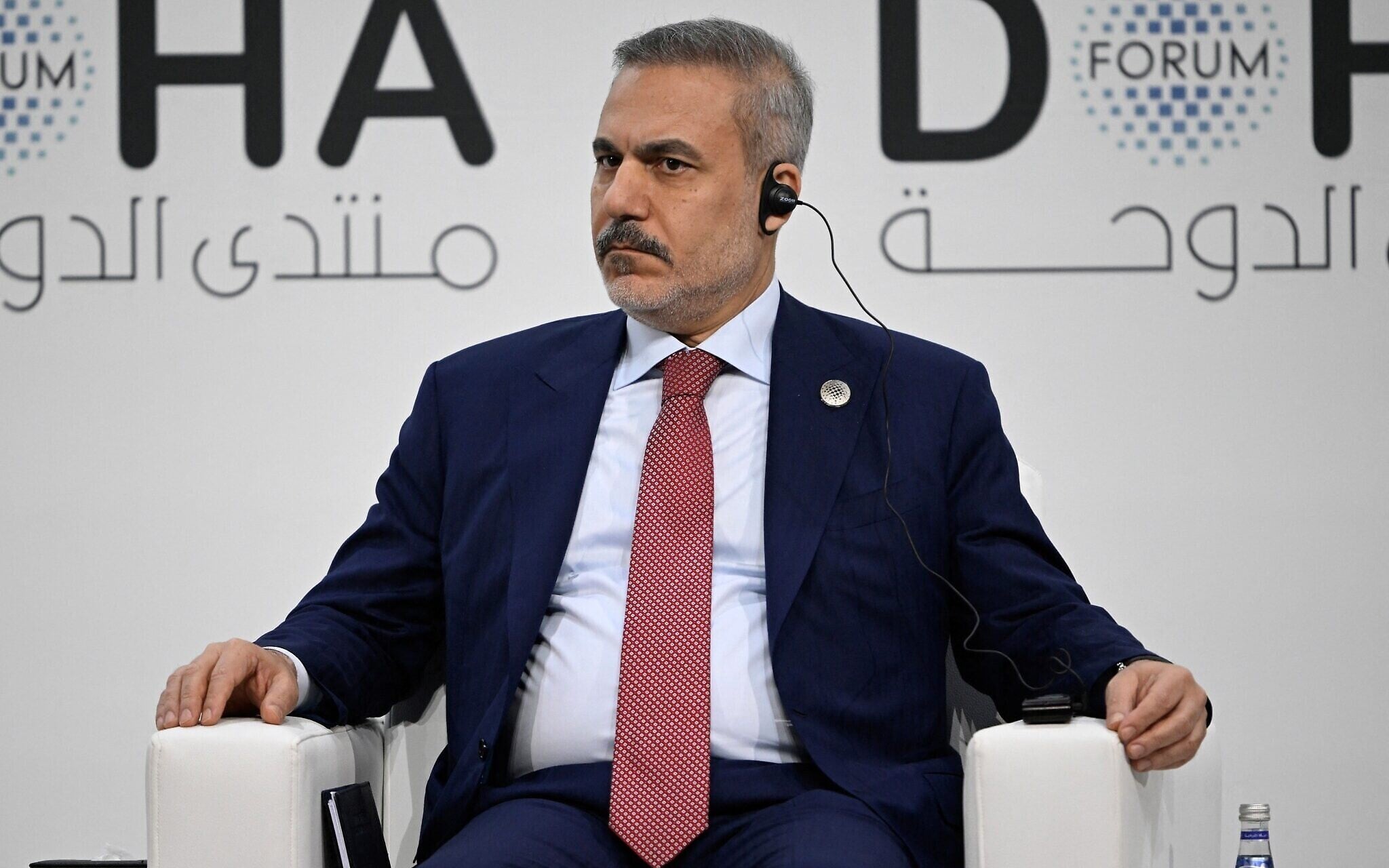
Turkish Foreign Minister Hakan Fidan attends a session on the opening day of the Doha Forum, an annual diplomatic conference, in Doha, December 6, 2025. (Mahmud Hams/AFP)
Iran’s violations of Turkish airspace are unacceptable, Turkey’s Foreign Minister Hakan Fidan tells his Iranian counterpart Abbas Araghchi during a phone call, Turkish media reports.
Fidan warns that Ankara will take all measures necessary to protect Turkey, say Turkish Foreign Ministry sources.
Turkey, a NATO member, said yesterday that NATO air defenses shot down a second ballistic missile that was fired from Iran and had entered Turkish airspace.
According to Turkish sources, Araghchi insists during the call that the missiles did not come from Iran and that his country is investigating.
Kremlin says Putin’s proposals to mediate Iran war are still on the table

In this pool photograph distributed by the Russian state agency Sputnik, Russia's President Vladimir Putin chairs a Security Council meeting via videolink in Moscow on December 26, 2025. (Mikhail METZEL / POOL / AFP)
Russian President Vladimir Putin has offered different options to mediate in the Iran war and these proposals are still on the table, the Kremlin says.
“From the very beginning of this situation, even before the military phase began, President Putin has proposed various options for our mediation and good offices that could help reduce tensions. Many of these proposals are still on the table,” Kremlin spokesman Dmitry Peskov tells reporters.
“Russia is ready to assist to the best of its ability and will be happy to do so, but you know that this requires multiple understandings and multiple agreements, so we’ll have to be a little patient.”
Peskov was speaking a day after Putin spoke by phone to US President Donald Trump and, according to the Kremlin, shared proposals aimed at ending the war in Iran quickly.
Peskov declines to elaborate on the content of the proposals.
Trump, for his part, told reporters yesterday that Putin “wants to be helpful” with the Iran conflict, but he said he told the Kremlin leader that “You could be more helpful by getting the Ukraine-Russia war over with.”
Russia, which has a strategic partnership treaty with Iran, has condemned the US-Israeli strikes against the Islamic Republic, which began on February 28. As a major energy exporter, it has, however, benefited from the resulting boost to oil prices.
Trump’s envoy Steve Witkoff said over the weekend he had asked Russia not to supply intelligence to Iran, after the Washington Post said Moscow was providing Tehran with targeting data to help it attack US forces in the Middle East.
Peskov says Russia is not commenting on such reports, and declines to say if the issue had come up during the Putin-Trump call.
Wave of airstrikes targeted underground IRGC weapons R&D site — IDF
A subterranean weapons research and development complex was bombed as part of a wave of airstrikes in Tehran overnight, the IDF says.
The military says the Israeli Air Force hit “vital infrastructure of the Iranian terror regime” as part of the strikes in the capital.
One of the strikes targeted a weapons research and development complex of Iran’s Islamic Revolutionary Guard Corps at Imam Hossein University, the IRGC’s military academy.
“At this complex, the IDF struck an underground route where the armed forces of the IRGC conducted experiments and tests for ballistic missile development and production processes,” the military says.
In addition, the IDF says it also struck infrastructure at the main headquarters of the Quds Force, the extraterritorial arm of the IRGC, along with other weapons production sites and air defense systems.
The IDF says the strikes are part of a new stage of the war aimed at “deepening the blow to the core arrays of the Iranian terror regime and its foundations.”
צה״ל השלים במהלך הלילה גל תקיפות נוסף בטהרן: הותקף מתחם תת-קרקעי בו התבצעו תהליכי מחקר ופיתוח של אמצעי לחימה
צה"ל ממשיך להעמיק את הפגיעה בכלל מערכיו ויכולותיו של משטר הטרור האיראני.
חיל האוויר, בהכוונת אמ"ן, השלים במהלך הלילה (ב') גל תקיפות נוסף לעבר תשתיות חיוניות של משטר… pic.twitter.com/rh8kM0adSj
— צבא ההגנה לישראל (@idfonline) March 10, 2026
War displaced 100,000 in Lebanon in single day, UN says

A woman looks on as people sleep wrapped in blankets in a makeshift encampment along the waterfront in Beirut on March 10, 2026, as civilians who fled the city's southern suburbs due to the Israel-Hezbollah conflict remain displaced. (Anwar AMRO / AFP)
The United Nations says more than 100,000 people have been newly displaced within Lebanon in just 24 hours amid the fighting between Israel and the Iran-backed Lebanese terror group Hezbollah.
Israel and Hezbollah have been righting since last week, when the terror group began attacking Israel amid the US-Israeli war with Iran. The IDF issued evacuation orders for the entirety of southern Lebanon south of the Litani River, and a section of Beirut’s suburbs that serves as a Hezbollah stronghold, amid its strikes on Hezbollah.
“As of today, more than 667,000 people in Lebanon have now registered on the (Lebanese) government’s online platform as displaced — and this is an increase of 100,000 in just one day,” says Karolina Lindholm Billing, the UN refugee agency’s representative in Lebanon.
“That’s a faster pace of displacement compared to 2024,” she tells reporters in Geneva, speaking from Beirut, referring to the previous conflict between Israel and Hezbollah.
Supreme Court suspends appeal by former Gaza director of World Vision convicted of terror
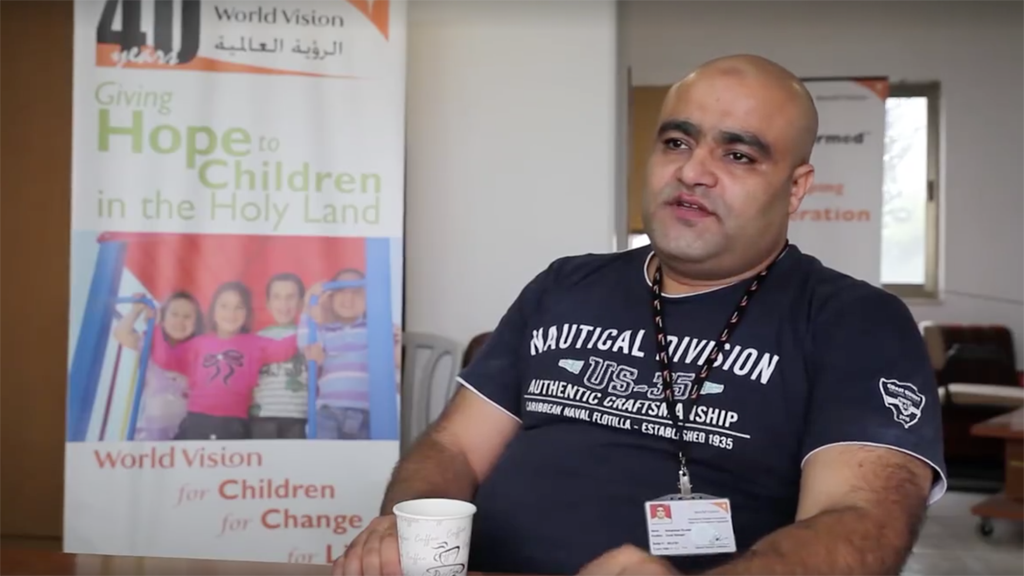
Mohammad el-Halabi, a manager of the World Vision charity's operations in the Gaza Strip, was indicted on August 4, 2016, for diverting the charity's funds to the Hamas terrorist organization. (Screen capture: World Vision)
The Supreme Court has frozen the appeal of Mohammad el-Halabi, the former Gaza director for the international Christian charity World Vision who was convicted in 2022 on terror charges for funding Hamas.
Halabi appealed the conviction and his 12-year prison sentence to the Supreme Court. He was released in an exchange of security prisoners and hostages held in Gaza in February 2025.
According to a report by Ynet, the State Attorney’s Office opposed bringing Halabi back to Israel for court hearings for the appeal, meaning that the legal process was halted.
The Supreme Court ruling today means Halabi’s appeal has now been formally suspended.
Iran security chief says Trump’s threats to hit harder are ’empty’
Iran’s security chief Ali Larijani dismisses threats by US President Donald Trump to hit the country harder if the flow of oil stops through the strategic Strait of Hormuz.
“Iran is not afraid of your empty threats. Even those greater than you could not eliminate the Iranian nation. Take care of yourself not to be eliminated!” says Larijani in a post on X.
Qatar says Iran attacking civilian infrastructure; also warns against strikes on energy facilities
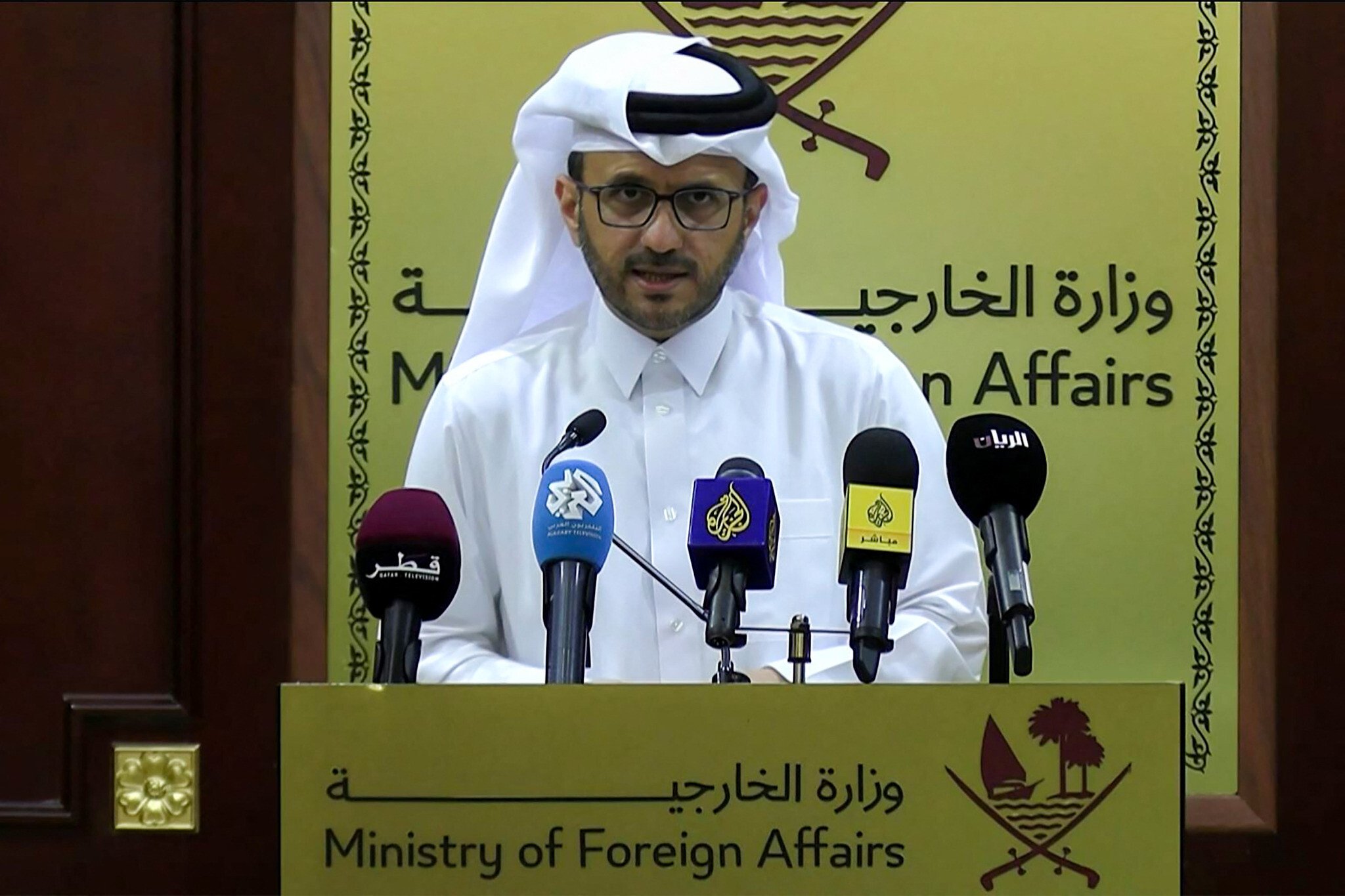
This frame grab from AFPTV footage shows Qatari foreign ministry spokesman Majed al-Ansari speaking during a media briefing in Doha on June 17, 2025. (Jacqueline PENNEY / AFPTV / AFP)
Iran has pressed its attacks against Qatar’s infrastructure, the Gulf state’s foreign ministry spokesman says, over a week after Iranian drone strikes forced a halt to Qatari gas production.
“The targeting of civilian infrastructure continues… and we rebuke any justification that the Iranians are offering for these attacks,” Qatar’s foreign ministry spokesman Majed al-Ansari says, without specifying which civilian facilities had been targeted in Qatar.
He also warns that attacks on regional energy infrastructure during the war will be felt economically throughout the world.
“The attacks on energy facilities that have happened, also on both sides, are a dangerous precedent… it will cause repercussions throughout the world,” he says.
New Iranian missile launch detected, sirens set to sound in north
The IDF says it has detected a new ballistic missile attack from Iran.
Sirens are expected to sound in northern Israel in the coming minutes.
Danish Supreme Court case opens on arms sales to Israel
Denmark’s Supreme Court will begin hearing arguments today in a lawsuit filed by four humanitarian organizations that accuse the country of violating international law by exporting weapons to Israel.
In April 2025, a lower court rejected the lawsuit, filed against the Danish foreign ministry and national police by the Palestinian human rights association Al-Haq, ActionAid Denmark, and the Danish branches of Amnesty International and Oxfam.
The organizations allege Denmark is violating its international commitments by selling Israel parts for F-35 jet fighters, given what an Amnesty official called Israel’s “war crimes and genocide” in the Gaza Strip. Israel adamantly rejects accusations of genocide.
The Supreme Court will solely address the question of whether the organizations are entitled to test the legality of Denmark’s arms sales in the courts.
The Eastern High Court found, in an April 2025 ruling seen by AFP, that the plaintiffs “cannot be considered to be affected in such a direct, individual and concrete manner that they meet the general conditions of Danish law regarding their right to bring proceedings.”
If the four win their case before the Supreme Court, they intend to move forward and contest the legality of Denmark’s arms sales to Israel.
In April, the Danish foreign ministry told AFP the Scandinavian country’s position on export control, including the F-35 program, was “in accordance with applicable EU and international law obligations.”
The Danish lawsuit was filed in March 2024 on the heels of a similar suit filed in the Netherlands by a coalition of humanitarian organizations.
A Dutch court in December 2024 rejected demands by pro-Palestinian groups for a total ban on exporting goods to Israel that can be used for military means.
The court ruled the government was respecting rules governing the country’s arms trade.
Denmark’s Supreme Court is due to announce its ruling in about a week.
IDF repeats warning to evacuate Beirut’s southern suburbs ahead of strikes on Hezbollah
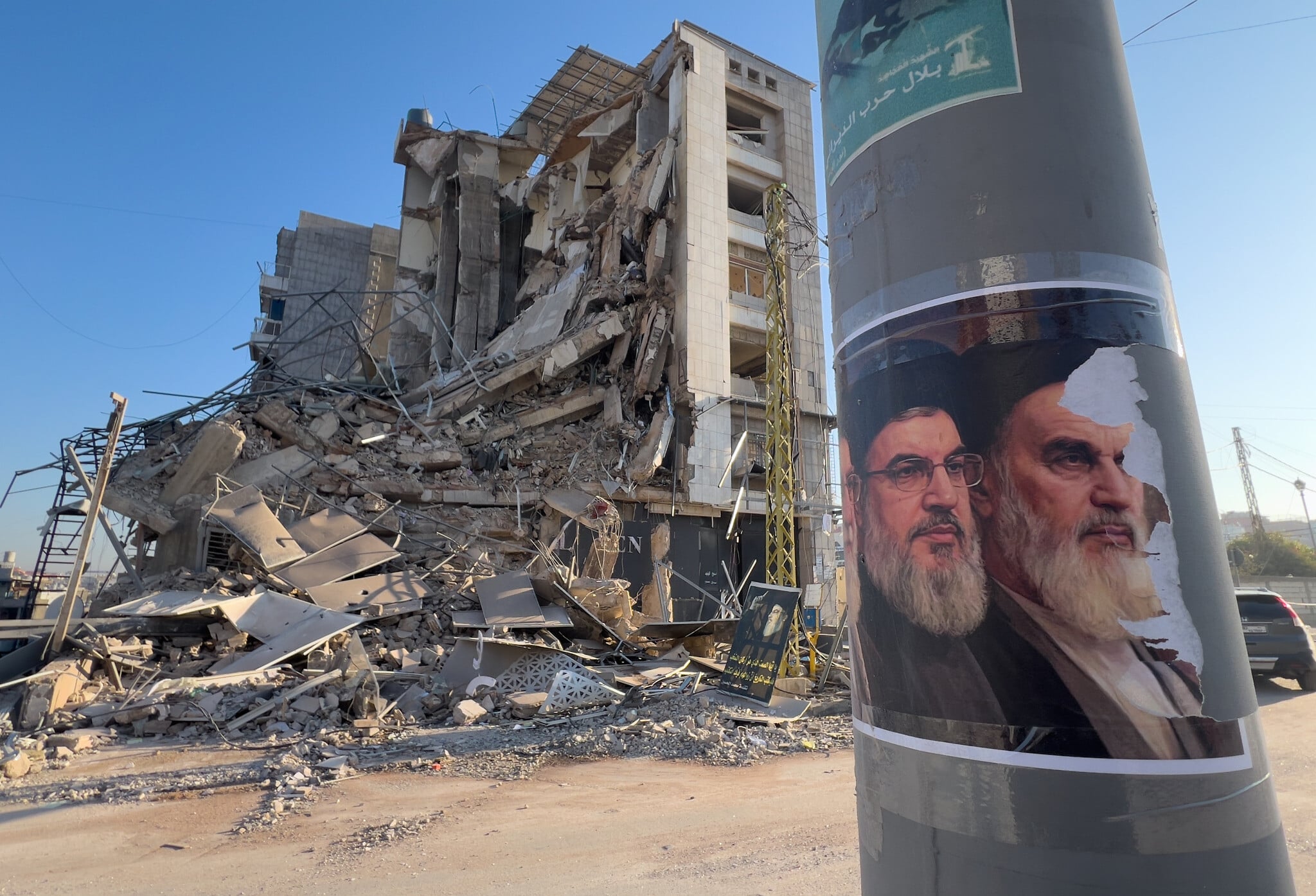
Portraits of former Hezbollah leader Hassan Nasrallah and the Iranian revolutionary founder Ayatollah Khomeini, are seen in front of a destroyed building in Dahiyeh, Beirut's southern suburbs, Lebanon, March 10, 2026. (AP Photo/Hussein Malla)
The IDF repeats its warning to evacuate the southern suburbs of Beirut, a known Hezbollah stronghold, ahead of strikes against the terror group’s assets.
“The terror activities of Hezbollah force the IDF to act against it with force. The IDF does not intend to harm you. For your safety, you must evacuate your homes and move away immediately until further notice!” says army spokesman Col. Avichay Adraee.
The “urgent warning” is addressed to residents of the southern suburbs, known as the Dahiyeh, “especially residents of the neighborhoods: Haret Hreik, Ghobeiry, Laylaki, Hadath, Burj al-Barajneh, Tahwitat al-Ghadir, Shiyyah.”
The IDF first issued the evacuation warning for the Dahiyeh last week. The military has since conducted dozens of strikes against Hezbollah targets in the area, including destroying some 30 multistory buildings.
France supplied air defense material to allies in Middle East, minister says
France has supplied air defense material to its allies in the Middle East following strikes from Iran, French Defense Minister Catherine Vautrin says, according to French broadcaster franceinfo.
No reports of direct impacts, injuries in latest Iranian missile salvo on Israel
There are no reports of direct impacts or injuries in the latest Iranian ballistic missile attack on Israel, the second today.
Sirens had sounded across northern Israel and parts of the center.
Government OKs over NIS 5 billion to fund Haredi education, settlements and more
Prime Minister Benjamin Netanyahu’s government approves the inclusion of over NIS 5 billion ($1.6 billion) in discretionary coalition funds for Haredi institutions, West Bank settlements and other party priorities in the 2026 state budget, which must be passed in the coming weeks.
Coalition funds are money allocated in the budget-planning process based on agreements struck between the parties during coalition negotiations at the formation of the government.
According to Channel 12, the funds, whose approval was opposed by Finance Ministry officials, include NIS 1.6 billion ($518 million) for ultra-Orthodox educational institutions and a further NIS 77 million ($24.9 million) for Haredi cultural activities.
The outlet says the Finance Ministry opposed the allocation of the funds.
The money for Haredi education is an attempt to compensate for the some NIS 1 billion ($314 million) in funding recently held up by the High Court of Justice, the Calcalist financial news site reports.
According to Channel 12, the funds include NIS 400 million ($129.5) for the Settlements and National Missions Ministry, which supports right-wing and religious activities, including NIS 138 million ($44.7 million) for West Bank settlements.
Calcalist reports that NIS 49 million ($15.8 million) will go toward programs aimed at preventing youths, some of whom are viewed as at-risk of substance abuse or crime, from dropping out of yeshivas or leaving the ultra-Orthodox community. The 2025 state budget included NIS 28 million ($7.7 million) for the same purpose.
Opposition politicians slam wartime allocation of billions to Haredi institutions, settlements
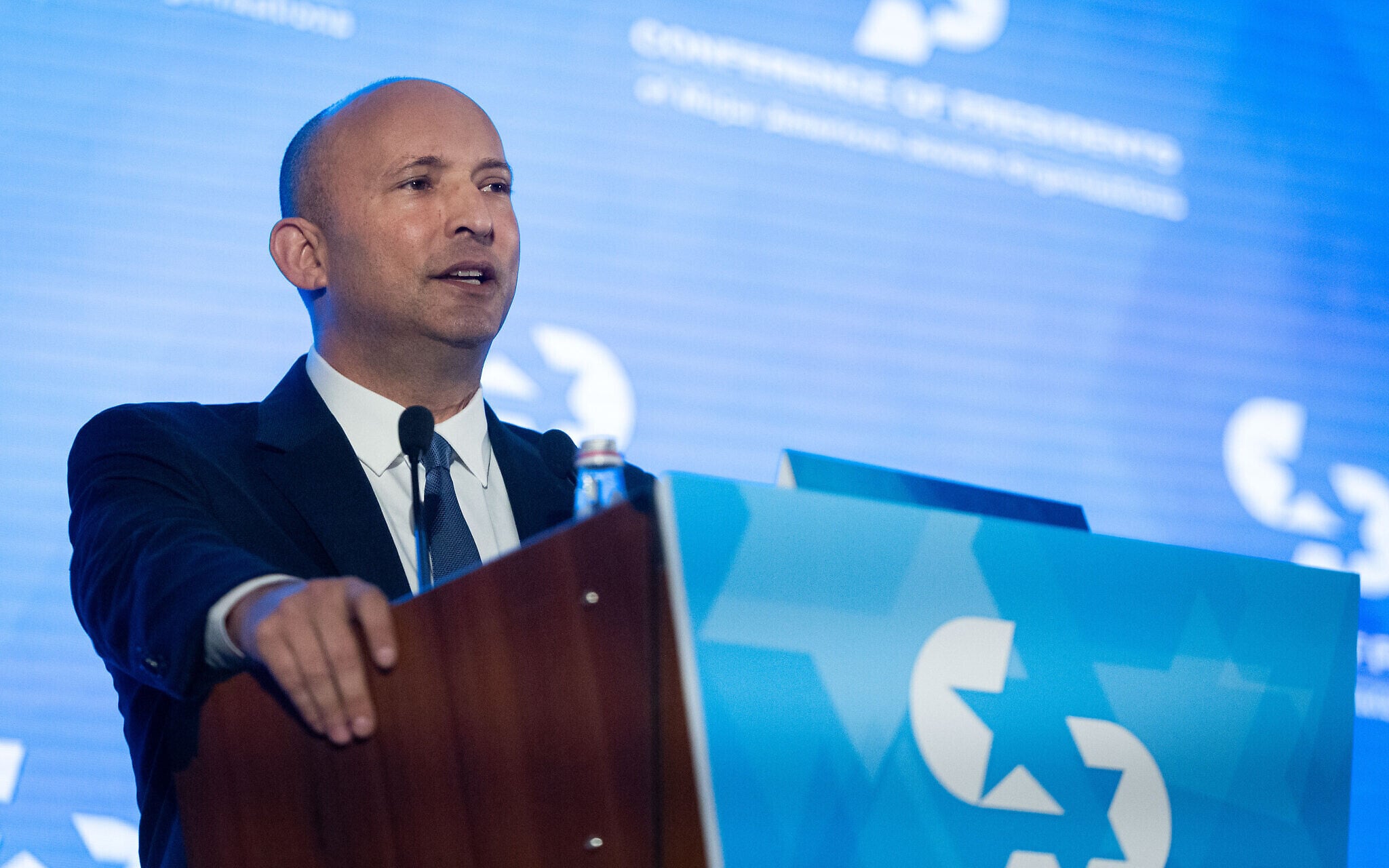
Former prime minister Naftali Bennett speaks at the Conference of Presidents of Major American Jewish Organizations in Jerusalem, on February 17, 2026. (Yonatan Sindel/Flash90)
Opposition politicians slam the government for approving the allocation of over NIS 5 billion ($1.6 billion) to causes including Haredi institutions, accusing it of funding draft evasion during wartime.
Millions of shekels were also allocated to West Bank settlements, raising the ire of left-wing politicians.
“While the people of Israel are fighting on the front lines, this government is busy looting the public purse,” declares former prime minister Naftali Bennett.
“Like thieves in the night,” the government “is now secretly transferring billions of shekels of political money to evaders under the guise of an emergency budget,” he declares. “They are transferring these billions not to defense, not to the families of the reservists, not to the reconstruction of the north and the south” and “they think that because the people of Israel are preoccupied with the war, they will not notice that they are looting us.”
“Those funds could have been allocated to security, reservists, health, welfare, education, and rehabilitation. But the Netanyahu-Goldknopf-Smotrich government invests solely in itself: draft dodging, settlements, and corruption,” tweets The Democrats chairman Yair Golan.
Ahead of the vote, Yesh Atid MK Vladimir Beliak, who heads his party’s effort to stymie the coalition’s budget, insisted that “the only way to maintain the standard of living and even improve it is through economic growth. And to encourage growth, at the very least, we shouldn’t be funding ignorance and idleness.”
The funds allocated were coalition funds — money allocated in the budget-planning process based on agreements struck between the parties during coalition negotiations at the formation of the government.
According to Channel 12, the funds, whose approval was opposed by Finance Ministry officials, include NIS 1.6 billion ($518 million) for Torah institutions, which are primarily Haredi; NIS 77 million ($24.9 million) for Haredi culture; and NIS 138 million ($44.7 million) for the Settlements Division of the Settlements and National Missions Ministry.
The Calcalist financial news site reports that NIS 49 million ($15.8 million) will go toward preventing students from dropping out of yeshivas — despite the fact that the government stated last year that starting this year, it would no longer finance the education of ultra-Orthodox youths who are studying at institutions that don’t have a rigorous curriculum and allow them to decline to perform mandatory IDF service.
Southern Iran airport damaged in US and Israeli strikes, local media reports
US and Israeli strikes have hit an airport in southern Iran, damaging part of the site as well as aircraft, local media report.
“Following an American-Zionist attack on Kerman Airport, part of it was damaged and two old, out-of-service aircraft were hit,” Iran’s Tasnim news agency says, quoting a statement from the governor’s office in the southern province of Kerman.
It is not clear whether there are any military facilities at or near the site.
Yesterday, the Israeli military said it had completed a “wave of strikes against six military airfields” in Iran, hitting planes and runways as well as defense and detection systems.
Iranian media reported on Friday that US and Israeli attacks had also hit Mehrabad airport in Tehran, with one outlet saying a fighter jet hangar was struck.
Earlier this week strikes hit another airport in the southeastern city of Bushehr, damaging aircraft and the terminal, according to Iranian media.
WATCH: Pentagon holds briefing on progress of Iran war
The US Department of Defense is holding a briefing on the progress of the Iran war. Watch it live here:
New Iranian missile attack detected, sirens set to sound in central Israel and Jerusalem
The IDF says it has detected a new ballistic missile attack from Iran.
Sirens are expected to sound in central Israel and Jerusalem in the coming minutes.
Trump ‘not happy’ with choice of new Iranian leader, says talks with regime ‘possible’; ‘if we’d waited three days, we’d have been attacked’
US President Donald Trump speaks at a news conference, March 9, 2026, at Trump National Doral Miami in Doral, Florida. (AP/Mark Schiefelbein)
US President Donald Trump tells Fox News that he is “not happy” with the selection of Mojtaba Khamenei as Iran’s new supreme leader this week.
“I don’t believe he can live in peace,” he says.
Trump also leaves open the door to potential negotiations with Iran: “It’s possible, depends on what terms.”
“We sort of don’t have to speak anymore… but it’s possible,” he says.
Trump says that the US would have been attacked if he had waited three more days to strike Iran: “If we had waited three days, I believe we would have been attacked.”
“When we attacked them first, we knocked out 50% of their missiles,” he adds. “And if we didn’t, it would have been a much harder fight.”
US war on Iran not ‘morally legitimate,’ says DC Catholic archbishop
Cardinal Robert McElroy of Washington attends a press conference at the North American College in Rome, Friday, May 9, 2025. (AP/Gregorio Borgia)
The US campaign against Iran does not meet the standards of a just war, says the Catholic archbishop of Washington, DC.
“The Khamenei regime has been for decades a brutal and repressive government that has spread terrorism throughout the world and should be replaced,” says Cardinal Robert W. McElroy in an interview with the Catholic Standard.
At the same time, argues McElroy, the war does not meet three of the six criteria that the Catholic Church uses to determine the morality of a war.
He claims that the war does not meet the standard of just case “because our country was not responding to an existing or imminent and objectively verifiable attack by Iran,” and it is therefore a preventative war.
McElroy also contends that the war doesn’t meet the criterion of right intention because the aims of the war are unclear: “You cannot satisfy the just war tradition’s criterion of right intention if you do not have a clear intention.”
In addition, the archbishop says that it is not clear that the potential benefits of the war will outweigh the harm being done.
“Already the war has had unintended consequences. Iran’s morally despicable decision to target its neighbors in the region has spread the expanse of destruction,” he says. “Lebanon may fall into civil war. The world’s oil supply is under great strain. The potential disintegration of Iran could well produce new and dangerous realities. And the possibility of immense casualties on all sides is immense.”
“For all of these reasons, Catholic teaching leads to the conclusion that our entry into this war was not morally legitimate,” he says.
Air Force struck armed Iranian missile launcher minutes before it could attack, IDF says
The Israeli Air Force struck an armed ballistic missile launcher and killed several Iranian soldiers minutes before they could attack Israel last night, the military says.
According to the military, the IAF identified a squad of Iranian soldiers preparing to launch ballistic missiles at Israel from western Iran.
An IAF drone was then dispatched to the area and “destroyed the missile launcher, and then eliminated the launch team, minutes before they were set to fire at the State of Israel,” the military says.
The IDF publishes footage of the strikes.
דקות ספורות לפני שיגור מאיראן: חיל האוויר איתר וחיסל חוליית שיגור ומנע ירי לעבר שטח מדינת ישראל
חיל האוויר זיהה אמש (ב'), מספר חיילים במערך הטילים הבליסטיים וכלי הטיס הבלתי מאוישים של משטר הטרור האיראני, בעת שפעלו במערב איראן ותכננו לשגר טילים לעבר מדינת ישראל.
מיד לאחר הזיהוי,… pic.twitter.com/wJxvYTQZya
— צבא ההגנה לישראל (@idfonline) March 10, 2026
New Iranian missile attack detected, sirens set to sound in north and central Israel
The IDF has detected another ballistic missile launch from Iran.
Sirens are expected to sound in northern and central Israel in the coming minutes.
Meanwhile, there are no reports of direct impacts or injuries in the Iranian ballistic missile attack on central Israel.
Sirens had sounded across central Israel and parts of the south and West Bank a short while ago.
This will be ‘most intense day’ of strikes on Iran, says US defense secretary, says this war is not like Iraq
US War Secretary Pete Hegseth speaks during a press briefing at the Pentagon in Washington, March 4, 2026. (AP/Konstantin Toropin)
Today will be “the most intense day of strikes” on Iran, says US Defense Secretary Pete Hegseth in a Pentagon briefing. “The most fighters, the most bombers, the most intelligence, more defined and better than ever.”
At the same time, the last 24 hours has seen the lowest number of missiles Iran has fired over the course of one day in the ongoing campaign, he says.
The goals of the US campaign have not changed, and are being executed with “ruthless precision,” he adds.
He lists the aims: first, destroying the missile stockpiles, missile launchers, and their defense industrial base; and second, to destroy Iran’s navy.
And finally, to “permanently deny Iran nuclear weapons.”
“We will not relent until the enemy is totally and decisively defeated,” he says, and that will be carried out “on our timeline.”
“This is not 2003,” he says, in a reference to the invasion that launched the Iraq War. “This is not endless nation-building.”
Judge says police twice tried, failed to take PM’s testimony in probe involving chief of staff
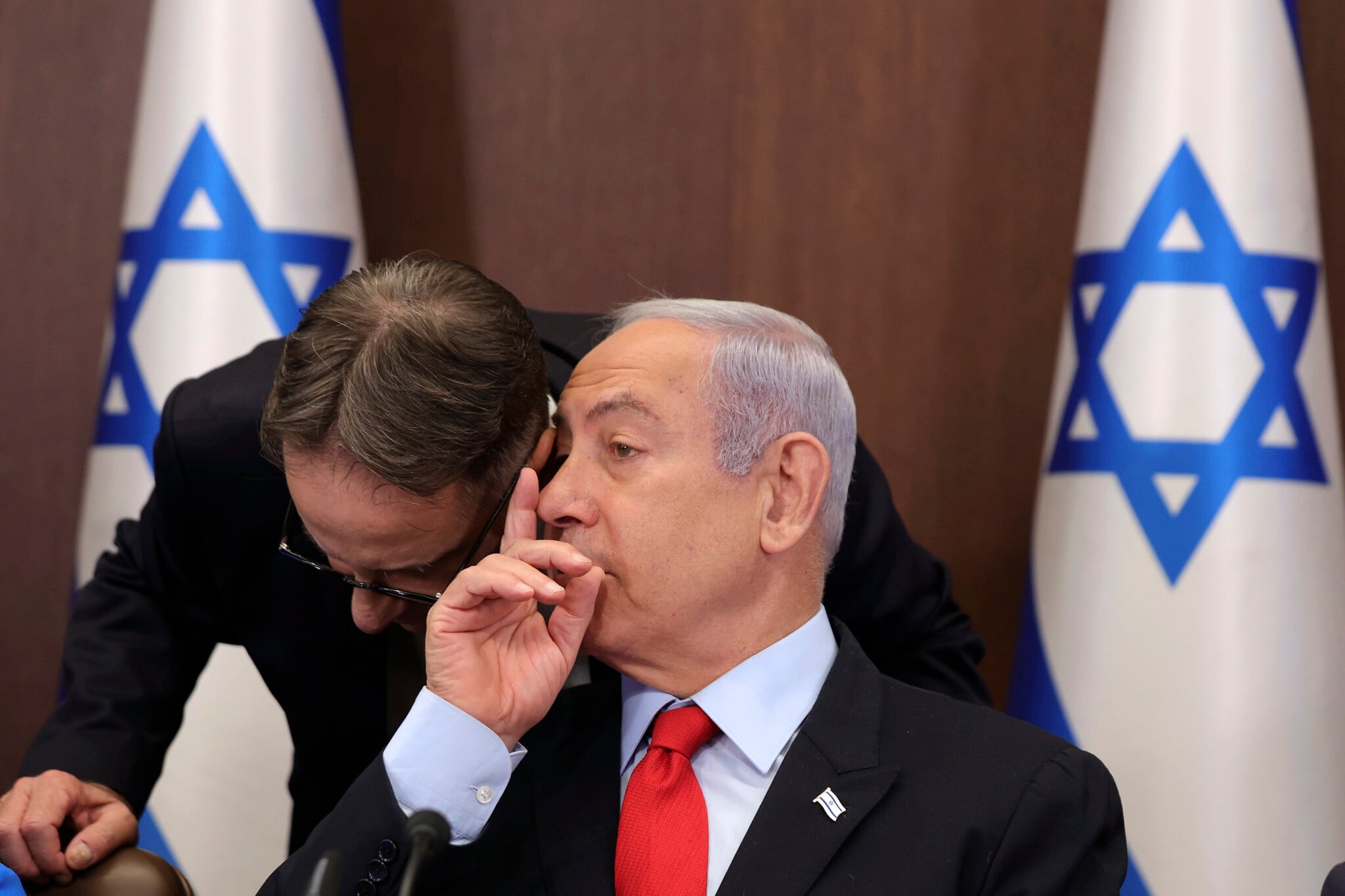
Prime Minister Benjamin Netanyahu, right, speaks with his chief of staff Tzachi Braverman during the weekly cabinet meeting at the Prime Minister's Office in Jerusalem, July 30, 2023. (Abir Sultan/Pool Photo via AP)
Police twice tried and failed to take testimony from Prime Minister Benjamin Netanyahu regarding the Bild leak investigation and suspicions his chief of staff tried to interfere in the probe, according to a Lod District Court judge.
Judge Amit Michels made the statement yesterday at a hearing on the extension of restrictive conditions imposed on Jonatan Urich, Netanyahu’s adviser who is implicated in multiple investigations. Per the decision, Urich’s restrictive conditions will last until March 18 at least, forbidding him from leaving the country or contacting Netanyahu and others involved in the case.
The judge said the failed attempts to take testimony from Netanyahu could be chalked up to his busy schedule, particularly amid the current war with Iran.
Urich, a central suspect in the Qatargate affair, is also being probed on suspicions he was involved in the leak of classified information to the German newspaper Bild by Eli Feldstein, Netanyahu’s ex-spokesman, to sway public opinion against a hostage deal with Hamas.
The hearing also concerns a suspected attempt to quash the probe by Netanyahu’s chief of staff Tzachi Braverman, who allegedly told Feldstein he could halt a military investigation into the leak during a meeting in the underground parking lot of the Kirya military headquarters.
Israeli finishes 12th in women’s alpine combined Paralympic skiing event

Israel's Sheina Vaspi competes in the alpine ski women's combined standing super-G, at the 2026 Winter Paralympics, in Cortina d'Ampezzo, Italy, March 10, 2026. (AP/Kirsty Wigglesworth)
Israeli Winter Paralympian Sheina Vaspi finishes 12th in the women’s alpine combined standing out of 15 skiers at the 2026 Milano Cortina Games.
The alpine combined is made up of one super-G run and one slalom run. Vaspi, who lost her left leg in a car accident as a young child, finished the super-G this morning in 11th place and the slalom in 13th place, to give her a combined finish of 12.
In the super-G event yesterday, Vaspi skied out of the track and did not complete the run. She is slated to compete in the giant slalom on Thursday. Vaspi skipped the downhill event on Saturday since she does not compete on Shabbat, and is also slated to miss the slalom this Saturday unless it is rescheduled due to weather.
No reports of injuries in latest Iranian missile salvo on Israel
A small number of missiles were launched in Iran’s latest attack, the third attack today, setting off sirens in wide areas across central and northern Israel.
There are no reports of injuries, and the missiles were likely intercepted, according to initial military assessments.
Missile fragments reportedly landed in several areas.
Hegseth: Israeli oil strike ‘wasn’t necessarily our objective’

US Defense Secretary Pete Hegseth gives a briefing on the Iran war, March 10, 2026. (Screenshot/CNBC)
Asked about Israel’s strike against Iranian oil facilities, amid reports that the White House was unhappy with the attack, US Defense Secretary Pete Hegseth says hitting the oil sites “wasn’t necessarily our objective.”
He firmly denies Israel is pulling the US into operations that go against Washington’s interests: “We’re not getting pulled in any direction. We’re leading, the president is leading.”
More than 60% of Israelis seeking to come home have returned — Airports Authority

An El Al airplane is seen in the sky above Tel Aviv, March 6, 2026. (Chaim Goldberg/Flash90)
The Israel Airports Authority says over 60 percent of Israelis who were stranded abroad upon the outbreak of the Iran war have returned, mainly via air routes and land border crossings with Egypt and Jordan.
Tel Aviv’s Ben Gurion Airport was gradually reopened Wednesday night for inbound flights, to help repatriate around 100,000 Israelis stuck abroad after the country’s airspace was shut on February 28 as US-Israeli strikes began. Since the partial reopening of Ben Gurion, about 32,000 Israelis have returned home on 177 repatriation flights operated by Israeli airlines, as of yesterday, the Israel Airports Authority says.
Another 40 repatriation flights carrying an estimated 7,000 passengers were expected to land today.
Between February 28 and March 9, a total of 25,000 Israelis who were abroad returned to the country via land border crossings with Egypt and Jordan. During the same period, 31,000 people departed Israel via land border crossings.
UAE shuts down region’s largest oil refinery after drone strike
The UAE shuts down the Middle East’s largest oil refinery after it is hit by a drone, Bloomberg reports.
The strike caused a fire at the site, which can process 922,000 barrels a day. Abu Dhabi’s media office said there were no injuries in the attack.
Abu Dhabi authorities are responding to a fire that broke out at a facility in the Ruwais Industrial Complex, caused by a drone attack. No injuries have been reported at this time.
The public is reminded to obtain information from official sources only and to avoid spreading…
— مكتب أبوظبي الإعلامي (@ADMediaOffice) March 10, 2026
Iran fires 9 ballistic missiles, 35 drones at UAE today — Emirati Defense Ministry

A view of downtown Dubai on March 3, 2026. (Giuseppe CACACE / AFP)
Iran fired nine ballistic missiles at the UAE today, says the Emirati Defense Ministry, adding that eight were intercepted and one fell into the Persian Gulf.
Iran also launched 35 drones at the UAE, nine of which slipped past air defenses and impacted inside the country.
In total, Iran has fired 262 ballistic missiles and 1,475 drones at the UAE.
WHO warns of health risks from ‘black rain’ in Iran
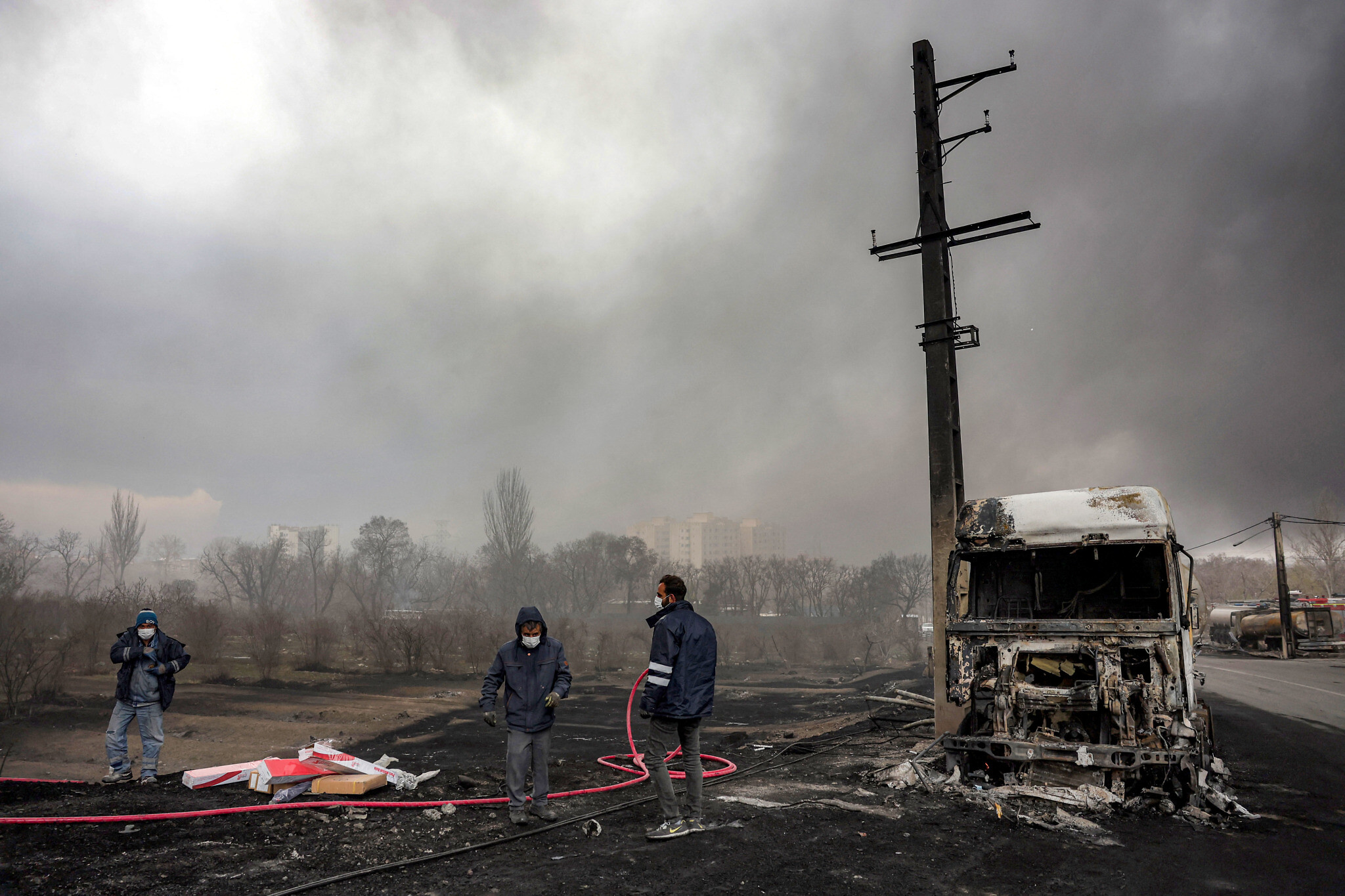
An Iranian civil defence member stands with a hose next to a destroyed fuel tanker vehicle near an ongoing fire following an overnight airstrike on the Shahran oil refinery in northwestern Tehran on March 8, 2026. The United States and Israel launched strikes against Iran on February 28, sparking swift retaliation by the Islamic republic which responded with missile attacks across the region. The war has dragged in global powers, upended the world's energy and transport sectors, and brought chaos to even usually peaceful areas of the volatile region. (Photo by AFP)
The World Health Organization warns that the “black rain” falling in Iran after strikes on oil facilities could cause respiratory problems, and it backs Iran’s advisory urging people to remain indoors.
The UN health agency, which has an office in Iran and works with authorities on health emergencies, says it has received multiple reports of oil-laden rain this week. Tehran was choked in black smoke on Monday after an oil refinery was hit, in an escalation in strikes on Iran’s domestic energy supplies as part of the US-Israeli campaign.
“The black rain and the acidic rain coming with it is indeed a danger for the population, respiratory mainly,” WHO spokesperson Christian Lindmeier tells a press briefing in Geneva, adding that Iran had advised people to stay indoors.
Asked whether the WHO backed that advice, he says: “Given what is at risk right now, the oil storage facilities, the refineries that have been struck, triggering fires, bringing serious air quality concerns, that is definitely a good idea.”
One video sent to Reuters by a WHO staff member shows what they said was a cleaner mopping up black liquid at its office entrance in Tehran on March 8. Reuters is not able to independently verify the footage.
Satellite images show damage from Israeli strikes on Iran’s ballistic missile production sites
New satellite images show extensive damage at Iranian ballistic missile production sites following Israeli airstrikes last week.
One image, taken by the defense intelligence firm Vantor, shows multiple buildings destroyed or badly damaged at Iran’s Parchin military complex, south of Tehran.
The IDF said it struck Parchin on Thursday, targeting “factories for the production of explosives for ballistic missile warheads; complexes for the production of unique raw materials for missile engines; a facility for mixing and casting missile engines; and a complex used for research, development, assembly, and production of advanced cruise missiles.”
????️Satellite imagery shows impacts of precision strikes at Parchin Military Complex in Iran on March 6th. Multiple buildings are seen damaged or fully destroyed.
Use the slider to compare here: https://t.co/lRDsFiEbzO#IranIsraelUS #MiddleEast #Iran pic.twitter.com/TulyHRuO6e
— Soar (@SoarAtlas) March 10, 2026
Another image, taken by Airbus, shows multiple buildings damaged and destroyed at a missile production plant in Shahrud.
The military said it hit the Shahrud ballistic missile production site on Saturday, saying it was the facility where “most of the missiles fired at Israel were manufactured.”
The damage to Shahroud is extensive
More or less every building in the solid motor production lines was damaged, many destroyed. Several mixing & casting buildings, along with what might be non-destructive testing & premix buildings.
Thanks to our partners @Airbus for the image https://t.co/lxTnSN8zTL pic.twitter.com/FTgBU9gGPI
— Sam Lair (@sam_lair) March 9, 2026
Germany’s Merz says West Bank E1 settlement project ‘big mistake’

German Chancellor Friedrich Merz attends a press conference at the end of an intergovernmental summit at Villa Doria Pamphilj in Rome, January 23, 2026. (Gregorio Borgia/AP)
German Chancellor Friedrich Merz says a new West Bank construction project being pushed by the Israeli government east of Jerusalem is a “big mistake.”
“The German government urgently calls for such steps to be refrained from,” Merz says, claiming that advancing the so-called E1 project would “complicate the two-state solution.”
Israel gave the green light in August to E1, a new construction project covering around 12 square kilometers (4.6 square miles) in the West Bank.
The plan has been condemned by several international leaders, with UN Secretary General Antonio Guterres’s spokesman saying it would pose an “existential threat” to a future contiguous Palestinian state. The Israeli government opposes Palestinian statehood.
An Israeli settlement watchdog in January denounced the government’s publishing of a tender for the construction of around 3,400 housing units in the E1 area, long a contentious site.
Standing alongside Czech Prime Minister Andrej Babis in Berlin, Merz describes the developments as “annexation moves” and calls on Israel to halt the settlement push.
“It is crucial that we Europeans convey this message together,” he says.
German Foreign Minister Johann Wadephul will “emphasize this” on a trip to Israel, Merz says.
In 2025, the expansion of Israeli settlements reached its highest level since at least 2017, when the United Nations began tracking such data, according to a UN report.
Israel approved a range of new settlements in December, a move far-right Finance Minister Bezalel Smotrich said was aimed at preventing the establishment of a Palestinian state.
With flights scarce, UTJ lawmaker flies to UK amid war to attend grandchild’s wedding
United Torah Judaism MK Meir Porush flew to England to attend the wedding of a grandchild, i24 News reports, sharing a picture of the ultra-Orthodox MK that was originally posted by the Haredi WhatsApp group HaPargod.
The previous day, Social Equality Minister May Golan flew to the United States to address an International Women’s Day event organized by the United Nations.
Both are traveling in the middle of the war with Iran, during a period when many Israelis and foreign visitors are finding it difficult to leave the country due to sharply reduced airport activity brought about by ongoing Iranian ballistic missile strikes.
The country’s airspace initially shut on February 28, when Israel and the US launched a major joint military strike on Iran and the Islamic Republic responded with barrages of missile fire. In the wake of the attack, US Ambassador Mike Huckabee advised US citizens in Israel wishing to leave the country to do so via Egypt, noting the “limited options” for egress.
Several hundred passengers were able to leave Israel this week as Ben Gurion Airport was partially reopened Sunday for outbound flights for the first time since the beginning of the war. Despite this, air travel options remain severely limited, with only two narrow-body aircraft permitted to leave per hour, each only carrying no more than 70 to 100 passengers.
On Monday, HaPargod shared video of the head of the ultra-Orthodox Oratta Yeshiva at Ben Gurion Airport toasting his success in arranging travel for 90 students who were flying on a pilgrimage to the Polish town of Leżajsk, prompting resentment among non-Haredi Israelis.
“There are 2 states here: One state that works and serves [in the army]… and is about to collapse [under the strain] and another state” in which the Haredim “have become AAA-class citizens,” complained The Democrats party director-general Omer Granot-Lubaton in a post on X about the yeshiva students on Monday.
IDF launches fresh airstrikes on Beirut’s Hezbollah stronghold
The IDF says it has launched a wave of airstrikes against Hezbollah infrastructure in Beirut’s southern suburbs.
The strikes come after the military reiterated its warning to evacuate the area, a Hezbollah stronghold known as the Dahiyeh.
Further details on the strikes will be provided, the army says.
Iran’s Larijani says Hormuz will either be strait of peace or strait of defeat
The Strait of Hormuz will either be a strait of peace and prosperity for all or a strait of defeat and suffering for “warmongers,” Iranian security chief Ali Larijani says in a post on X.
The vital oil transit route has been all but shut since vessels in the area were hit by Iranian strikes following US and Israeli attacks on the Islamic Republic.
Tehran has threatened to block the narrow waterway in response to any attack.
Qatar: Attacks on energy, civilian sites by Iran, US and Israel will have ‘grave consequences’ for world economy
Qatar warns both sides of the Iran conflict against attacks on civilian sites and energy infrastructure, saying it could result in a humanitarian disaster.
“This region cannot take these kinds of attacks on its facilities,” says Foreign Ministry spokesman Majed Al-Ansari. “We will see a humanitarian catastrophe.”
“We have seen these kinds of attacks on both sides of the Gulf,” he says, pointing fingers at both Iran and the US and Israel.
“The attacks on energy facilities, which has also happened on both sides, is a dangerous precedent,” he says two days after Israel carried out a major attack on an Iranian oil facility, and hours after an Iranian drone shut down production at a major Emirati oil refinery.
“What is happening right now is going to have grave consequences for the international economy,” Ansari warns.
Germany’s foreign minister visits Israel, tours site of deadly Iran missile impact
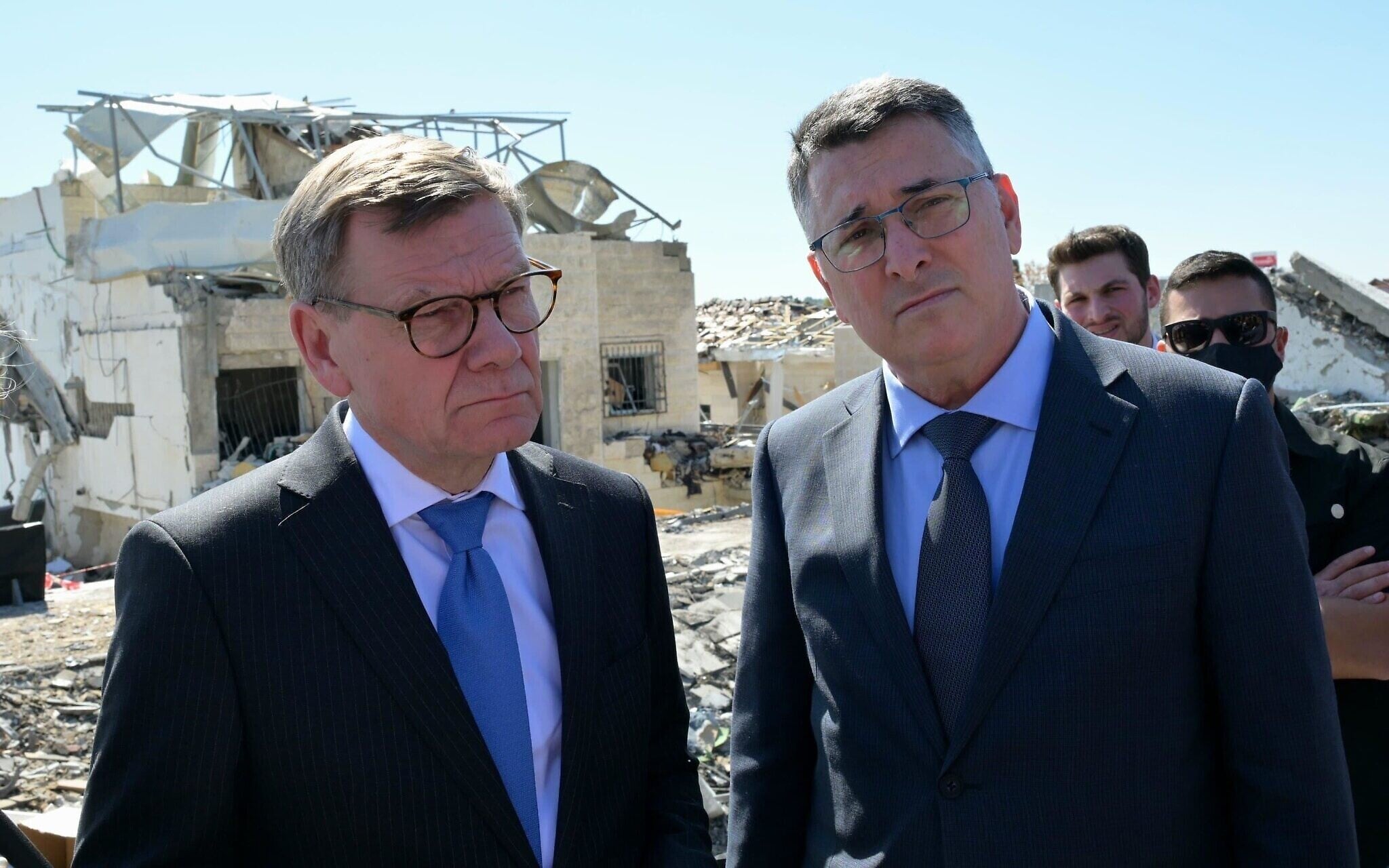
Foreign Minister Gideon Sa'ar, right, and German Foreign Minister Johann Wadephul visit the site of a deadly Iranian missile impact days earlier in Beit Shemesh, March 10, 2026. (Shlomi Amsalem/GPO)
German Foreign Minister Johann Wadephul is in Israel, marking the first diplomatic visit to the country since the start of the air campaign against Iran.
He and Foreign Minister Gideon Sa’ar visited the site of the deadly Iranian missile attack in Beit Shemesh and met with relatives of the victims, according to Sa’ar’s office.
Hegseth says US is taking probe into Iran school strike ‘very seriously’
Responding to a question shouted by a reporter at a news conference about accountability for a deadly strike on a girls’ school in Iran’s Minab, US Defense Secretary Pete Hegseth says that “we take things very, very seriously and investigate them thoroughly.”
“No nation takes more precautions to ensure there’s never targeting of civilians,” he says, adding that “open source information” shouldn’t be used to determine what happened.
Satellite images, expert analysis, a US official and public information suggest the explosion that killed at least 165 people, mostly children, was likely caused by US airstrikes that also hit an adjacent compound associated with Iran’s Revolutionary Guard.
Trump erroneously claimed yesterday that Iran has access to the American Tomahawk cruise missile, the weapon likely used to strike the school.
IDF tank on transporter truck was hit by Hezbollah projectile earlier today; no injuries
Earlier today, an IDF tank that was on a transporter truck on the Lebanese border was hit by a projectile fired by Hezbollah.
The incident took place at an army post in the Galilee Panhandle area, according to the military.
The IDF says that no soldiers were in the tank at the time, and no injuries were caused.
The military is investigating whether the projectile was an anti-tank guided missile or an unguided rocket.
Half of Iranian missiles fired at Israel had cluster bomb warheads, IDF assesses
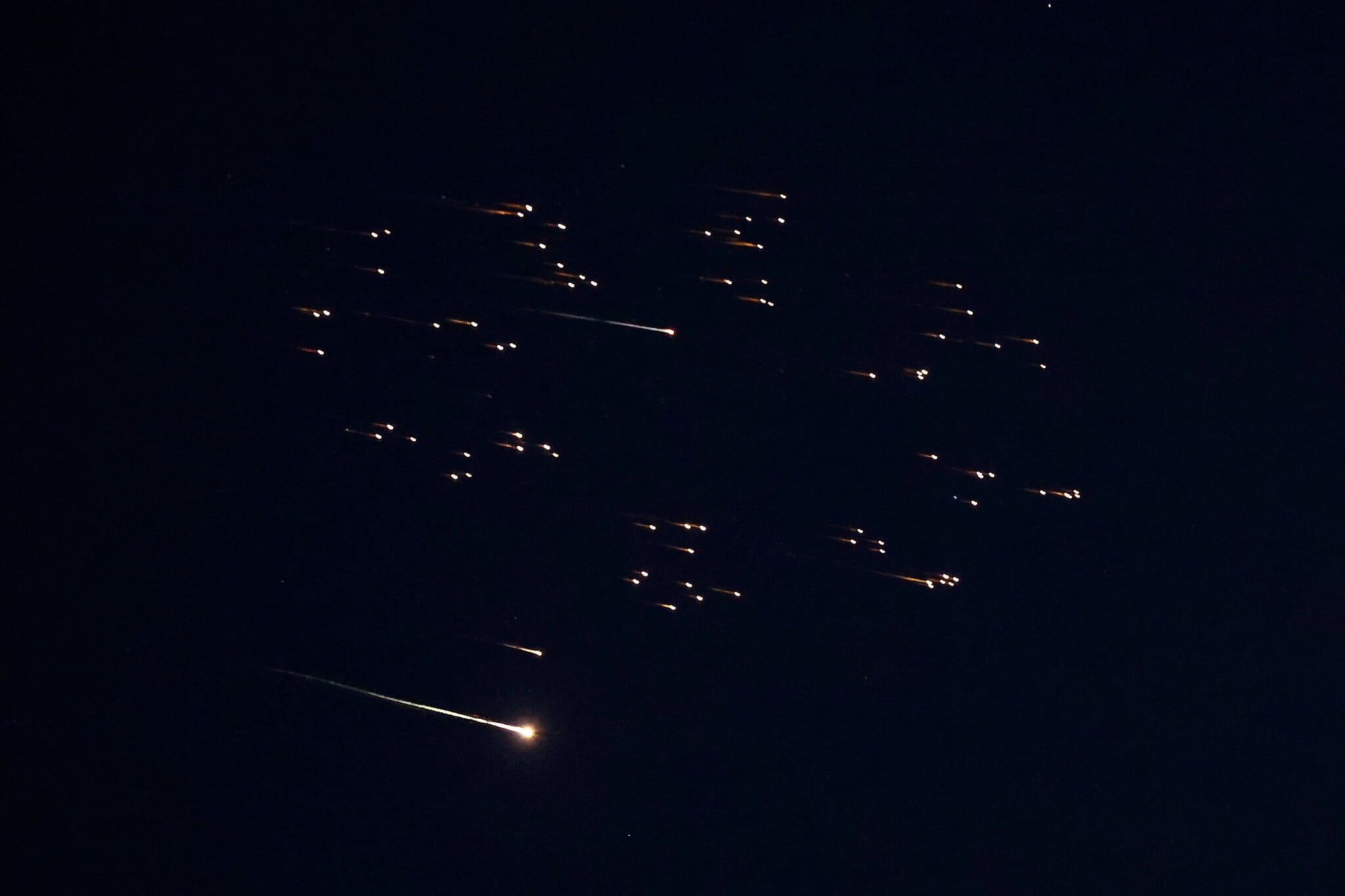
Rocket trails are seen in the sky above Netanya on March 5, 2026, in an apparent cluster munition attack from Iran. (Jack GUEZ / AFP)
Around 50% of Iran’s ballistic missiles fired at Israel during the war have been armed with cluster bomb warheads, according to fresh IDF assessments.
The cluster bomb warheads indiscriminately spread dozens of submunitions, each with several kilograms of explosives, over a radius of around 10 kilometers (6 miles).
The interception of such missiles has been effective but challenging, military officials say, stressing that Israel’s air defenses are not hermetic.
According to the IDF Home Front Command, Iran’s missile fire during the war has been aimed at population centers, along with military facilities and key infrastructure.
The attacks from Iran in recent days have consisted of just one or a small number of missiles at a time. The IDF believes Iran is struggling to carry out coordinated, larger barrages toward Israel
Yesterday, two people were killed when a cluster bomb munition struck a construction site in central Israel. Another person was seriously wounded elsewhere in central Israel, and several more impact sites causing damage were reported.
IDF finds ‘isolated failure’ allowed 2 Hezbollah rockets to impact without sirens or interception
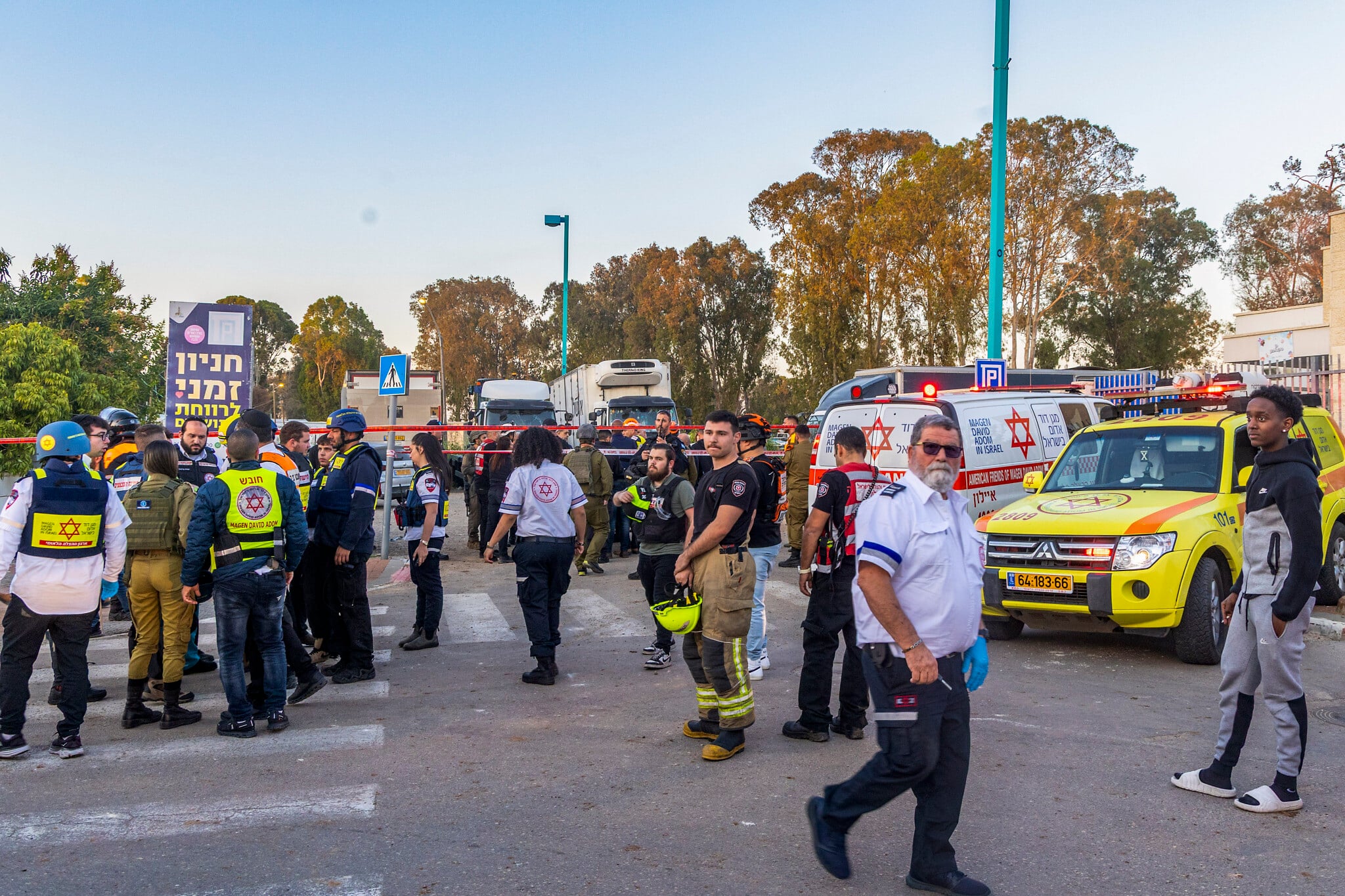
Israeli rescue and emergency forces at the scene where shrapnel from a missile fired from Lebanon fell outside a kindergarten in Ramle, March 9, 2026. (Yossi Aloni/Flash90)
The Israeli military says an “isolated failure” resulted in two Hezbollah missiles impacting central Israel yesterday without being intercepted and without warning sirens sounding.
Hezbollah fired several missiles from Lebanon in the attack, claiming to have targeted the IDF Home Front Command headquarters in Ramle, known as Rehavam Base, as well as a “satellite communications station” in the Ela Valley near Beit Shemesh.
One of the missiles struck Ramle, damaging a daycare and lightly wounding 14 people. Another hit an open area in the Mateh Yehuda Regional Council, damaging infrastructure and wounding two others, according to rescue services and police. The other missiles were intercepted by air defenses, the IDF says.
According to the military, attempts to shoot down the two missiles failed, and the impacts occurred without sirens sounding in the relevant areas.
The IDF describes the incident as an “isolated failure,” adding that “this is not a new threat” and the Israeli Air Force “has intercepted similar threats in the past.”
The failure was investigated by both the Israeli Air Force, which is responsible for the interception, and the Home Front Command, which operates the warning system.
“Following the investigation, adjustments were implemented to strengthen interception capabilities against similar threats in the northern arena,” the military says.
Interceptions seen as Hezbollah targets north with more rockets
Sirens sound in the Galilee amid a rocket attack from Lebanon.
A number of interceptions are seen over the area, and there are no immediate reports of injuries.
Hezbollah has fired many dozens of rockets at Israel in recent days.
Minister: Some schools may reopen Sunday, depending on Home Front Command’s assessment on Saturday
Education Minister Yoav Kisch at the Education Ministry in Jerusalem, in preparation for the opening of the school year, August 31, 2025. (Chaim Goldberg/Flash90)
In a virtual press conference, Education Minister Yoav Kisch confirms that a gradual reopening of schools in certain areas might happen on Sunday, as long as the Home Front Command allows it in its next assessment of the security situation on Saturday night.
“The outline has been defined,” Kitsch says. “There is a process in which local authorities might be classified as yellow. What does yellow mean? It means that educational activities will be allowed adjacent to a standard protected space.”
“This is subject to the Home Front Command’s situation assessments,” he adds. “On Saturday night, there will be another assessment, which will determine whether we move forward with the opening outline on Sunday.”
In the first stage, only special education schools, daycares, and grades 1, 2, 11 and 12 are set to reopen.
According to the minister, as of now, it is not feasible to reopen schools in the Gush Dan area in central Israel, which includes the greater Tel Aviv area, nor in the north of the country, given the heavy fire they are exposed to. However, it might be possible in other regions.
Kisch says the ministry and all the relevant authorities will do whatever they can to prepare ahead of time so that if the Home Front Command allows it on Saturday night, schools in yellow areas will be ready to operate on Sunday morning.
Kisch also stresses that, as long as they cannot reopen in person, schools will continue distance learning to maintain the connection between teachers and students.
IDF says it has struck over 70 primed Hezbollah rocket launchers since hostilities resumed
The Israeli Air Force struck and destroyed several Hezbollah rocket launchers while the terror group was attempting attacks from Lebanon on Israel yesterday, the military says.
In addition, the IDF says it struck several Hezbollah operatives who operated one of the launchers, as well as an operative who had been heading to a launch site.
The IDF publishes footage showing some of the strikes.
סוכל בזמן אמת: צה״ל זיהה והשמיד משגר של חיזבאללה במהלך נסיון שיגור
אתמול (ב׳), בסגירת מעגל מהירה חיל האוויר זיהה משגרים של ארגון הטרור חיזבאללה בנסיון לבצע שיגורים לעבר שטח מדינת ישראל, זמן קצר לאחר הזיהוי המשגרים הותקפו והושמדו.
בנוסף, הותקפו המחבלים שתועדו מחמשים את המשגר… pic.twitter.com/HnodiUO8pj
— צבא ההגנה לישראל (@idfonline) March 10, 2026
Since hostilities escalated last week, the IDF says it has destroyed more than 70 primed Hezbollah rocket launchers in strikes.
The IDF has said that Hezbollah is launching most of its attacks from deeper within southern Lebanon, and not from close to the border.
IDF detects fresh Iranian missile salvo; sirens to sound in central Israel
The IDF has detected a new ballistic missile launch from Iran.
Sirens are expected to sound in central Israel in the coming minutes.
Tel Aviv memorial honors US soldiers killed in Iranian strike on Kuwait

A memorial set up for US soldiers killed in the ongoing US-Israeli war with Iran, at Dizengoff Square in Tel Aviv, March 10, 2026. (Avshalom Sassoni/FLASH90)
A memorial has been set up in Israel for American troops killed in Kuwait in the current war with Iran.
Some people walking by the memorial in Tel Aviv’s Dizengoff Square pause in silence, and some bring flowers to lay in front of photos of the six soldiers.
A sign says: “For the American heroes, your courage and dedication will not be forgotten.”
“Both of the countries are fighting together against a common enemy, and I think it’s really beautiful to see the solidarity between the people,” says Tel Aviv resident Gili Klein, whose boyfriend and several friends are currently serving in the Israeli military.
The US Army Reserve soldiers were working in logistics when a drone hit their command center in Port Shuaiba, Kuwait, one day after the US and Israel launched their military campaign against Iran.
Rockets from Lebanon target north as Iranian salvo targets Jerusalem area, parts of south
Sirens sound in the Haifa Bay area in northern Israel amid a rocket attack from Lebanon, concurrently amid an Iranian ballistic missile attack on the Jerusalem area.
The Iranian missile attack set off sirens across the Jerusalem area, the West Bank and parts of southern Israel.
The IDF has said it has no intelligence indicating that concurrent fire from Iran and by Hezbollah in Lebanon is a “coordinated” effort.
Missile impacts reported in Beit Shemesh
Medics are responding to reports of impacts in the Beit Shemesh area following Iran’s latest ballistic missile attack on Israel.
Magen David Adom says it has not received any reports of injuries so far.
Iran claims to arrest spy for US, Israel, Gulf countries; says 30 apprehended in past days
Iran’s intelligence ministry has arrested a foreign national it claims was conducting espionage on behalf of the United States and Israel and acting as a proxy for two Gulf countries, state media cites the ministry as saying.
The ministry also says it has arrested 30 spies, internal mercenaries, and operational agents of Israel and the US over the past few days.
Canadian police investigate reports of gunfire at US consulate in Toronto
Canadian police are investigating reports that the United States consulate in downtown Toronto was hit by gunfire early this morning.
No injuries have been reported.
Toronto police say they responded to reports at around 5:30 a.m. that someone shot at the US consulate.
In a post on social media, police say they were at the scene near University Avenue and Queen Street West.
“Evidence of a firearm discharge has been located,” police say in the post.
No suspect information has been released.
“The shooting that took place at the US consulate early this morning is an absolutely unacceptable act of violence and intimidation aimed at our American friends and neighbors,” Ontario Premier Doug Ford says in a statement.
“Everyone at all levels of government and across Canada needs to make clear that there is zero tolerance for this sort of intimidating and dangerous behavior.”
Two Toronto-area synagogues were struck by gunfire last weekend.
“The US consulate was shot at. This comes after shootings at synagogues,” Toronto Mayor Olivia Chow says. “This cannot stand. Toronto’s Jewish community has the right to practice their faith and culture and to live their day-to-day lives without fear, intimidation or violence. As we have seen too many times, antisemitic incidents spike when international incidents rise. It is never acceptable to target the Jewish community.”
Chow says there is heavy police presence at both the US and Israeli consulates in Toronto.
No injuries in latest Iranian salvo; missile hits open area outside Beit Shemesh
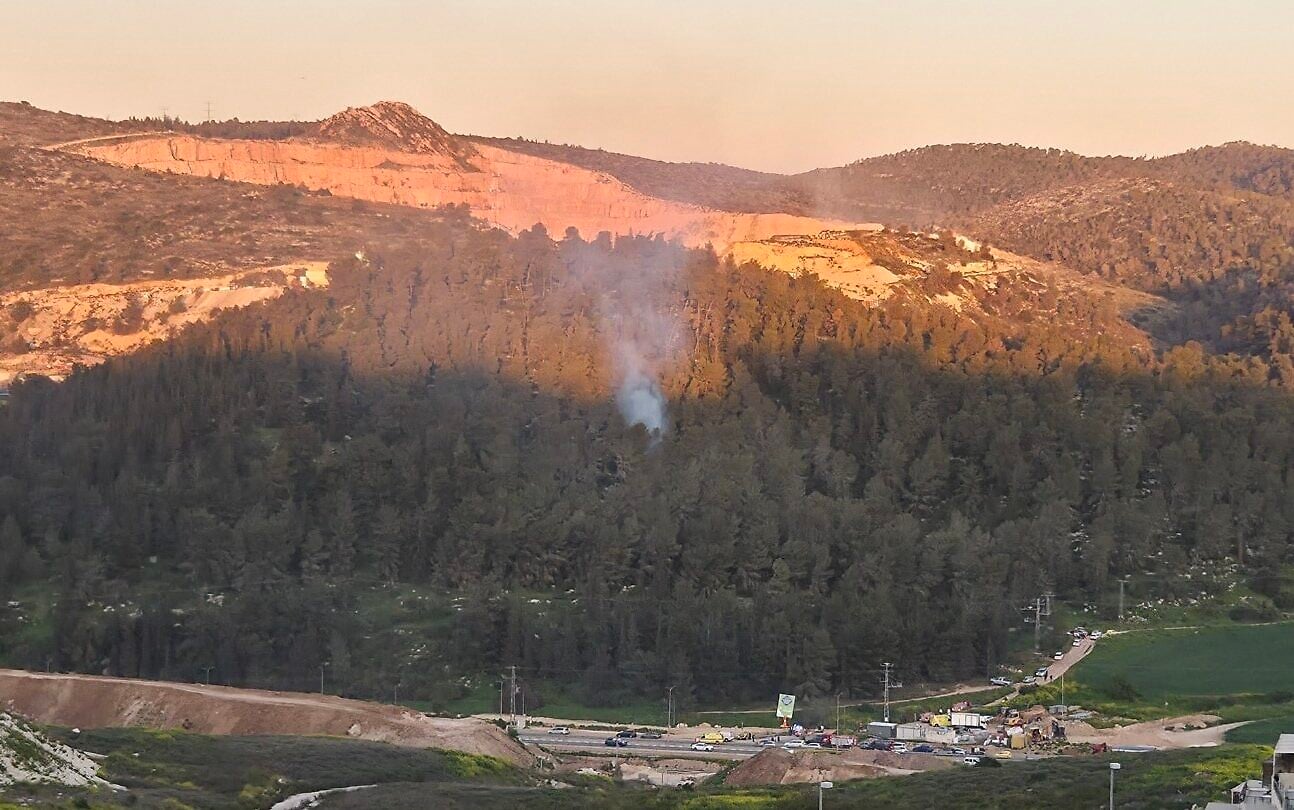
The scene of an Iranian ballistic missile that struck an open area near Beit Shemesh, March 10, 2026. (Courtesy)
No injuries are reported in Iran’s latest ballistic missile attack on Israel, the fourth today.
One missile struck an open area just outside Beit Shemesh, first responders say and footage shows.
Sirens had sounded across the Jerusalem area, the West Bank, and parts of southern Israel.
No injuries are reported in Iran's latest ballistic missile attack on Israel, the fourth today.
One missile struck an open area just outside Beit Shemesh, first responders say and footage shows.
Sirens had sounded across the Jerusalem area, the West Bank, and parts of southern… pic.twitter.com/j6sovAsDwz
— Emanuel (Mannie) Fabian (@manniefabian) March 10, 2026
Smotrich’s contentious plan to expand dairy imports removed from state budget agenda
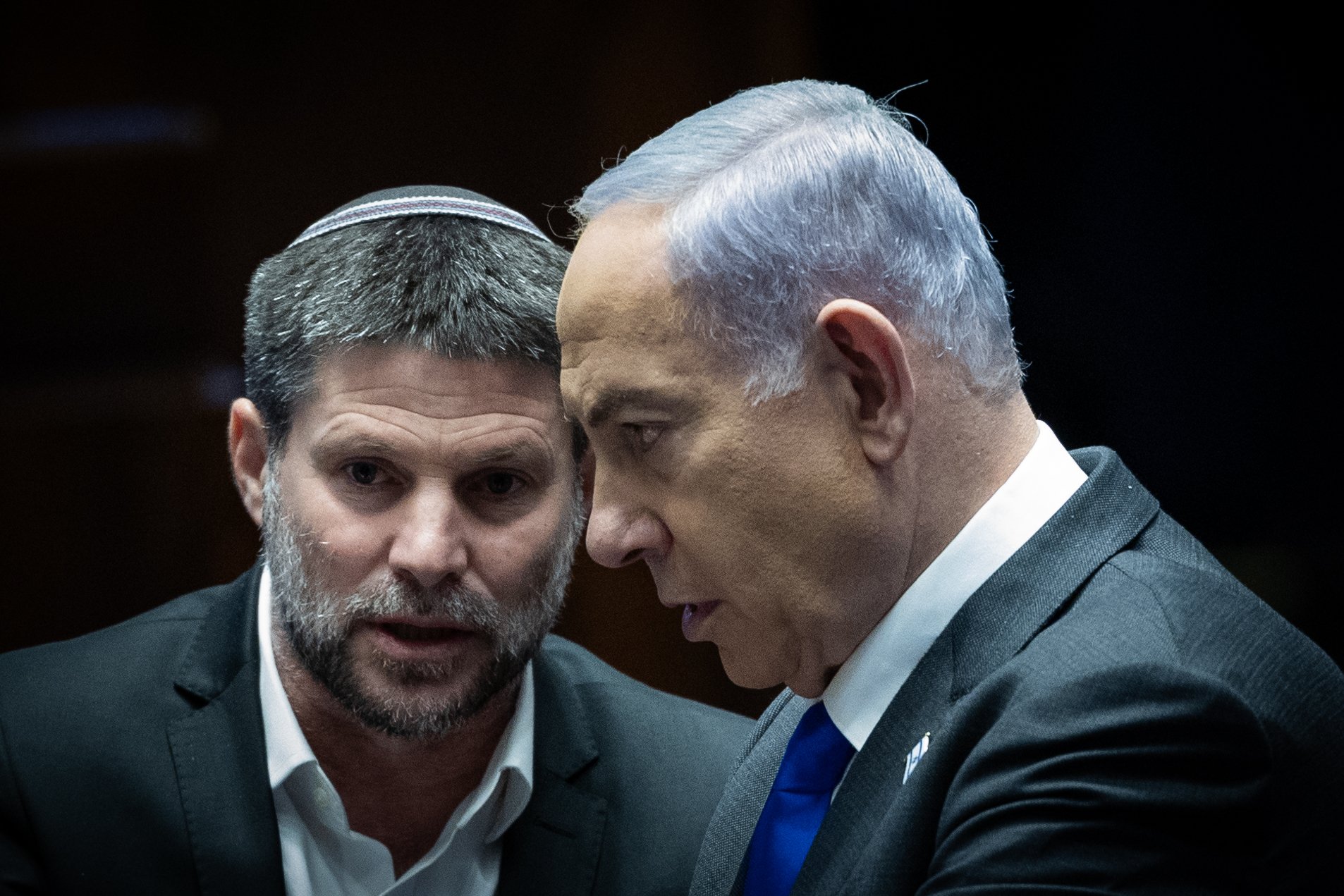
Prime Minister Benjamin Netanyahu, right, and Finance Minister Bezalel Smotrich in the Knesset, February 7, 2024. (Yonatan Sindel/Flash90/File)
Finance Minister Bezalel Smotrich’s dairy reform has been removed from the 2026 Arrangements Law, a critical piece of legislation whose passage is needed in order to adopt the 2026 state budget.
Following Hebrew media reports that Prime Minister Benjamin Netanyahu had insisted on removing Smotrich’s controversial reform from the law in order to pass the budget, a spokesperson for the finance minister’s office tells The Times of Israel that “it was decided to split issues that are in dispute, such as the dairy reform, from the Arrangements Law,” and that the decision was made by the prime minister and Smotrich together.
“At the moment, the main task is to ensure the passage of a budget that addresses all security needs and provides stability for the economy,” the finance minister’s office says.
The office adds that “in coordination with the prime minister, it was agreed that the reform will continue to advance in committee and, after the war ends, will be promoted as legislation under coalition discipline.”
As part of a broader plan to lower the cost of living, Smotrich’s proposed legislation would slash milk production from the current 1.5 billion liters to 1 billion, cut the price per liter that dairy processors pay to farmers by 15%, and abolish tariffs of up to 40% to flood the Israeli market with imported dairy products.
Though the plan was approved by the government in December, it needs the Knesset’s authorization to pass.
The reform has generated significant opposition from farmers who argue that it will cause widespread job losses and harm national food security, as well as within Prime Minister Benjamin Netanyahu’s Likud party, including Agriculture Minister Avi Dichter and Economy Minister Nir Barkat.
The dairy reform is the latest Smotrich-backed measure to be derailed. Last month, the Knesset revoked his order allowing Israelis to purchase up to $150 of personal goods, up from $75, from overseas websites without paying the 18% VAT, after Netanyahu declined to impose coalition discipline despite initially saying he would.
Canada boosts security at Israeli, American diplomatic buildings, after US consulate shooting
Canada is increasing security around US and Israeli embassies and consulate buildings in Toronto and Ottawa after a shooting incident at the US consulate in Toronto, a Canadian police official says.
Royal Canadian Mounted Police chief superintendent Chris Leather says the consulate shooting is being investigated as a “national security incident.”
‘We made a mistake’: In 1st, GOP lawmaker acknowledges US strike hit Iran elementary school
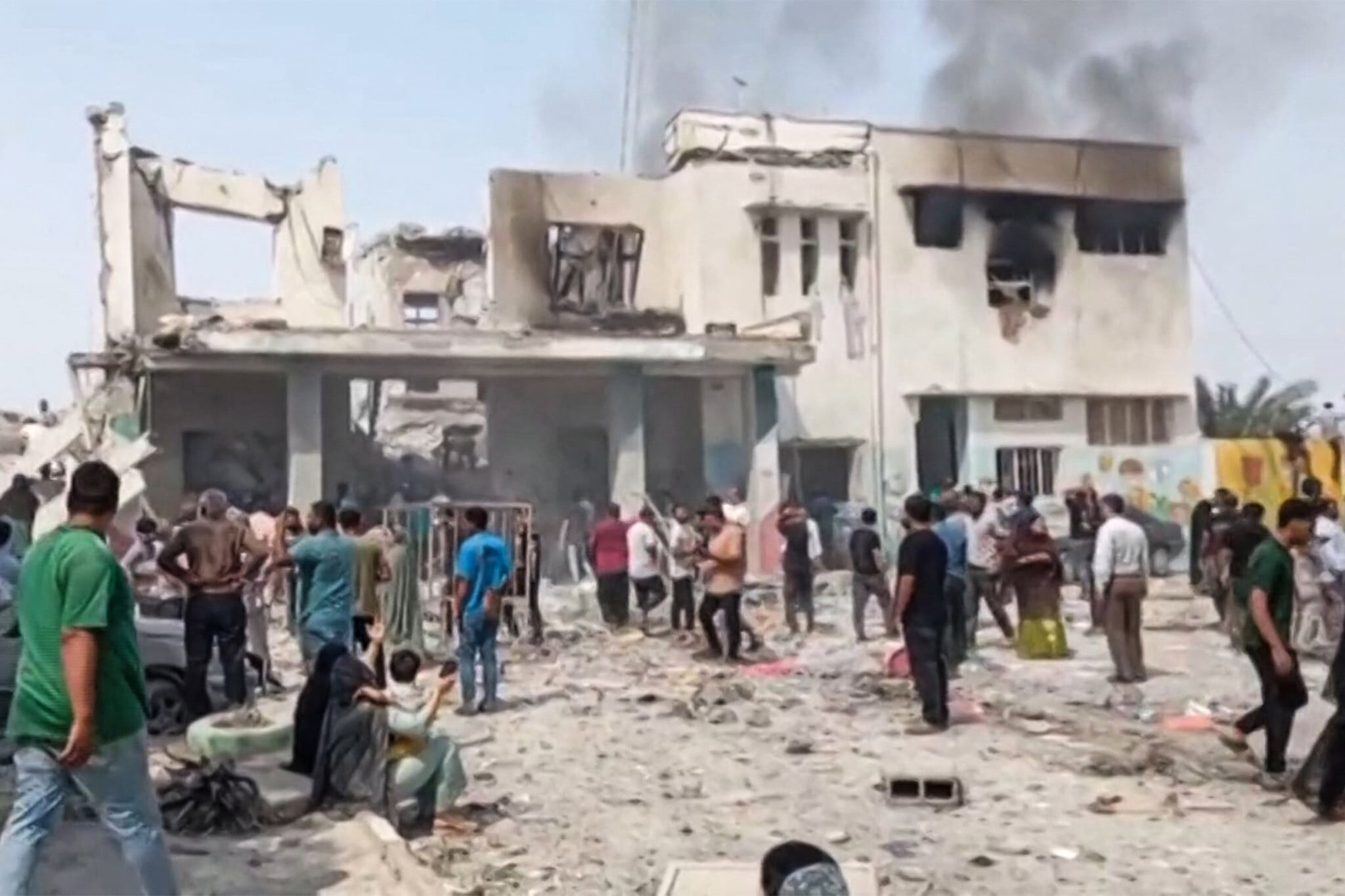
Image grab from Iranian state television broadcast on February 28, 2026, shows what it says is the site of deadly US and Israeli strikes that hit a girls' elementary school in Minab, in the southern Iranian province of Hormozgan near the strategic sea route of the Strait of Hormuz. (IRIB TV/AFP)
Republican US Senator John Kennedy apologizes for what he says was a US strike on a school in Iran that reportedly killed over 160 people.
“It was terrible. We made a mistake,” Kennedy tells reporters on Capitol Hill.
“Other countries do that sort of thing intentionally, like Russia. We would never do that intentionally. I think the [Defense] Department is investigating it now, and I’m sorry. I’m just so sorry it happened,” he says.
Kennedy is the first Republican lawmaker to acknowledge American culpability in the strike that killed scores of civilians on the first day of the Iran war.
While the Pentagon has said it’s still investigating the matter, initial findings have reportedly pointed to the US as responsible for the strike.
Footage indicated that an American-made Tomahawk missile was used, though US President Donald Trump suggested yesterday, without proof, that Iran or Israel may have been responsible for firing it.
Germany jails man for supplying Hezbollah with drone equipment
A German court jails a 35-year-old man for supplying the Lebanese Hezbollah terror group with equipment for drones.
The Lebanese man, previously named as Fadel Z., is convicted of offenses including “membership of a foreign terrorist organization” and being “an accomplice to attempted murder.”
The court in the city of Celle sentences him to six years and four months in prison.
It finds that Fadel Z. joined Hezbollah at some point after July 2016.
It says that by 2022, he had organized exports of “militarily useful goods” to the tune of 500,000 euros ($580,000) in order to help Hezbollah’s drone program.
The components he delivered included material for more than 300 explosive drones.
The man was arrested in summer 2024.
The court notes that he was “born in a Hezbollah stronghold in Lebanon and was brought up with the ideology of the terror organization.”
Prosecutors had demanded a jail sentence of nine years, but the court decides on a lower term, partly because Fadel Z. admitted some of the offenses and thereby sped up the trial.
Hezbollah’s military wing is classed as a terrorist organization by the United States, the European Union and Britain.
Germany considers Hezbollah a Shiite terrorist organization, and in 2020 banned Hezbollah from carrying out activities on its soil.
Times of Israel staff contributed to this report.
Online antisemitism in Switzerland spiked in 2025, as real-world incidents decline 20%
Real-world antisemitic incidents in Switzerland fell by nearly 20% in 2025. Still, online hate speech surged by more than a third as the Middle East conflict continued to fuel tensions, according to a new report by an umbrella organization of the country’s Jews.
The annual report by the Swiss Federation of Jewish Communities (SIG) and the GRA Foundation Against Racism and Antisemitism records 177 real-world incidents across Switzerland, a decrease from 221 incidents in 2024. However, the frequency of physical and verbal harassment remains three times higher than levels recorded before Hamas launched its war against Israel on October 7, 2023.
While physical acts dipped, digital antisemitism spiked 37% to 2,185 cases, the survey shows. Researchers identified Telegram as the primary platform for this surge, accounting for 1,445 incidents. Conspiracy theories represented 42% of online hate, often utilizing code words like “Khazars” to delegitimize Jewish history and Israel’s right to exist.
The report highlights a “constant strain” on the Jewish community over the last two years. Many Swiss Jews have begun avoiding religious symbols in public or staying away from certain social spaces to avoid hostility, it notes.
SIG President Ralph Friedländer and GRA President Zsolt Balkanyi-Guery warn that the normalization of antisemitism poses a threat to the country’s democratic foundations, and call on the Swiss government to finalize an action plan for its National Strategy Against Racism and Antisemitism to combat the rising trend.
“It is up to civil society to take a firm stand against such a development,” the report says.
In lessons from last war, Hezbollah returns to guerrilla roots, avoids communication devices, awaits Israeli invasion
Lebanon’s Hezbollah is applying lessons from its last war with Israel as it braces for a possible full-scale Israeli invasion and protracted conflict, returning to its roots in guerrilla warfare in south Lebanon, four Lebanese sources say.
Operating in small units, fighters from the Iran-backed terror group are avoiding the use of communication devices that could be at risk of Israeli tapping, and are rationing the use of key anti-tank rockets as they engage Israeli troops, say the sources, who are familiar with Hezbollah military activities.
While Israel plans for the likely continuation of its Lebanon offensive after the Iran war, the four sources say Hezbollah’s calculations are based on Iran’s clerical leadership surviving the war, leading to a regional ceasefire of which it would be part.
In 2024, not only did Israel booby-trap hundreds of pagers used by Hezbollah, but it also penetrated the group’s private phone network, according to Lebanese officials familiar with Hezbollah’s post-war investigation into breaches.
The sources say Hezbollah is avoiding any devices that could be susceptible to eavesdropping.
Two of the Lebanese sources say four deputies have been appointed for every Hezbollah commander, to ensure continued operations.
The sources say much of Hezbollah’s fighting on the ground had been focused so far near the town of Khiyam, near the intersection of Lebanon’s border with Israel and Syria.
This is one area where Hezbollah believes any Israeli land invasion could begin.
Reuters reported last week that Hezbollah’s elite Radwan fighters, who withdrew from the south following the 2024 ceasefire, had returned to the area.
The sources decline to be named due to the sensitivity of the matter.
Hezbollah’s media office doesn’t immediately respond to a request for comment.
An Israeli security source says there is no sign that Hezbollah is looking to de-escalate — quite the opposite. While Israel has eliminated a few of Hezbollah’s very senior commanders, it seems that the group is managing to stabilize its ranks and make and execute decisions.
Minister demands AG hand over Netanyahu pardon materials, accuses her of unnecessary delays to process

Heritage Minister Amichay Eliyahu during a meeting at the Knesset in Jerusalem, on July 7, 2025. (Yonatan Sindel/Flash90)
Heritage Minister Amichay Eliyahu demands that Attorney General Gali Baharav-Miara provide his office with all relevant information regarding the Justice Ministry Pardons Department’s opinion on Prime Minister Benjamin Netanyahu’s request for a pardon in his corruption trial.
Eliyahu’s demand comes after Justice Minister Yariv Levin’s decision yesterday to delegate the authorities he has within the pardon process to Eliyahu, due to Levin’s potential conflict of interest. This possibility arises from his longtime close association with Netanyahu, the fact that Levin testified in Netanyahu’s trial, and that he is a senior member of the prime minister’s Likud party.
The justice minister does not have influence over the position drawn up by the Pardons Department, but the department is nevertheless under his authority and the minister is entitled to receive and review the material produced by the department for the pardon request, and is also the official who transmits the legal position paper produced by the department for the pardon request to the president’s office.
Eliyahu complains in his letter that Baharav-Miara has delayed passing him the legal position paper drafted by the Pardons Department, although given that Levin only delegated his authorities to the heritage minister yesterday, the nature of the grievance is not immediately clear. Eliyahu’s office does not immediately respond to a request for comment.
“The government’s mandate and the public mandate given to me require me to examine the issue seriously and professionally and without further delay,” Eliyahu tells Baharav-Miara, and says that the delays he accuses her of “cast a heavy shadow on the position of officials in the Attorney General’s Office in the issue under discussion.”
Baharav-Miara’s office declines to comment on Eliyahu’s allegations.
Sa’ar says Israel not seeking ‘endless war’ with Iran; German FM says Tehran ‘not ready’ for diplomacy
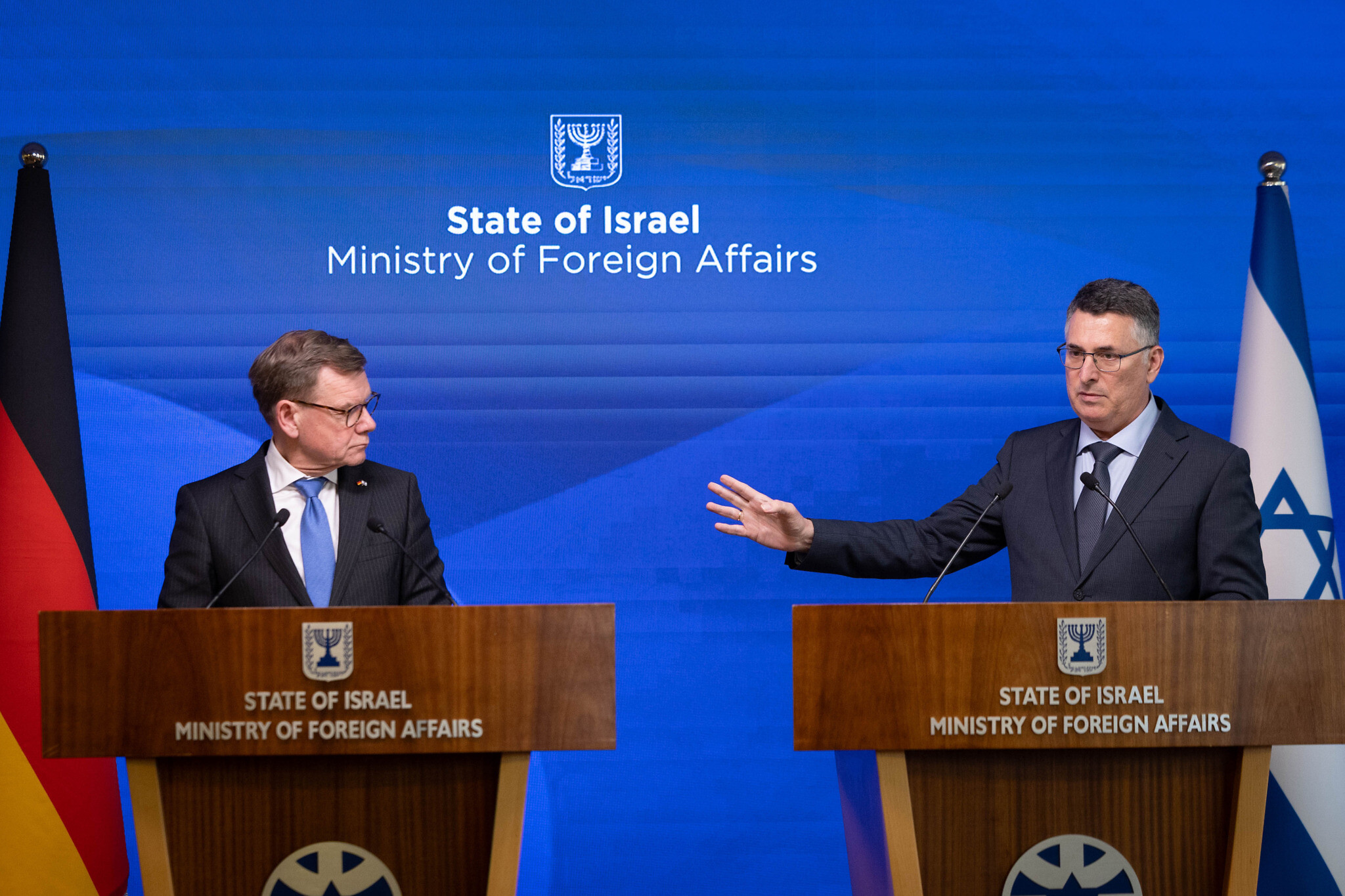
FILE: Foreign Minister Gideon Sa'ar, right, speaks during a joint press conference with his German counterpart Johann Wadephul in Jerusalem, March 10, 2026. (AP Photo/Oren Ben Hakoon)
Foreign Minister Gideon Sa’ar says that Israel is not seeking an “endless war” in Iran and will coordinate with the United States on when to stop their ongoing joint bombing campaign against the Islamic Republic, during a Jerusalem press conference alongside German Foreign Minister Johann Wadephul.
While Sa’ar declines to give the operation a clear timeline, he says in response to a question that “in due time, we will consult with our American friends when we think it is the right time to [end the conflict.] We are not looking for an endless war.”
He says Israel’s goals are “to remove for the long term existential threats from Iran to Israel,” adding that “it is hard to see [this happening] with the current regime.”
Referring to Iran’s newly selected supreme leader, Mojtaba Khamenei, whose father and predecessor, Ali Khamenei, was assassinated in the US-Israeli campaign, Sa’ar says “the new Khamenei is no less extremist than the previous.”
He reiterates remarks from Israeli officials that “regime change can also happen after the campaign. But it’s important to create the conditions for a change in Iran, for the people of Iran to be able to regain their freedom.”
“We must not miss this opportunity with partial results. So we will continue until the minute that we and our partners think it is appropriate to stop,” Sa’ar says.
Addressing international criticism of the campaign, Sa’ar says that “all those that called during [recent] days for ‘de-escalation’ are ensuring escalation for the people of Iran and for the Middle East and beyond, decades forward.”
Sa’ar reiterates his call for “countries to take the next moral step and cut all diplomatic ties with this terror regime.”
Wadephul, who is the first foreign leader to hold a diplomatic visit to Israel since the start of the campaign, says that while Germany hopes for a diplomatic solution to the conflict — and while Jerusalem and Washington “are ready for a diplomatic solution” — he doesn’t see the same being true for Iran.
He points to Iran’s attacks on the region and continued use of proxy terror groups, saying: “For now, this is what we hear from Tehran; they are not ready for a diplomatic solution. And as long as this is not the case, we still have to wait.”
Witkoff says he and Kushner may visit Israel next week, says ‘almost all’ Iranian enrichment abilities destroyed

US Special Envoy to the Middle East Steve Witkoff speaks during a meeting of the Cabinet in the Cabinet Room of the White House on January 29, 2026, in Washington, DC. (WIN MCNAMEE / GETTY IMAGES NORTH AMERICA / Getty Images via AFP)
US special envoy Steve Witkoff says he and Jared Kushner may visit Israel next week, while clarifying that this is not finalized yet.
He denies in a CNBC interview that the visit initially planned for this week was canceled due to anger over Israel’s targeting of Iranian oil production sites.
He says the visit is aimed at coordinating with Israel on Iran.
“We’ll probably make that trip next week, but we’re not sure about it as of now,” Witkoff says.
Asked if Israel’s end goals for the war are the same as Washington’s — given that Jerusalem has been more insistent on the need for regime change — Witkoff insists that they are.
“Israel is a one bomb country. One bomb takes them out,” he says, without elaborating.
Witkoff says Iran has not shown interest in returning to negotiations since the US and Israel launched the war on February 28.
“I’m sure the president would be open to it, but right now, peace through strength matters. People like the Iranians only understand one thing — a bad alternative if they don’t do as the president has asked them to do,” he claims.
He says Iran has created an “offensive missile shield” to protect its nuclear program and is wreaking havoc across the region, losing all of its allies in the process by targeting them since the war’s outbreak.
Witkoff is pressed on the US justification for the war after it claimed to have obliterated Iran’s nuclear program last year.
He responds that the US has “destroyed almost all of their enrichment capability and conversion capability” — an apparent acknowledgement that Iran’s program had not, in fact, been completely obliterated.
He points out that Iran has barred UN monitors from accessing their nuclear sites since the US and Israeli strikes on Iran last year. “If everything was just for civil purposes, as they said, why would they not allow observers into their country? They won’t allow them in because there are bad things going on there.”
He also notes that Iran has 460 kilograms of uranium enriched to 60% — a level not needed “unless you’re pursuing a weapon.”
“They could easily have taken the 60% enriched material and made a dirty bomb out of it,” Witkoff says. However, this would ostensibly require sites that the US claims it completely obliterated last year.
As for reports that Russia is sharing intelligence with Iran against the US, Witkoff says Moscow has denied this.
“Let’s hope that they’re not sharing… We can take them at their word,” he says.
IDF says it destroyed most main assets of Iran’s internal security forces and Basij in western Ilam Province
The Israeli military says it has destroyed “most of the central assets” of Iran’s internal security forces and Basij paramilitary force in the Ilam Province of western Iran.
In the past week, the IDF says it ramped up strikes on the Iranian internal security forces and Basij in several areas of Iran, and the province where most damage was caused is Ilam.
The military says that Iran’s internal security forces and Basij in the Ilam Province “carried out numerous terror plans and, among other things, conducted brutal repression during the internal protests in Iran in December–January.”
In the Ilam Province, the IDF says it destroyed a main headquarters of the internal security forces; a headquarters of Iran’s Intelligence Ministry; a headquarters of the IRGC, responsible for protest suppression; a headquarters of the special forces unit of the internal security forces; several Basij headquarters; and IRGC infrastructure “used to strengthen the regime’s control and governance in the province.”
‘This land belongs to the Jews’: Residents say IDF has told 5 West Bank Palestinian hamlets to leave
Jordan Valley Brigade commander Col. Gilad Shriki visited five Palestinian communities in the northern Jordan Valley on Sunday, telling residents they should leave the area because a fence will soon be built, making it difficult for them to live there, residents tell The Times of Israel.
The commander visited the communities of Farisiya, Hammamat al Maleh, Ein al-Hilweh, Samra and Makhoul, where several dozen families live in total.
A resident of one of the communities, who has asked to remain anonymous for security reasons, tells The Times of Israel that Shriki arrived with about five soldiers and an Arabic-speaking officer, a Druze man who introduced himself as a member of the Civil Administration. Shriki introduced himself, after which the Arabic-speaking officer said: “It would be better if you went to Tammun and Tubas” — cities in Palestinian Authority-ruled territory in the northern West Bank. “I told him: my identity is here. He told me, ‘Take your ID and go.’ He said: This is Area C, this land belongs to the Jews.”
A second resident, who lives in a different community, tells The Times of Israel that a similar visit took place at his home that same day by the brigade commander accompanied by an Arabic-speaking officer. “He [the Arabic-speaking officer] told me, ‘We will build a fence up there,'” referring to a fence that would separate the communities’ lands from areas under Palestinian Authority control, he says.
“‘You won’t be able to stay here when we build the fence. It’s better that you leave than that we demolish your house,'” he quotes the officer as having said. “He spoke to me alone. My family was afraid to come out [of the house]. This is the first time something like this has happened,” he adds.
A resident of a third community tells The Times of Israel that during the meeting, the brigade commander spoke in Hebrew and the Arabic-speaking officer translated his remarks. “He said, ‘What was before October 7 [2023] is not what will be after October 7. The land is yours, but you don’t have a permit to live here.’ He also said they would build a fence, and whoever is in Tubas will be in Tubas, and whoever is here will remain here.”
An Israeli activist from the group Jordan Valley Activists, who also asks not to be named, tells The Times of Israel that during the visit to the community where he accompanies residents, the brigade commander told him the place was expected to be demolished soon and that the residents had no future there. “He told me, ‘Listen, it’s done for them. I don’t see a future for this place. The Civil Administration will demolish it within the next year. That’s what I told them [the residents] as well.’ He was very polite — he conducted a polite demoralization tour.”
According to Jordan Valley Activists, 22 such communities in the northern Jordan Valley have left their dwellings over the past two years amid settler violence.
The Civil Administration has not responded to a request for comment.
An IDF spokesperson confirms the visit by the officer, saying it was aimed at “providing the communities with a sense of security and emphasizing that the IDF is responsible for the security of all residents in the area.”
The commander “clarified that the IDF is working to eliminate incidents of friction from both sides, and that such incidents will not pass without a response,” the statement says, adding: “It was also clarified that in order to graze sheep and cattle in firing zones, this must be done in coordination with relevant authorities.”
The statement adds that the officer said enforcement measures are being advanced for illegally built structures in the area.
March 8, 2026 Morning
—
"This is Area C, a military area, so you have to get out of here."
"But we've been here for 50 years."
"It's better for you to leave than for us to expel you."This conversation took place yesterday, between Col. Gilad Shriki, commander of the Valley… pic.twitter.com/QdU3q8cgl6
— Jordan Valley Activists نشطاء غور الأردن (@JVActivists) March 9, 2026
Footage shows Hezbollah missile impact yesterday at European firm’s satellite station near Beit Shemesh
A dashcam video shows yesterday’s Hezbollah missile impact at a satellite station near Beit Shemesh.
The impact caused damage to the infrastructure at the site and injured two people, according to rescue services.
The IDF says an “isolated failure” resulted in the missile impacting without being intercepted and without warning sirens sounding in the area.
Hezbollah claimed the satellite station belongs to the “Communications and Cyber Defense Division of the Israeli enemy army,” although the site is in fact not a military installation, but rather a civilian-commercial site operated by the European company SES.
This dashcam video shows a Hezbollah missile striking the SES Satellite Station in Haela Valley near Beit Shemesh, March 9, 2026. (Social media; used in accordance with Clause 27a of the Copyright Law)
Trump administration estimates cost of Iran war’s first two days at $5.6 billion, source says
US President Donald Trump’s administration has said it used $5.6 billion in munitions during the first two days of strikes against Iran in a report provided to US congressional committees, a source familiar with the information says.
Members of Congress, who may soon have to approve additional funding for the war, have expressed concern that the conflict will deplete US military stocks at a time when the defense industry is already struggling to keep up with demand.
Trump met executives from seven defense contractors on Friday as the Pentagon worked to replenish supplies.
The administration has not provided a public assessment of the cost of the conflict it launched on February 28, along with its ally Israel.
Members of Congress have clamored for more information, including public testimony from officials about issues such as how the conflict might affect the US military’s readiness to defend the country.
Several congressional aides have said they expect the White House to soon submit a request to Congress for additional funding for the war. Some officials have said the request could be for $50 billion, but others have said that estimate seems low.
Tehran says 4 Iranian diplomats killed in Israeli attack in Lebanon on Sunday
Four Iranian diplomats were killed in Lebanon on Sunday in an Israeli attack, Iranian state media says, citing Iran’s UN Ambassador Amir Saeid Iravani.
US Navy has escorted an oil tanker through Strait of Hormuz, US energy secretary says
US Secretary of Energy Chris Wright says the US Navy has successfully escorted an oil tanker through the Strait of Hormuz “to ensure oil remains flowing to global markets.”
Damascus accuses Hezbollah of firing artillery at Syrian army positions across the border
The Syrian military accuses Lebanese terror group Hezbollah of launching shells toward Syrian army positions near the border town of Serghaya, state-run news agency SANA reports.
The Syrian military says in a statement that “appropriate options are being studied to do what is necessary” and the army “will not tolerate any aggression targeting Syria.”
Lebanese President Joseph Aoun later says that he spoke with Syrian interim President Ahmad al-Sharaa and agreed that the countries need to coordinate “to control the borders and prevent any security breaches.”
Hezbollah has claimed to be clashing with Israeli troops in Serghaya, which the IDF has denied.
In a statement, the terror group denies firing on Syrian troops and says: “We have no intent of opening a [second] front while we are engaged with the Israelis.”
Suspected drone infiltration sirens sound in north, as IDF says Hezbollah intensifying its fire
Sirens warning of a suspected drone infiltration from Lebanon sound in the Galilee Panhandle area.
At the same time, during a press statement, IDF Spokesman Brig. Gen. Effie Defrin says the military has identified that Hezbollah has been attempting to increase its rate of fire on Israel.
Herzog: If Hezbollah keeps up hostilities, it ‘doesn’t understand what awaits it’
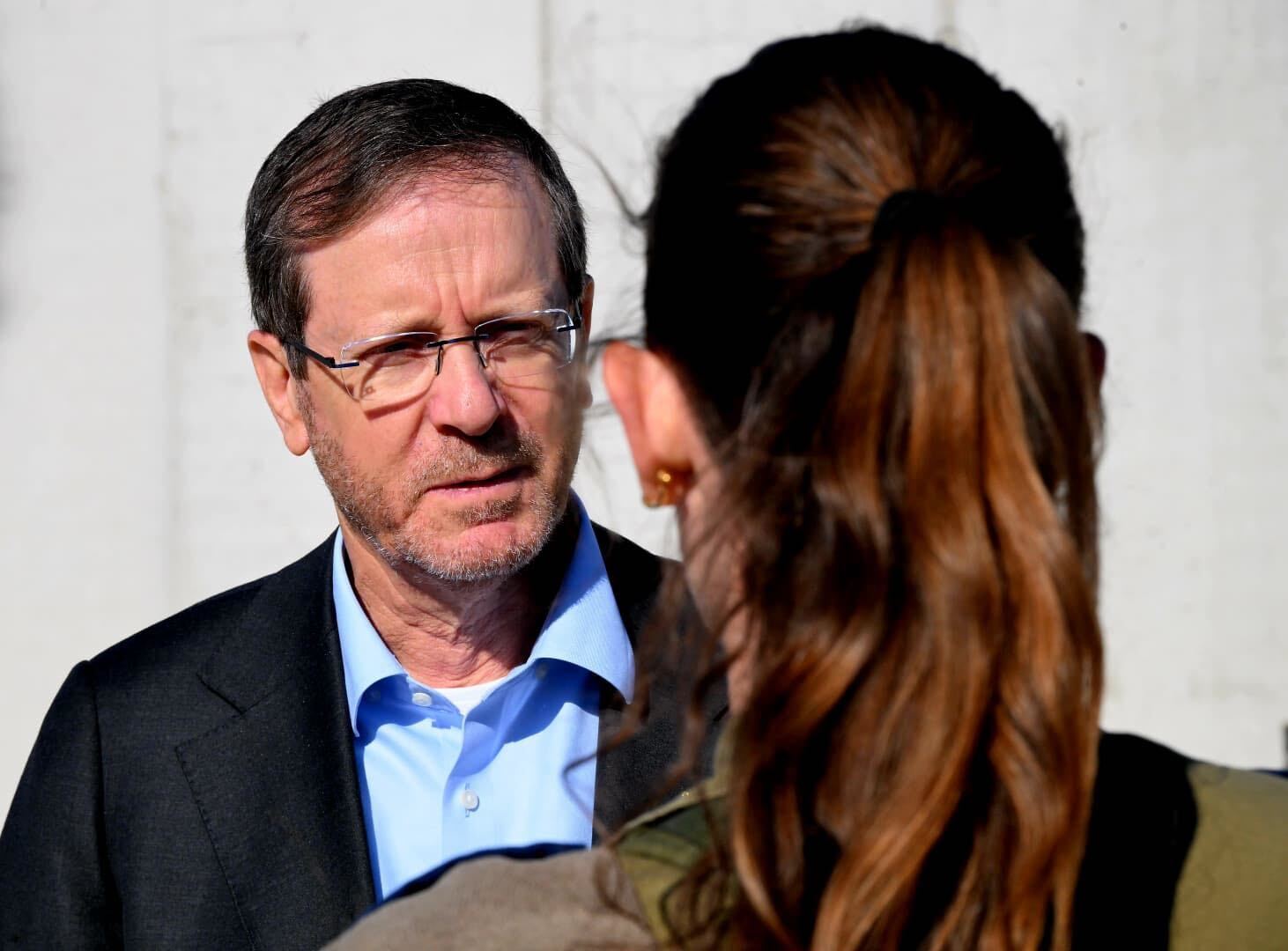
President Isaac Herzog, left, visits an air defense battery along Israel's border with Lebanon, March 10, 2026. (Haim Zach/GPO)
Israel is set on destroying Hezbollah, President Isaac Herzog says during a visit to an air defense battery along Israel’s border with Lebanon.
“If Hezbollah even thinks about continuing to harass or threaten, it simply does not understand what awaits it,” warns Herzog. “It certainly does not understand that Israel is determined to dismantle it once and for all.”
The military deployed troops deeper in southern Lebanon after Hezbollah began attacking Israel last week, saying it aims to “establish a forward defense that will create an additional security layer for the residents of the north.”
Hezbollah has kept up its fire on northern Israel, launching frequent barrages of dozens of rockets.
US House speaker says Iran war is ‘limited in scope,’ mission is ‘nearly completed’
US House Speaker Mike Johnson says the operation in Iran is “by design limited in scope and mission.” He also tells reporters in Florida that he thinks the mission “is being achieved.”
“It’s nearly completed,” the Republican says.
He characterizes rising US gas prices as a “temporary blip” that will come down in “a couple of weeks.”
International Energy Agency holds emergency meeting on securing oil supplies
International Energy Agency (IEA) chief Fatih Birol convenes the agency’s 30 member states for talks to assess the security of oil supplies and “inform a subsequent decision on whether to make emergency stocks of IEA countries available,” now that the situation in the Middle East “is creating significant and growing risks” for the oil market.
IEA member countries, including the US, currently hold over 1.2 billion barrels of public emergency oil stocks. The IEA hosted a meeting at its Paris headquarters earlier in the day with G7 energy ministers.
Residents of Tehran report some of the heaviest airstrikes of the current war last night
Residents of Tehran report some of the heaviest airstrikes of the current war, saying extensive strikes have led to electricity cuts in many neighborhoods.
One resident of the western part of the capital says his neighborhood was shaking for half an hour because of strikes around midnight last night. Another resident says he didn’t think he would survive the night.
A 27-year-old mother of a toddler says she witnessed what she says was a residential building get hit. She and others reached by The Associated Press speak on condition of anonymity to prevent reprisals.
Iranian media claims civilians were the main casualties in the overnight strikes. Those claims cannot be independently confirmed.
Another Iranian missile attack detected; sirens expected in central Israel
The IDF says it has detected a ballistic missile launch from Iran.
Sirens are expected to sound in central Israel in the coming minutes.
IDF confirms it killed Hezbollah regional commander on Sunday, airs footage of strike
The IDF confirms killing a Hezbollah regional division commander on Sunday night, publishing footage of the airstrike.
The killing of Hassan Salameh, also known as Abu Hussein Ra’ab, was first announced by Defense Minister Israel Katz on Monday.
Salameh headed Hezbollah’s Nasr Unit, one of three regional divisions in southern Lebanon. It is responsible for the region between Mount Dov and Bint Jbeil.
The IDF says Salameh was targeted by the Israeli Air Force in the southern Lebanon town of Jouaiyya.
According to the military, Salameh has served in several roles in Hezbollah over the years, and he assumed command of the Nasr Unit after his predecessor, Taleb Abdullah, was killed in June 2024.
בתקיפה לילית מדויקת בדרום לבנון: צה"ל מאשר כי חוסל מפקד יחידת 'נאצר' בארגון הטרור חיזבאללה
שלשום (א') חיל האוויר תקף, בהכוונת אמ"ן ופיקוד הצפון במרחב ג'ויא וחיסל את חסן סלאמה, מפקד יחידת 'נאצר' בארגון הטרור חיזבאללה.
סלאמה נכנס לתפקיד מפקד היחידה לאחר חיסול קודמו בתפקיד, אבו… pic.twitter.com/b9AEYmn5Az
— צבא ההגנה לישראל (@idfonline) March 10, 2026
Ukraine sending anti-drone experts to Mideast; US said to have rejected related deal with Kyiv last year
Three fully equipped teams of anti-drone experts will arrive this week in Qatar, the United Arab Emirates and Saudi Arabia, Ukrainian President Volodymyr Zelensky tells journalists.
Answering a follow-up question, Zelensky’s communications adviser says an expert team is also being sent to a US base in Jordan. An official in the president’s office confirms that these are military personnel.
Zelensky does not elaborate on the teams’ makeup or exact mission.
Last week, he said the US and its allies in the Middle East were seeking Ukraine’s expertise in countering Iran’s Shahed drones.
Russia has fired tens of thousands of Shaheds at Ukraine since it invaded its neighbor just over four years ago.
Meanwhile, Axios reports that Washington last year rejected a deal proposed by Kyiv to sell systems that have successfully dealt with Iran’s attack drones. Last week, the US reversed course, after being hit harder than expected by such drones, the report adds.
No injuries reported in latest Iranian missile attack
No injuries are reported in Iran’s latest ballistic missile attack on Israel, the fifth today.
Sirens had sounded across central Israel and parts of the West Bank.
One missile struck an open area, according to initial military assessments.
US energy secretary deletes post about Navy escorting vessel through Strait of Hormuz
US Secretary of Energy Chris Wright deletes a post on X that had said the US Navy successfully escorted an oil tanker through the Strait of Hormuz “to ensure oil remains flowing to global markets.”
It is unclear why Wright deleted the post.
Oil prices tumbled after the announcement, with Brent oil futures down 15% to $84.09 a barrel.
Hezbollah targets Kiryat Shmona area with rockets
Sirens sound in the northern border city of Kiryat Shmona and nearby towns amid a rocket attack from Lebanon.
There are no immediate reports of injuries.
Hezbollah has targeted the area with numerous rocket barrages since hostilities escalated earlier this month.
US official now says military has not escorted any ships through Strait of Hormuz
The US military has not escorted any ships through the Strait of Hormuz so far, a US official tells Reuters, after US Energy Secretary Chris Wright posted and deleted a tweet that had said the Navy had escorted an oil tanker through the strait.
Iran has also denied the claim.
As many as 150 US troops wounded so far in Iran war, sources say
As many as 150 US troops have been wounded so far in the war with Iran, two people familiar with the matter tell Reuters.
The figure is far higher than previously disclosed.
The Pentagon does not immediately comment.
US seeing signs that Iran is preparing to deploy mines in Strait of Hormuz — report
US intelligence has started seeing indications that Iran is taking steps to deploy mines in the Strait of Hormuz, CBS News reports in a post on X.
UN Security Council to hold an emergency meeting on Lebanon fighting
Humanitarian chief Tom Fletcher will brief the Security Council at an emergency meeting tomorrow morning, UN spokesman Stephane Dujarric says.
France calls for the meeting with support from the council’s other European members, the United Kingdom, Denmark, Greece and Latvia. Paris expresses deep concern about escalating violence in Lebanon and condemns Hezbollah’s attacks on Israel since March 1.
France’s Foreign Ministry urges Hezbollah “to end its operations and hand over its weapons” and on Israel “to refrain from any land-based or long-term interventions in Lebanon.”
Pentagon says 140 US service members have been wounded since the start of the Iran war
The Pentagon says that about 140 US service members have been wounded in the 10 days of conflict with Iran.
“The vast majority of these injuries have been minor, and 108 service members have already returned to duty,” Pentagon spokesman Sean Parnell says in an emailed statement.
Eight US service members are currently “severely injured,” Parnell adds.
The new figure is the first insight into the broader toll of injuries that have been sustained by US troops in the wake of a barrage of retaliatory rocket and drone strikes from Iran that have also claimed the lives of seven soldiers in Kuwait and Saudi Arabia.
Report: Trump administration has asked Israel not to strike more Iranian oil facilities
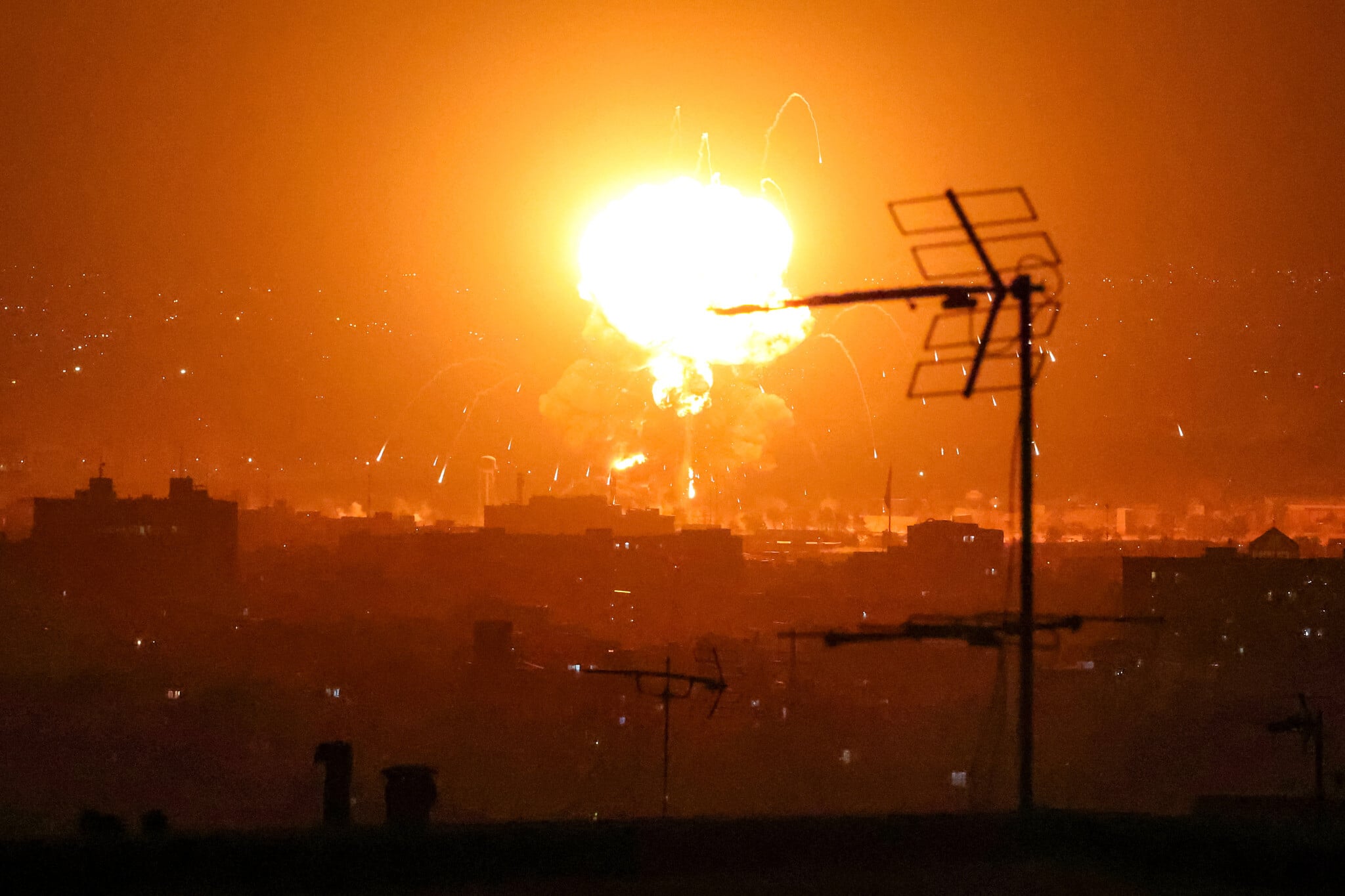
Flames rise from an oil storage facility south of the capital Tehran as strikes hit the city during the US–Israel military campaign, Iran, March 7, 2026. (Photo by ATTA KENARE / AFP)
US President Donald Trump’s administration asked Israel yesterday not to strike additional oil or energy facilities in Iran, according to a report by Channel 12 news, following earlier reports that the White House is unhappy with Israel’s recent strike on oil facilities in Tehran.
Washington’s message was conveyed to Israel’s senior political leadership as well as to IDF Chief of Staff Lt. Gen. Eyal Zamir, according to the network, which cites three sources familiar with the details.
According to the sources, the administration outlined three main reasons for the request.
First, officials reportedly argued that attacks on energy infrastructure ultimately harm the Iranian public, a large portion of whom oppose the Iranian regime and support the campaign against it — potentially pushing Iranians to rally behind their leadership.
Iran’s environmental authorities urged the population to remain indoors to avoid respiratory problems and other health consequences following the Israeli strike.
Second, the administration was said to explain that Trump hopes to cooperate with a potential future Iranian government in the oil sector after the war. Following the US capture of Venezuelan President Nicolas Maduro last month, Trump’s administration took steps to secure and tap Venezuela’s oil reserves.
The third reason is said to be that the American officials fear that an Iranian response to strikes on oil facilities could include large-scale strikes on oil and energy infrastructure across the Gulf, potentially triggering an economic crisis.
A source tells Channel 12 that Trump views strikes on Iran’s energy and oil facilities as a “doomsday option” only to be used if Iran first attacks Gulf oil facilities.
Iran has fired some 300 missiles at Israel in current war, with rate steadily slowing
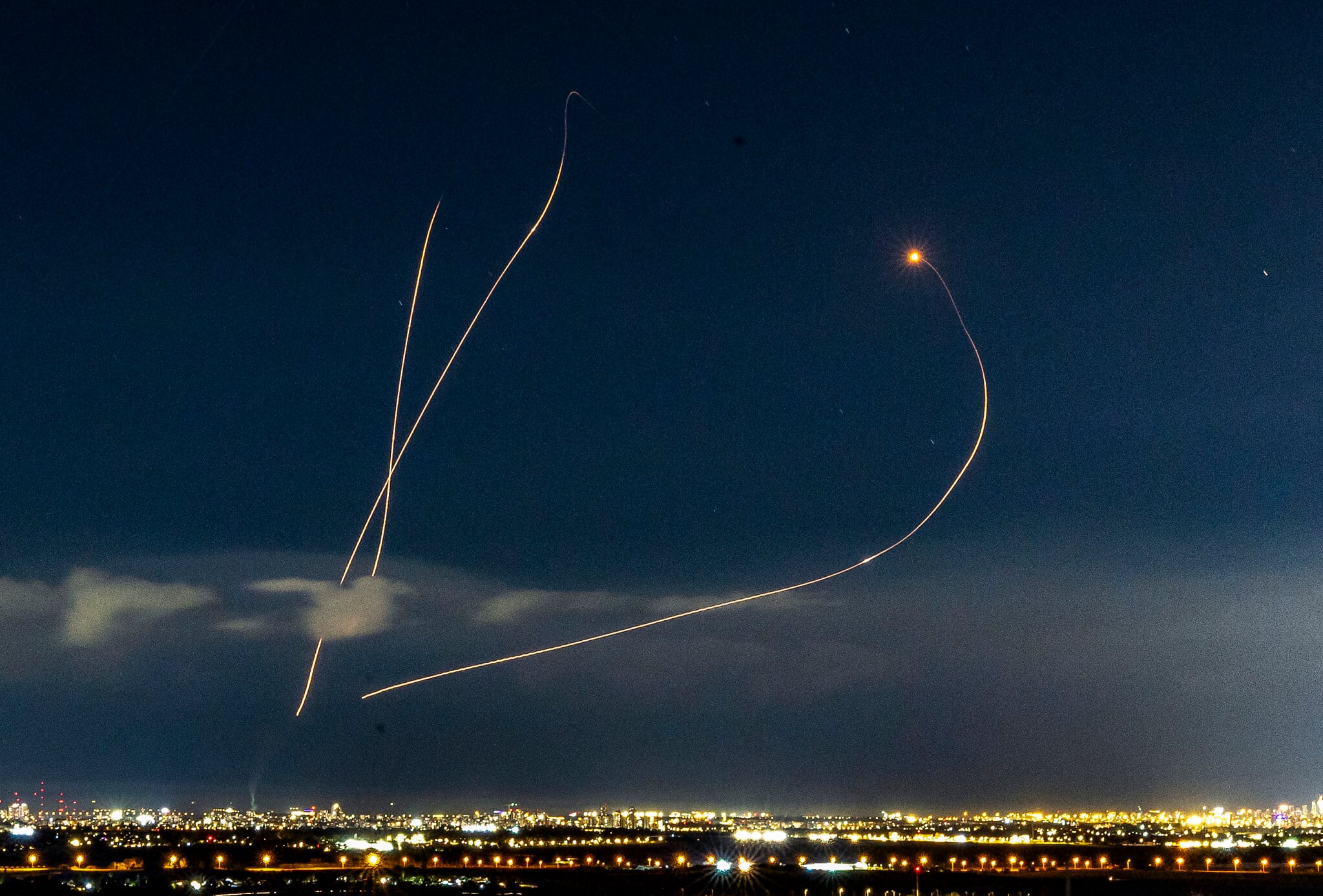
An Israeli missile defense system fires interceptors at missiles fired from Iran, as seen over central Israel, March 9, 2026. (Yossi Aloni/Flash90)
Iran has launched some 300 ballistic missiles at Israel since the war began, with the rate steadily slowing over the days.
On the first day of the war, February 28, after Israel and the US launched strikes against Iran, some 90 ballistic missiles were fired toward Israel. The following day, the number dropped to around 60.
Over the following six days, roughly 20 missiles were fired each day in multiple salvos, each consisting of a small number of projectiles.
On Sunday and Monday, fewer than 20 missiles were launched on each day, also in small salvos or single missiles.
Iran has launched hundreds more ballistic missiles at other countries in the Middle East during the conflict.
The IDF reports that it has so far destroyed or disabled more than 300 Iranian ballistic missile launchers — about 65% of Iran’s total stockpile.
Iran was estimated to have a stockpile of around 2,500 ballistic missiles at the start of the war. It is unclear how many it still possesses at this time.
Meanwhile, hundreds of rockets have been launched by Hezbollah from Lebanon during the conflict, though not all of them have crossed the border into Israel.
White House says US moving to dismantle Iran’s missile infrastructure
White House press secretary Karoline Leavitt speaks with reporters in the James Brady Press Briefing Room at the White House, March 10, 2026, in Washington. (AP Photo/Alex Brandon)
White House press secretary Karoline Leavitt says that after destroying over 50 Iranian naval vessels and deeming the Islamic Republic’s navy “combat ineffective,” the US is moving to dismantle Iran’s missile infrastructure.
US B2 bunker buster bombers recently dropped dozens of 2,000 lb penetrator explosives on deeply buried missile sites, Leavitt says during a press briefing that opens with her largely reviewing previously stated accomplishments in the Iran war.
She says the stated objectives of the war remain: destroying Iran’s missile program, ensuring Iran never obtains a nuclear weapon, and ensuring that Tehran’s proxies can no longer destabilize the region. Leavitt later adds the destruction of Iran’s navy as another war aim — one previously stated by US officials.
Leavitt says Washington anticipated that Iran would try and disrupt global markets in response to attacks and offered political risk insurance to tankers in the Gulf, waived certain oil sanctions and has offered US Navy escort to tankers when necessary. She notes that this has not yet happened, contrary to what Energy Secretary Chris Wright asserted in a since-deleted X post.
“The US military is drawing up additional options following the president’s directive to continue keeping the Strait of Hormuz open. I will not broadcast what those actions look like, but just know the president is not afraid to use them,” Leavitt adds.
She insists that recent increases in oil and gas prices are only temporary and that Americans will see them drop back down once the war’s objectives are met.
Leavitt recalls that the initial timeline for the operation was four to six weeks, while noting that the US believes things are moving ahead of schedule.
New drone infiltration alerts sound in north
Fresh sirens warning of a suspected drone infiltration from Lebanon sound in the Galilee Panhandle area.
The alerts are activated in Kiryat Shmona and surrounding towns.
Hezbollah has launched dozens of drones at Israel since hostilities escalated earlier this month.
The IDF has said the terror group will likely attempt to increase its rate of fire.
IDF says it hit various Iranian command centers in Tehran and Tabriz today
During a wave of strikes earlier today, the Israeli Air Force struck several key Iranian regime headquarters in Tehran and Tabriz, the military says.
According to the IDF, Iranian soldiers and security personnel were gathered at the headquarters when the strikes were conducted.
The IDF says the targets include: a headquarters of Iran’s special forces; an IRGC compound; a headquarters of a security unit responsible for ballistic missile fire; a headquarters of Iran’s Security Police agency; and a Basij compound.
“The headquarters and compounds were struck while soldiers of the Iranian terror regime were operating inside them to advance terror activities against the State of Israel and other countries in the Middle East,” the military says.
The IDF says the strikes are part of a new stage of the war aimed at “deepening the blow to the core arrays of the Iranian terror regime and its foundations.”
בתקיפה משולבת בטהרן ובתבריז במקביל: צה"ל תקף מפקדות מרכזיות כשבתוכן חיילים של גופי הביטחון במשטר הטרור האיראני
צה"ל ממשיך להעמיק את הפגיעה בכלל מערכיו ויכולותיו של משטר הטרור האיראני.
במהלך גל תקיפה משולב שהושלם מוקדם יותר היום (ג') בטהרן ובתבריז במקביל, חיל האוויר בהכוונת אמ"ן… pic.twitter.com/QRRJJvhMIr
— צבא ההגנה לישראל (@idfonline) March 10, 2026
Smotrich, Netanyahu say Haredi draft exemption law shelved to boost defense budget by tens of billions
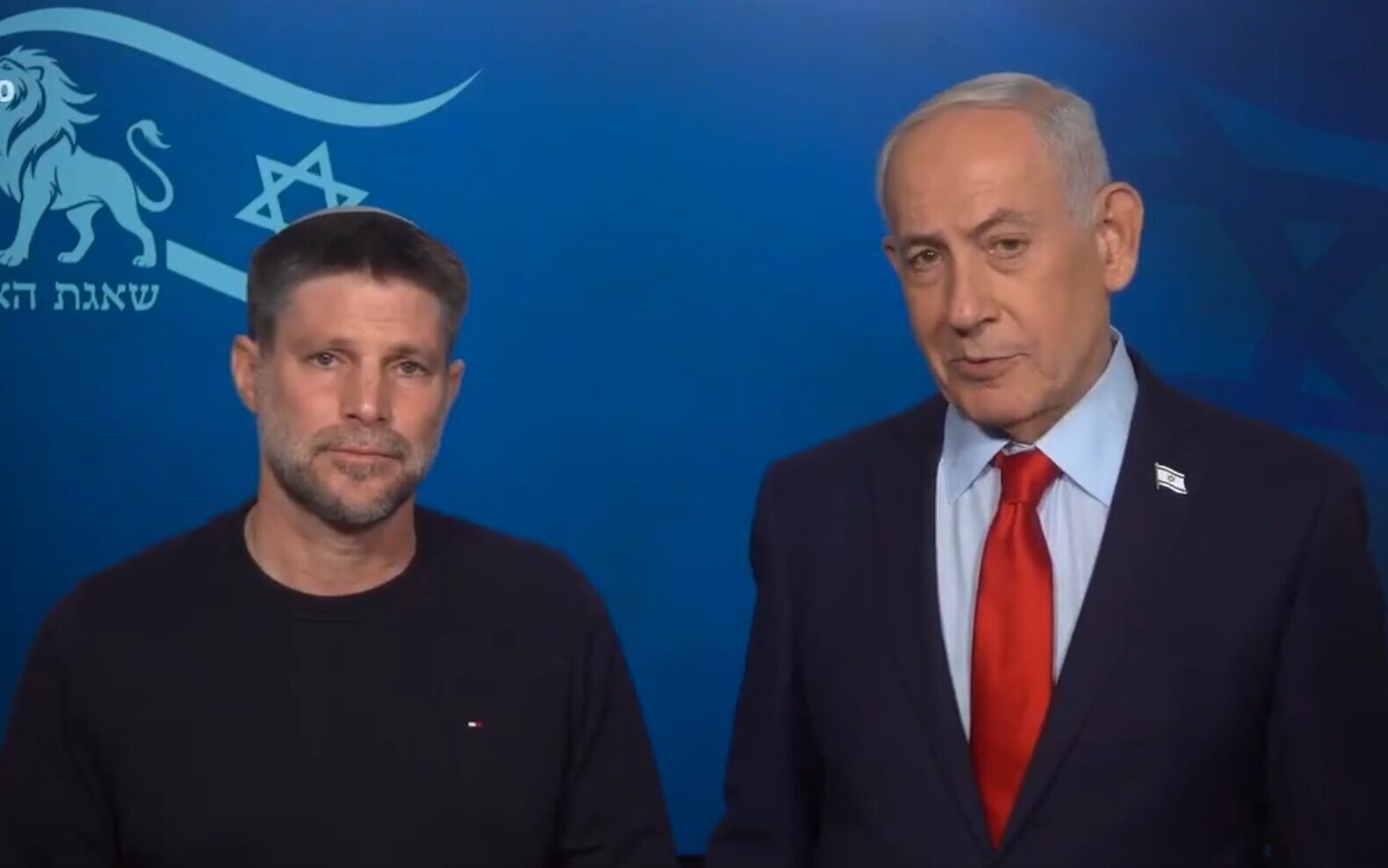
Prime Minister Benjamin Netanyahu, right, and Finance Minister Bezalel Smotrich issue a joint statement from Jerusalem, March 10, 2026. (Screenshot/GPO)
Finance Minister Bezalel Smotrich announces that the ultra-Orthodox draft exemption law being advanced by the coalition, as well as unspecified parts of his economic reform agenda, will be temporarily shelved as the government works to pass the 2026 state budget as quickly as possible in order to pour billions of shekels into defense amid the ongoing war with Iran.
In a joint statement with Smotrich, Prime Minister Benjamin Netanyahu declares that while Israel dismantled Iran’s “nuclear and ballistic capabilities” during last summer’s war and is now “acting with increased force” to destroy its remaining capabilities, such an operation costs tens of billions of shekels, requiring a “special” state budget to support the war effort.
According to Channel 12, the defense budget is set to be increased by NIS 28 billion ($9 billion) on top of the NIS 112 billion ($34 billion) for defense listed in the version of the state budget which passed its first of three readings in the Knesset in January.
According to the Kan public broadcaster, the increased defense spending will be made possible by freeing up funds via a broad 3% cut to ministerial budgets.
Israel must massively increase the defense budget in order “to destroy the Iranian axis of evil,” and, such as, “we are now putting aside controversial issues that are not suitable for wartime,” such as legislation exempting yeshiva students from military service as well as “several reforms around which we have not yet reached a broad consensus,” says Smotrich.
Netanyahu recently stated that the passage of the draft exemption bill will have to wait until after the state budget is approved.
Smotrich does not list which of his proposed economic reforms will be shelved, though his spokesman told The Times of Israel earlier this evening that his dairy sector reform has been removed from the 2026 Arrangements Law, a critical piece of legislation whose passage is needed in order to adopt the 2026 state budget.
Smotrich has also been pushing to lower VAT on imports, open up competition in the banking sector, and impose an NIS 30 ($10) tax on e-cigarettes, among other proposals.
Continuing his comments, Smotrich states that he and Netanyahu had “wanted to bring more good news to the citizens of Israel in this budget, with an emphasis on the struggle against the cost of living,” but the “responsibility resting on our shoulders requires us to focus on passing the budget immediately for the security of the state and the welfare of its residents.”
“Passing the budget immediately will allow us, with God’s help, to win the war, provide good services to the citizens of Israel in many fields, establish a new regional order in the Middle East centered on the State of Israel as a regional and global power, and put the State of Israel on a path of accelerated growth, development and prosperity in the coming years,” he says.
Smotrich does not discuss any measures to assist citizens hit hard by the war.
The joint statement comes only hours after the government voted to approve over NIS 5 billion ($1.6 billion) in discretionary coalition funds for Haredi institutions, West Bank settlements and other party priorities in the 2026 state budget, drawing harsh condemnations from opposition politicians who claimed the allocations constituted a subsidy for draft evasion.
Not expecting Iran to cry uncle, Trump will determine when Iran has ‘unconditionally surrendered’ — White House
While US President Donald Trump is calling for Iran to “unconditionally surrender,” he does not expect Tehran to publicly make such an announcement, White House press secretary Karoline Leavitt says.
“What the president means [by ‘unconditional surrender’] is that Iran’s threats will no longer be backed by a ballistic missile arsenal that protects them from building a nuclear bomb,” Leavitt explains during a press briefing. “President Trump will determine when Iran is in a place of unconditional surrender when they no longer pose a credible and direct threat to the United States of America and our allies.”
Pushed to explain what Trump has described as a “feeling” that led him to conclude Iran was going to preemptively attack the US before Washington and Jerusalem struck first, Leavitt asserts it was a “feeling based on facts.”
She points to the three rounds of nuclear talks held last month during which Iran “lied” to the US, while trying to maintain the ability to build a nuclear bomb — something Tehran has long denied. Leavitt also highlights Iran’s rapid increase in its missile program, claiming the effort was motivated by a desire to shield Iran’s nuclear program from attack.
Trump “was not going to sit back and allow the Iranian regime to threaten or to attack the United States of America any longer,” Leavitt adds.
Israeli ministers, security officials reportedly say Iranian regime collapse could take a year, amid ‘fog’ over war’s length
Government ministers have said, following a security briefing, that the fall of Iran’s regime could take up to a year, even as the ongoing US-Israeli campaign against Iran is expected to end sooner, the Kan public broadcaster reports, citing ministers present at the briefing and Israeli officials.
“After [the campaign ends], the work will be up to the Iranian people,” ministers tell the network, while Israeli security officials add that “there is real fog regarding the duration of the attack in Iran,” since it is “difficult to decipher” the intentions of US President Donald Trump.
The officials add that conditions are not yet ripe for the Iranian public to take to the streets, and that Israeli and US airstrikes are expected to continue in the coming week.
Israeli officials also acknowledge to Channel 13 – apparently referring to the same briefing – that there is no certainty Iran’s regime will fall, and that no signal has been received from Trump indicating when the fighting will end.
The officials say that for now, Israel’s strategy is to maintain sustained military pressure until the Iranian people can overthrow their rulers.
“Our role is to continue striking the oppressors,” one official tells Channel 13, “until the public rises up.”
Shooting near Baltimore synagogue not connected to Jewish community, security group says
A US Jewish security group says that a shooting today near a synagogue in Baltimore appears unrelated to the Jewish community.
The shooting, near the Agudath Israel of Baltimore synagogue, had raised some alarm bells in the Jewish community. Jewish security officials have urged vigilance due to potential attacks related to the Iran war.
The Secure Community Network says the shooting appears to be a domestic incident, though.
“There are no indications that the Jewish community was the target, and there is no known active threat to the community,” the group says.
IDF strikes Hamas rocket launcher in northern Gaza, citing ceasefire violation
The IDF says it struck a Hamas rocket launcher in the northern Gaza Strip earlier today.
According to the military, the launch site in Gaza City’s Sabra neighborhood had previously been used in attacks on Israel.
“Restoring the site to operation constitutes a violation of the ceasefire agreement,” the military says.
It publishes footage of the strike.
מוקדם יותר היום, הותקף אתר שיגור ובו משגר רקטות במרחב צברה שבעיר עזה. האתר שימש את ארגון הטרור חמאס לירי רקטות לעבר שטח מדינת ישראל: pic.twitter.com/waG028wsi3
— Israeli Air Force (@IAFsite) March 10, 2026
Trump threatens Iran with consequences ‘at a level never seen before’ amid reports of mines being placed in Strait of Hormuz
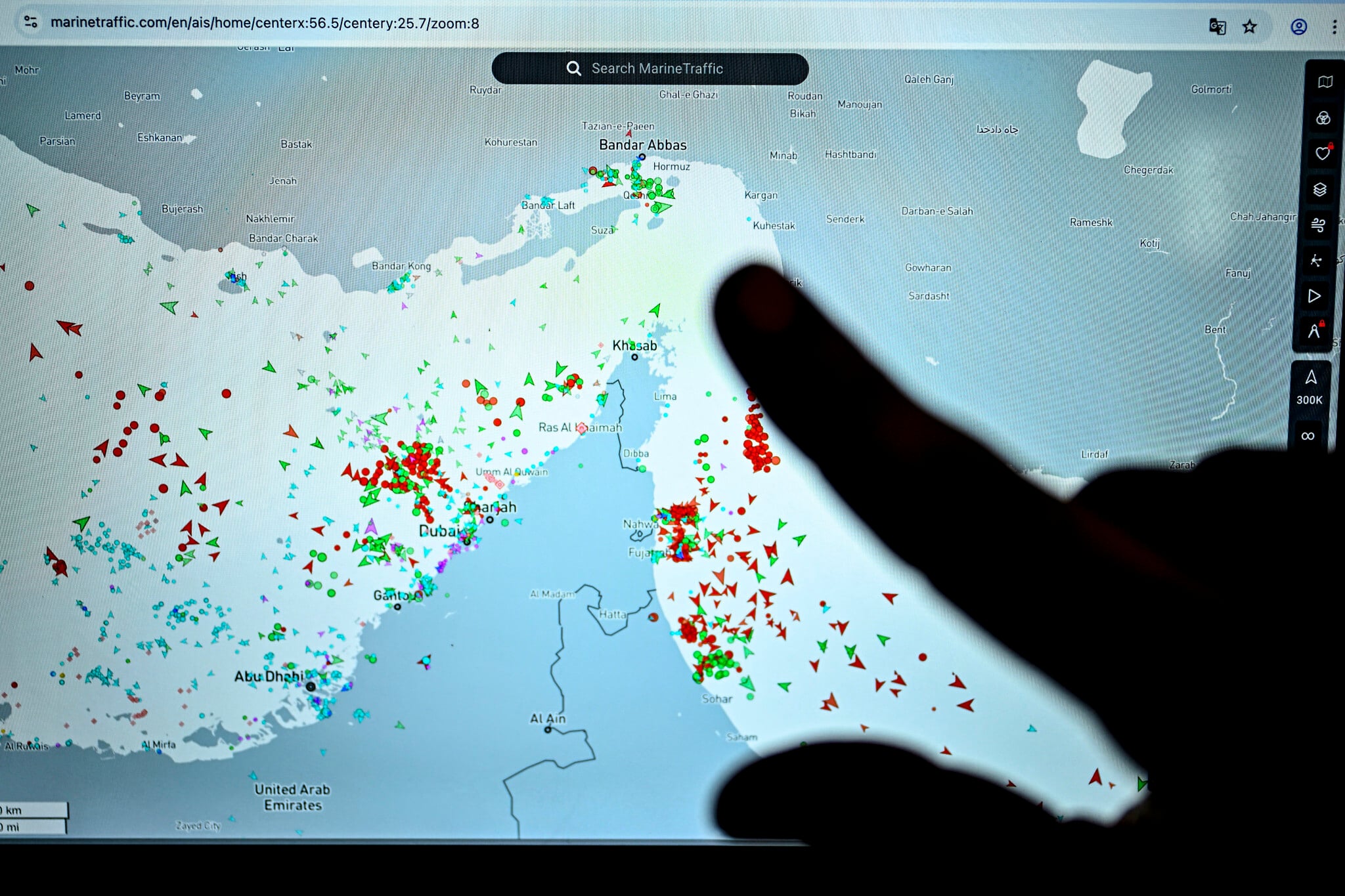
A person points at a page on the Marinetraffic website that shows commercial boats traffic on the edge of the Strait of Hormuz near the Iranian coast, in Paris on March 4, 2026. (JULIEN DE ROSA / AFP)
US President Donald Trump issues a somewhat confusing new threat to Iran, demanding that it immediately remove any mines that it may have placed in the Strait of Hormuz.
“If Iran has put out any mines in the Hormuz Strait, and we have no reports of them doing so, we want them removed, IMMEDIATELY!” Trump writes on Truth Social.
It’s unclear if the word “no” was a typo, given that the post was made following several American media reports today claiming that US intelligence has started seeing indications that Iran is taking steps to deploy mines in the Strait of Hormuz.
“If for any reason mines were placed, and they are not removed forthwith, the military consequences to Iran will be at a level never seen before,” Trump says.
“If, on the other hand, they remove what may have been placed, it will be a giant step in the right direction!” he adds.
Trump later deletes the post and republishes it several minutes later with a new line at the end.
“We are using the same technology and missile capabilities deployed against drug traffickers to permanently eliminate any boat or ship attempting to mine the Hormuz Strait,” he writes.
Netanyahu to Iranian people: Coming days will bring opportunity to free yourselves, be ready
Prime Minister Benjamin Netanyahu tells the Iranian people that Israel will soon “create the conditions” for them to “grasp your destiny.”
“People of Iran,” he writes in English on the Prime Minister of Israel X account. “We are waging a historic war for liberty. This is a once in a lifetime opportunity for you to remove the Ayatollah regime and gain your freedom.”
“Together with the United States, we are hitting the Tyrants of Teheran harder than ever,” writes Netanyahu, promising that “we will continue to hit with growing force the tyrants who terrorized you for decades.”
Netanyahu says that “in the coming days we will create the conditions for you to grasp your destiny.”
“When the time is right, and that time is fast approaching, we will pass the torch to you,” he writes.
“Be ready to seize the moment!”
Trump says US has destroyed 10 inactive mine-laying vessels in Strait of Hormuz
US President Donald Trump declares that within the last few hours, the American military has “hit and completely destroyed 10 inactive mine laying boats and/or ships, with more to follow!”
He publishes the news on his Truth Social account moments after an earlier post in which he said that the US has not received any reports of Iran laying such mines in the Strait of Hormuz, while threatening Tehran if it were to take such actions.
Herzog defends strikes on Iran oil sites, says war needs ‘end result,’ not exact timetable
President Isaac Herzog does not offer a timetable on when the war with Iran could end, telling Germany’s Bild newspaper: “We need to take a deep breath and get to the end result.”
Herzog said the US and Israeli attacks on Iran are changing the whole configuration of the Middle East. He defends strikes on Iranian oil sites as a way of taking away money from Tehran’s “war machine.”
Foreign Minister Gideon Sa’ar earlier said Israel is not planning for an endless war and is consulting with Washington about when to stop it.
“The Iranians are the ones spreading chaos and terror throughout the region and the world. So I think if we measure everything by a speedometer, we won’t get anywhere. We need to take a deep breath and get to the end result,” Herzog tells Bild.
Eliminating the Iranian threat would “enable the entire system in the region to suddenly breathe again and develop further. That’s fantastic,” he adds.
UN Security Council to vote tomorrow on demanding Iran stop attacking its Arab neighbors — sources
A United Nations Security Council draft resolution, obtained by The Associated Press, condemns Iran’s attacks on Bahrain, Kuwait, Oman, Qatar, Saudi Arabia, the United Arab Emirates and Jordan. The measure calls for an immediate end to all strikes and threats against neighboring states, including through proxies.
A vote has been scheduled for tomorrow afternoon, three diplomats say, speaking on condition of anonymity ahead of an official announcement.
The draft, sponsored by Gulf Cooperation Council members, would be the first Security Council resolution considered since Israel and the United States launched airstrikes on Iran and Tehran responded with attacks against Israel and across the region.
‘We won big’: Lapid, Bennett celebrate shelving of Haredi draft exemption law
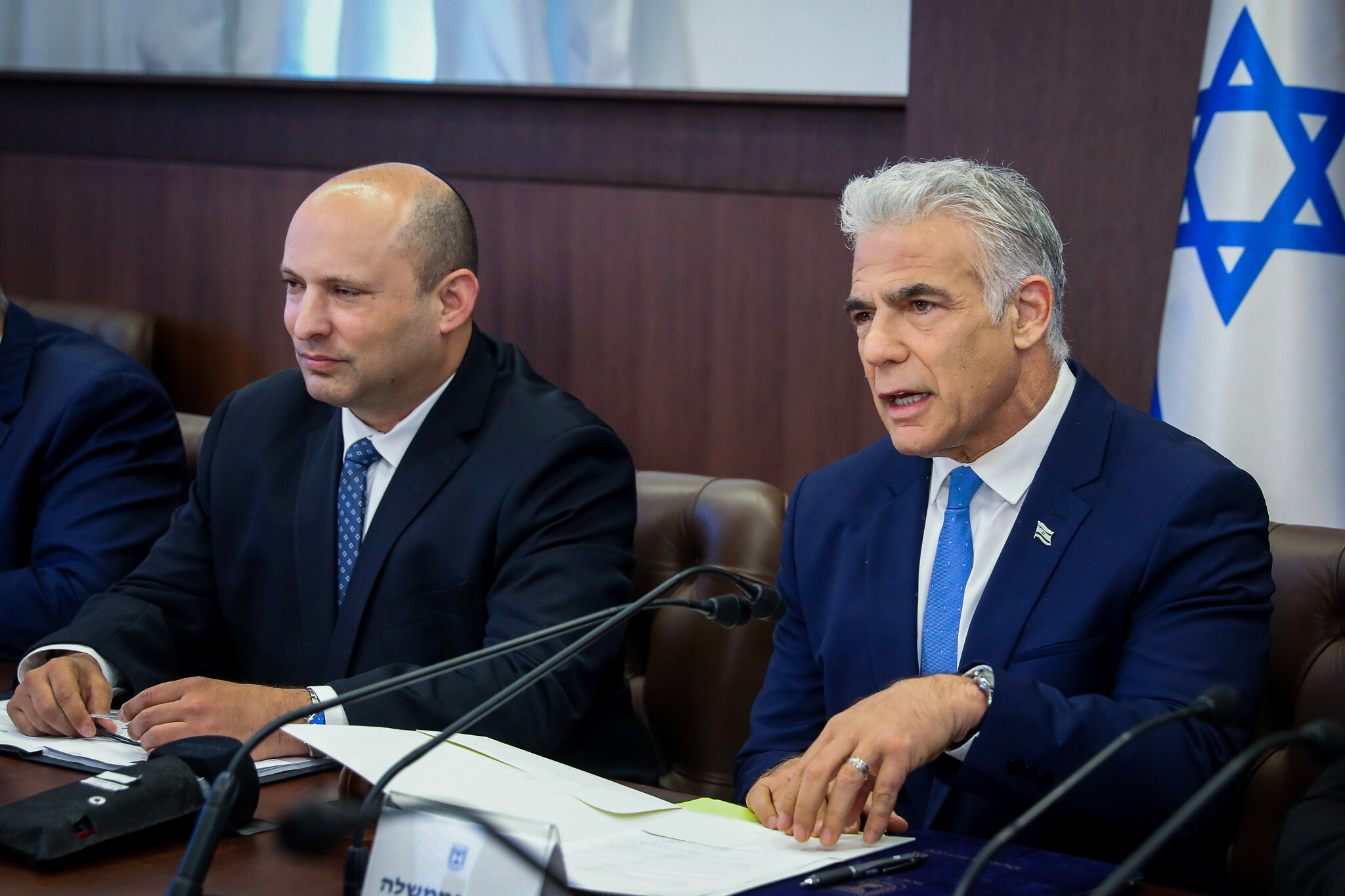
Prime Minister Yair Lapid (right) and alternate prime minister Naftali Bennett at a cabinet meeting at the Prime Minister's Office in Jerusalem on July 31, 2022. (Marc Israel Sellem/Pool)
Opposition party heads declare victory after Prime Minister Benjamin Netanyahu and Finance Minister Bezalel Smotrich announced that the ultra-Orthodox draft exemption law being advanced by the coalition will be temporarily shelved as the government works to pass the 2026 state budget as fast as possible in order to pour billions of shekels into defense, amid the ongoing war with Iran.
“When the debates on the despicable draft evasion law that Netanyahu tried to promote began, I declared that I guarantee that the law will not pass,” says Opposition Leader Yair Lapid. “For many months, we thwarted every possibility of advancing the law in the Knesset,” and “tonight, Netanyahu and Smotrich admitted what we have long said: the despicable law has failed,” he claims.
“We won, we won big,” says former prime minister Naftali Bennett in a video message. “After two years of determined struggle by the reservist organizations, by the entire people of Israel, against the law that I defined as ‘the most anti-Zionist law in the history of Israel,’ we won,” and now “everyone understands that everyone must serve together.”
“The people of Israel: one. The Netanyahu government and the Haredim: zero,” he declares.
For the past year and a half, the Haredi leadership has pushed for a law keeping its constituency out of the Israel Defense Forces, after the High Court ruled that decades-long blanket exemptions from army duty traditionally afforded to full-time Haredi yeshiva students were illegal.
Some 80,000 ultra-Orthodox men aged between 18 and 24 are currently believed to be eligible for military service, but have not enlisted. During the course of the war in Gaza, the IDF repeatedly told lawmakers that it lacked 12,000 troops due to the strain of the conflict and other military challenges. Despite that conflict being halted, the military maintains that it is still short of regular service troops.
The current version of the bill, which would ostensibly increase military conscription among members of the Haredi community but ultimately enshrines continued exemptions for full-time yeshiva students, has been come under fire from the IDF brass, the attorney general, and a wide array of other critics, who have objected to it on the grounds that it is full of loopholes, preserves inequality in the mandatory draft, and will not increase Haredi enlistment amid what the military says is a manpower shortage.
Speaking with Channel 14 last week, Netanyahu stated that the budget would pass before the conscription bill. He told the pro-government network that “we are working on that in a serious manner.”
Iran parliament speaker says ‘we aren’t seeking a ceasefire’
Iran is not seeking a ceasefire in the war against the United States and Israel, Iran’s parliament speaker says, adding that the “aggressor” should be punished.
“Certainly we aren’t seeking a ceasefire,” Mohammad Bagher Ghalibaf, a former top commander in Iran’s Revolutionary Guards and key figure after the killing of former supreme leader Ayatollah Ali Khamenei, writes in an English-language X post.
“We believe the aggressor must be punished and taught a lesson that will deter them from attacking Iran again,” he adds.
IDF says it’s striking Iranian regime targets in Tehran
The Israeli Air Force has launched a new wave of airstrikes in Tehran, the IDF announces.
The military says the strikes are targeting Iranian regime infrastructure sites.
Israel said to reject Lebanon’s request for cessation in fighting to allow for talks
Israel has rejected diplomatic overtures by Lebanon to halt its escalating offensive against the Hezbollah terror group, demanding negotiations only take place “under fire,” the Financial Times reports, citing three people with knowledge of the matter.
The talks have not materialized because of disagreements over sequencing, with Beirut demanding there be a “cessation of fire” before any meeting takes place and the Israeli government wanting only to discuss the possibility of a cessation, the newspaper says.
US Energy Department blames staffer for inaccurate social media post on oil tanker escort
A spokesperson says the video clip posted by US Energy Secretary Chris Wright was deleted from his official X account after it was determined that it was incorrectly captioned by department staff.
The post, which claimed that the US Navy had helped an oil tanker through the Strait of Hormuz, was quickly taken down.
Spokesperson Ben Dietderich says the secretary and other officials are “closely monitoring the situation” in the strait, a key access point for oil and natural gas shipments in the Middle East. The US military is considering additional options to keep it open, “including the potential for our Navy to escort tankers,” Dietderich says.
The prospect of military escorts could help reduce price pressures created by the war.
Fresh Iranian missile salvo triggers sirens in central Israel
The IDF says it has detected a new ballistic missile launch from Iran.
Sirens subsequently sound in central Israel and the northern West Bank.
Single missile from Iran intercepted, IDF assesses; no injuries reported
No injuries or direct impacts are reported in Iran’s latest ballistic missile attack on Israel, the sixth today.
It consisted of one missile, which was likely intercepted, according to initial military assessments.
Sirens had sounded across central Israel and parts of the West Bank.
G7 leaders to hold video summit on Mideast war tomorrow
G7 leaders will hold a video conference tomorrow to discuss the economic consequences of the war in the Middle East, particularly the “energy situation,” the French presidency says.
“This will be the first discussion on these issues between G7 members. Economic coordination is a key issue for an effective and useful response to the situation,” the Elysee says. The meeting will start at 1400 GMT.
President Emmanuel Macron will chair the meeting, as France holds the G7 presidency this year.
US military says it destroyed 16 Iranian minelaying vessels Tuesday in Strait of Hormuz
The American military says it has destroyed 16 Iranian minelaying vessels near the Strait of Hormuz on Tuesday.
“US forces eliminated multiple Iranian naval vessels, March 10, including 16 minelayers near the Strait of Hormuz,” the US Central Command says on X, attaching a video showing some of the strikes.
Earlier, several American media reports claimed that US intelligence had started seeing indications that Iran is taking steps to deploy mines in the Strait of Hormuz.
Following the reports, US President Donald Trump said that the American military had destroyed “10 inactive mine laying boats and/or ships, with more to follow!”
U.S. forces eliminated multiple Iranian naval vessels, March 10, including 16 minelayers near the Strait of Hormuz. pic.twitter.com/371unKYiJs
— U.S. Central Command (@CENTCOM) March 10, 2026


read more: