Pompeo to travel to Israel, Saudi Arabia, Qatar in Mideast peace push
Outgoing US secretary unveils 7-nation tour beginning Friday, says talks will focus on ‘historic efforts to forge peace and cooperation throughout the Middle East’
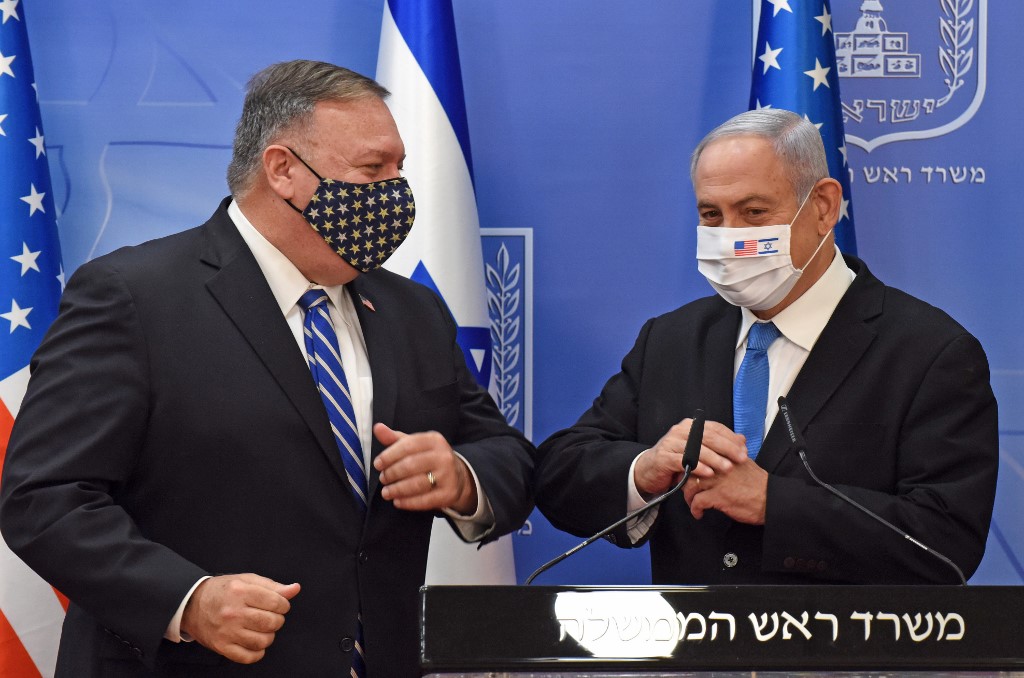
US Secretary of State Mike Pompeo (L) and Israeli Prime Minister Benjamin Netanyahu bump elbows, ahead of making a joint statement to the press after meeting in Jerusalem, on August 24, 2020. (DEBBIE HILL / POOL / AFP)
The Times of Israel liveblogged Tuesday’s developments as they unfolded.
Former Israeli and American peace negotiators are paying tribute to Saeb Erekat, the former top Palestinian official who died earlier today of COVID-19.
Tzipi Livni, a former Israeli foreign minister who negotiated with Erekat in the 2000s, says she is “saddened” by his death. In a tweet, she says he had texted her after falling ill, saying “I’m not finished with what I was born to do.” She offers her condolences, saying “he will be missed.”
Yossi Beilin, a former Israeli cabinet minister and peace negotiator, calls Erekat’s death “a big loss for those who believe in peace, both on the Palestinian side and the Israeli side.”
He says that Erekat had sent his own children to “Seeds of Peace,” a summer camp promoting coexistence between Israelis and Palestinians, and that after a flood in Jericho, he had been moved to see his daughter receive 23 emails from Israeli friends asking if she was OK.
“He said: ‘For me this is the whole story — if we care for each other and understand that we can be friendly,’” Beilin recalls.
Jason Greenblatt, in a tweet, acknowledges differences of opinion with Erekat as he sends condolences to his family.
My deep condolences to the family of Saeb Erekat. Saeb & I were worlds apart in our views of the Israeli-Palestinian conflict, it’s history & how to resolve it. But he tried hard to represent his people. Wishing his family much comfort /strength during this difficult time.
Ofir Sofer, a lawmaker for the religious right-wing Yamina party, says: “Saeb Erekat praised terrorists, advocated a boycott of the State of Israel and was even one of the promoters of the Jenin massacre blood libel. How can even half a good word be said about him?”
That was a reference to the fact that in 2002, Erekat was an influential propagator of a false report that the Israeli army had massacred 500 Palestinians in Jenin. In fact, in bitter fighting when the IDF entered the Jenin refugee camp, from which Palestinian suicide bombers were being dispatched to target Israelis, 50-55 Palestinians, most of them armed gunmen, and 23 Israeli soldiers were killed.
The false allegations disseminated by Erekat and his colleagues were given wide credibility and immense coverage in much of the international media.
Prime Minister Benjamin Netanyahu’s son Yair calls him a “terrorist who worked for the destruction of Israel,” slamming journalists who mourned him.
However, Likud lawmaker Tzachi Hanegbi tells Army Radio that he is “saddened” by the news and wished his family “know no more sorrow.”
The European Union’s foreign policy chief, Josep Borrell, mourns the death of Saeb Erekat from the coronavirus.
“It is with great sadness that I learned that Saeb Erekat, Secretary General of the PLO Executive Committee, passed away today,” he says in a statement. “His passing away represents a great loss for the Palestinian people and for the Middle East peace process.
“During his life Saeb Erekat tirelessly sought to fulfil the legitimate aspirations of his people. As a key participant to the negotiations for the Oslo Accords, he always advocated a just and lasting negotiated two state solution to the Israeli-Palestinian conflict. He personally contributed to developing close relations between the EU and Palestine. I am grateful to him for his contribution in this regard.
“I extend my heartfelt condolences to his family, to the Palestinian Liberation Organization and to the people of Palestine,” adds Borrell.
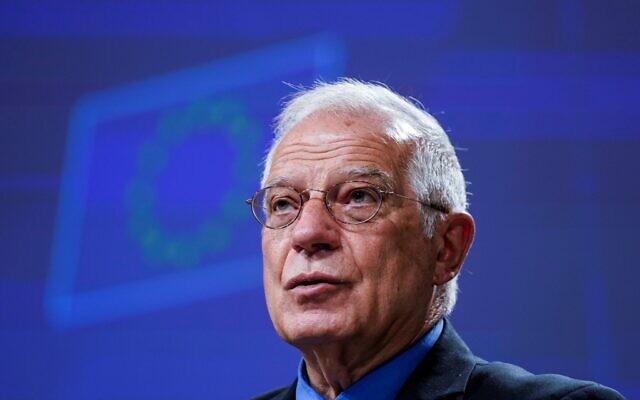
European Union foreign policy chief Josep Borrell addresses an online press conference following an EU-China Strategic Dialogue video meeting with senior Chinese representatives at EU headquarters in Brussels, June 9, 2020. (Kenzo Tribouillard, Pool Photo via AP)
International observers from the Organization of American States say they saw no instances of fraud or voting irregularities in the US presidential election.
The delegation included 28 experts and observers from 13 countries who observed the election process in in Georgia, Iowa, Maryland, Michigan and the District of Columbia. COVID-19 prevented a broader coalition of experts.
The OAS says the Election Day was peaceful, although there were efforts to intimidate poll workers as the votes were counted, and says the country’s mail-in ballots were a secure system.
The report says the OAS supports “the right of all contesting parties in an election, to seek redress before the competent legal authorities when they believe they have been wronged.”
“It is critical however, that candidates act responsibly by presenting and arguing legitimate claims before the courts, not unsubstantiated or harmful speculation in the public media,” the OAS says.
— AP
Demonstrators supporting a full ballot count gather outside the Philadelphia Convention Center three days after the US presidential election polls closed as they await tabulation results, November 6, 2020, in Philadelphia. (AP Photo/John Minchillo)
The Hezbollah member convicted of the 2005 assassination of former Lebanese premier Rafik Hariri should receive a life sentence, even though he remains at large, prosecutors say.
Salim Ayyash was found guilty in absentia of murder by a UN-backed Special Tribunal for Lebanon in the Netherlands on August 18, but three other alleged members of the Shiite terror movement were acquitted.
Hezbollah chief Hassan Nasrallah has refused to hand over the defendants in the trial over the suicide bombing that killed the Sunni billionaire politician and 21 other people.
Judges are hearing evidence from the prosecution, victims and the defense about what sentence 56-year-old Ayyash should receive. The sentencing itself will happen at a later date.
Vehicles burn following a bomb attack that targeted the motorcade of former prime minister Rafik Hariri, killing him and 22 others in Beirut, Lebanon, February 14, 2005. (AP Photo/File)
“The severest penalty available to the tribunal for the offenses is life imprisonment, and in the submission of the prosecution that is the only just and proportionate sentence,” prosecutor Nigel Provoas tells the court.
“Why life imprisonment? These were offenses of extreme gravity, it’s hard to imagine offenses of this type more serious than this. This is considered to be the most serious terrorist attack that has occurred on Lebanese soil.”
Prosecutors are also arguing for a seizure of Ayyash’s assets.
In their long-awaited ruling in August, judges said there was sufficient evidence to show that Ayyash was at the center of a network of mobile phone users who scoped out Hariri’s movements for months before his assassination.
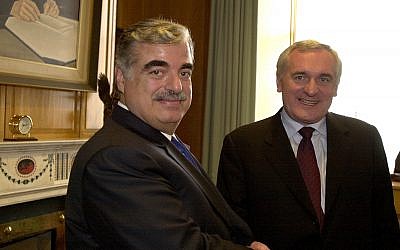
The Prime Minister of Lebanon Rafik Hariri, left, is greeted by Bertie Ahern, the Irish Prime Minister for talks at Government Buildings, Dublin, April 26, 2004. (AP photo/John Cogill)
But there was not enough evidence to convict Ayyash’s co-defendants Assad Sabra, Hussein Oneissi and Hassan Habib Merhi, they said.
The judges added that there was no proof tying Hezbollah’s leadership or its allies in Damascus to the attack.
Lebanon’s caretaker prime minister announces a fresh two-week lockdown to stem the spread of coronavirus despite a grinding economic crisis that has already battered businesses.
“We’ve reached a stage of critical danger as private and public hospitals don’t have the capacity to receive severe cases,” Hassan Diab says in a televised address.
He says the lockdown, with limited exemptions, would go into force from Saturday until November 30.
The outgoing premier, who stepped down in the wake of a devastating August 4 explosion at Beirut’s port, says some industries will be excluded from restrictions.
The health sector and other vital industries would also be allowed to operate, he says, without providing details.
The airport too will remain open, Lebanese media cited the Higher Defence Council as saying.
Lebanon, a country of six million people has recorded more than 95,000 Covid-19 cases, including 732 deaths since February.
The number of new cases soared last week with the daily virus tally hitting unprecedented highs several days in a row.
A first countrywide lockdown imposed in March was effective in stemming the spread of the virus, and restrictions were gradually lifted as summer beckoned people outdoors.
Iran’s judiciary announces that 157 prisoners convicted of security offenses have been pardoned as part of an amnesty granted by supreme leader Ayatollah Ali Khamenei.
In the latest amnesty, announced last week to mark the anniversary of the birth of the Prophet Mohammed, a total of 3,780 prisoners were pardoned or saw their sentences reduced, judiciary spokesman Gholamhossein Esmaili tells a news conference.
Those pardoned included “157 convicted of propaganda against the state, illegal gathering, collusion against national security, or participation in the riots,” Esmaili adds.
The last is a reference to repeated street protests that rocked Iran between 2017 and 2019 as the economy braced for, then reeled from, sweeping sanctions imposed by the administration of US President Donald Trump.
The Knesset is meeting to vote on Israel’s normalization deal with Bahrain.
Prime Minister Benjamin Netanyahu addresses the parliament ahead of a vote on the treaty.
He’s heckled by Joint List MK Samy Abu Shahadeh, who says the agreement doesn’t include the word normalization, “because they’re embarrassed.”
Responding to the Arab lawmaker, Netanyahu notes the Joint List party voted against the UAE normalization deal last month. Today, “you have an opportunity to fix it.”
“If not today, we’ll give you another chance soon to fix it,” he says, hinting at future deals.
“Bahrain is a small country with big aspirations,” says Netanyahu, hailing its tolerance for its local Jewish community.
Netanyahu says the deals with Bahrain and UAE are “tremendous” for Israel’s economy and shipments from the UAE are arriving daily at the Haifa port. “I recommend you go see it, it’s simply amazing,” he says.
The prime minister says the normalization deals “didn’t fall from the sky,” but are rather a result of Israel’s change of policy rooted in “strength.”
“A strong Israel is bringing Arab countries closer,” he says.
He again says other countries will soon make peace with Israel and align against Iran.
The prime minister also slams Palestinian intransigence on the peace process. He doesn’t mention the death of top Palestinian official Saeb Erekat earlier today.
“I believe the peace deals with the Arab world can eventually wake up the Palestinians, and as a result they will give up their extreme demands, the practical result of which is the destruction of Israel,” he says.
Netanyahu thanks Donald Trump for his support for Israel during his presidency.
He says he’s pleased that Joe Biden and Kamala Harris have praised the normalization deal.
Netanyahu also brushes aside criticism that he’s made Israel a partisan issue in the United States, referring to remarks by opposition leader Yair Lapid.
“He’ll explain to me how to uphold relationships with both parties? It’s absurd,” says Netanyahu, underlining his “warm” relationship with Biden.
Netanyahu says two moments with Biden are “unforgettable” to him.
The first is a conversation after Netanyahu’s father died in 2012, and the second was a long phone call after Biden’s son Beau died, says the prime minister.
“There are things that are above politics and above diplomacy,” says Netanyahu.
“As for the last few years, here are the facts: Whenever I go visit the Capitol, I always, always meet the leaders of both parties, both in Congress and the Senate,” he says, disputing accusations that his relationship with Donald Trump has undermined bipartisan US support for Israel.
Bipartisan support for Israel is a foundation of our foreign policy, he says.
Says Netanyahu: I stand for Israel’s interests, and “there is no difference if it’s a Republican or Democratic administration.”
Netanyahu says that his opposition to the Iran nuclear deal during the Obama administration, “contrary to the false statements, did not harm or ruin our relationship with America, because the strong alliance between us is strong even when there are disagreements between us.”
“I am proud that despite our disagreements with President Obama,” Israel got the largest-ever military aid package under his leadership, he says.
Netanyahu says that he only sees the interests of Israel, not whether the US administrations is Republican or Democrat, and says he will continue to defend the state’s interests.
Opposition leader Yair Lapid responds to Netanyahu’s speech.
“Netanyahu’s attempt to claim that he upheld good relationships with the Democrats is embarrassing,” he tweets. “His disconnect from what happened in the past few years in the US is so great that he doesn’t even know what the Democrats and new administration are saying about the man who established ‘Trump Heights’ during a tumultuous campaign in the US.”
That’s a reference to a Golan Heights community named for Trump over his recognition of Israel’s sovereignty in the territory.
“Netanyahu took an uncalculated gamble and risked the special relationship between Israel and the US. Only a new government can fix it,” says Lapid.
Speaking in the Knesset plenum, Blue and White leader Benny Gantz implores Prime Minister Benjamin Netanyahu to pass a state budget, which is due by December.
Netanyahu is widely believed to be stalling on the budget in order to call snap elections and avoid a handover of power to Gantz next year.
“The citizens of Israel are looking at us [expectantly]. They are looking for a government that will make peace at home, a functioning government that will serve them during the most difficult crisis we’ve faced in decades,” says Gantz.
“You know very well that I extended my hand to you despite many difficulties. I did this to fight the coronavirus and prevent the dangers of a civil war. I joined as a partner [in the government] for the sake of the lives, health and livelihoods of Israelis — not as an accomplice in an economic and social crime against them.
“You and I know well that the treasury has a nearly completed budget ready for 2021 and I won’t allow you to prevent it [from being passed],” adds Gantz.
He says time is running out on the budget. “It’s in your hands whether to prevent the economic and social disaster and to do the right thing for the citizens of Israel.”
Bahrain’s top diplomat Abdullatif bin Rashid Al Zayani is due in Israel next week for his first-ever visit, the Walla news site reports.
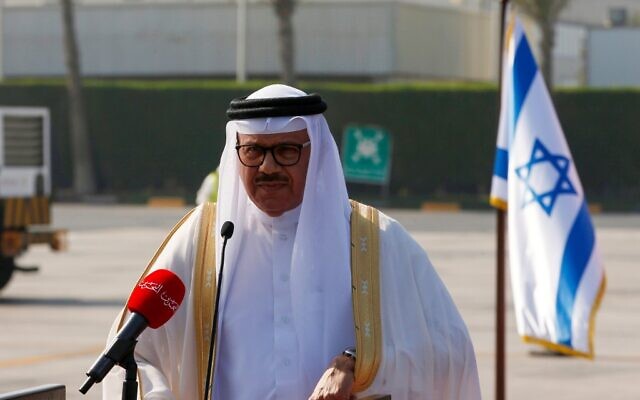
Bahraini Foreign Minister Abdullatif al-Zayani delivers a statement upon the arrival of a US-Israeli delegation in the Bahrain International Airport on October 18, 2020. (Photo by RONEN ZVULUN / POOL / AFP)
A leading scientific adviser to the British government says he expects several coronavirus vaccines to be approved by early 2021, allowing life to begin to return to normal.
John Bell, professor of medicine at Oxford University, tells lawmakers that Monday’s announcement by US pharmaceutical giant Pfizer that its vaccine candidate was effective in treating patients was likely just the start.
Bell, a member of the government’s Scientific Advisory Group for Emergencies (SAGE), says the news signaled other leading potential vaccines in late-stage trials could prove similarly effective.
“I wouldn’t be surprised if we hit the new year with two or three vaccines all of which could be distributed,” he tells a parliamentary hearing.
“I’m quite optimistic of getting enough vaccinations done in the first quarter of next year that by spring things will start to look much more normal than they do now.”
Bell adds that he believes there is a 70 to 80 percent chance of that scenario unfolding.
Joel Kolko, a Brooklyn rabbi who was accused of molesting students at the yeshiva where he taught for years, died of COVID-19 while in Israel, according to the New York Post.
The newspaper could not confirm his date of death but said he had been visiting Israel when he fell ill and died at age 74.
Multiple former students of Yeshiva Torah Temimah in Brooklyn accused Kolko of molesting them over the years, and in 2016, the yeshiva paid $2.1 million to two former students who accused Kolko of sexual assault. The boys were 6 years old at the time of the abuse.
The lawsuits filed by Kolko’s former students claimed that the school knew about the assaults but kept Kolko on staff. (A 2006 New York Magazine article detailed some of the accusations and noted that one attorney representing a victim had also been involved in lawsuits over the Catholic Church’s handling of child sex abuse claims.)
The school is currently facing additional lawsuits from other alleged Kolko victims who filed suit after the passage of New York’s Child Victims Act in 2017, which increased the window of time in which victims could sue for damages for assault that happened when they were minors.
Whether Kolko’s death will impact those lawsuits was not immediately clear. “You have grown men who claim that 40 or 50 years ago something happened, and now the person alleged to have done it is not available,” Avi Moskowitz, a lawyer representing the yeshiva, tells the Post.
But a lawyer for one of the victims tells the tabloid it would not affect the case. “At the end of the day, there’s little denying Kolko did what he did. My client will testify,” says Niall MacGiollabhui, the lawyer.
IKEA branches in Israel will partially reopen tomorrow, according to Hebrew-language media reports.
The store has brought back hundreds of workers from furlough and will resume operations Wednesday.
Some departments will be closed, however, as will the restaurants and playing areas for children.
Customers try maintain a safe distance from each other as they wait in line to enter an IKEA outlet in the Israeli coastal town of Netanya on April 22, 2020, after authorities eased down some of the measures that have been in place during the novel conronavirus pandemic crisis. (Photo by JACK GUEZ / AFP)
Eran Segal, a computational biologist at the Weizmann Institute of Science, shares data on the latest virus cases on Twitter, breaking it down by community affiliation.
He says 40 percent of active cases are among Arab Israelis, who make up one-fifth of the population, with 45% of all those hospitalized from the Arab community.
Cases are sharply down among the ultra-Orthodox, who represent 11% of virus cases and 9% of hospitalizations, roughly equivalent to their proportion in the general population.
The rest of the cases — 49% of total virus cases and 45% of hospitalizations — are among the general population, he says, namely, Jewish Israelis who are not ultra-Orthodox.
Hamas terror chief Ismail Haniyeh and Palestinian Authority President Mahmoud Abbas share a rare phone call after senior PLO official Saeb Erekat’s death.
“In every position he occupied, he was a faithful patriot, a righteous son of Palestine and a fighter for its freedom and independence,” Haniyeh says in a statement.
Former Hamas chief Khalid Mashaal also called Abbas earlier this afternoon, according to a statement by the official PA WAFA news agency.
Abbas thanks both Hamas officials for the gestures, according to the statement.
Yaakov Edri, currently the mayor of Or Akiva and formerly a government minister for the now-defunct Kadima party, has been arrested on suspicion of a slew of corruption offenses.
Edri — who also served as a Likud lawmaker before joining Kadima — was arrested earlier today. His remand has been extended by six days.
According to the Kan public broadcaster, he’s suspected of fraud, breach of trust, money laundering, tax offenses, and other financial crimes. Other reports say he’s suspected of bribery.
Iran welcomes a Russian-brokered deal to end the Nagorno-Karabakh conflict between its northern neighbors Armenia and Azerbaijan and calls for “foreign fighters” to pull out of the region.
The accord ends six weeks of fierce clashes between Yerevan and Baku over the disputed region that left hundreds dead.
Iran’s foreign ministry, in a statement, hails the agreement “which led to the ceasefire and halt in hostilities.”
Tehran hopes the deal will “lead to final measures for the establishment of sustainable peace in the Caucasus region.”
It calls for “respect for sovereignty and territorial integrity, no change to official international borders, the liberation of occupied territories, return of the displaced, and respect for the security and rights of minorities.”
The ministry stresses the need for “the withdrawal of all takfiri forces and foreign fighters from the region.”
The term “takfiri” is used by Iranian authorities to refer to Sunni jihadists.
Jordanians vote in a parliamentary election overshadowed by the coronavirus pandemic, which has dealt a heavy blow to the Arab country’s already debt-ridden economy.
More than 50,000 security force personnel were on hand to ensure masks were worn inside polling stations and social distancing maintained.
Authorities ruled that the four-yearly election should go ahead but voters who have tested positive for the novel coronavirus face up to a year in prison if they ignore instructions to stay home.
A member of the Jordanian security forces directs voters outside a polling station in Jordan’s capital Amman on November 10, 2020, during the 2020 general election. (Khalil MAZRAAWI / AFP)
On the eve of polling day, the kingdom had confirmed around 115,000 infections and 1,295 deaths in its population of about 10 million.
Some 4.5 million Jordanians are eligible to vote and by early afternoon (1100 GMT), turnout was around 13 percent. Polls close at 7:00 p.m. (1700 GMT), with results expected in the coming days.
Parliament has limited authority in Jordan, where the king has wide powers to rule by decree.
But it has provided a platform for the opposition when it has not boycotted the elections.
French President Emmanuel Macron urges European countries to develop a “rapid and coordinated response” to terror attacks that have plagued the continent in recent years.
Such a response should focus on “the development of common databases, the exchange of information or the strengthening of criminal policies,” he told a video conference with fellow EU leaders.
Defense Minister Benny Gantz again warns of early elections if the state budget is not passed by December.
“If there is no budget and no functioning government, we’ll probably go to elections,” he says during a visit to the Jerusalem municipality, according to the Ynet news site.
Gantz says he doesn’t want early elections to be called, but may have no choice.
“If both conditions are fulfilled, there won’t be elections, and if not, then there probably will,” he says.
Yamina leader Naftali Bennett rules out the possibility he would team up with other political parties to form an alternate government to replace Prime Minister Benjamin Netanyahu’s coalition, without elections.
“I don’t believe in this process. I was always against elections because it’s bad for the country, but then I concluded that the situation is so bad that new elections and a new government are preferable. We need fast elections, to replace this terrible government,” Bennett tells the Kan public broadcaster.
Defense Minister Benny Gantz warns the government will lock down additional “red” cities with high rates of coronavirus infection.
During a tour of the Jerusalem municipality with Justice Minister Avi Nissenkorn, Gantz also urges Israelis to cooperate with contact tracing efforts.
“We will impose a lockdown on other red cities in order to be able to open up other places. The public must cooperate with the [epidemiological] investigations, they aren’t giving us the full picture,” says Gantz.
Most Israelis who recently returned from Denmark are refusing to get checked for a coronavirus mutation linked to minks in the European country, according to Channel 12.
Just 40 of the 180 Israelis who were in Denmark recently have agreed and are cooperating with the IDF’s Home Front Command on the issue, the network says.
The Health Ministry has said it’s unlikely they’re carrying the mutation, but reports on Monday suggested health officials suspect at least three may be indeed infected with the strain.
US defense officials say James Anderson, the top policy adviser at the Pentagon, has submitted his resignation Tuesday, a day after President Donald Trump fired Defense Secretary Mark Esper. Anderson has been the acting undersecretary for policy since June. Previously he served as the deputy undersecretary since his confirmation for that job in August 2018.
Trump’s firing of Esper comes as he has refused to concede his election loss to Democrat Joe Biden.
Defense officials speak about Anderson’s resignation on condition of anonymity to discuss personnel matters.
A wide range of policy staff positions in the Pentagon have been filled with people on an acting basis over the past year or more, as several staff members have left or have not been confirmed.
Chris Miller, who was tapped to serve as the Pentagon chief on Monday after Esper was fired, is in his second day in the building, meeting with top staff.
Attorney General Avichai Mandelblit says his conflict of interest arrangement for Prime Minister Benjamin Netanyahu — which prevents him from appointing top law enforcement officials, among other restrictions — is legally binding.
In a letter to the High Court of Justice, Mandelblit says the legal framework is not a recommendation, or dependent on the prime minister’s “good will.”
Under Mandelblit’s arrangement, Netanyahu also cannot be involved in any matters that affect witnesses or other defendants in his trial, or legislation that would impact the legal proceedings against him. He cannot intervene in matters related to the status of several top police and prosecution officials, in several fields under the responsibility of the Communications Ministry, or in the Judicial Appointments Committee, which appoints judges to the Jerusalem District Court — where his trial is being conducted — and to the Supreme Court, which would hear any appeals in the case.
Netanyahu’s lawyers have disputed part of the rules.
“The law does not grant the attorney general the authority to determine conflict of interest on a particular issue,” Netanyahu’s attorneys wrote on his behalf, claiming that only the prime minister himself is authorized to make such a determination.
The High Court of Justice will consider the issue on Thursday.
Netanyahu is currently on trial, facing charges of bribery, fraud and breach of trust. He denies any wrongdoing.
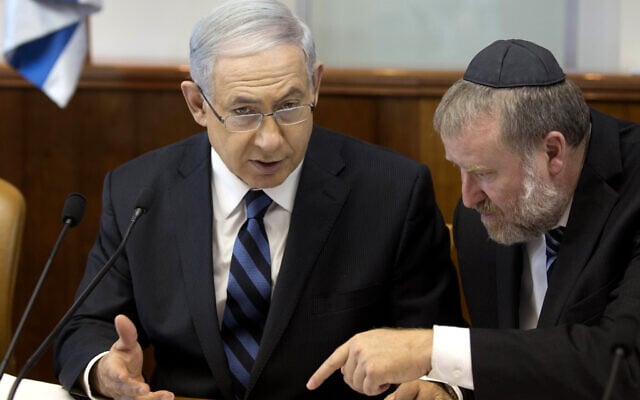
Prime Minister Benjamin Netanyahu, left, speaks with then-cabinet secretary Avichai Mandelblit during the weekly cabinet meeting in Jerusalem, September 21, 2014. (AP/Menahem Kahana, Pool/File)
After a five-hour marathon session with more than 70 speeches, the Knesset approves Israel’s agreement on the establishment of diplomatic relations with Bahrain with an overwhelming majority.
Sixty-two lawmakers vote in favor; 14 — all from the predominantly-Arab Joint List party — oppose the agreement. There are no abstentions.
The agreement will now head back to the cabinet, where it is expected to be ratified with unanimous support in the coming days.
Vice President-elect Kamala Harris’ husband, Doug Emhoff, will leave his job as a partner with a high-profile law firm to focus on his role in the new Biden administration.
A campaign spokeswoman says that Emhoff will sever ties with DLA Piper by Inauguration Day. Emhoff took a leave of absence from the firm in August, when Harris was named Joe Biden’s running mate. Biden and Harris will be inaugurated on January 20.
While Emhoff is not a lobbyist, the firm has lobbied the federal government on behalf of a range of corporate clients. Ethics experts say that connection could have presented an appearance of conflicts of interest as the Biden administration tries to restore trust and ethics in government following President Donald Trump’s norm-shattering presidency.
Emhoff, who is Jewish, is working with the transition team to determine the issues he will take on as the vice-presidential spouse. He would be the first man to hold that role, as Harris is set to become the nation’s first female vice president.
US Secretary of State Mike Pompeop announces he’s approved the sale of 50 advanced F-35 stealth jets and other advanced weaponry to the United Arab Emirates.
“Today, I directed the Department to formally notify Congress of our intent to authorize the UAE’s proposed purchase of several advanced capabilities that are worth $23.37 billion, for up to 50 F-35 Lightning II aircraft, valued at $10.4 billion; up to 18 MQ-9B Unmanned Aerial Systems, valued at $2.97 billion; and a package of air-to-air and air-to-ground munitions, valued at $10 billion,” says Pompeo in a statement.
“This is in recognition of our deepening relationship and the UAE’s need for advanced defense capabilities to deter and defend itself against heightened threats from Iran,” he says.
The deal for the UAE to acquire the stealth F-35s has raised concerns in Israel that it would erode the country’s regional military edge, with Prime Minister Benjamin Netanyahu drawing criticism for allegedly authorizing it in the context of Israel’s normalization with Abu Dhabi.
Illustrative: An F-35 fighter jet arrives at the Vermont Air National Guard base in South Burlington, Vermont, September 19, 2019. (Wilson Ring/AP)
Says Pompeo: “The UAE’s historic agreement to normalize relations with Israel under the Abraham Accords offers a once-in-a-generation opportunity to positively transform the region’s strategic landscape. Our adversaries, especially those in Iran, know this and will stop at nothing to disrupt this shared success. The proposed sale will make the UAE even more capable and interoperable with US partners in a manner fully consistent with America’s longstanding commitment to ensuring Israel’s Qualitative Military Edge.”
US and Israeli officials have asserted the F-35 sale was not directly tied to normalization, but Trump officials have acknowledged that the deal with Israel placed the UAE in a better position to purchase the advanced aircraft, which only Israel has in the Middle East.
Netanyahu initially voiced opposition to the sale, but last month reversed his position, issuing a statement saying Israel would not oppose US plans to provide “certain weapon systems” to the UAE.
The Trump administration notified Congress of the proposed sale earlier today.
UN Secretary-General Antonio Guterres sends condolences over the death of top PLO official Saeb Erekat from COVID-19.
Guterres says he’s “deeply saddened” by the news.
“I am grateful to have known Dr. Erekat and to have called him my friend. He was dedicated to the peaceful pursuit of justice, dignity and the legitimate rights of Palestinians to self-determination, sovereignty and statehood,” he says.
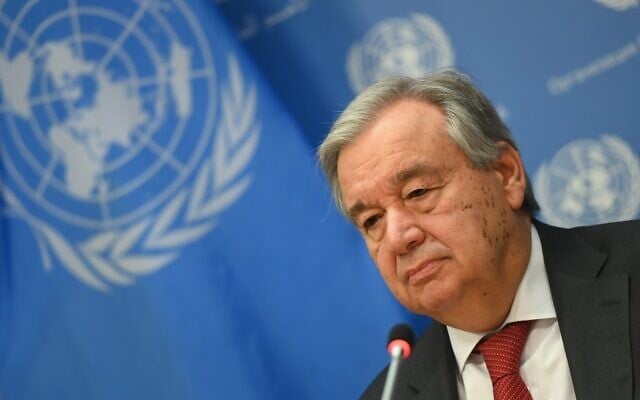
United Nations Secretary-General Antonio Guterres at UN Headquarters in New York City, on February 4, 2020. (Angela Weiss / AFP)
“Now is the time to continue his crucial work and end the conflict that has tragically affected the lives of so many. I reiterate my own and the United Nations’ commitment to support all efforts to bring the parties together to achieve a long-awaited, just and sustainable two-state solution, with Israel and Palestine, living side by side in peace and security.
“On behalf of the United Nations, I extend our heartfelt condolences to Dr. Erekat’s family, President Abbas, the people of Palestine and his many friends and supporters around the world.”
Government officials are reviewing a proposal to offer lottery tickets to Israelis undergoing coronavirus testing in a bid to incentivize the tests, with prizes of up to NIS 10,000, according to Channel 12.
Mifal Hapayis — which runs the national lottery — is suggesting linking the two and has submitted a request with the treasury for approval. The Finance Ministry is expected to consider the proposal in the coming weeks, the network says.
US Secretary of State Mike Pompeo announces a seven-nation tour of US allies, which have congratulated President-elect Joe Biden despite Donald Trump’s refusal to concede.
Pompeo says he will leave Friday for Paris and then head to Istanbul and the former Soviet republic of Georgia before visiting Jerusalem and three key Gulf Arab allies — Saudi Arabia, the United Arab Emirates and Qatar.
The trip will see the top US diplomat discuss Trump’s “historic efforts to forge peace and cooperation throughout the Middle East,” Pompeo tells reporters.
— AFP
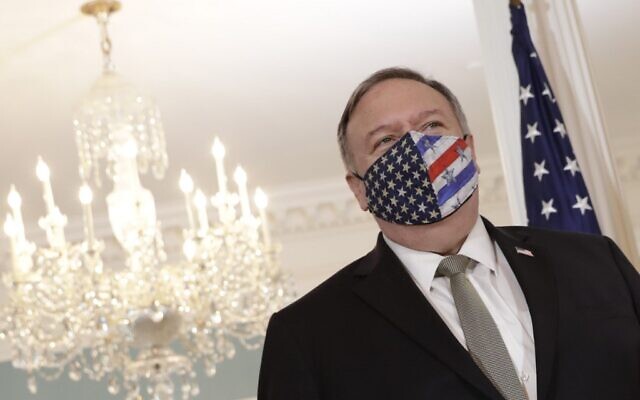
US Secretary of State Mike Pompeo is seen before his meeting with Romania’s Foreign Minister Bogdan Aurescu (not pictured) at the State Department in Washington, DC, October 19, 2020. (YURI GRIPAS / POOL / AFP)
US President-elect Joe Biden has spoken to British Prime Minister Boris Johnson, French President Emmanuel Macron and German Chancellor Angela Merkel, leaders of three of the United States’ most important European allies.
Johnson’s support for Brexit and warm relationship with President Donald Trump have made many Democrats wary, but he is nonetheless among the first European leaders to congratulate Biden in a phone call.
Johnson’s office says the two men “discussed the close and longstanding relationship” between the two countries and promised to strengthen those bonds in areas including trade and security. In the 25-minute call, they also promised to work on “shared priorities, from tackling climate change to promoting democracy and building back better from the coronavirus pandemic,” Downing St. says.
US Secretary of State Mike Pompeo refuses to acknowledge Joe Biden’s win in the US elections.
“There will be a smooth transition to a second Trump administration,” he tells reporters, when asked about the handover of power to a Biden administration.
The UAE’s ambassador to the United States says the talks on the advanced jet sales began after Abu Dhabi and Jerusalem signed the normalization agreement in Washington in September.
“That conversation began after the Abraham Accords,” Yousef al-Otaiba tells Israel’s Channel 12. The interview was conducted before the US announced the approval of the $23 billion sale of 50 F-35 jets and other advanced arms to the Gulf nation.
“And by the way, we’ve been trying to acquire the F-35 for six years. So this started a long time ago, it never made progress, we felt the Abraham Accords unlocked or created the opening for this to occur,” he says.
He was pressed whether the UAE would have sought normalization with Israel without knowing whether the Jewish state would tacitly approve the US arms sale.
“I don’t know. I honestly don’t know the answer,” he says, adding that he had confidence in the US administration’s backing for the sale.
UAE ambassador to Washington Yousef al-Otaiba, September 18, 2014. (UAE embassy website)
The UAE envoy says he believes in reaching a deal with Iran, “but let’s address all the problems, not just one of them. Let’s not just take the nuclear issue and forget about all the other problems we have to deal with today.”
“So now, you have a new administration, but you also have a lot of leverage on Iran, whether it’s sanctions, whether it’s COVID, whether it’s low oil prices, whether it’s the region and whatever it’s going through in general. Why are we not using this leverage to get a better deal?”
“I think that they’re in a better position for negotiation,” he says of the Biden administration.
The Emirati diplomat won’t comment on which other Mideast countries he feels could soon make peace with Israel.
“I don’t know which countries are ready or when they’ll be ready. But I can tell you that what we did kind of broke the ice, broke the taboo, that this is no longer impossible. It can be done.”
Pointing to the Bahraini and Sudanese normalization agreements in the aftermath of the UAE deal, he says this proves “this is not an aberration… This is a trend.”
He says the UAE still backs a two-state solution, but a peace deal between Israel and the Palestinians “requires diplomacy and requires a willingness and requires political courage from the leaders to make the compromises that you have to make to get this issue resolved.”
Asked whether he sees the leaders from both sides as having that courage, he remarks, “Not right now.”
Otaiba says Israel’s plan to annex parts of the West Bank prompted the Gulf state to move ahead with normalization.
“It was mainly annexation… It was annexation that made us reach this decision, in the way we did, in the time we did. I believe that annexation was going to have a profoundly negative impact in our part of the world,” he says.
“It was going to cause a very negative reaction to Israel. It was going to put Jordan under pressure. It was going to force the United States to defend what is a very unpopular decision in the region. And finally, it was going to risk all the progress that we have been making in terms of opening up to Israel.”
“We prevented a negative outcome. We created a ‘win-win’ and I think it’s going to open, potentially, a lot of cooperation.”
He says it’s a reflection of a “change of mindset in the Middle East.”
“Look, we’re not going to agree on everything. No two countries agree on everything,” he adds.
He says he believes that a successful UAE-Israel partnership will keep annexation off the table.
“But that’s on us. We have to demonstrate that this is a success. We believe we’re going to have a warm peace. We have a young population, not attached to history, who spend most of their time thinking about their future and they see opportunities with Israel, they see excitement, they see enthusiasm.”
Outgoing coronavirus czar Ronni Gamzu says he doesn’t think a third national lockdown is looming. But he is urging Israelis not to expect traditional gatherings during next month’s Hanukkah holiday.
Asked by Channel 12 whether Israelis can expect to face restrictions over the holiday, or whether Hanukkah will be “normal,” he says: “There is no normal during the coronavirus [pandemic]. No one should plan anything normal. Everything will be coordinated and everything will be different and everything will be much more cautious and adapted to the virus.”
As a multimedia journalist, my job is to take the quality, fact-based journalism produced by The Times of Israel newsroom and make it accessible across every platform — from Instagram posts to podcasts to short-form videos.
This is how many, especially young people, consume news these days. But misinformation is rampant on social media. Our team at ToI produces accurate, responsible short-form reporting on Israel and the Jewish world.
If you believe in the importance of factual social media journalism, please consider joining our reader support group, The Times of Israel Community. Your financial support is essential to sustain responsible multimedia reporting.
We’re really pleased that you’ve read X Times of Israel articles in the past month.
That’s why we started the Times of Israel - to provide discerning readers like you with must-read coverage of Israel and the Jewish world.
So now we have a request. Unlike other news outlets, we haven’t put up a paywall. But as the journalism we do is costly, we invite readers for whom The Times of Israel has become important to help support our work by joining The Times of Israel Community.
For as little as $6 a month you can help support our quality journalism while enjoying The Times of Israel AD-FREE, as well as accessing exclusive content available only to Times of Israel Community members.
Thank you, David Horovitz, Founding Editor of The Times of Israel


 Add ToI as a Preferred Source on Google