

Live updates (closed)
 Add ToI as a Preferred Source on Google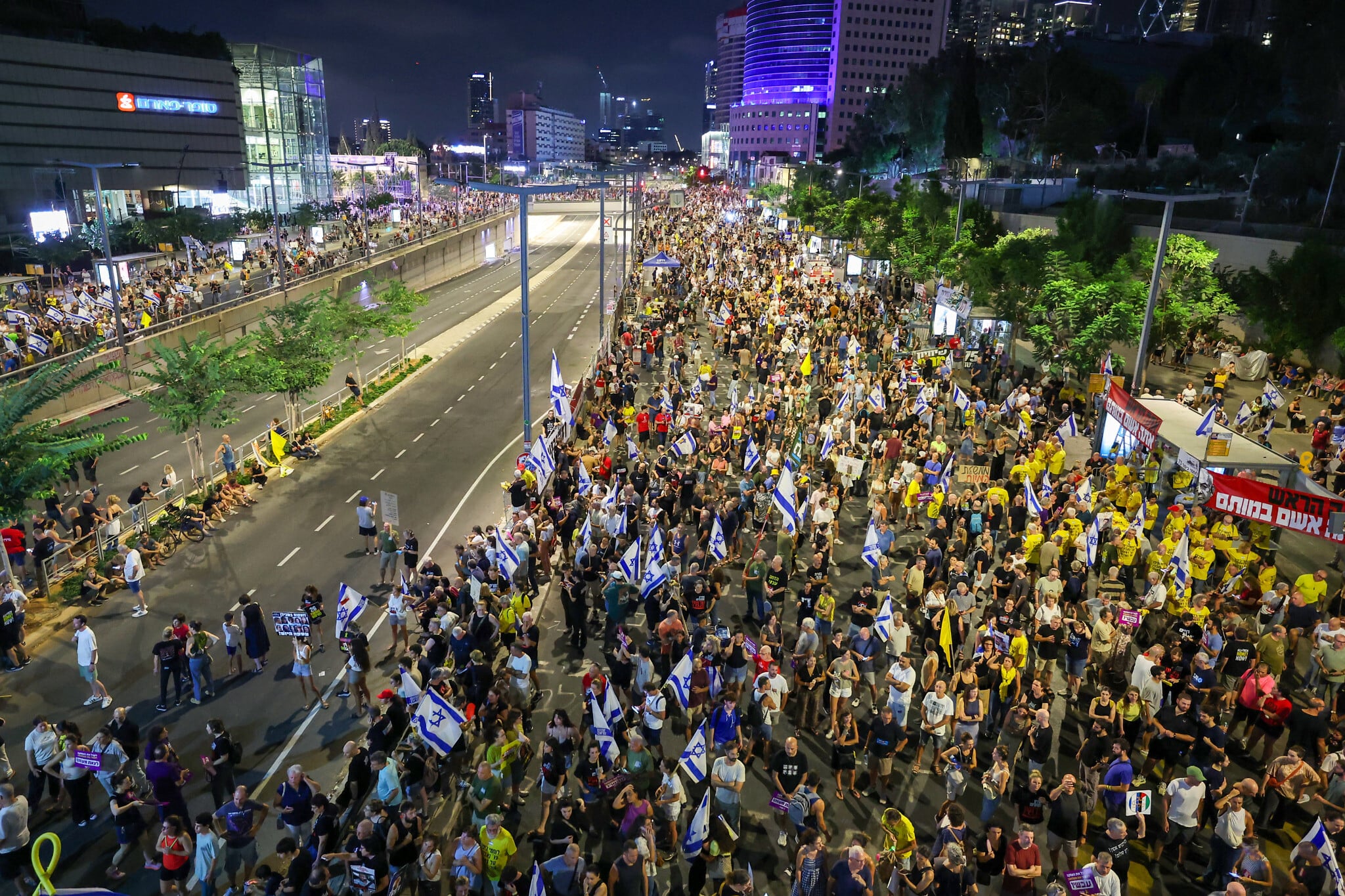
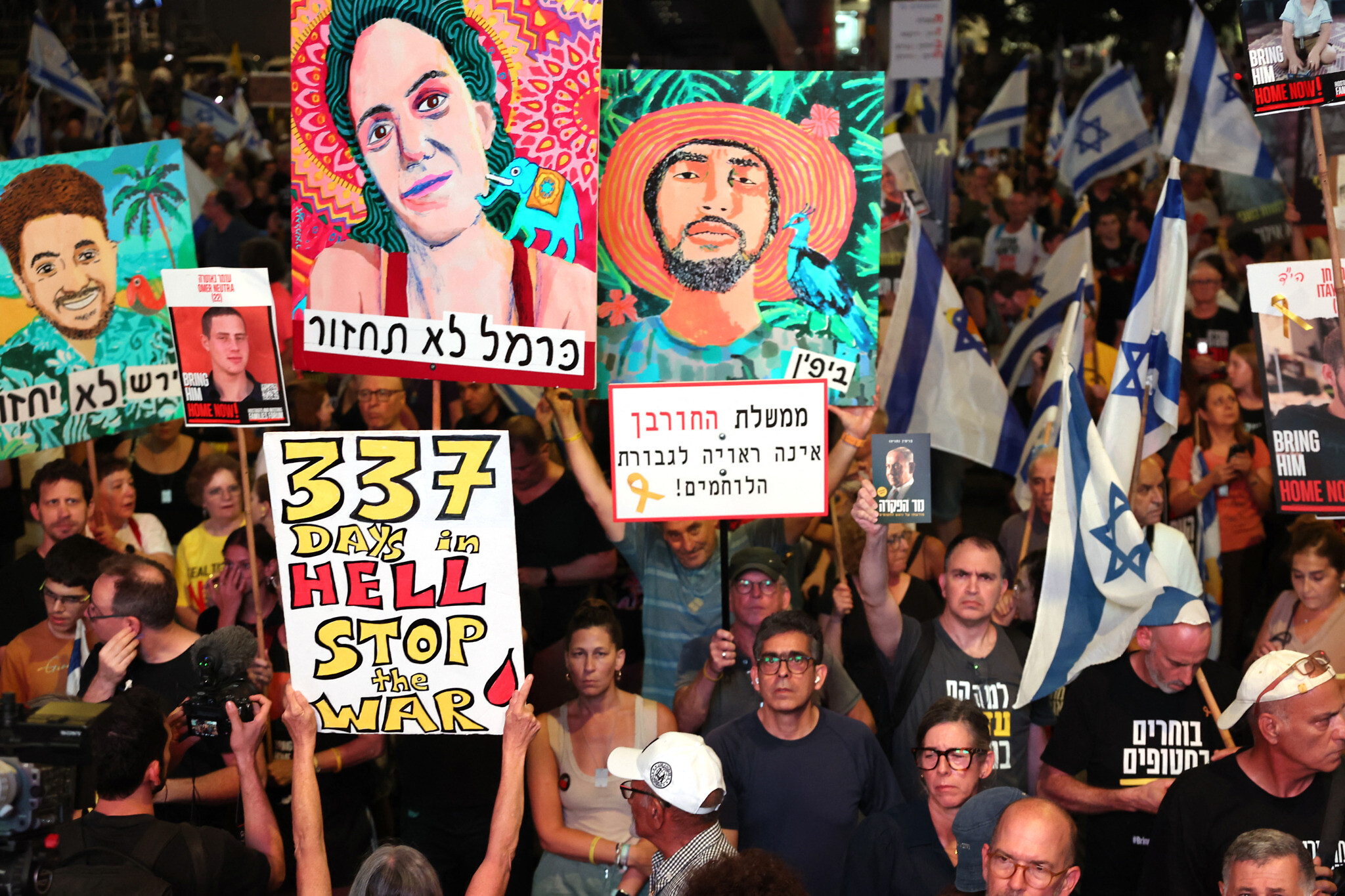
The Times of Israel liveblogged Saturday’s events as they unfolded
US sees potential Iran transfer of missiles to Russia as alarming ‘dramatic escalation’
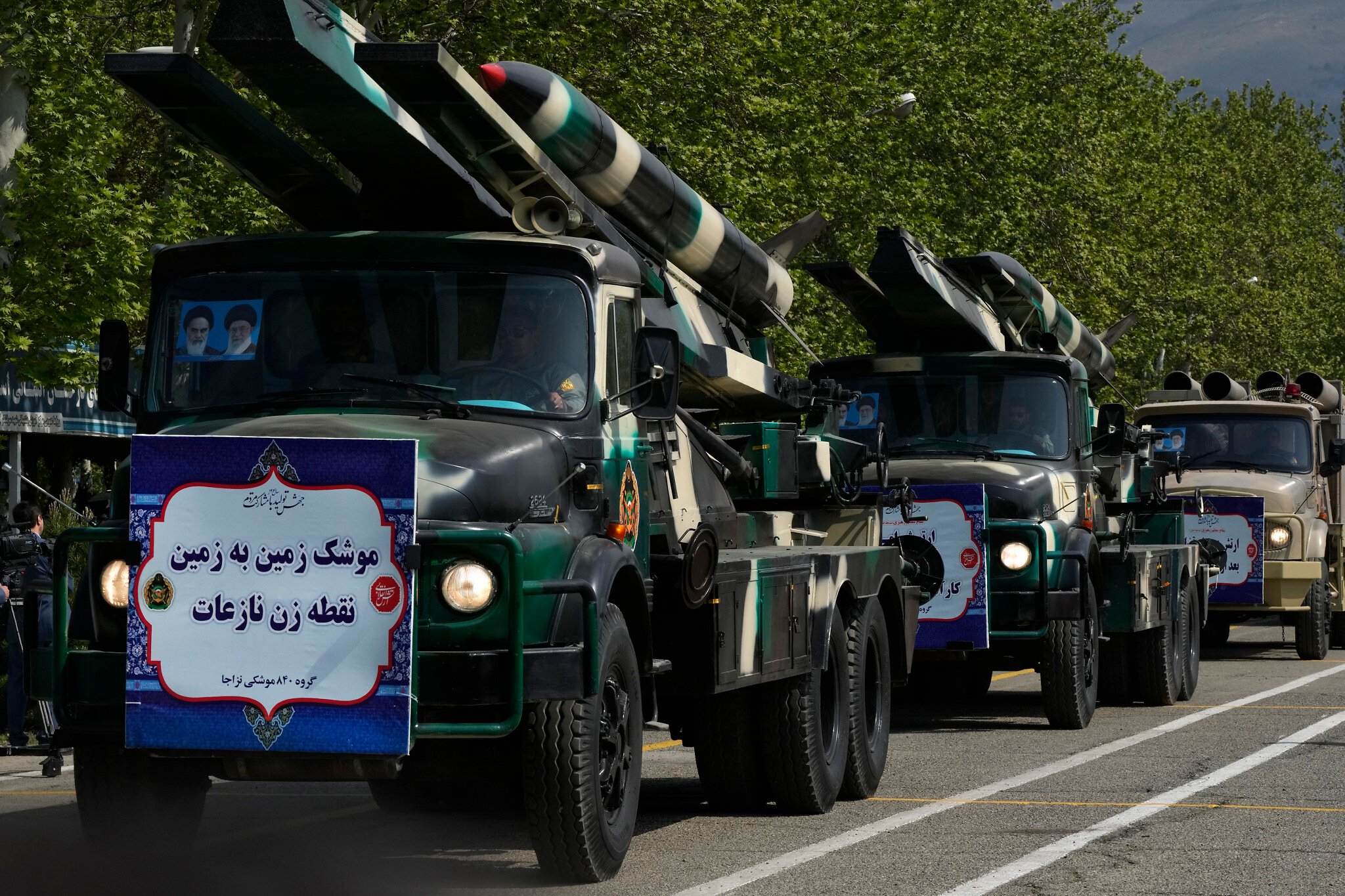
Missiles are carried on trucks during an Army Day parade at a military base in northern Tehran, Iran, Wednesday, April 17, 2024. (AP Photo/Vahid Salemi)
Any Iranian transfer of ballistic missiles to Russia would mark a sharp escalation in the Ukraine war, the United States says, following reports that the two countries had deepened ties in recent weeks with such an arms transfer.
Reuters reported in August that Russia was expecting the imminent delivery of hundreds of Fath-360 close-range ballistic missiles from Iran and that dozens of Russian military personnel were being trained in Iran on the satellite-guided weapons for eventual use in the war in Ukraine.
Short-range missiles have now been delivered to Russia by Iran, the Wall Street Journal reported, citing an unnamed US official.
“We have been warning of the deepening security partnership between Russia and Iran since the outset of Russia’s full-scale invasion of Ukraine and are alarmed by these reports,” says White House National Security Council spokesperson Sean Savett.
“Any transfer of Iranian ballistic missiles to Russia would represent a dramatic escalation in Iran’s support for Russia’s war of aggression against Ukraine.”
Another US official told Reuters they were watching the potential Iranian-Russian missile transfers closely.
Court rules woman arrested for throwing sand at Ben Gvir during beach visit to stay in jail overnight
The Tel Aviv Magistrates Court rejects an appeal to have a 27-year-old woman released from police custody after she was detained for allegedly throwing a handful of sand at National Security Minister Itamar Ben Gvir as he visited a Tel Aviv beach.
The court says the woman will be held until a scheduled hearing on extending her remand, which is set for Saturday night.
The ruling comes after several hours in which the woman’s family and activists said she had disappeared and was no longer at the Tel Aviv police station.
The Ynet news site reports that she was taken to the Neve Tirza women’s prison and then brought back to Tel Aviv due to “faulty paperwork.”
The judge orders the police and prison services to ensure she receives all necessary medical treatment after the woman’s mother claimed she suffered from a chronic illness.
זו הבת שלי שנעצרה בחוף הים בטענה שזרקה חול על בן גביר.
משטרת הדיקטטורה החליטה, ללא הצדקה לסכן את חיי הבת שלי, שחולה במחלה כרונית – ומשאירה אותה במעצר מסכן חיים מבחינתה.
אין לה שום עבר פלילי, אפס מסוכנות.
אבל זאת ההנחייה מלמעלה.
אם למישהו שם בכל זאת יש לב ושכל, בבקשה… pic.twitter.com/tNBH8NFRBH
— Sharon Goldenberg (@goldens32) September 6, 2024
Police said the minister was at the beach with his family and that it takes the crime of “assaulting a public servant” seriously.
Ben Gvir, the leader of the far-right Oztma Yehudit party, oversees the police. He has often been the target of public protest for his hardline positions and his staunch opposition to a deal that would release hostages held by Hamas in Gaza in exchange for a ceasefire and the release of Palestinian prisoners.
Pakistani charged with plotting ‘slaughter’ at NY Jewish center on anniversary of Oct. 7 Hamas attack
A Pakistani man was arrested in Canada this week for plotting a mass shooting at a Jewish center in Brooklyn on the one-year anniversary of the Oct. 7 attack by Hamas that sparked the latest conflict in the Middle East, federal authorities announce.
US Attorney General Merrick Garland says Muhammad Shahzeb Khan had attempted to travel from Canada, where he lives, to New York City with the “stated goal of slaughtering, in the name of ISIS, as many Jewish people as possible.”
The 20 year-old, who is also known as Shahzeb Jadoon, was apprehended on Sept. 4 and charged with attempting to provide material support and resources to the terror group, which stands for the Islamic State of Iraq and al-Sham.
“As I said to Canada’s Minister of Public Safety yesterday, we are deeply grateful to our Canadian partners for their critical law enforcement actions in this matter,” Garland says in a statement. “Jewish communities — like all communities in this country — should not have to fear that they will be targeted by a hate-fueled terrorist attack.”
US authorities said Khan began sharing ISIS propaganda videos and expressing his support for the terror group in social media posts and communications with others on an encrypted messaging app last November.
In conversations with two undercover law enforcement officers, he confirmed that he and another ISIS supporter based in the US had been planning to carry out attacks against Jewish centers in America and needed to obtain AR-style assault rifles, ammunition and other materials, according to the Justice Department.
Khan also provided details about how he would cross the border from Canada into the US and that he was considering conducting the attacks on either the Oct. 7 anniversary or on Oct. 11, which is the Jewish holiday of Yom Kippur, authorities say.
Then on Aug. 20, he told the undercover officers that he had settled on targeting New York City because of its sizeable Jewish population and sent a photograph of the specific area inside of a Jewish center where he planned to carry out the attack, according to the Justice Department.
Using three separate vehicles, Khan began travelling to the US but was stopped around Ormstown, a town in the Canadian province of Quebec that is about 12 miles (19 kilometers) from the US border, federal authorities say.
Republican former VP Dick Cheney says he will vote for Kamala Harris
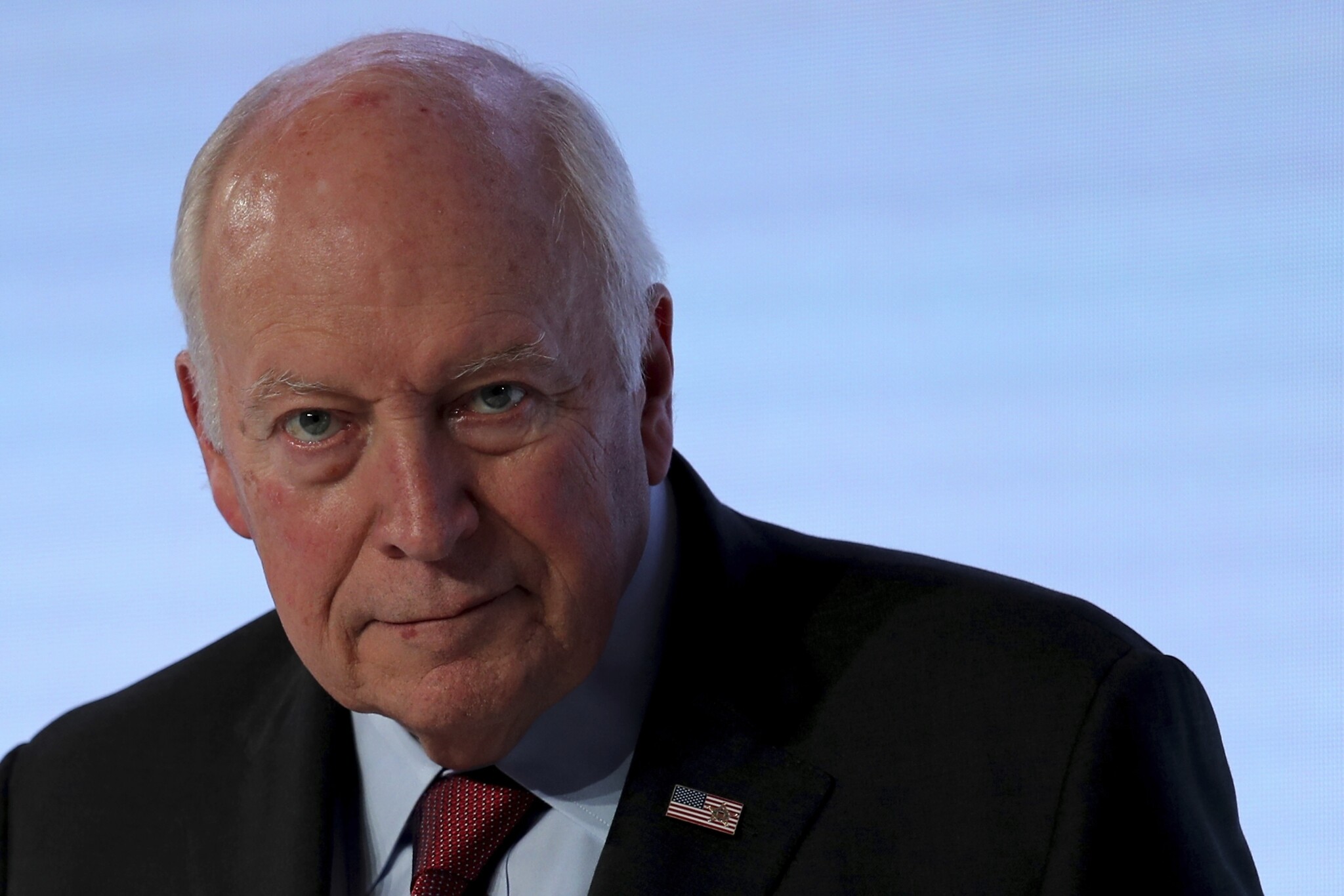
Former US Vice President Dick Cheney reacts after his speech at the Arab Strategy Forum in Dubai, United Arab Emirates, Monday, Dec. 9, 2019. (AP Photo/Kamran Jebreili)
US Republican former Vice President Dick Cheney says he will vote for Democratic presidential candidate Kamala Harris over Republican former President Donald Trump in the Nov. 5 US elections, following a similar statement by his daughter Liz Cheney this week.
Cheney says that “in our nation’s 248-year history, there has never been an individual who is a greater threat to our republic than Donald Trump.”
He adds: “As citizens, we each have a duty to put country above partisanship to defend our Constitution. That is why I will be casting my vote for Vice President Kamala Harris.”
Palestinians say 8 killed in strike that targeted Hamas command center in Gaza school
At least 8 Palestinians were killed in an Israeli strike on a school in Gaza city, the Palestinian Authority’s official news agency WAFA reports.
The IDF earlier said in a statement it had “conducted a precise strike on terrorists who were operating inside a Hamas command and control center… embedded inside a compound that previously served as the ‘Halima al-Sa’diyya’ School in the northern Gaza Strip.”
The Israeli army said in a statement it had “conducted a precise strike on terrorists who were operating inside a Hamas command and control centre… embedded inside a compound that previously served as the Halima al-Sadia School in the northern Gaza Strip.”
Wafa says the dead were in refugee tents inside the former school.
In a separate incident, five Palestinians were killed in an Israeli strike on a residential building in the Nuseirat camp in central Gaza, WAFA says.
There is no immediate army comment on that incident.
Rocket warning sirens sound in northern Israel
Rocket warning sirens sound just after dawn in northern Israel.
The sirens sound in the community of Matat and in the Mount Merom area in the Upper Galilee.
There are no immediate reports of injuries or damage.
Rocket Alert [06:04:32] (1):
• Confrontation Line — Sdeh Meron School
Population: 6,400 pic.twitter.com/ZLTheI7Vf7— ILRedAlert (@ILRedAlert) September 7, 2024
Sirens in northern border towns warn of suspected drone attack
Sirens sound in a number of communities close to the northern border, warning of a suspected drone attack.
The IDF later says the alert was a false alarm.
IDF: Some 30 rockets fired in barrage from Lebanon toward Meron, no casualties
The IDF says around 30 projectiles were fired from Lebanon toward the Meron area in a barrage earlier this morning.
All of the rockets impacted in open areas and there were no casualties, the military says.
The army also says that strikes were carried out overnight on another Hezbollah rocket launcher and releases footage of the moment of impact.
בהמשך לתקיפת מספר משגרים אמש, מטוסי קרב תקפו במהלך הלילה משגר נוסף של ארגון הטרור חיזבאללה במרחב יעטר שבדרום לבנון.
בהמשך להתרעות שהופעלו בין השעות 6:04-6:05 במרחב מתת, זוהו כ-30 שיגורים שחצו משטח לבנון ונפלו בשטחים פתוחים, אין נפגעים>> pic.twitter.com/58SedgQyHB
— צבא ההגנה לישראל (@idfonline) September 7, 2024
Poll: Majority of Israelis say hostage deal takes precedence over troops staying in Philadelphi Corridor
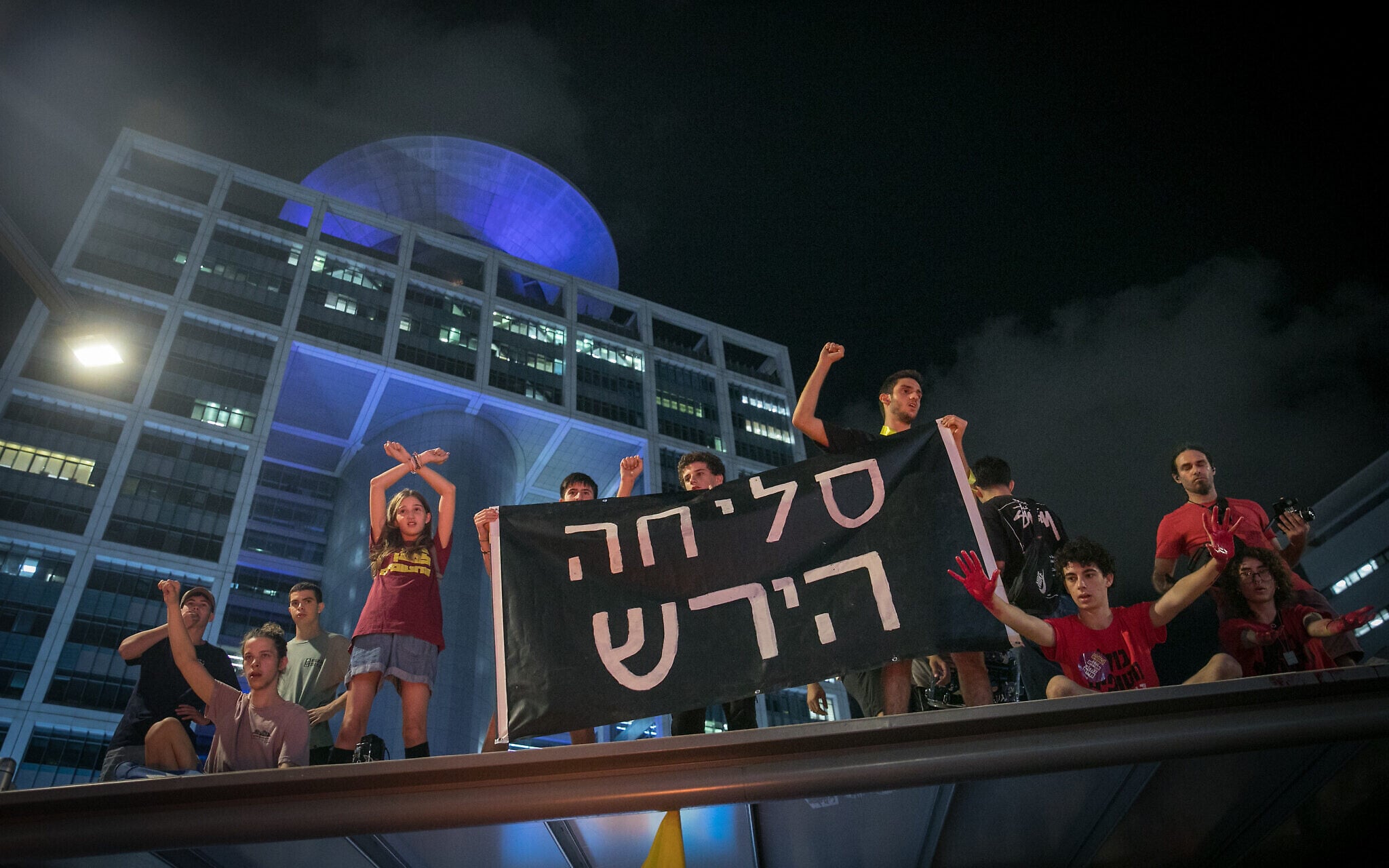
Protesters calling for a hostage deal hold a sign reading 'Sorry Hersh' after the murder of Hersh Goldberg-Polin, outside the Defense Ministry in Tel Aviv, September 5, 2024 (Miriam Alster/Flash90)
Sixty percent of Israelis believe a hostage deal should take precedence over troops staying in the Philadelphi Corridor, a Channel 12 news poll finds, with 28% responding that the axis on the Egypt-Gaza border was more important. Twelve percent said they did not know.
When asked if they believe the government is doing all it can to bring the hostages home, 61% said no, 34% said yes and 5% said they did not know.
The outlet says that when asked what they think stems from Netanyahu’s insistence on the IDF remaining in the Philadelphia Corridor, a majority said it came from the premier’s political considerations.
Pollsters found that voters for Netanyahu’s Likud party were more likely to believe remaining in the Philadelphi Corridor takes precedence over a deal to bring home the 101 hostages held in the Gaza Strip.
The survey also found that Netanyahu is less trusted by the public than opposition leaders — 35% of Israelis trust Opposition Leader Yair Lapid more than Netanyahu, compared to 33% who trust the premier more and 28% who trust neither of them.
When asked about National Unity leader Benny Gantz, 41% of the respondents answered that they trust Gantz more, and 27% answered that they believe Netanyahu more.
However the outlet says the poll found former prime minister Naftali Bennett is the most trusted — 44% of the Israeli public trust him over Netanyahu, compared to 29% who trust the premier more.
Respondents also see Netanyahu as the Israeli who holds the most responsibility for October 7 – 43% said the premier was to blame, followed by Chief of Staff Herzi Halevi with 18%, Shin Bet chief Ronan Bar with 14% and Defense Minister Yoav Gallant with 6%.
The survey also examined the public’s position regarding far-right National Security Minister Itamar Ben Gvir’s attempt to formally change the status quo on the Temple Mount, and promote Jewish prayer at the flashpoint site.
The poll found more than two-thirds of the Israeli public — 68% — opposes Jewish prayers on the Temple Mount, and thus opposes changing the existing situation.
The outlet does not give details on the poll’s methodology or margin of error.
Family of American said killed by IDF at West Bank protest says US must order independent probe

Ayşenur Ezgi Eygi. (Picture via social media)
The family of an American woman who was said to have been shot and killed by IDF troops during a protest near Nablus in the northern West Bank yesterday, calls for an independent investigation into her death.
Aysenur Ezgi Eygi, 26, an American originally from Turkey, was an activist with the International Solidarity Movement (ISM).
“Her presence in our lives was taken needlessly, unlawfully, and violently by the Israeli military,” Eygi’s family says in a statement.
“A US citizen, Aysenur was peacefully standing for justice when she was killed by a bullet that video shows came from an Israeli military shooter.
“We call on President [Joe] Biden, Vice President [Kamala] Harris, and Secretary of State [Antony] Blinken to order an independent investigation into the unlawful killing of a US citizen and to ensure full accountability for the guilty parties,” the family says.
The Israeli military said yesterday it was investigating the matter.
Sirens warn of suspected drone attack on northern border town
Sirens sound in a Ayelet HaShahar, close to the northern border, warning of a suspected drone attack.
Earlier this morning, a barrage of some 30 rockets was fired toward the Meron area from Lebanon.
Man in his 40s found dead in open area in Holon
The body of a man aged around 40 was found in an open area in Holon, Hebrew-language media reports.
It was unclear if there was any suspicion of foul play.
Police say driver of Palestinian vehicle arrested after collision with police car in West Bank
Police say the driver of a Palestinian vehicle has been arrested after a collision with a police car near the settlement of Eli in the West Bank.
In a statement, police say the circumstances surrounding the incident were under investigation.
There were no injuries.
IDF: Palestinian accelerated vehicle toward police car in West Bank attack
The Israel Defense Forces says that an incident in which a Palestinian vehicle collided with a vehicle in the West Bank was a deliberate attack.
The collision happened at the Eli gas station, the scene of a number of previous terror attacks.
“A Palestinian vehicle accelerated towards a police car and collided with it, there were no casualties,” the IDF says.
“The terrorist was caught by IDF troops and handed over to security forces for further investigation,” the statement concludes.
In rare joint statement, heads of CIA and MI6 call for hostage-ceasefire deal
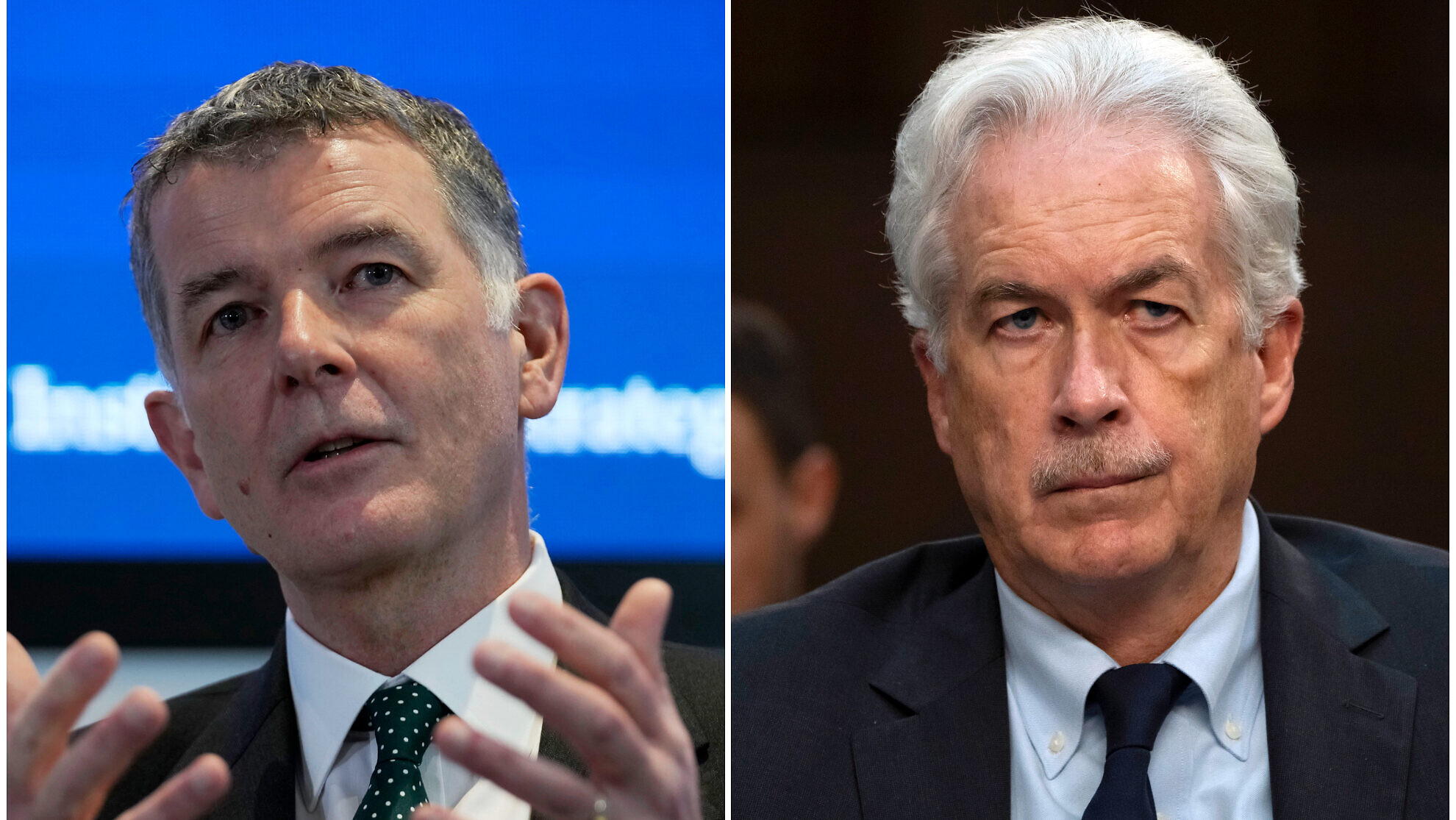
(L) Richard Moore, the Chief of Britain's Secret Intelligence Service, also known as MI6, in London, on November 30, 2021; (R) CIA director William Burns attends a hearing of the Senate Intelligence Committee, March 11, 2024, in Washington. (AP Photo/Mark Schiefelbein)
The heads of the American and British foreign intelligence agencies say they are “working ceaselessly” for a ceasefire and hostage deal in Gaza, in a rare joint statement.
CIA Director William Burns and MI6 Chief Richard Moore say their agencies had “exploited our intelligence channels to push hard for restraint and de-escalation.”
In an opinion piece for The Financial Times, the two spymasters say a ceasefire in the Israel-Hamas war “could end the suffering and appalling loss of life of Palestinian civilians and bring home the hostages after 11 months of hellish confinement.”
Burns has been heavily involved in efforts to broker an end to the fighting, traveling to Egypt in August for high-level talks aimed at bringing about a hostage deal and at least a temporary halt to the conflict.
So far there has been no agreement, though United States officials insist a deal is close. US President Joe Biden said recently that “just a couple more issues” remain unresolved. Prime Minister Benjamin Netanyahu, however, has said reports of a breakthrough are “exactly inaccurate” and Hamas has been similarly dismissive.
The article is the first joint opinion piece by the heads of the two spy agencies.
Sirens in northern border towns warn of incoming rocket fire
Sirens sound in a number of towns close to the northern border, warning of incoming rocket fire.
This morning a barrage of some 30 rockets was fired at Israel from south Lebanon.
Small protest outside prison where woman held for allegedly throwing sand at Ben Gvir
A small protest is being held outside the prison where a 27-year-old woman is being held for allegedly throwing sand at far-right National Security Minister Itamar Ben Gvir on a Tel Aviv beach.
The demonstrators use drums and a megaphone as they chant that Noa Goldenberg is detained because “that is what the minister wanted.”
Goldenberg was arrested yesterday afternoon and her whereabouts where unknown for a number of hours.
She is due in court for a hearing on her detention this evening.
"השר הנחה, השר רצה והנה נועה בנווה תרצה": הפגנה מחוץ לכלא נווה תרצה, שם עצורה החשודה בהשלכת חול על בן גביר@VeredPelman https://t.co/uZLweTKInV pic.twitter.com/Prw4fF95Sa
— כאן חדשות (@kann_news) September 7, 2024
IDF says rocket barrage fired at Western Galilee; reports of home hit in Shlomi, no injuries
A barrage of rockets was fired from Lebanon at the Western Galilee a short while ago.
According to the IDF, some of the rockets were intercepted by air defenses.
Some of the projectiles struck the community of Shlomi, reportedly causing damage to a home, and others struck open areas near Liman, sparking a fire.
There are no injuries in the attack.
The barrage comes after Hezbollah launched a barrage of some 30 rockets at the Mount Meron area earlier this morning.
Rocket sirens sound in Safed, surrounding area
Sirens sound in Safed and the surrounding area, warning of incoming rocket fire from Lebanon.
IDF: 5 rockets fired toward Safed impacted in open areas
A barrage of five rockets was fired from Lebanon at the Safed area a short while ago, according to the IDF.
The rockets struck open areas, the military adds. There are no injuries.
Sirens had sounded in the northern city and the nearby town of Birya amid the attack.
IDF: Jets struck Hezbollah infrastructure, rocket launcher in south Lebanon
Israeli fighter jets struck Hezbollah infrastructure and a rocket launcher in southern Lebanon’s Qabrikha a short while ago, the IDF says.
The military says the launcher had been used to fire rockets at Israel previously.
It publishes footage of the strikes.
מטוסי קרב תקפו לפני זמן קצר במרחב קבריח'א שבדרום לבנון, תשתיות צבאיות ומשגר של ארגון הטרור חיזבאללה, ממנו שוגרו רקטות לעבר שטח הארץ.
בנוסף, צה"ל תקף בארטירליה במרחבים עייתא א-שעב ושובא שבדרום לבנון>> pic.twitter.com/6n53NWLxXt
— צבא ההגנה לישראל (@idfonline) September 7, 2024
CIA chief: Israel, Hamas will need to make ‘hard choices, political compromises’ for a deal
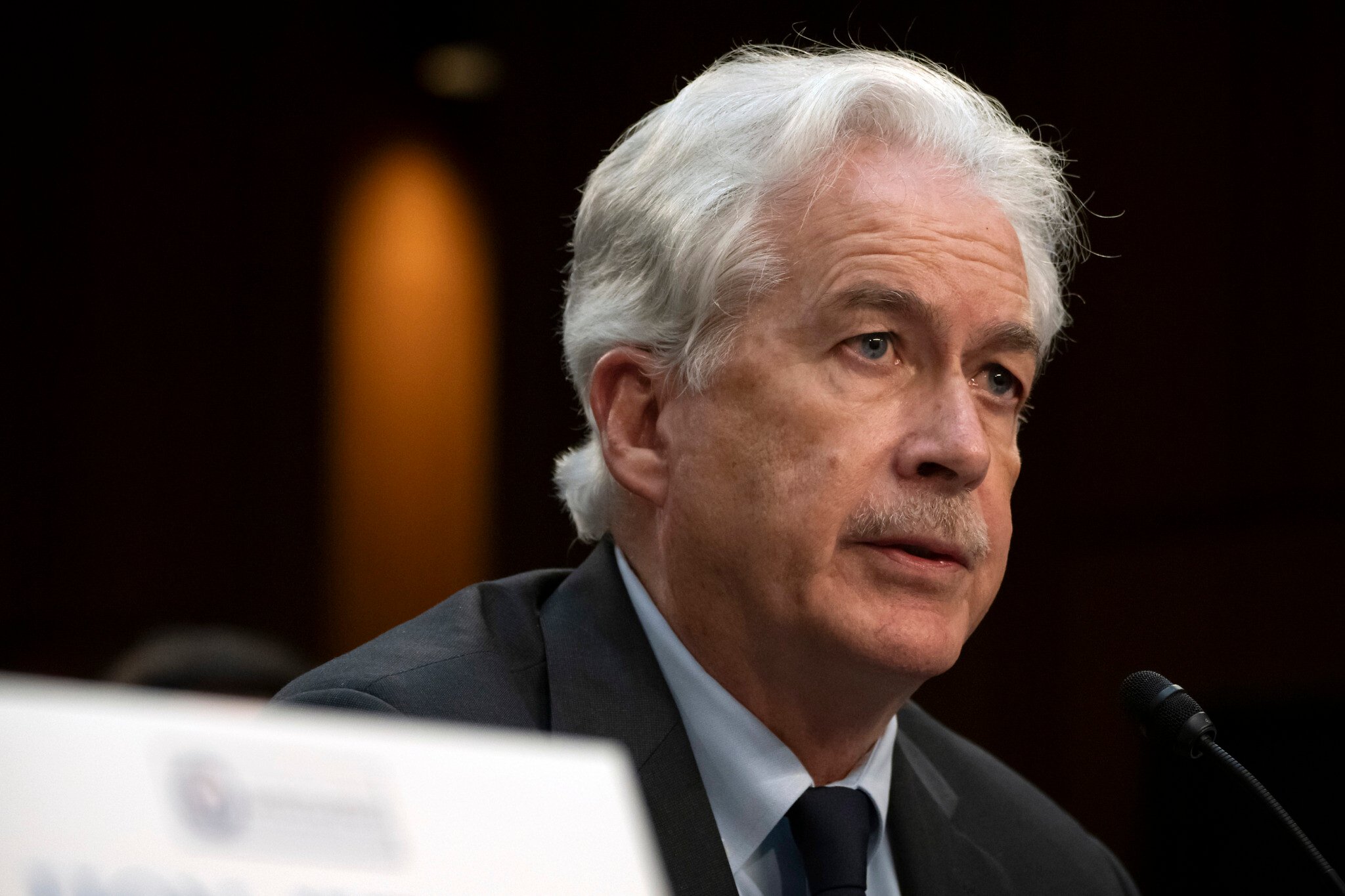
CIA director William Burns speaks during a hearing of the Senate Intelligence Committee on Capitol Hill, in Washington, March 11, 2024. (Mark Schiefelbein/AP)
CIA Director William Burns, the chief US negotiator trying to help secure a ceasefire in Gaza and the release of hostages by Hamas, says a more detailed proposal on the proposal will be made in the coming days but will require both sides to make some tough decisions.
“We will make this more detailed proposal, I hope in the next several days, and then we’ll see,” Burns says at a Financial Times event in London, alongside his British counterpart, MI6 Chief Richard Moore.
“I cannot tell you how close we are right now,” Burns says.
He says that while 90 percent of the text has been agreed between the warring sides, “the last 10% is the last 10% for a reason, because it’s the hardest part to do.”
Burns says ending the conflict will require “some hard choices and some political compromises” from both Israel and Hamas.
UK spy chief says still expecting Iranian retaliation for killing of Haniyeh
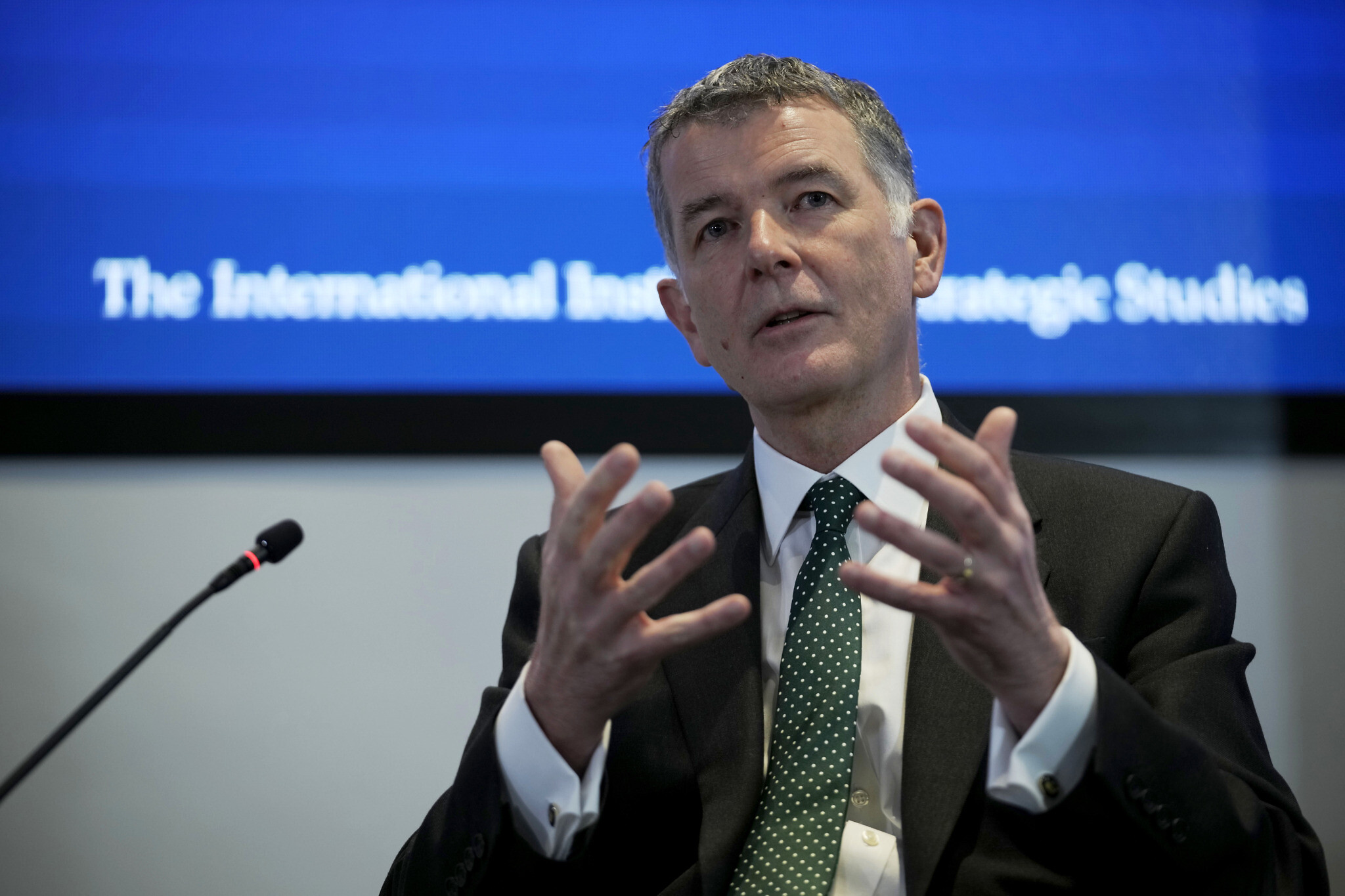
Richard Moore, the Chief of Britain's Secret Intelligence Service, also known as MI6, answers questions at the International Institute for Strategic Studies, in London, on Nov. 30, 2021. (AP Photo/Matt Dunham)
The head of Britain’s MI6 foreign spy agency Richard Moore says he believes Iran is still planning to retaliate for the killing of Hamas leader Ismail Haniyeh, which took place in Tehran in late July and which Iran blames on Israel.
“I suspect they will try and we won’t be able to let our guard down for the type of activity that the Iranians might try and prosecute in that direction,” Moore says at an FT event when asked about whether Iran would retaliate.
Israel has neither claimed nor denied responsibility for the Tehran blast that killed the terror leader.
IDF strikes cell of Hamas operatives in former Gaza City school; Palestinians report several casualties
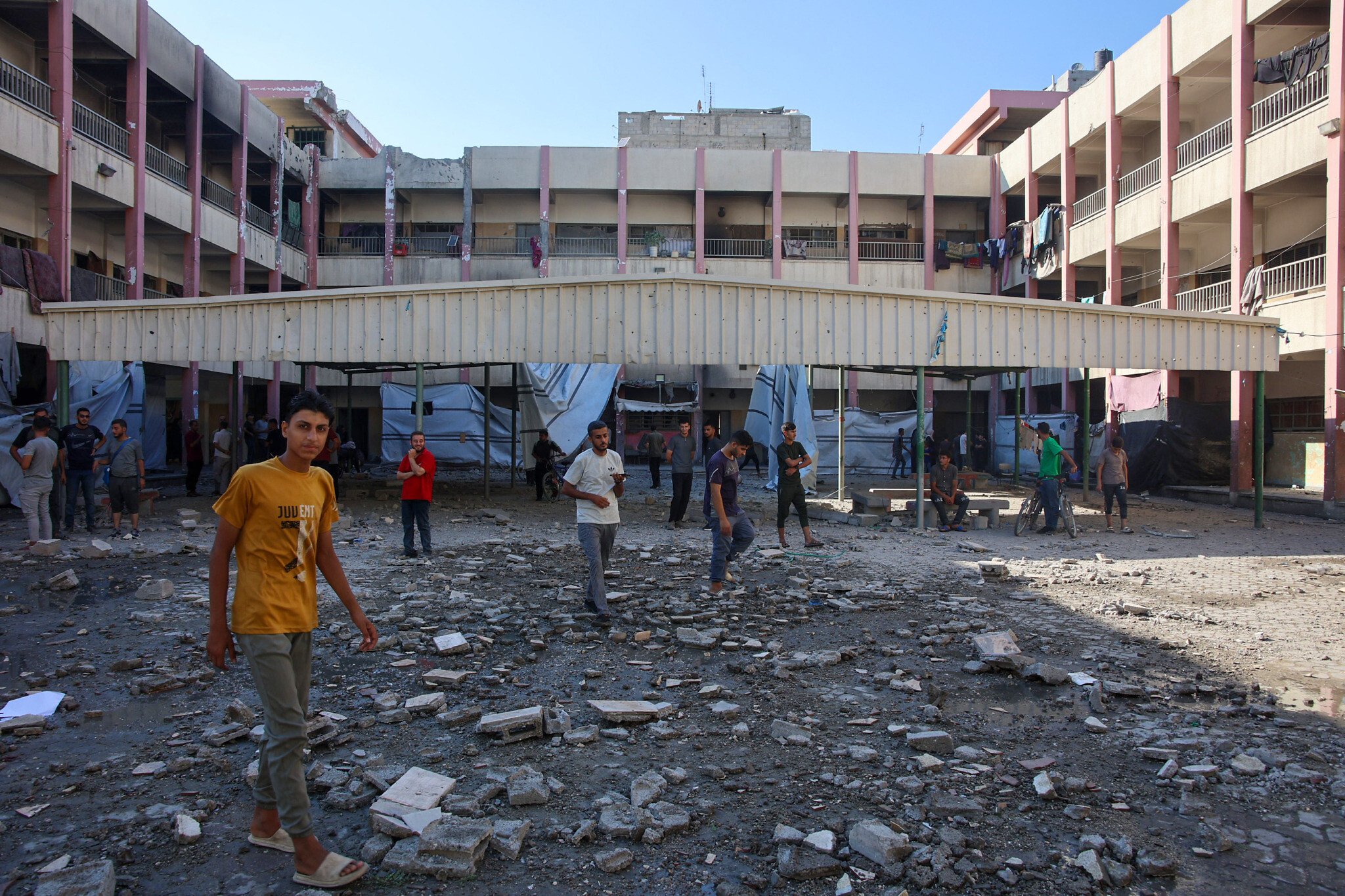
Palestinians inspect the damage following an IDF strike on a Hamas cell embedded in the Amr Ibn al-Aas School in Gaza City's Sheikh Radwan neighborhood on September 7, 2024. (Omar al-Qattaa/AFP)
The IDF says it carried out an airstrike against a group of Hamas operatives at a command room embedded within a former school in Gaza City.
According to the military, Hamas was using the Amr Ibn al-Aas School in Gaza City’s Sheikh Radwan neighborhood to plan and carry out attacks against troops and Israel.
Palestinian media report several casualties in the strike.
To mitigate harm to civilians in the strike, the IDF says it carried out “many steps,” including using precision munitions, aerial surveillance, and other intelligence.
“The Hamas terror organization systematically violates international law, brutally exploiting civilian institutions and the population as a human shield for terror activity,” the military adds.
In recent months, dozens of airstrikes have been carried out against Hamas sites embedded within schools and other sites used as shelters for civilians, according to the IDF.
Police remove anti-Israel protesters from Toronto University building amid ‘from the river to the sea’ chants
Anti-Israel protesters demonstrate at Toronto University, chanting antisemitic slogans as they call for the school to divest from the Jewish state over its ongoing war against Hamas in Gaza.
The demonstration is dispersed by police, according to reports on social media. Videos show protesters wearing face masks and Palestinian keffiyeh scarves being pushed out of a university administration building by police.
A video posted to X shows a speaker leading the crowd in chants of, “From the sea to the river, Palestine will live forever,” a version of the Palestinian nationalist chant, “From the river to the sea, Palestine will be free.”
https://twitter.com/V_Palestine20/status/1832383693362475470
The phrase has been used for decades by Palestinian movements including Hamas, and pro-Palestinian activists say it is a call for liberation. Israel and Jewish groups view it as advocating Israel’s destruction. It has been condemned in congressional votes and investigated in multiple instances by the US Department of Education.
Tens of thousands join anti-Israel, pro-Palestinian march headed for Israeli embassy in central London
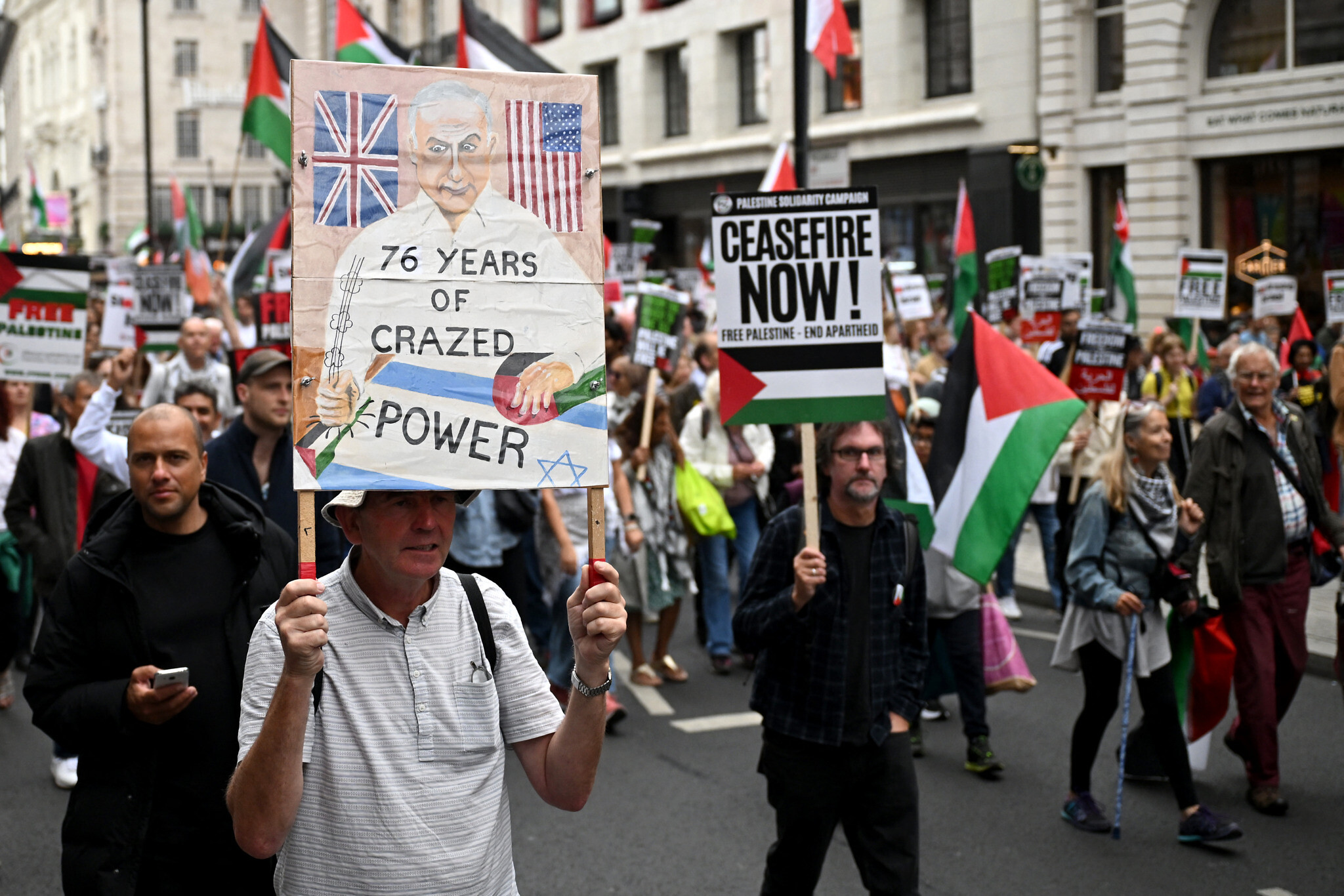
Anti-Israel, pro-Palestinian activists and supporters wave flags and hold placards as they march through London, during a National Day of Action for Palestine on September 7, 2024. (Justin Tallis/AFP)
Tens of thousands of protesters are marching through the streets of London as part of a National March for Palestine demonstration.
Videos posted to social media show activists holding anti-Israel, pro-Palestinian signs, and chanting the controversial “from the river to the sea” slogan.
The march, organized by the Palestine Solidarity Campaign, began at Regent Street in central London and is headed for the Israeli embassy near Kensington Palace.
The London pro-Pals haven’t even started marching yet and they’re already chanting the genocidal “from the river to sea”. How is this not incitement? Why do we have to keep hearing them call for Israel’s destruction and nothing is done. pic.twitter.com/UnC1xreFsW
— Heidi Bachram (@HeidiBachram) September 7, 2024
IDF: Interceptor missiles launched at suspected drone from Lebanon outside of Israeli airspace
Interceptor missiles were launched at a suspected drone launched from Lebanon a short while ago, the IDF says.
The military says the target did not enter Israeli airspace in the incident.
‘Shake up the country, oust Netanyahu’: Hostage’s mother urges public to demand deal, calls PM ‘Mr. Death’
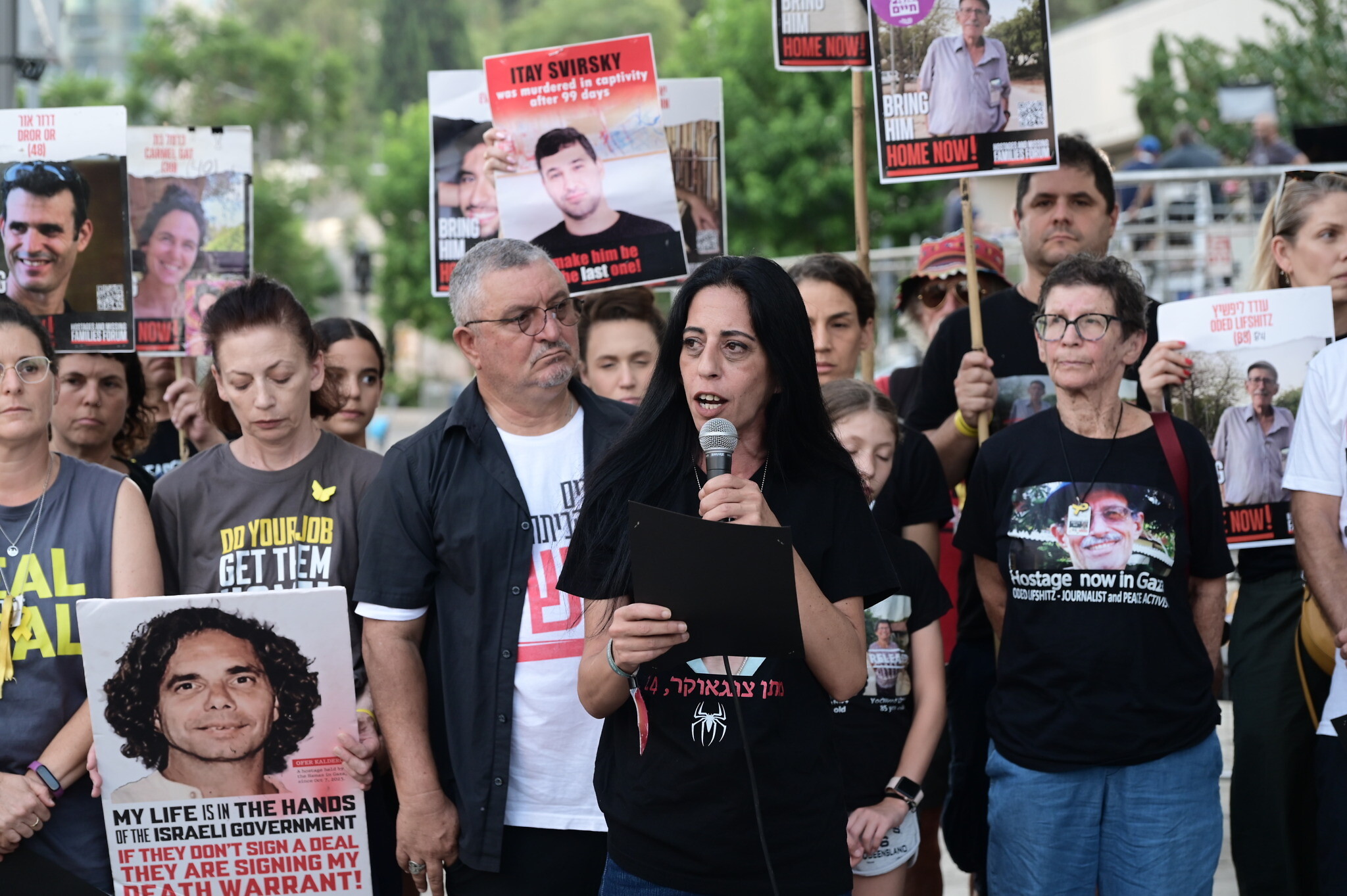
Einav Zangauker, whose son Matan is held hostage by Hamas in Gaza, calls for a hostage-ceasefire deal and the ouster of Prime Minister Benjamin Netanyahu, alongside other families of hostages in Tel Aviv on September 7, 2024. (Avshalom Sassoni/Flash90)
In two separate statements, Einav Zangauker calls on the public to take to the streets tonight, to pressure the government to close a deal to free her son Matan Zangauker and the other 96 hostages held by Hamas in Gaza since October 7.
She calls Prime Minister Benjamin Netanyahu “Mr. Death,” says he is acting as “a criminal against his people,” and claims the only way to attain a hostage deal is to oust him.
“My friends, we are in a time of crisis. Netanyahu has decided to give up the hostages and bury my Matan in the tunnels, on the altar of his political survival,” she says in an initial video statement.
Zangauker charges that the prime minister is motivated by his own interests rather than national security concerns, amid reports that the premier is prioritizing keeping forces on the Philadelphi Corridor between Gaza and Egypt over bringing back the hostages.
Masses took to the streets earlier in the week in the wake of the murder of six hostages in a Gaza tunnel amid Netanyahu’s demand to keep the IDF on the Gaza-Egypt border, a core obstacle to a deal.
“There is only one way to save the hostages and that is incessant public pressure on Netanyahu and his coalition. It’s time to shake up the country and shake Netanyahu’s chair! Join us tonight for a long night of struggle at Begin Street in Tel Aviv. We won’t be able to recover as a country and as a society if we do not bring them home,” she says.
Tens of thousands of Israelis are set to rally around the country for a hostage deal and new elections tonight as pressure grows on the government to reach an agreement with Hamas in Gaza.
In a second statement, as people begin to gather for tonight’s rallies, Zangauker calls on the public and members of the coalition to push for Netanyahu’s ouster to save the hostages and the country. She says Netanyahu’s focus on keeping the IDF at Philadelphi is “spin” and that he is cold-bloodedly sabotaging a deal.
More military pressure in Gaza will only kill the hostages, she says, and charges that the prime minister is “prepared for the hostages to be killed in captivity.”
“Netanyahu’s hands are covered with the blood” of the hostages murdered by Hamas. “They could have been saved in all the deals he sabotaged… The remaining hostages can still be saved.”
“So long as Netanyahu is in power, we will continue to get hostages in body bags,” she claims. “Netanyahu must be ousted to save the hostages and the entire state.”
IDF, Shin Bet: Two Islamic Jihad commanders killed in strike on command room in central Gaza on Thursday
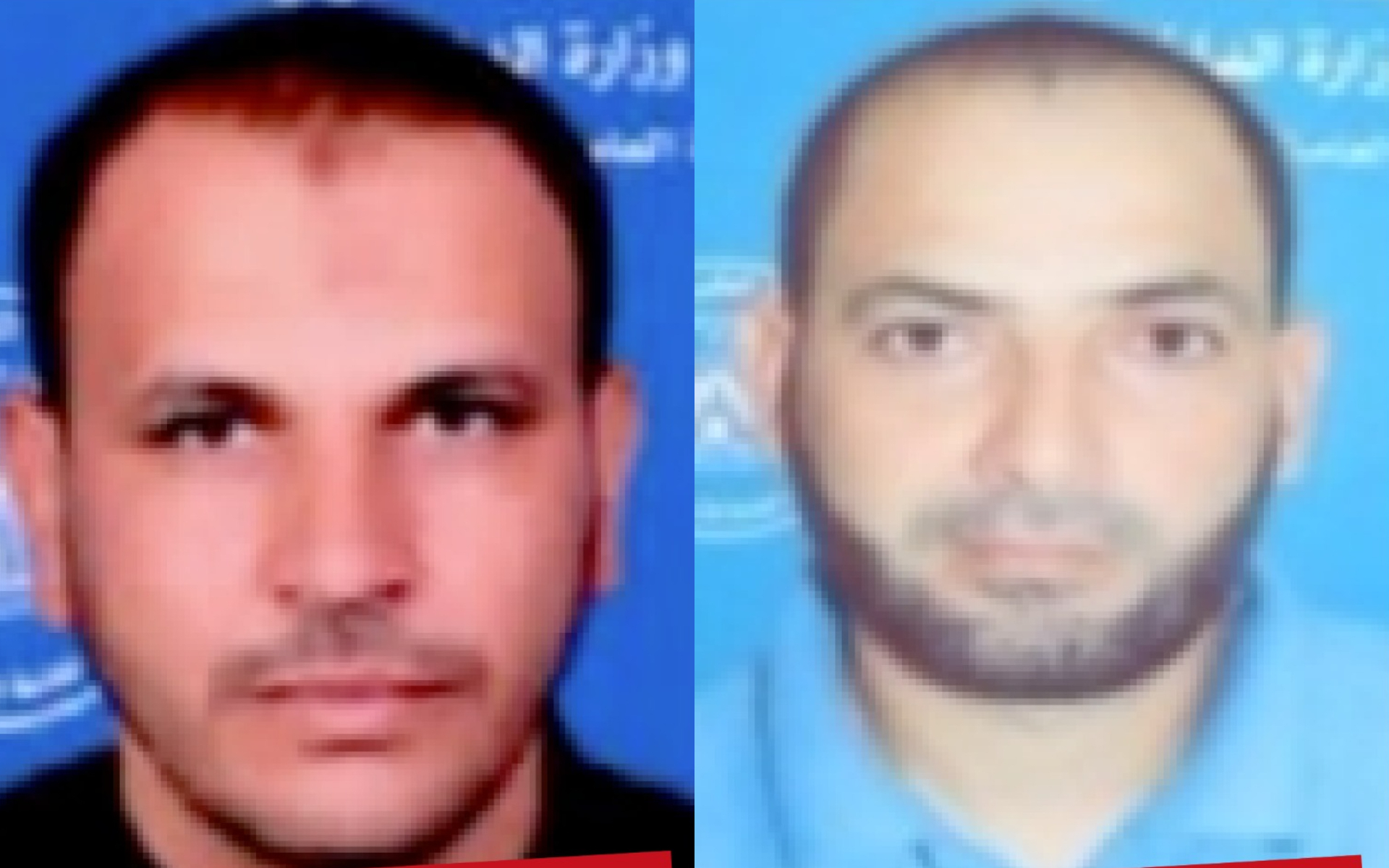
Abdullah Khattab, the commander of PIJ's South Deir al-Balah Battalion (left) and Hatem Abu al-Jidyan, the commander of PIJ's East Deir al-Balah Battalion (right), in handout images issued by the IDF on September 7, 2024. (Israel Defense Forces)
Two Palestinian Islamic Jihad battalion commanders were killed in an Israeli airstrike in the Gaza Strip on Thursday, the IDF and Shin Bet announce.
The strike targeted a command room embedded within the Israeli-designated humanitarian zone in central Gaza’s Deir al-Balah, according to the military.
Several terror operatives were killed in the strike, including Abdullah Khattab, the commander of PIJ’s South Deir al-Balah Battalion, and Hatem Abu al-Jidyan, the commander of PIJ’s East Deir al-Balah Battalion, the IDF and Shin Bet say.
The IDF says Khattab had oversaw his battalion during the October 7 onslaught, and was involved in numerous attacks on Israel and troops, including rocket fire and anti-tank fire.
Abu al-Jidyan also advanced numerous attacks against troops amid the ongoing fighting.
To mitigate harm to civilians in the strike, the IDF says it carried out “many steps,” including using precision munitions, aerial surveillance, and other intelligence.
“This is another example of the systematic use by the terror organizations in the Gaza Strip of the population and civilian infrastructure, including the humanitarian zone, to carry out terror acts against the state and IDF troops,” the military adds.
Former Hamas hostage: Footage of tens of thousands protesting ‘filled me with hope’ during captivity in Gaza

Sapir Cohen, who was kidnapped by Hamas on October 7 and held hostage for 55 days, holds up a poster of her boyfriend Sasha Trufanov, still held in Gaza, during an event at Yeshiva University's Stern College for Women on August 27, 2024, in New York City. (Michael M. Santiago/Getty Images/AFP)
Former Hamas hostage Sapir Cohen encourages the public to take to the streets tonight, saying the one thing that gave her hope during her five-week captivity in Gaza was the sight of “tens of thousands of people, all united, and all with one common goal: to bring us home alive.”
“Every day, I think about all the hostages and my partner Sasha [Trufanov] who remain behind. I remember those dark and difficult days when I lay in a tunnel, curled up from hunger. But one day, I was filled with hope. That was the day I saw you on television,” she says in a statement from the Hostages Families Forum ahead of mass rallies planned across the country.
Cohen, 29, was one of 105 hostages released from Gaza as part of an extension of a temporary cease-fire deal in November. She was kidnapped from Kibbutz Nir Oz during Hamas’s October 7 massacre, along with her boyfriend, his mother, and his grandmother.
“You gave me the strength to carry on, and I ask you to take to the streets and continue to strengthen all the hostages who remain behind.”
Speakers at the weekly Tel Aviv rally this evening will include Andrey Kozlov, a former hostage rescued from Gaza in an IDF operation; former hostage Danielle Aloni who was released along with her young daughter Emilia during the November ceasefire and Shay Dickmann, cousin of Carmel Gat, whose murder was announced by the IDF earlier this week along with five other hostages.
A parallel rally in Jerusalem will include Ella Mor, aunt of former hostage 4-year-old Avigail Idan whose parents were murdered on October 7 and Moshe Shapira, father of Aner Shapira, who fended off seven grenades from a bomb shelter near the Nova party on October 7 before he was killed, and was the best friend of Hersh Goldberg-Polin, who was one of the six hostages murdered last week.
It is believed that 97 of the 251 hostages abducted by Hamas on October 7 remain in Gaza, including the bodies of at least 33 confirmed dead by the IDF.
Turkey’s Erdogan calls for Islamic countries to ally against ‘growing threat of expansionism’ from Israel
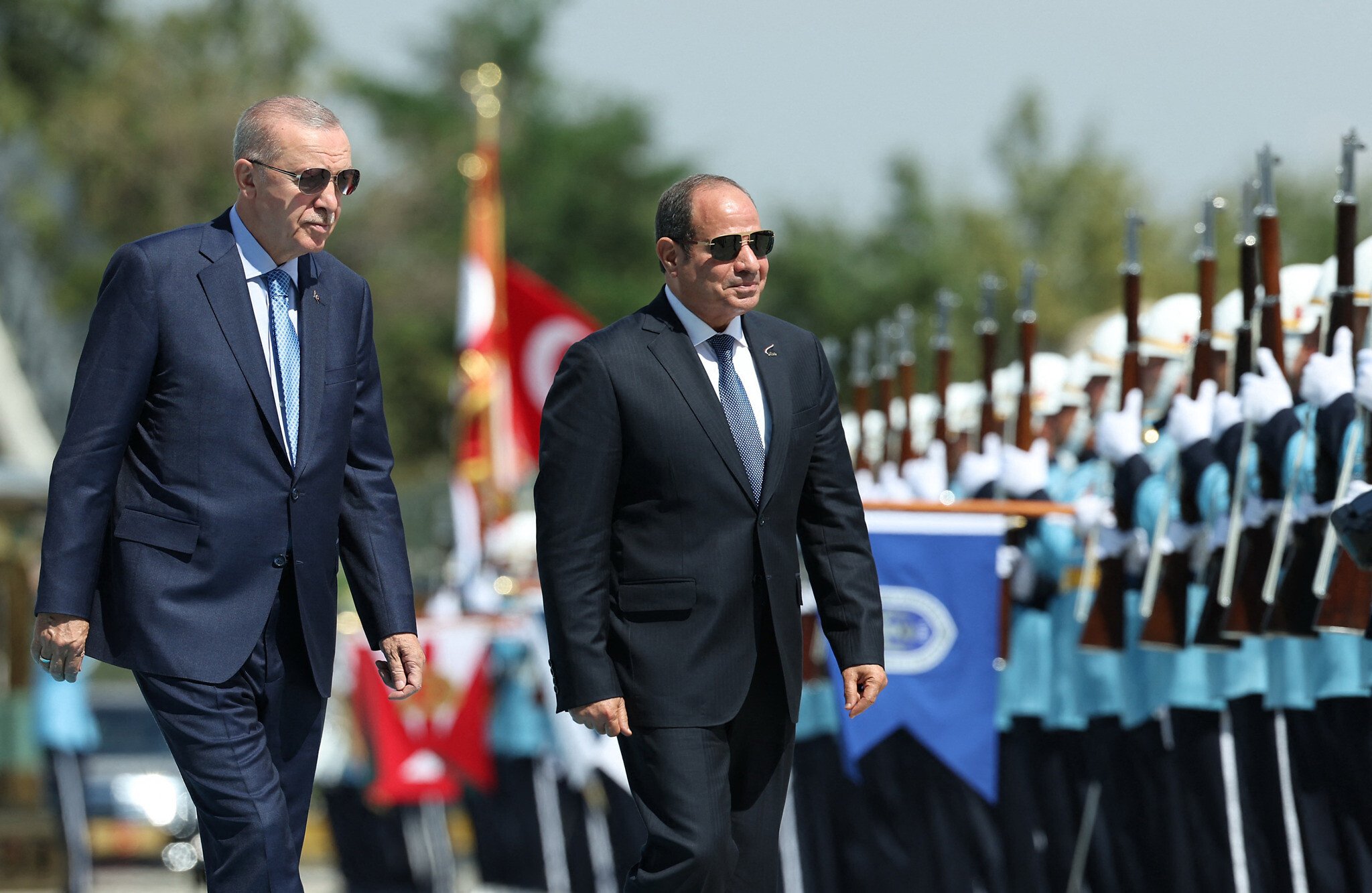
This handout photograph taken and released by the Turkish Presidency Press Office on September 4, 2024, shows Turkey's President Recep Tayyip Erdogan and Egypt's President Abdel Fattah al-Sisi in Ankara. (Handout/Turkish Presidential Press Service/AFP)
ISTANBUL – Turkish President Recep Tayyip Erdogan calls for Islamic countries to ally against what he calls “the growing threat of expansionism” from Israel.
His comments come after describing what Palestinian and Turkish officials say was the killing by Israeli troops of a Turkish-American woman taking part in a protest on Friday against settlement expansion in the West Bank.
“The only step that will stop Israeli arrogance, Israeli banditry, and Israeli state terrorism is the alliance of Islamic countries,” Erdogan says at an Islamic schools’ association event near Istanbul.
He says recent steps that Turkey has taken to improve ties with Egypt and Syria are aimed at “forming a line of solidarity against the growing threat of expansionism,” which he says also threatens Lebanon and Syria.
Erdogan hosted Egyptian President Abdel Fattah al-Sisi in Ankara this week and they discussed the ongoing Gaza war and ways to further repair their long-frozen ties during what was the first such presidential visit in 12 years.
Ties between them started thawing in 2020 when Turkey began diplomatic efforts to ease tensions with estranged regional rivals, including the United Arab Emirates and Saudi Arabia.
There is no immediate comment from Israel on Erdogan’s remarks.
Lebanese FM tells Al Jazeera: Israel sent a message that it doesn’t want a ceasefire, even after Gaza truce
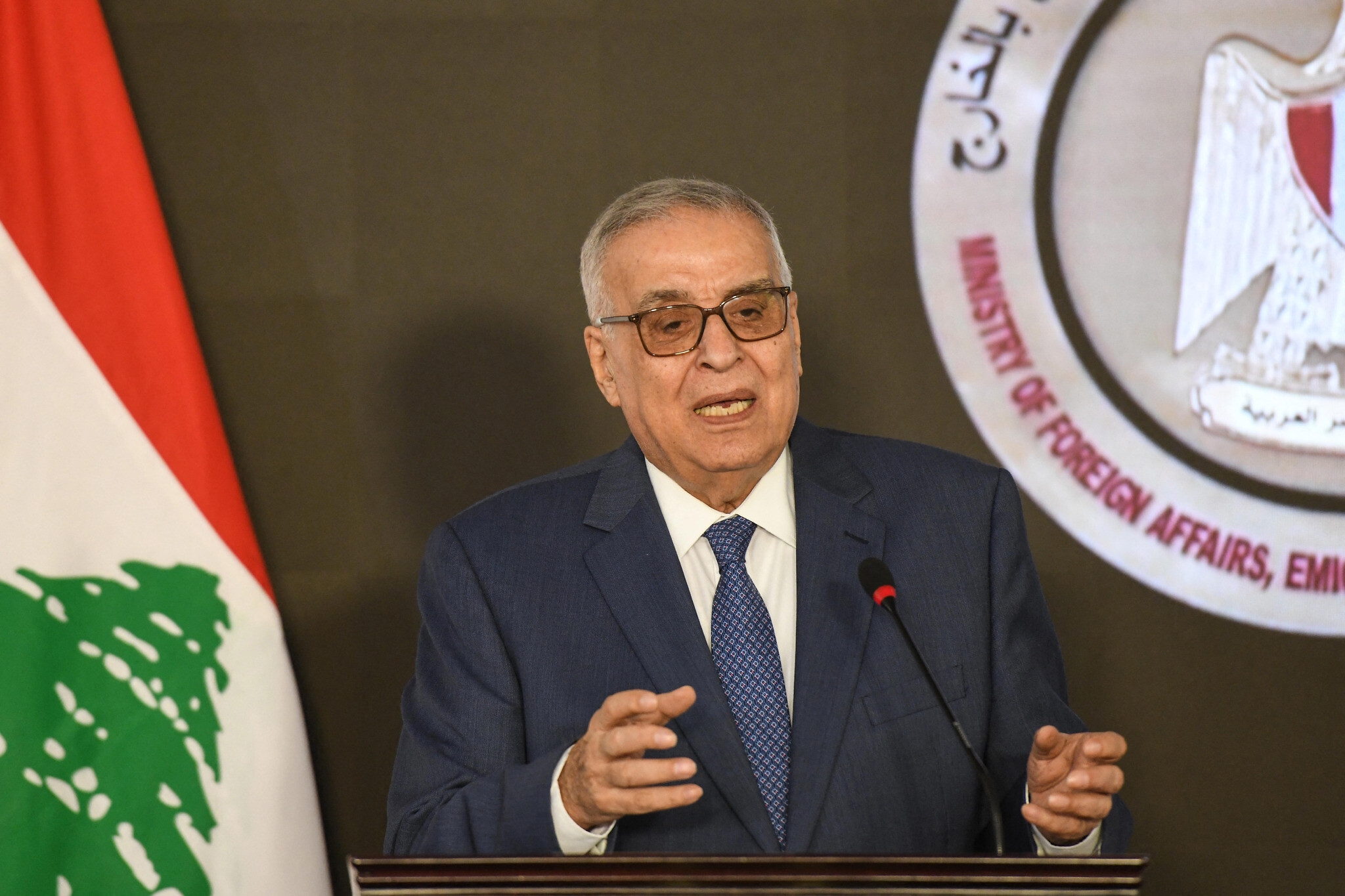
Lebanese Foreign Minister Abdallah Bouhabib speaks during a joint news conference after a meeting with his Egyptian counterpart in Egypt's new administrative capital on August 6, 2024. (Ahmed Hasan/AFP)
Lebanon’s foreign minister tells Al Jazeera that Israel has relayed a message to Beirut that it does not want a ceasefire, regardless of whether it reaches a hostage-truce deal with Hamas in Gaza.
“Israel sent us a message through intermediaries, making it clear that they are not interested in a ceasefire in Lebanon, even after a ceasefire is reached in Gaza. Israel is determined to continue the war in the north,” Abdullah Bouhabib tells the Qatari network.
Hezbollah-led forces have attacked Israeli communities and military posts along the border with Lebanon on a near-daily basis since October 8, with the group saying it is doing so to support Gaza amid war ongoing there since October 7.
So far, the skirmishes have resulted in 26 civilian deaths on the Israeli side, as well as the deaths of 20 IDF soldiers and reservists. There have also been several attacks from Syria, without any injuries.
Hezbollah has named 433 members who have been killed by Israel during the ongoing skirmishes, mostly in Lebanon but some also in Syria. Another 76 operatives from other terror groups, a Lebanese soldier, and dozens of civilians have also been killed.
Israel has warned it can no longer tolerate Hezbollah’s presence along its border following the October 7 atrocities and has warned that should a diplomatic solution not be reached, it will turn to military action to push Hezbollah northward.
Drone sirens sounding in northern communities near Lebanon border
Sirens are sounding in northern communities near the border with Lebanon, warning of incoming drones.
The alerts can be heard in the towns of Ayelet HaShachar and Yiftach.
🚨✈️ Drone Alerts [18:46]:
07/09/2024 18:46:32:
• Upper Galilee – Ayelet HaShachar07/09/2024 18:46:45:
• Confrontation Line – Iftach pic.twitter.com/amIKyIflFX— ILRedAlert (@ILRedAlert) September 7, 2024
Former IDF chief joins hostage rally in Rehovot; cyclists wear orange shirts in Tel Aviv for Bibas family
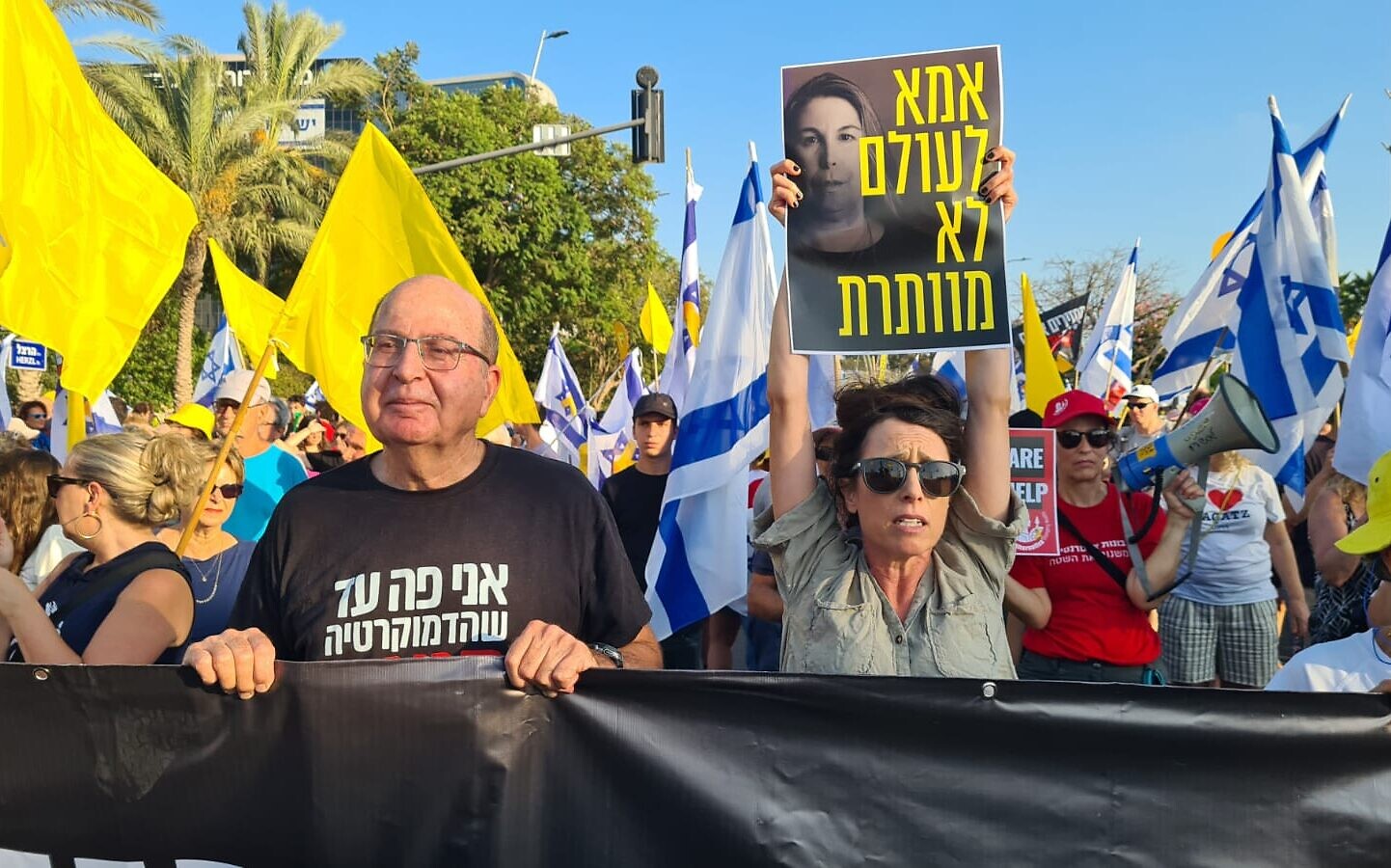
Former IDF chief of staff Moshe Ya'alon joins a protest in the central city of Rehovot calling on the government to close a hostage-ceasefire deal with Hamas, September 7, 2024. (Pro-Democracy Movement/Meir Conforti)
Moshe Ya’alon, a former IDF chief of staff who served as a Likud defense minister under Prime Minister Benjamin Netanyahu but is now a major critic, joins a protest in the central city of Rehovot calling on the government to close a hostage-ceasefire deal with Hamas.
Ya’alon leads the protest march along with relatives of hostages held by Hamas since October 7, holding a sign that reads, “Until they’re home, we’re in the streets.”
Further north, protesters block the HaOgen Junction in Netanya the Karkur junction at Pardes Hanna.
In Tel Aviv, dozens of cyclists ride wearing orange t-shirts in honor of Yarden and Shira Bibas and their two young sons, who were kidnapped from their home on Kibbutz Nir Oz on October 7 and have been held in Gaza since.
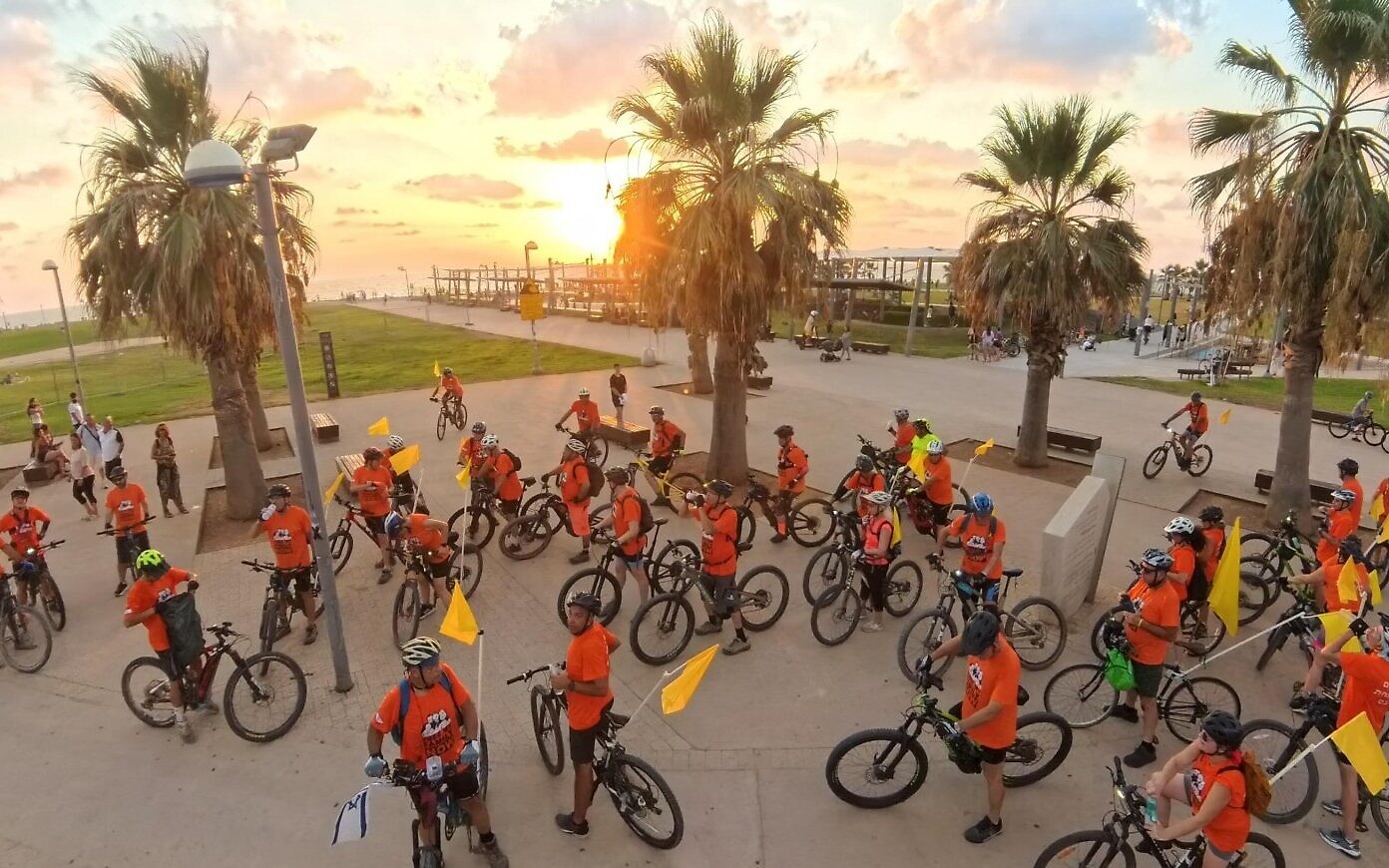
Tens of thousands of Israelis are set to rally around the country for a hostage deal and new elections this evening as pressure grows on the government to reach an agreement with Hamas in Gaza.
IDF: Drone sirens in northern towns a short while ago were ‘false identifications’
Suspected drone infiltration sirens that sounded in northern communities near the border with Lebanon a short while ago were determined to have been a “false identification,” the IDF says, meaning not a threat.
Rocket, drone sirens sounding again in northern border communities
Sirens are blaring in several northern communities near the border with Lebanon, warning of incoming rocket fire and drone infiltration.
The alerts are sounding in the largely evacuated towns and cities including Ayelet Hashachar, Sde Eliezer, Ramot Naftali, Mevo’ot Hermon Regional Council and Yiftach.
✈️ Hostile Aircraft Intrusion [19:23:39] (4):
• Confrontation Line — Mevuot Hermon Regional Council, Ramot Naftali
• Upper Galilee — Sdeh Eliezer, Ayelet HaShachar
Population: 3,100 pic.twitter.com/oh4ZNlZFl1— ILRedAlert (@ILRedAlert) September 7, 2024
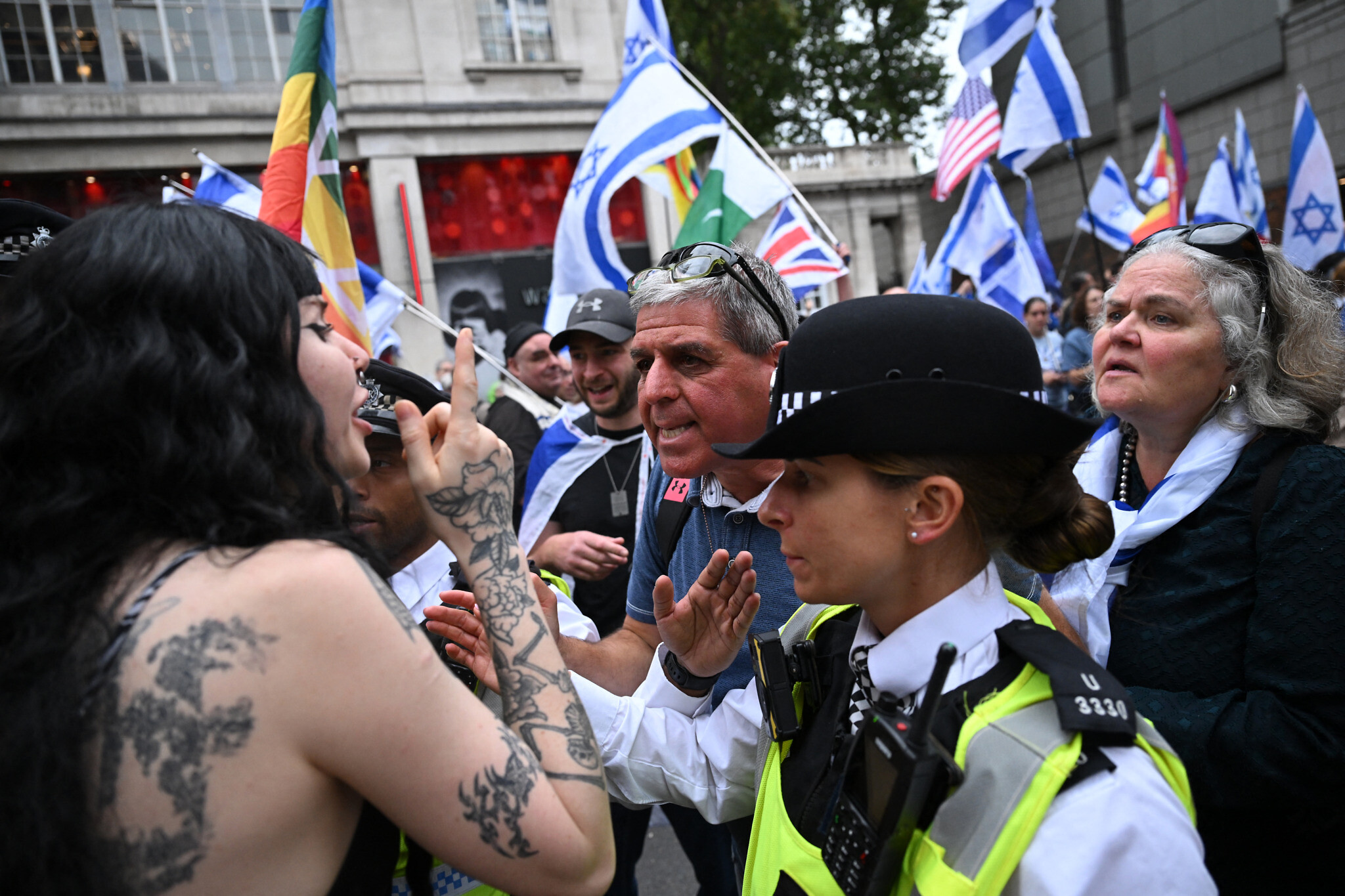
‘For Israel, against antisemitism’: Counter-protest at London embassy amid mass anti-Israel rally
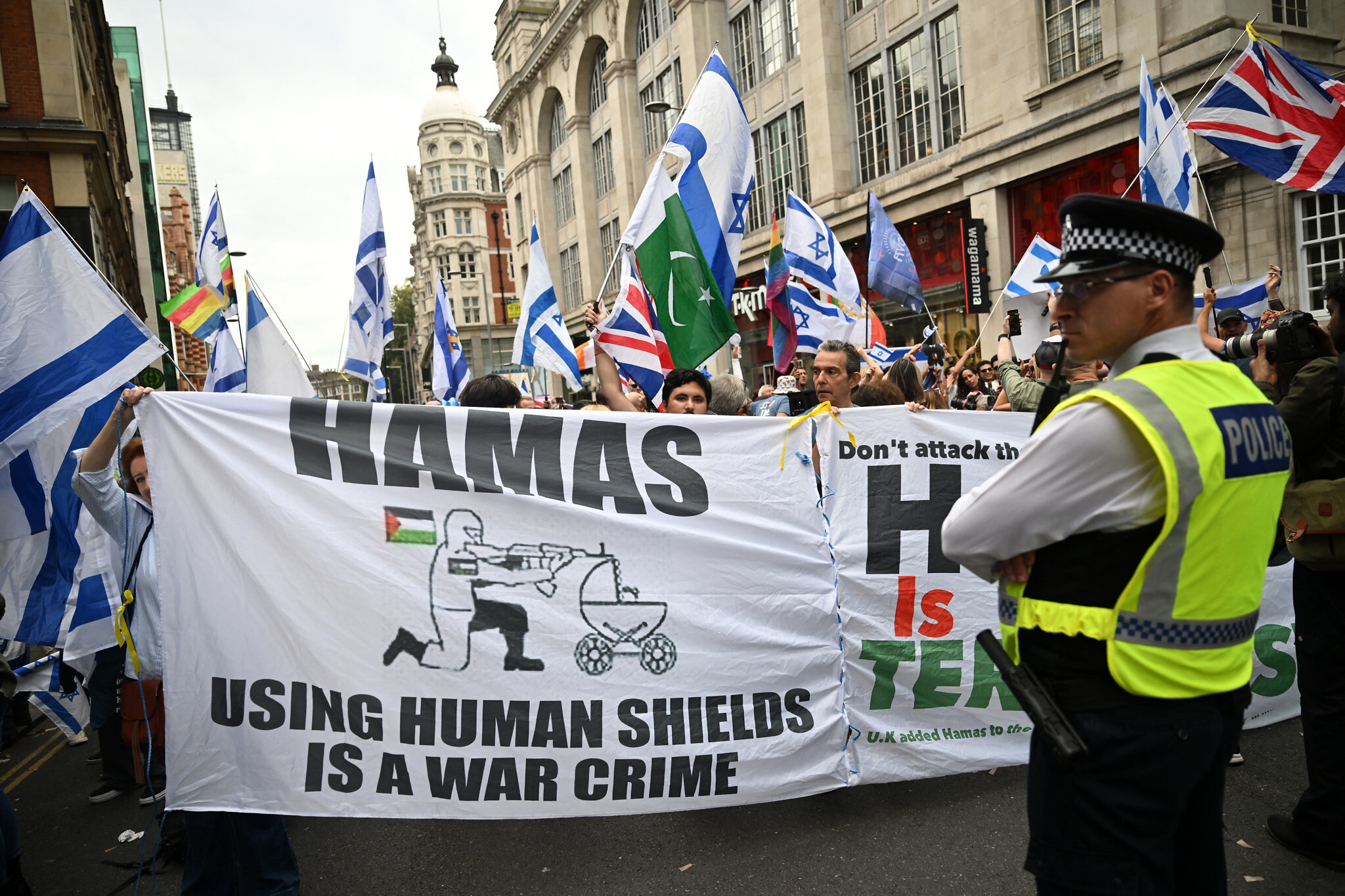
Police officers stand on duty by a Pro-Israel counter demonstration following a National Day of Action for Palestine march, in London on September 7, 2024. (Justin Tallis/AFP)
A small pro-Israel counter-protest is set up outside the Israel Embassy in London, as tens of thousands of anti-Israel protesters march through the city toward the mission.
Pro-Israel activists hold signs reading, “Hamas – using human shields is a war crime” and “For Israel, against antisemitism,” while some anti-Israel, pro-Palestinian protesters chant “From the river to sea,” and hold signs calling Prime Minister Benjamin Netanyahu “Satanyahoo.”
A large police presence can be seen at the mass demonstration. Six arrests have been made so far, the UK’s Metropolitan Police writes on X.
Photos from the demonstration show officers breaking up skirmishes between the two protest groups.
WATCH: IDF releases footage of recent engagement with terror operatives in southern Gaza’s Rafah
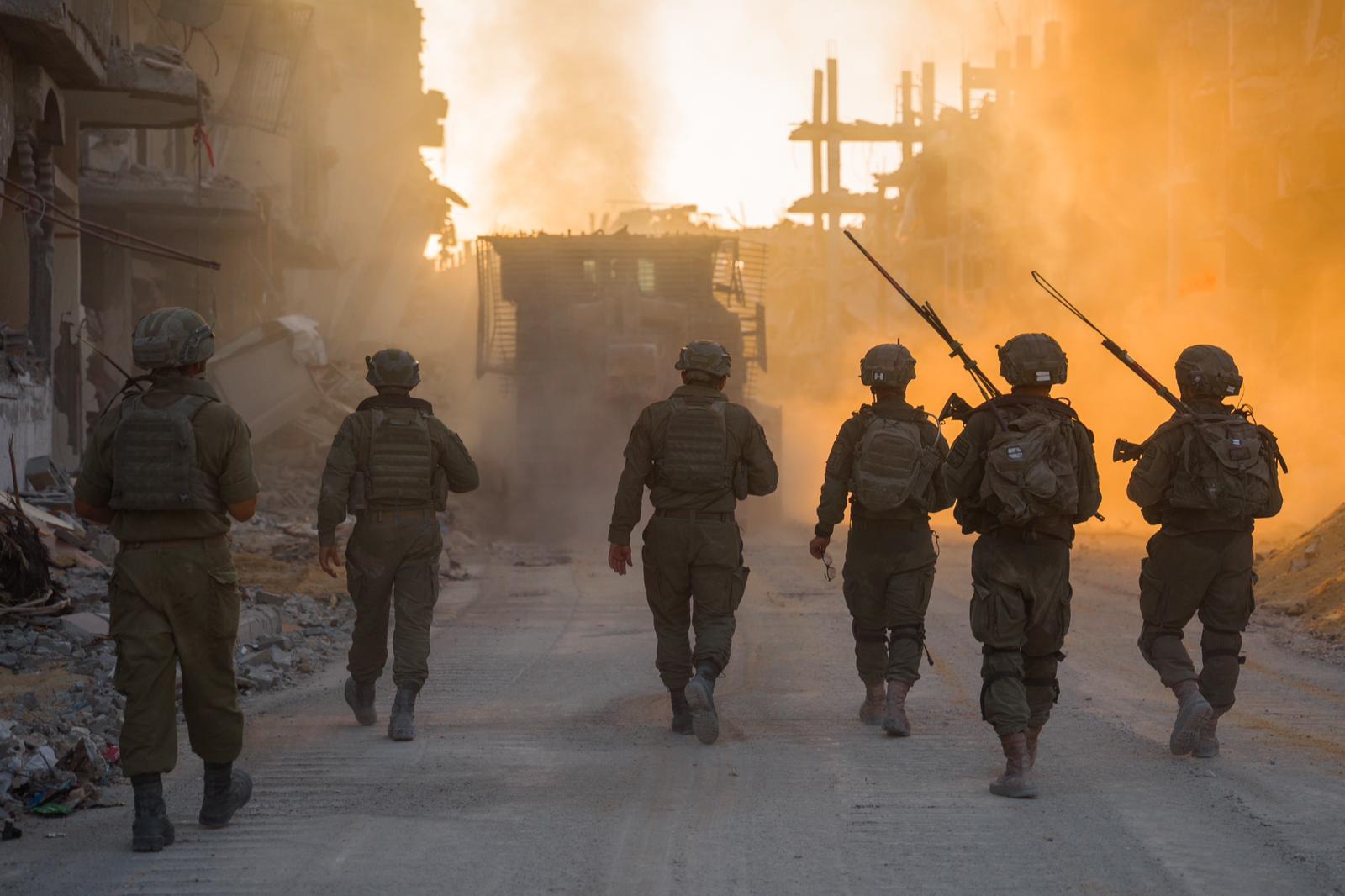
IDF troops with the 162nd Division are seen operating in the Tel Sultan neighborhood of Rafah in the southern Gaza Strip in this handout photo published on September 7, 2024. (Israel Defense Forces)
The IDF releases footage from a recent engagement with gunmen in the Tel Sultan neighborhood of Rafah in the southern Gaza Strip.
Troops of the Nahal Brigade’s 932nd Battalion raided a building where a group of terror operatives were holed up. Amid the raid, the gunmen hurled a grenade at the troops, wounding at least one of the soldiers.
The IDF says the troops returned fire, killing the gunmen. On their bodies, the soldiers found weapons and documents, the military adds.
In recent days, the IDF says troops with the 162nd Division have killed dozens of gunmen in Tel Sultan.
Lebanon says three emergency workers killed in Israel strike in southern Lebanon

Smoke rises in the southern Lebanese Marjayoun plain after being hit by Israeli shelling on September 7, 2024. The northern Israeli town of Metula can be seen in the background. (Rabih Daher/AFP)
Lebanon’s health ministry says three emergency personnel putting out fires in south Lebanon have been killed and two others wounded in an Israeli strike.
“Israeli enemy targeting of a Lebanese civil defense team that was putting out fires sparked by the recent Israeli strikes in the village of Froun led to the martyrdom of three emergency responders,” the Lebanese health ministry says in a statement.
Two others were wounded, one of them critically, the statement says, adding, however, that the toll was provisional.
There are no immediate comments from the IDF on the strike.
The health ministry “condemns this blatant Israeli attack that targeted a team from an official body of the Lebanese state,” the Lebanese statement says.
Earlier in the day, the Lebanon-based Hezbollah terror group took responsibility for a string of attacks on Israeli troops and positions near the border, including with Katyusha rockets, some in stated response to “Israeli enemy attacks” on south Lebanon.
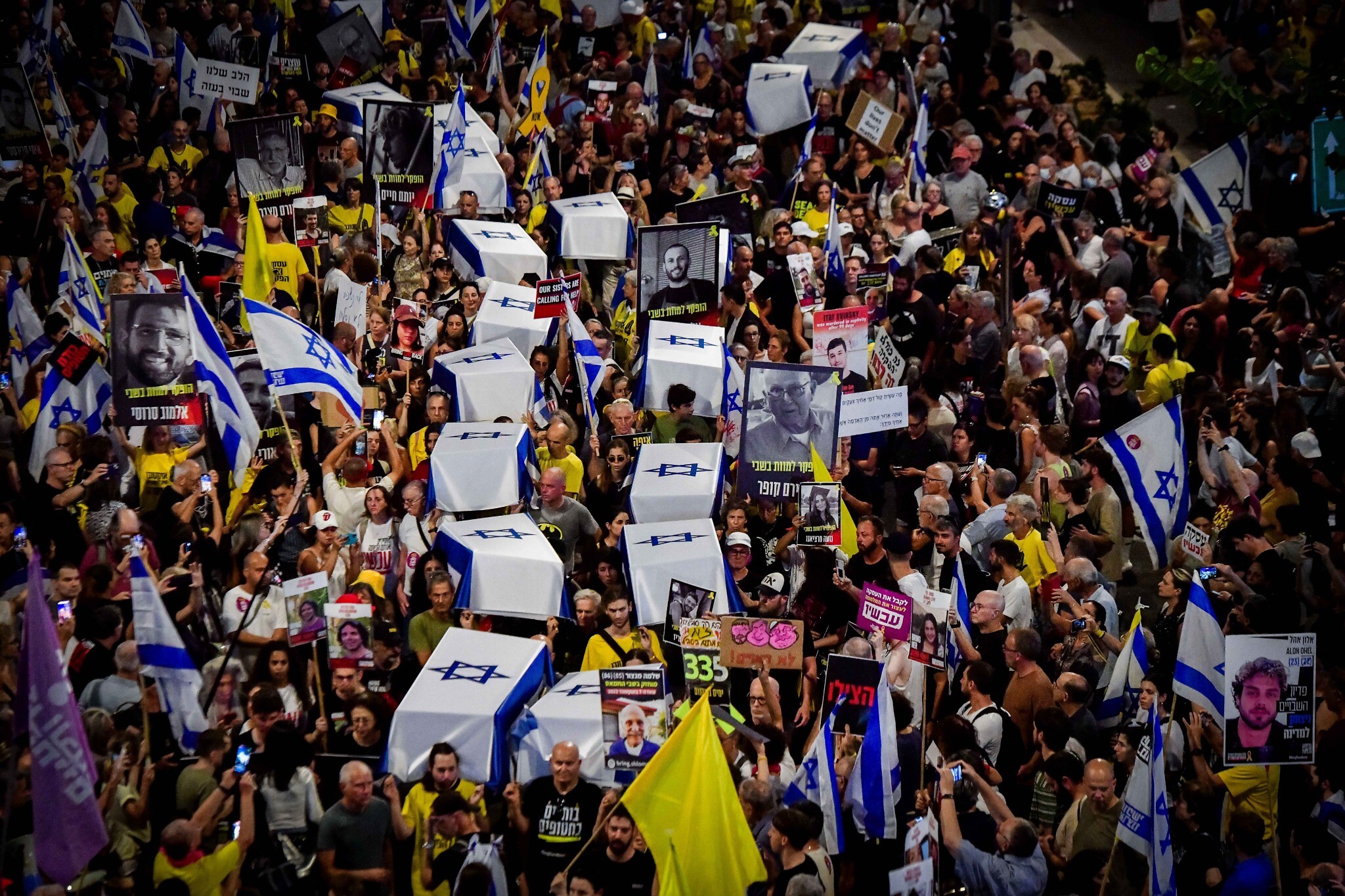
‘Why are they still in Gaza?’: At least 400,000 expected as mass hostage rally begins in Tel Aviv
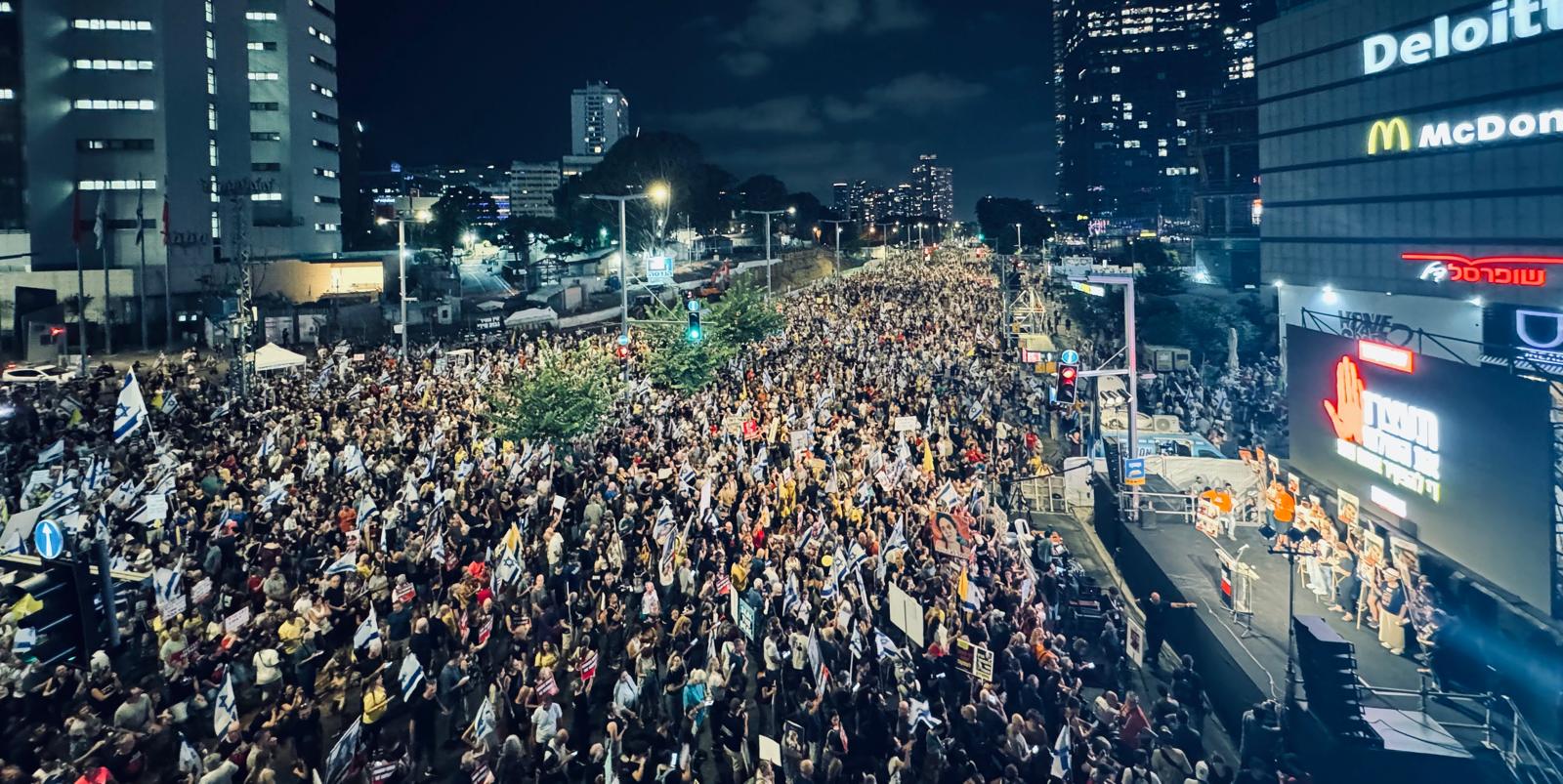
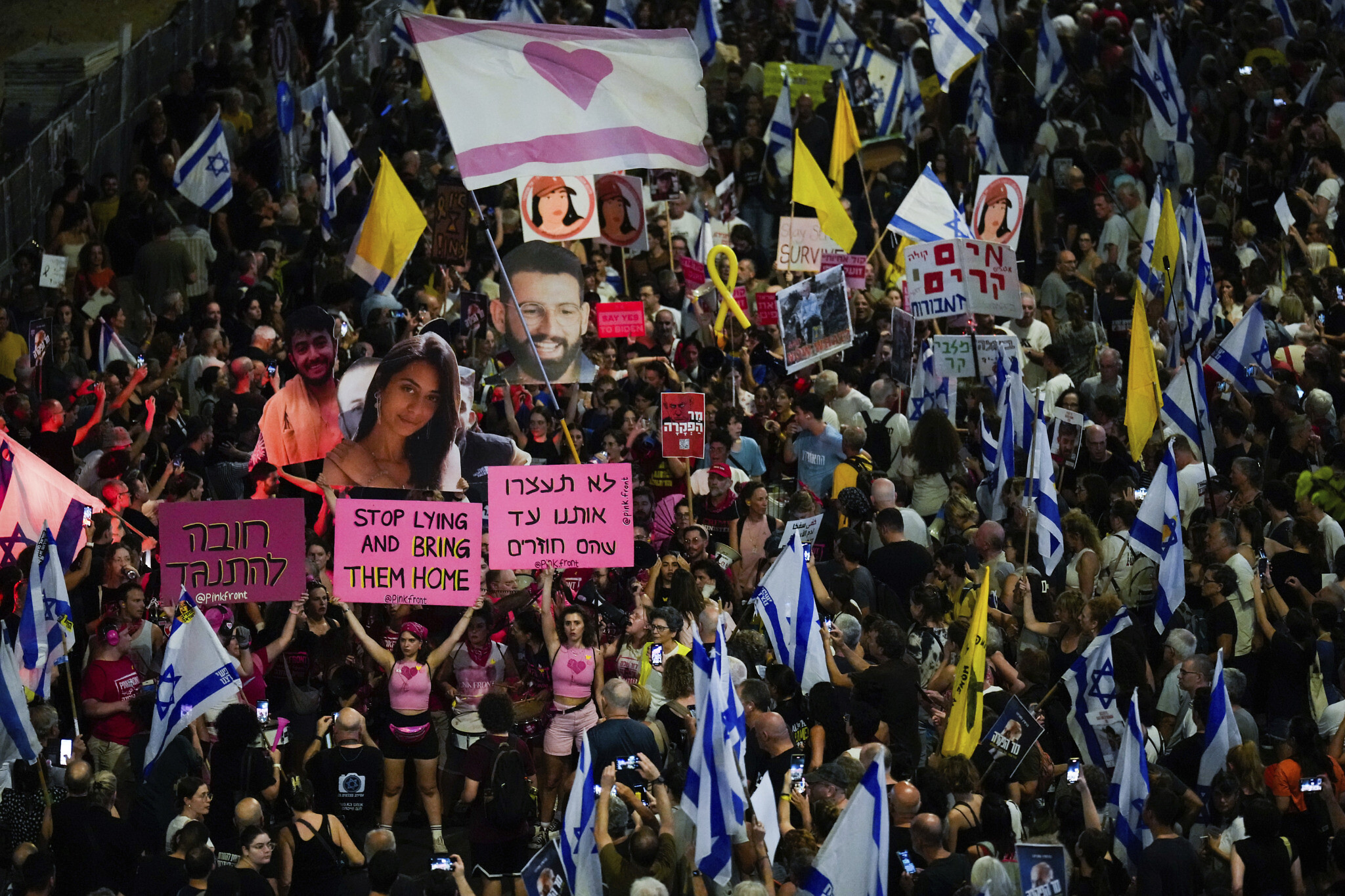
Tens of thousands gather at Tel Aviv's Begin Street for a mass rally calling on the government to close a hostage-truce deal with Hamas, September 7, 2024. (Pro-Democracy Movement/Snow)
TEL AVIV – Thousands gather on Tel Aviv’s Begin Street, outside the IDF headquarters, for the weekly protest to demand a hostages-for-ceasefire deal with Hamas.
An organizer says 400,000 people are present or set to arrive and asks the crowd to make room for thousands still to come. The tight mass of people causes disruptions in cellular reception.
The weekly protest comes after hostage-deal rallies were held daily since Sunday, when the army announced it had recovered the bodies of six hostages who had been executed by Hamas just days earlier.
The Sunday night protest, held 12 hours after the IDF announcement, drew some 300,000 protesters, and a general labor strike was called the following day.
As upbeat, anti-establishment Israeli rock music plays before the scheduled speeches, protesters shout the regular chants: “Why are they still in Gaza,” “Stop the world and save everyone,” “An agreement that’s not signed murders everyone.”
Featured speakers are set to include freed hostages Andrey Kozlov and Danielle Aloni.
Near the stage, a large flag of the Yesh Atid opposition party is set up and then taken down at an organizer’s demand: “We don’t want political parties here,” he says.
The Hostages Families Forum shares a live feed of the protest.
https://www.youtube.com/live/UE1SS8ndoYI
Smotrich: Philadelphi is not my only red line; Netanyahu’s proposed terms are dangerous for Israel
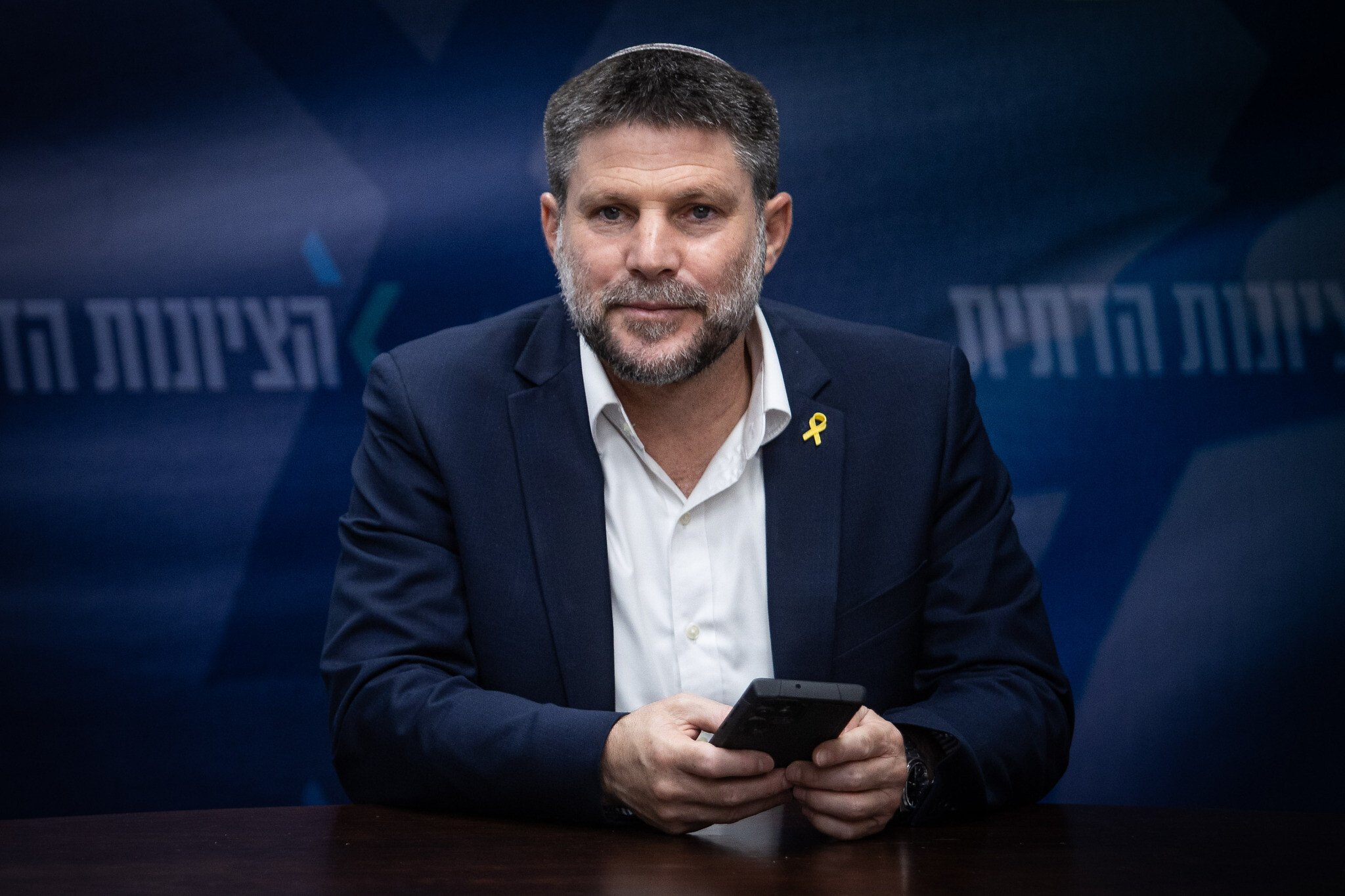
Finance Minister Bezalel Smotrich leads a faction meeting at the Knesset in Jerusalem, July 22, 2024. (Oren Ben Hakoon/ Flash90/ File)
Finance Minister Bezalel Smotrich says in a TV interview that he opposes a hostage-ceasefire deal even if it provides for Israel to maintain a presence on the Philadlphi Corridor, and argues that even the terms endorsed by Prime Minister Benjamin Netanyahu would thwart Israel’s declared war aims of destroying Hamas and returning all the hostages.
In an interview on Channel 12 news, Smotrich, head of the far-right Religious Zionism party, does not say definitively that he would bolt the coalition if such a deal advances, but notes that Netanyahu “knows my position extremely well.”
He says he has held multiple meetings with hostages’ families, including with the parents of Hersh Goldberg-Polin, one of six hostages slain by their Hamas captors last week, and firmly rejects the notion that IDF military pressure is counterproductive to attaining the release of the hostages.
Destroying Hamas and returning the hostages “are not contradictory goals,” he says.
Smotrich recalls that he has been demanding since January that Israel take charge of humanitarian aid to Gaza, and says he believes Netanyahu is “managing to impose” this demand on the IDF. This process, depriving Hamas of civil governance capacities, will “create an alternative to Hamas” and boost the chances of “a deal that Israel can live with,” he says.
He elaborates that he seeks “a deal of surrender” but “not where we surrender,” by leaving Gaza and releasing “hundreds of murderers who will go back to killing Jews.” Rather, he wants a “surrender deal where Hamas gives up its weapons [and] is booted from Gaza…” This, he says, would enable the rehabilitation of a demilitarized Gaza. Smotrich has previously made clear that he supports a return to full Israeli control of Gaza and the return of Jewish settlements there.
Asked whether he opposes even Netanyahu’s terms for a deal, Smotrich indicates he opposes all negotiations with Hamas, and that the only way to deal with Hamas is via military pressure. “If from the first day, Israel had said no negotiations, we would have won and got back the hostages,” he says.
“I very much want the hostages back, but I do not want collective suicide… No way should returning the hostages endanger the existence of Israel,” he says.
Pressed on whether Netanyahu’s updated proposal is dangerous, Smotrich rules out a deal involving the IDF’s full withdrawal from Gaza, says retaining the Philadelphi Corridor is “a minimum,” and states that history shows that releasing hundreds of murderers is dangerous.
Asked again about Netanyahu’s proposed terms, he says, “This deal
is not good for Israel. It won’t be good for security and it won’t return the hostages.” While some hostages would return, it would sentence the rest to death, he argues.
Smotrich says the war “has to end with the absolute destruction of Hamas,” and that this has vital implications for the north and for Iran.
Acknowledging that his positions are not always accepted by the government, he says, “My red lines are not only on Philadelphi” and that withdrawing from the Netzarim corridor across central Gaza, “would also be terrible” because Hamas would be able to rearm and revive in northern Gaza. He says the IDF has left large quantities of weaponry in northern Gaza that would be used against soldiers if they have to return.
Smotrich says a war is essential in the north “because we have to defeat Hezbollah and return the residents of the north to their homes.” There is
“no chance” of a satisfactory diplomatic arrangement there.
The IDF should stay in Gaza but refocus most effort on the north, he says, and ensure that Hezbollah and its infrastructure are pushed north of the Litani River.
On Defense Minister Yoav Gallant’s declared opposition to core aspects of the coalition’s war policies, he says multiple opinions in cabinet discussions are important and entirely legitimate, but when a decision is taken, there must be collective responsibility.
IDF strikes Hezbollah rocket launcher in southern Lebanon used to attack Safed earlier today
The IDF says it struck a Hezbollah rocket launcher in southern Lebanon’s Aynata this evening, used in an attack earlier today on Safed.
מטוסי קרב תקפו במרחב עינתא שבדרום לבנון והשמידו משגר של ארגון הטרור חיזבאללה ממנו שוגרו היום רקטות לשטח פתוח במרחב צפת.
בנוסף, כוחות צה"ל תקפו בארטילריה במרחבים אל עדייסא, א-נקורה, אבו שש וטיר-חרפא שבדרום לבנון>> pic.twitter.com/7XaiejcvsA
— צבא ההגנה לישראל (@idfonline) September 7, 2024
Separately, several drones were launched from Lebanon this evening at the Upper Galilee. The IDF says they impacted in northern Israel, causing no injuries.
Protesters near Netanyahu’s residence in Jerusalem wave yellow flags in plea for release of Hamas hostages
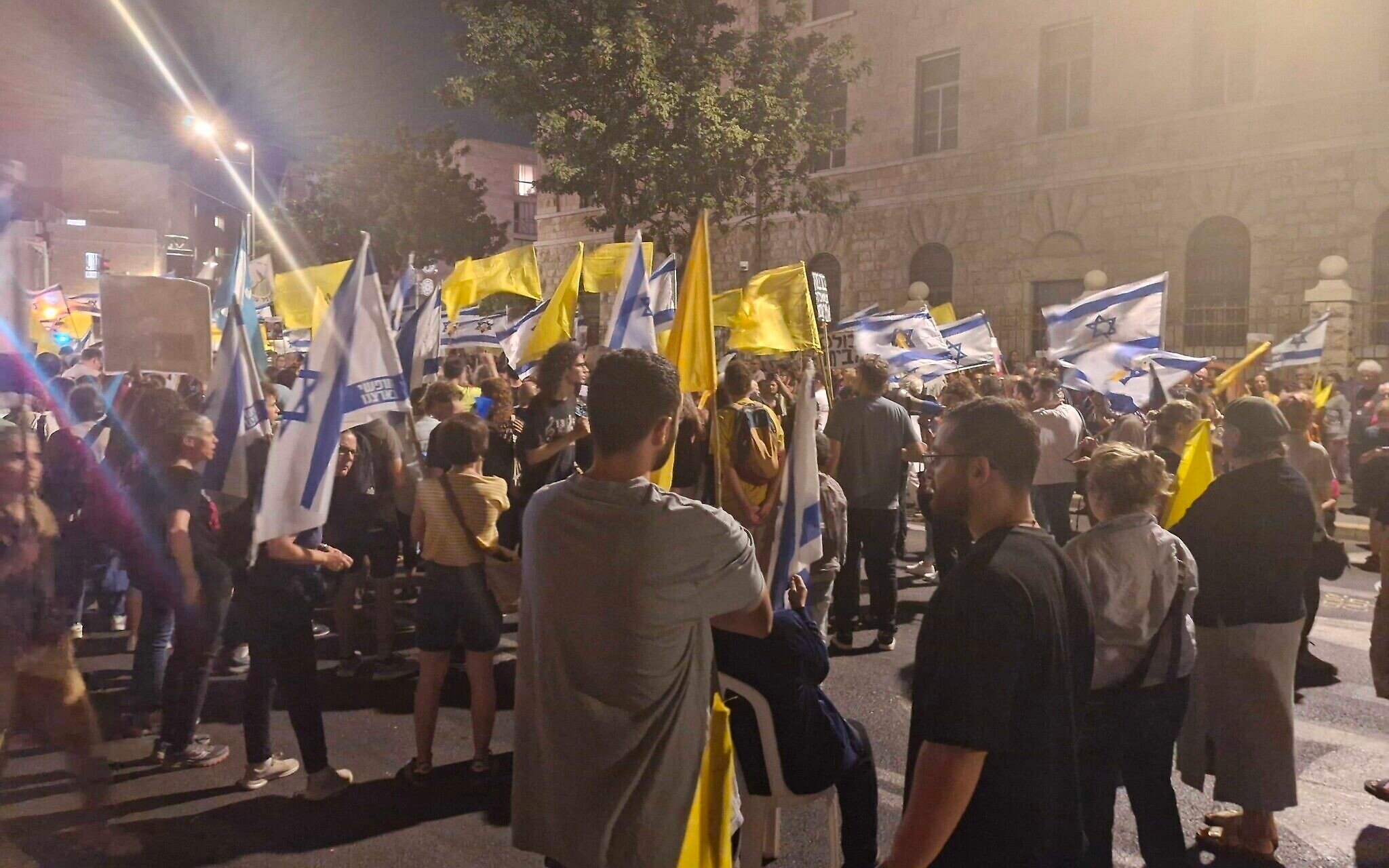
Protesters call for the release of hostages outside the prime minister's residence in Jerusalem, September 7, 2024. (Iddo Schejter/Times of Israel)
JERUSALEM — Pro-hostage-deal demonstrators are gathering outside Prime Minister Benjamin Netanyahu’s residence in Jerusalem, carrying yellow flags representing the movement for the release of hostages held by Hamas.
The protesters are chanting and calling for an end to the war, the downfall of the government, and another general strike to pressure for a deal.
“The regime’s lies won’t bring about security,” they chant.
Mother of slain IDF soldier whose body was abducted by Hezbollah meets hostage families at Nahariya rally
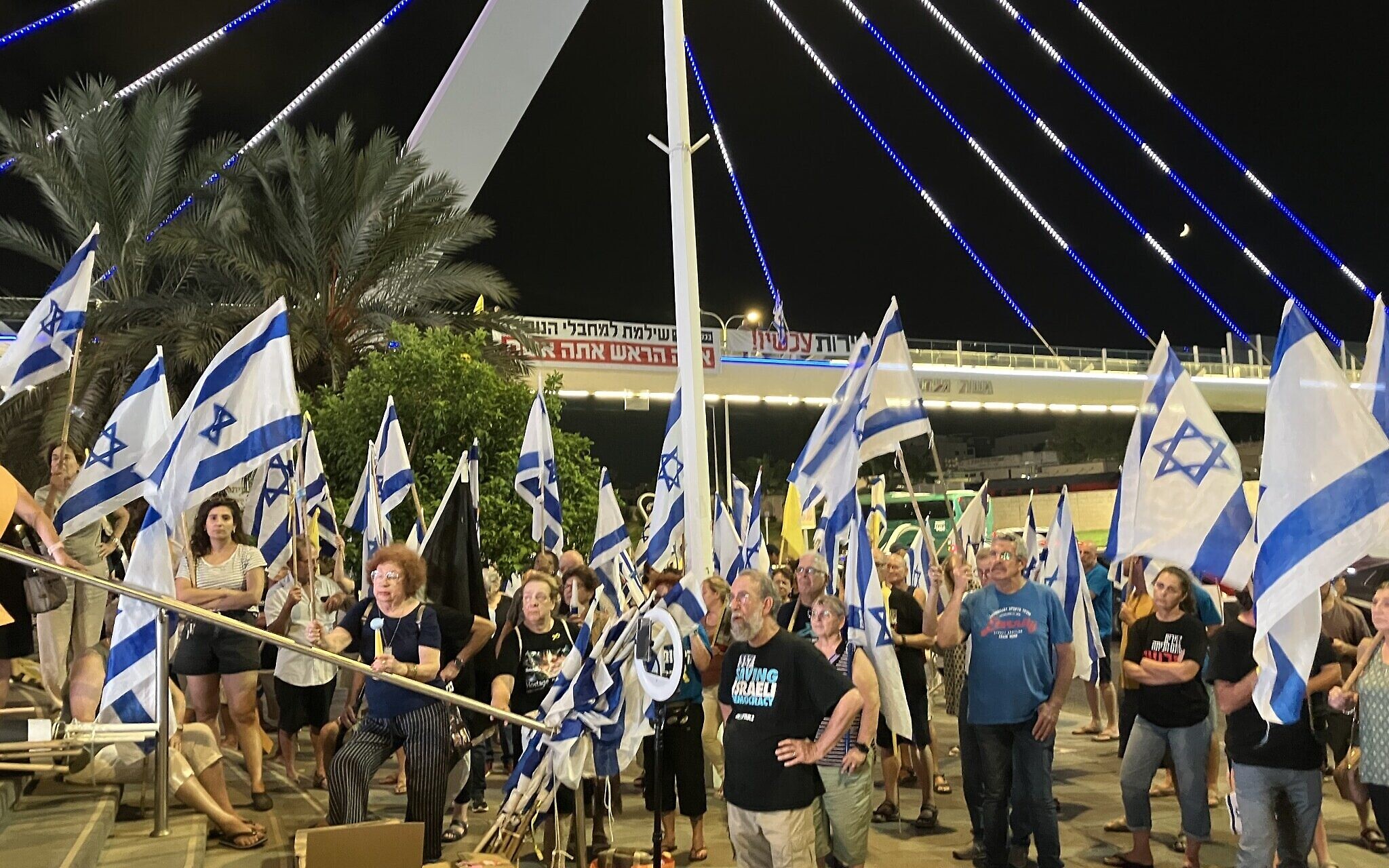
Hundreds of protesters gather in the northern city of Nahariya, calling for the government to secure a deal to free hostages held by Hamas in Gaza, September 7, 2024. (Diana Bletter/The Times of Israel)
NAHARIYA — About 200 protesters holding Israeli flags and yellow ribbons stand at the Nahariya junction in northern Israel.
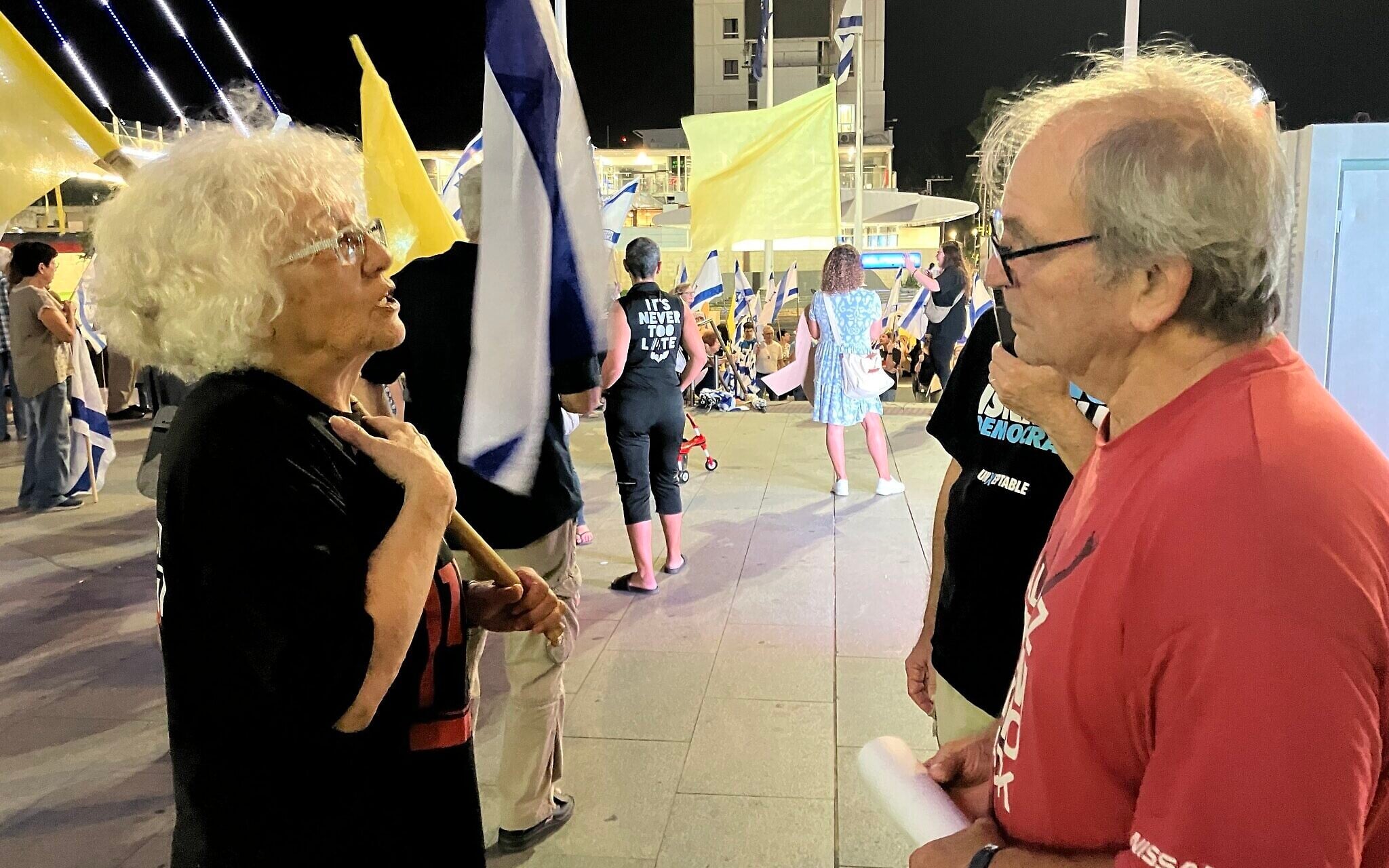
“We can’t let our indifference kill the hostages,” says Micki Goldwasser, whose son, Ehud Goldwasser, an Israeli soldier, was abducted in Israel by Hezbollah with Eldad Regev in July 2006, sparking the 2006 Lebanon War.
She introduces herself to Yehuda Beinin, whose daughter, Liat Atzili, was kidnapped by Hamas terrorists from Kibbutz Nir Oz on October 7. She was released on November 29 as part of a weeklong ceasefire deal.
Goldwasser says she can relate to Beinin’s situation, “But my son didn’t come back.”
The bodies of Goldwasser and Regev were returned to Israel in a 2008 Israel–Hezbollah prisoner exchange.
“Nothing’s changed since 2006,” Goldwasser tells The Times of Israel. “Back then, there wasn’t even budget for a camera at a critical point on the northern border.”
She says, “People were there for me then and now I’m here for others.”
Speaking at the rally, Beinin, who talked to US President Joe Biden after his daughter was released from Hamas captivity, says, “It’s not the Americans’ job to change the government in Israel, it’s our job.”
The rally ends with the singing of the Israeli national anthem, “Hatikva.”
Report: Security chiefs warn Jewish prayer on Temple Mount could trigger upsurge in West Bank, Jerusalem violence
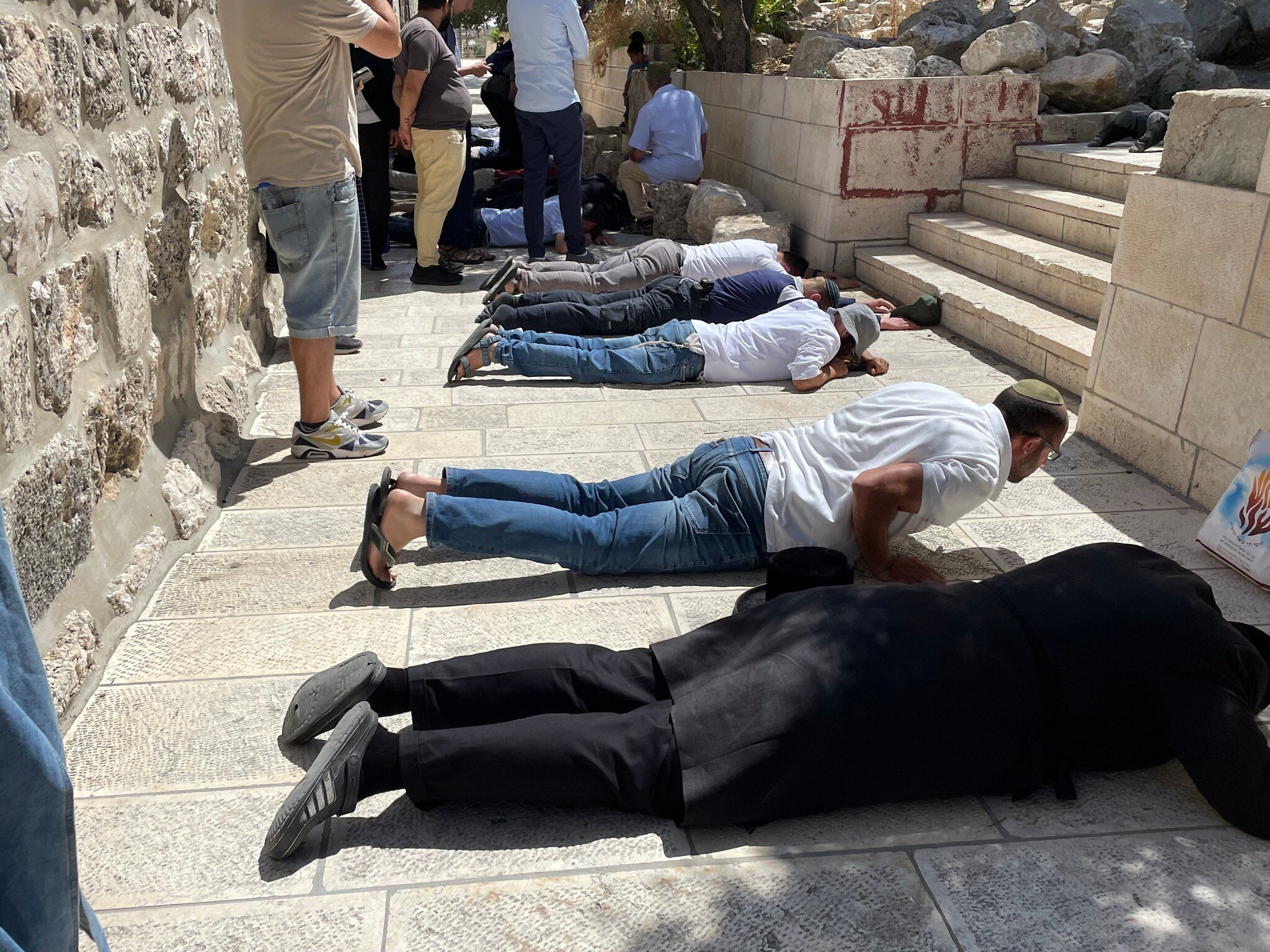
Jewish worshipers prostrate themselves on the Temple Mount during a prayer service at the holy site, August 28, 2024. (Jeremy Sharon/Times of Israel)
Israel’s security chiefs have reportedly warned the political leadership that Palestinian anger over overt Jewish prayer on the Temple Mount threatens to trigger a major escalation of violence against Israel in the West Bank and Jerusalem.
The security establishment has waved “a red flag” to alert the political echelon to the growing danger, Channel 12 reports.
The TV report says the security establishment is concerned that the police are not enforcing the “status quo” that outlaws Jewish prayer at the contested holy site, that prayer is now routinely tolerated, and that some Jewish worshippers prostrate themselves in prayer on the Mount.
National Security Minister Itamar Ben Gvir has said repeatedly in recent weeks and months that his policy is to allow Jewish prayer, and been repeatedly contradicted by Prime Minister Benjamin Netanyahu, who insists that the decades-old status quo remains in force. But the current situation atop the Temple Mount is one in which the police are enabling a “de facto change” to the status quo, the TV report notes.
Temple Mount is the holiest place in Judaism as the site of the two Biblical temples, and the site of the third holiest shrine in Islam.
The report says the security warning highlighted the particularly dangerous period in the days ahead of the High Holidays when many Jews go to the Mount.
Iran and its proxies are pushing hard to inflame the West Bank, with funding and weaponry, the report says.
It cites an increase in warnings of specific attacks in and from the West Bank, saying there have been 47 such warnings in recent days. While the IDF and Shin Bet are working to thwart such attacks, the security establishment is urging the political echelon to take steps to help “stabilize” the situation.
The IDF has already allocated significant resources to the West Bank, but there is concern that a worsening of the situation would require the allocation of primary resources to that front, with harmful implications for the war in Gaza, the north, and Israeli deterrence against Iran.
‘Absolutely possible’ Israel will soon receive new US hostage-ceasefire deal proposal — official
After CIA Director Bill Burns said a new hostage-ceasefire proposal was being finalized and would likely be presented within days, an Israeli official tells The Times of Israel that “it is absolutely possible” that Israel will soon receive a new US proposal.
“We are still waiting to see” what it contains, says the official.
Earlier today, Burns stressed that ending the conflict would require “some hard choices and some political compromises” from both Israel and Hamas.
FM says Erdogan ‘should be silent and ashamed’ for calling for Islamic alliance against Israel
After Turkish President Recep Tayyip Erdogan calls for Islamic countries to ally against what he calls “the growing threat of expansionism” from Israel, Foreign Minister Israel Katz calls him the real threat to the Middle East and his own people.
“Erdogan continues to throw the Turkish people into the fire of hatred and violence for the sake of his Hamas friends,” writes Katz on X.
He calls Erdogan’s accusation that Israel wants to conquer Middle Eastern countries “a dangerous lie and incitement.”
“Israel is defending its borders and citizens from the murderers and rapists of Hamas, and from the Shiite axis of evil led by Iran,” says Katz.
“Erdogan and the Muslim Brotherhood alliance have been working for years alongside Iran to undermine moderate Arab regimes in the Middle East.”
“Erdogan should be silent and ashamed.”
.@RTErdogan continues to throw the Turkish people into the fire of hatred and violence for the sake of his Hamas friends.
Today, he calls on Islamic nations to form an alliance against Israel, claiming "Israel wants to conquer countries in the region, including Turkey." This is… pic.twitter.com/jh5biai7vr
— ישראל כ”ץ Israel Katz (@Israel_katz) September 7, 2024
Two said hurt at Haifa hostage protest after being dragged over barbed wire by police
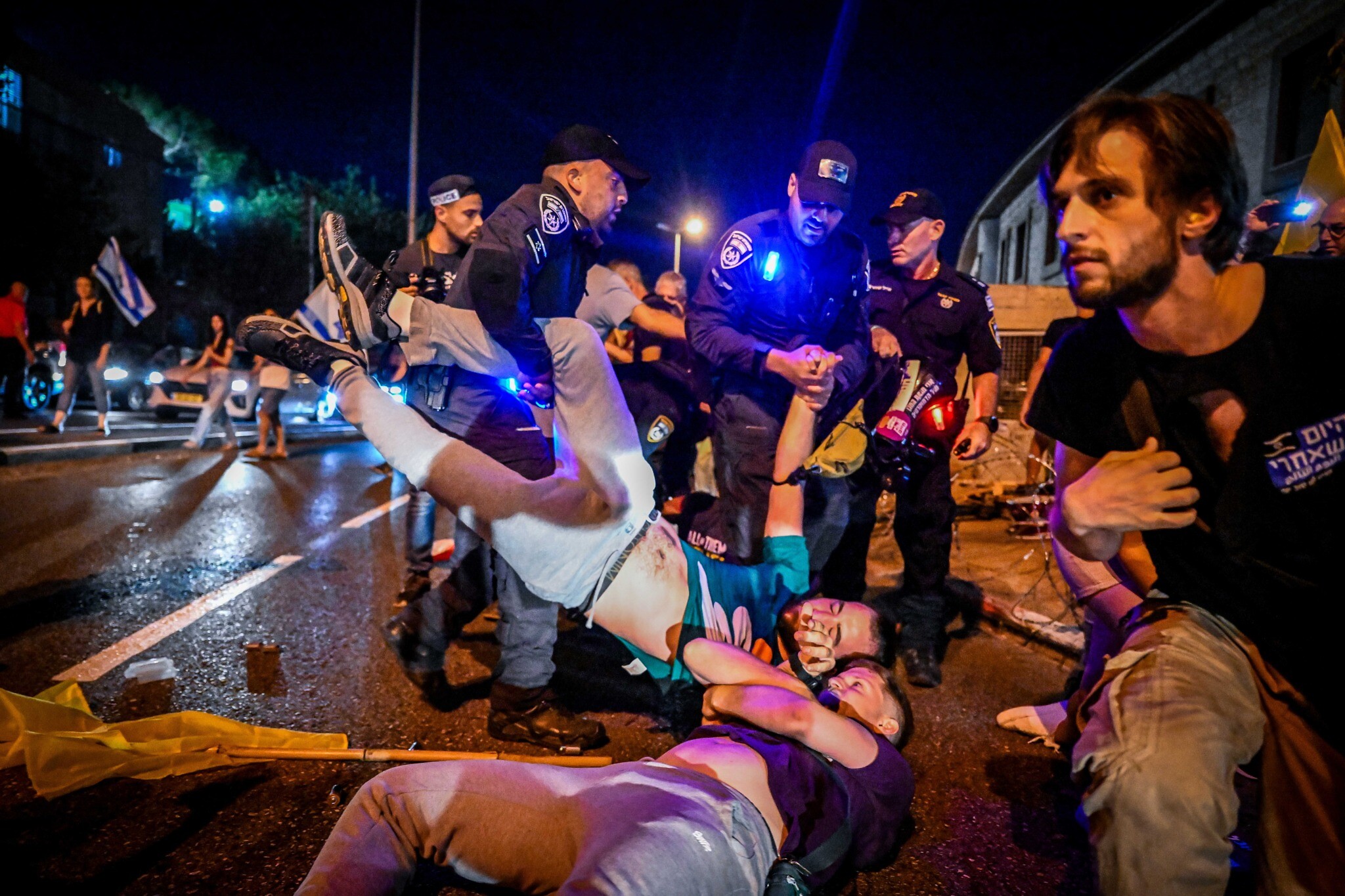
Protesters block a road and clash with police during a march calling for the release of Hamas-held hostages, in Haifa, September 7, 2024. (Flash90)
Two protesters have reportedly been injured at a Haifa hostage demonstration after being thrown over barbed wire by police.
The two are receiving medical treatment, according to reports from the protest.
Videos posted to social media show the protesters, who are calling for the government to secure a deal to free hostages held by Hamas since October 7, being dragged from the center of an intersection they were blocking, with one of them bleeding from the head.
The wire had reportedly been placed on the road by the protesters.
Parallel protests are being held around the country, with thousands gathered at the main rallies in Tel Aviv and Jerusalem.
שני מפגינים בחיפה למען עסקה הגיעו לבית החולים הערב אחרי ששוטרים השליכו אותם על גדר תיל שמוחים בעצמם הציבו במהלך המחאה. בתיעוד ניתן לראות כיצד השוטרים גוררים מפגין ממרכז הכביש והשליכו אותו אל עבר גדר התיל שנמצאת בצד, ואת הפנים המדממות של אחד המוחה שנזקק לטיפול רפואי pic.twitter.com/1NCUFvt0ei
— בר שם-אור Bar Shem-Ur (@Bar_ShemUr) September 7, 2024
Report: AG tells Netanyahu to set up state inquiry immediately, as best way to stop arrest warrants against senior officials
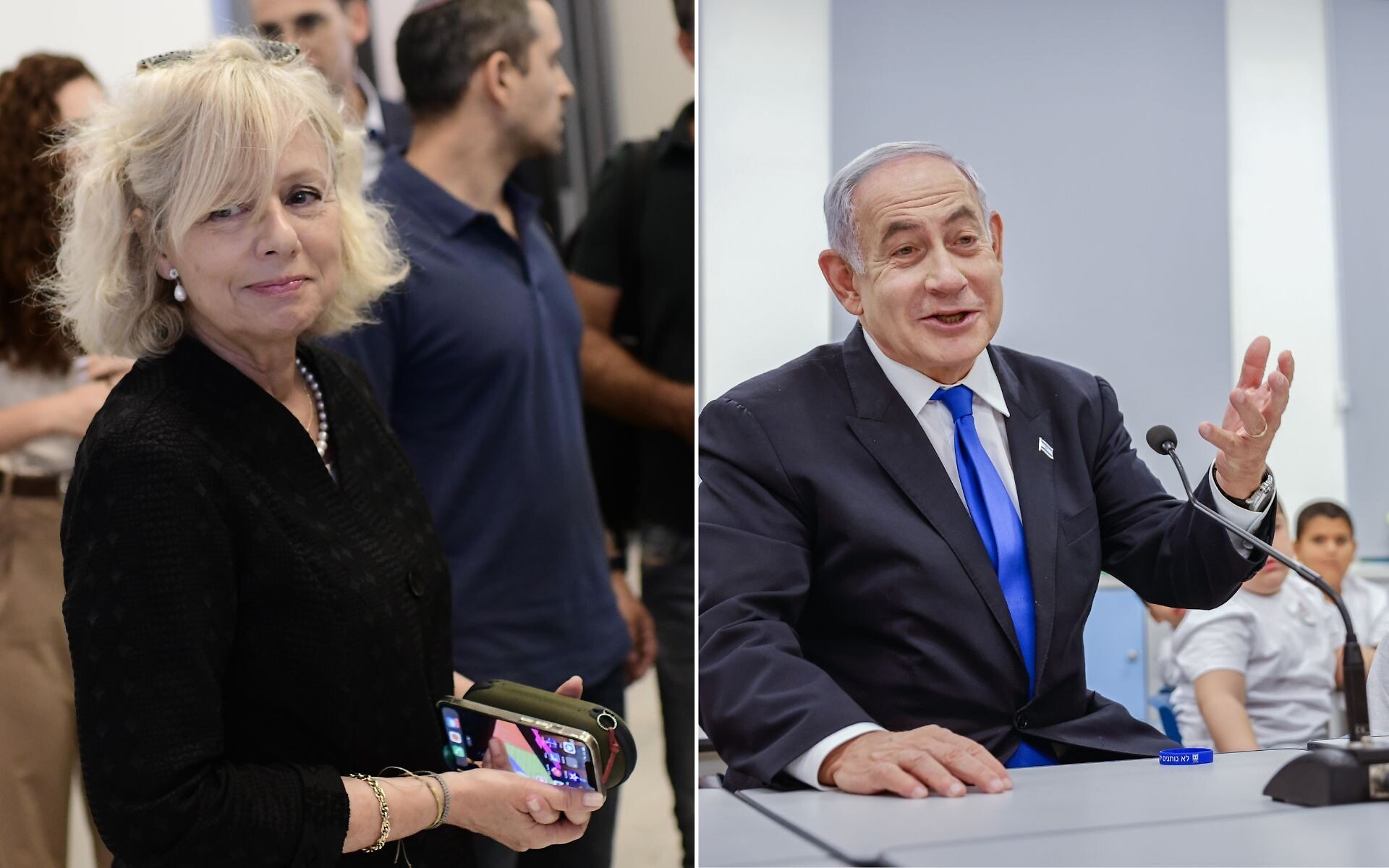
Left: Attorney General Gali Baharav-Miara in Tel Aviv, June 20, 2023. (Tomer Neuberg/Flash90); Right: Prime Minister Benjamin Netanyahu in the West Bank settlement of Ma’ale Adumim, September 1, 2023. (Olivier Fitoussi/Pool)
Attorney General Gali Baharav-Miara issues a harsh warning to Prime Minister Benjamin Netanyahu that a state commission of inquiry is the best way to stop arrest warrants from being issued against senior Israeli civilian and military officials, Channel 12 news reports.
“There is an extraordinary amount of topics of inquiry and severe dangers in the international relations sphere,” she writes in an official letter to Netanyahu and a small number of senior Israeli officials cited in the TV report.
She says that Israel’s defense of complementarity — the principle that international courts like those in The Hague can only get involved when national legal systems fail to carry out their duties — “can only be realized through a state commission of inquiry.”
Baharav-Miara warns that government commissions of inquiry are inadequate and that failing to establish an independent state commission of inquiry “fundamentally contradicts the government’s responsibilities to the public, and would represent an extreme case that justifies judicial intervention.”
“The international window is closing,” she warns. “A state commission of inquiry should be established immediately.”
Channel 12 also reports that IDF officers are concerned that arrest warrants will be issued against them if a commission of inquiry is not established.
At mass Tel Aviv rally, rescued Hamas hostage says he spent ‘two months in hell’ with murdered captive
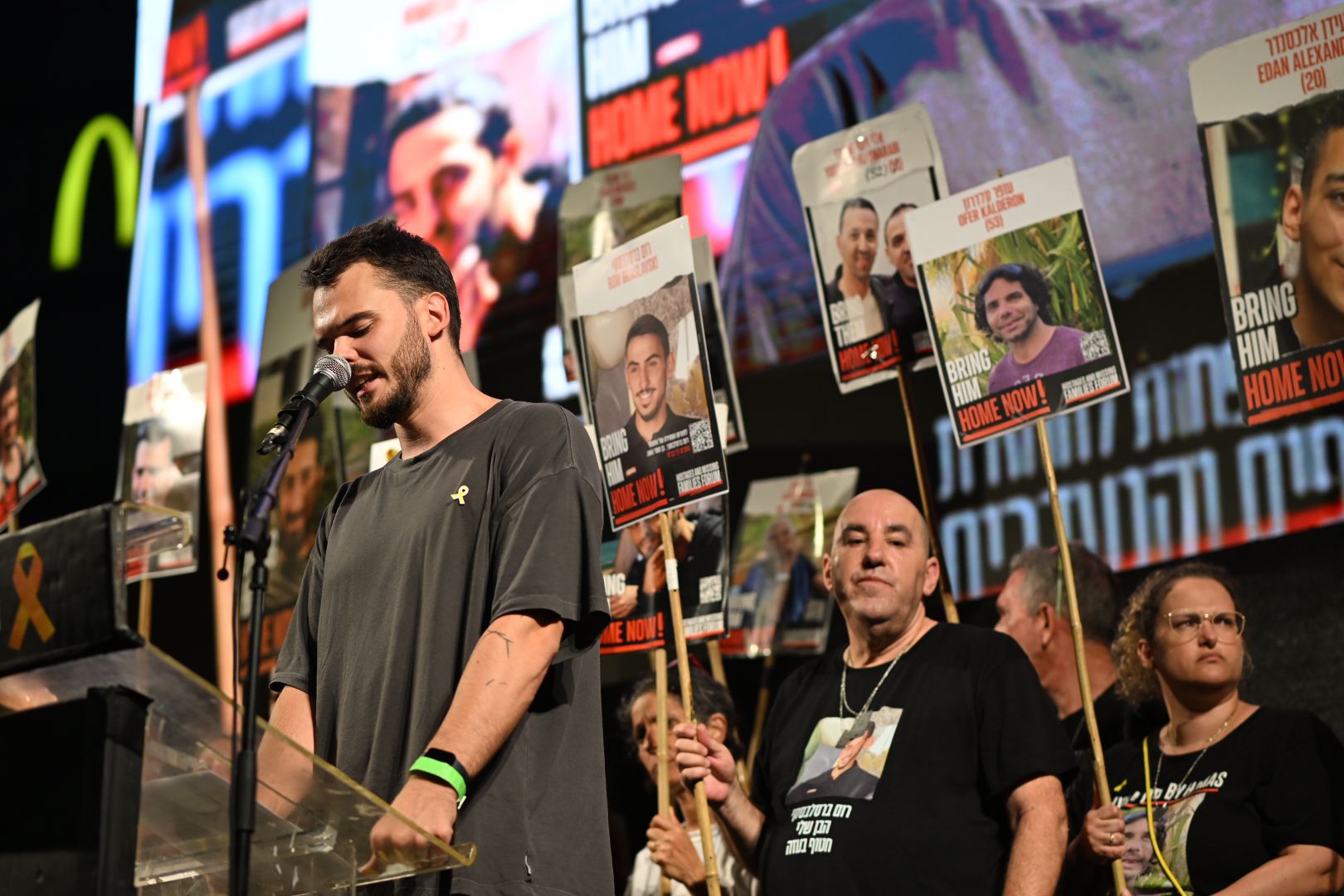
Rescued Hamas hostage Andrey Kozlov speaks at a rally urging a deal to save the remaining hostages, in Tel Aviv, September 7, 2024. (Lior Rotstein / Hostage Families' Forum)
Andrey Kozlov, who was freed from Hamas captivity in June along with three other hostages in an Israeli rescue operation, speaks at a massive rally taking place in Tel Aviv to pressure the government to close a hostage-ceasefire deal.
“I don’t know why, but I am blessed, I am here. Hersh, Eden, Carmel, Ori, Almog and Alex are not,” he tells the crowd, which is estimated to be in the hundreds of thousands, referring to six hostages whose bodies were recovered from Gaza last week after they were executed by Hamas days earlier.
“Alex [Lobanov] was with us in hell for two months, he told me his life story. We shared our fears and hopes. They took him and told us he will go home in the end of November. He should have been here with us,” the former hostage says.
Behind Kozlov on the stage are posters of the 97 hostages abducted by Hamas on October 7 believed to remain in Gaza, including the bodies of at least 33 confirmed dead by the IDF.
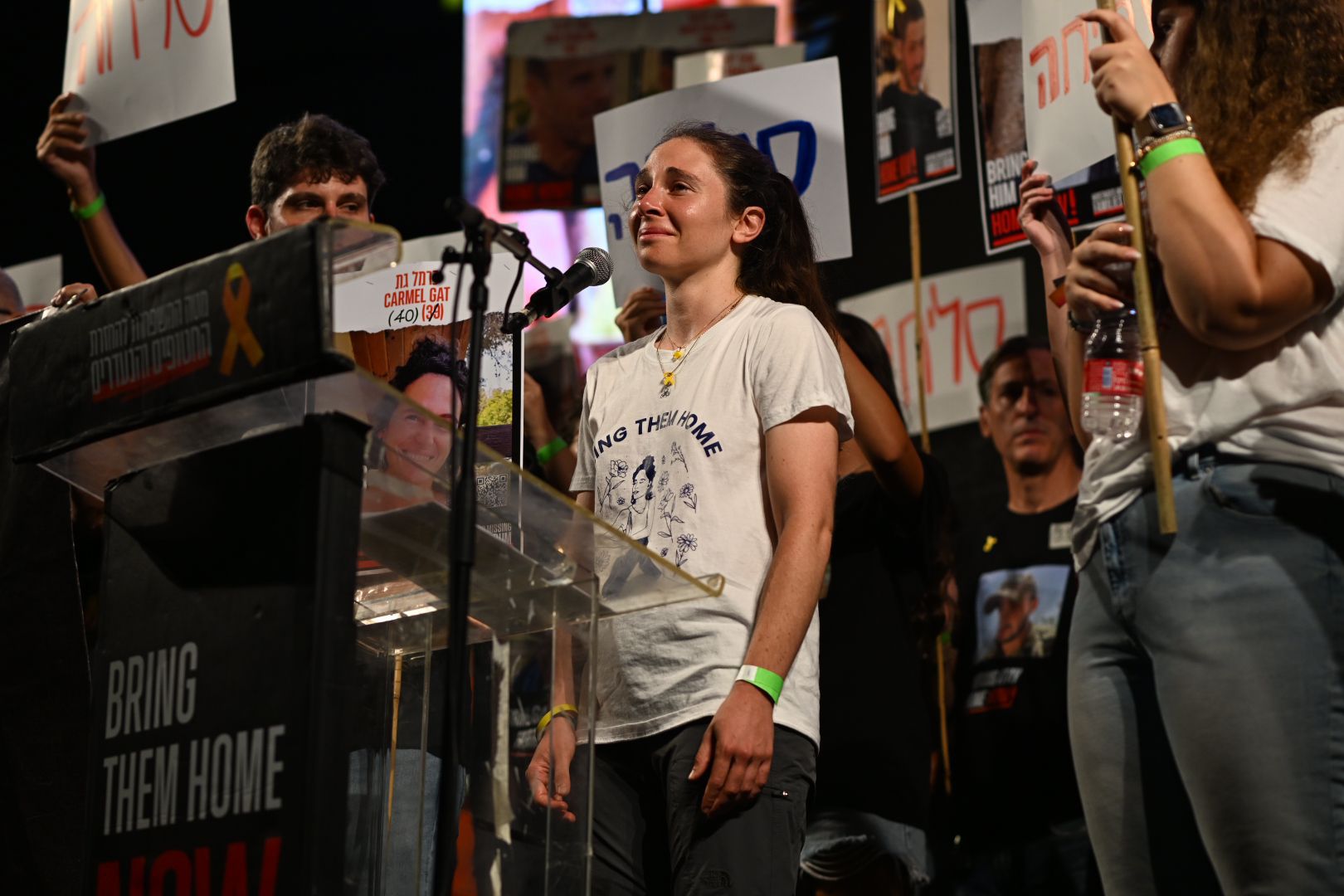
Speaking at the same rally, Shai Dickman, cousin of murdered hostage Carmel Gat, blames the government for the fact that she did not come home alive: “We were a step away from being able to embrace, but the military pressure led to her death,” she says. “My prime minister, Benjamin Netanyahu, you sabotaged a deal, you killed her. So, too, (Ministers) Smotrich, Regev, Levin, Katz, Dichter. You sabotaged a deal, you killed her.”
Hamas released 105 civilians during a weeklong truce in late November, and four hostages were released before that. Eight hostages have been rescued by troops alive, and the bodies of 37 hostages have also been recovered, including three mistakenly killed by the military as they tried to escape their captors.
IDF chief upbraids general for sending strategic document on Iran to PM without approval
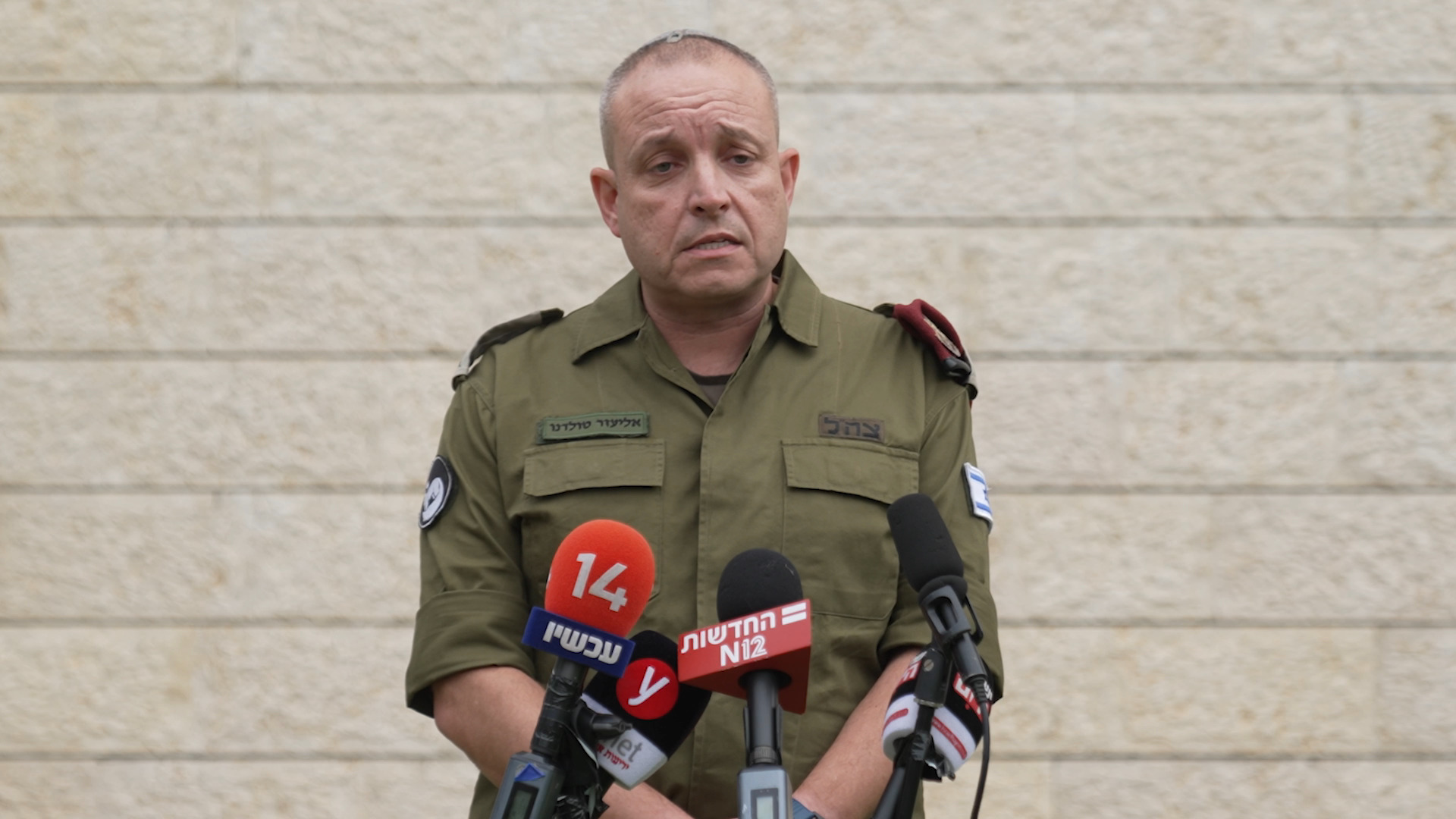
Maj. Gen. Eliezer Toledano, then chief of the IDF Southern Command, speaks to reporters, June 13, 2023. (Israel Defense Forces)
Maj. Gen. Eliezer Toledano, the head of the IDF’s Strategy and Third-Circle Directorate, sent a highly sensitive “strategic document” on Iran to Prime Minister Benjamin Netanyahu without following appropriate procedures, and was upbraided for this by IDF Chief Lt. Gen. Herzi Halevi, Channel 12 reports, in what it says is another incident highlighting the mounting friction between the security establishment and the prime minister.
Toledano, a former military secretary to the prime minister and a former head of the IDF’s Southern Command, drew up the document in recent weeks. It focuses on Iran’s regional influence, the impact of leadership changes in Tehran and other top-secret issues, the report says.
The directorate Toledano heads is tasked with the military’s Iran file.
Channel 12 says it is not clear whether Toledano sent the document to Netanyahu in a separate email without telling Halevi and Defense Minister Yoav Gallant, or whether he sent it to all three of them together.
Halevi and Gallant became aware that it was sent to Netanyahu without them seeing and approving it first, the report says, “and they are furious.”
Halevi told Toledano that he had exceeded his authority and breached procedures, the report says.
Gallant, separately, had “a very tough” discussion with Toledano, at the end of which Gallant temporarily suspended the general from attending cabinet meetings and other top-level security consultations pending further clarifications. That suspension has now been lifted.
The prime minister and defense minister declined to comment on the incident. The IDF Spokesman’s office confirmed that the document was distributed to the prime minister, defense minister, chief of staff and other generals “not in accordance with orderly procedures,” and that Toledano was “made aware of this” by Halevi.
Family members of Hamas hostages, Oct. 7 victims call for hostage deal outside PM’s home in Jerusalem
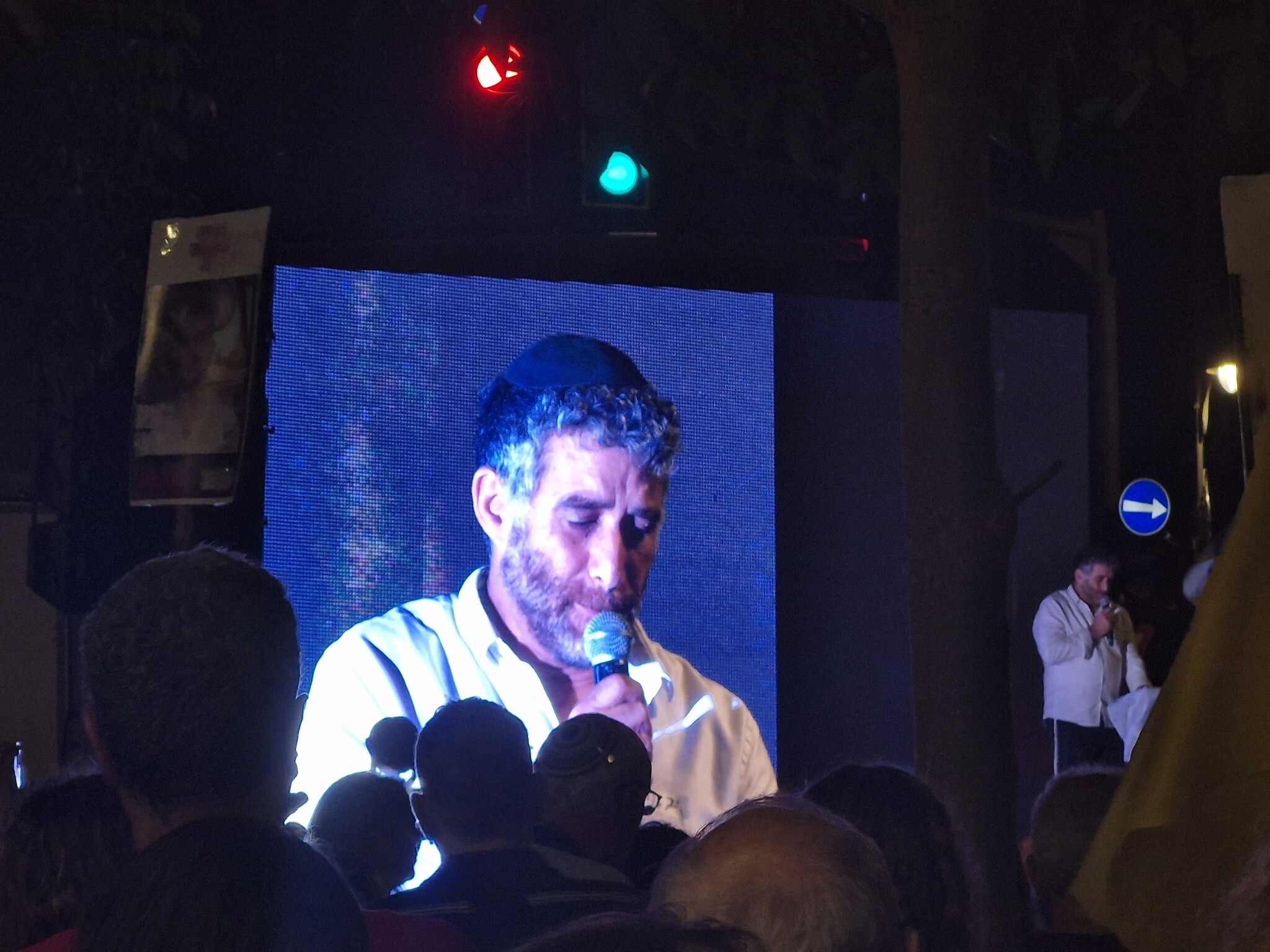
Moshe Shapira, whose son Aner Shapira was murdered by Hamas terrorists on October. 7, speaks at a demonstration calling for a hostage deal in Jerusalem, September 7, 2024. (Iddo Schejter/Times of Israel)
Family members of hostages and victims of the October 7 Hamas massacre speak in favor of a hostage deal at a protest outside the prime minister’s residence in Jerusalem.
Danny Miran, the father of Hamas hostage Omri Miran, speaks of his suffering since his son was kidnapped. Miran also speaks of his appreciation for the IDF and Israel Police, the latter of which draws boos from the crowd.
Gal Goren, whose parents Avner and Maya Goren were killed by Hamas, blames Prime Minister Benjamin Netanyahu for the hostages remaining in captivity, drawing boos from the crowd. He calls on demonstrators to continue the struggle for a hostage deal, so that “We can reach October 8.”
The audience gives a long round of applause for Moshe Shapira, whose son Aner Shapira was killed at the Supernova rave on October 7 after fending off grenades thrown by terrorists, saving people around him. Shapira calls for unity in Israeli society, and his speech is followed by the blowing of shofars.
ירושלים עכשיו במחאה למען החזרת החטופים.
קרדיט צילום: "משנים כיוון" pic.twitter.com/Caem7cfSuB
— לירי בורק שביט (@lirishavit) September 7, 2024
Protest organizers estimate unprecedented 500,000 at Tel Aviv hostage rally, tens of thousands in Jerusalem, Haifa, Kfar Saba
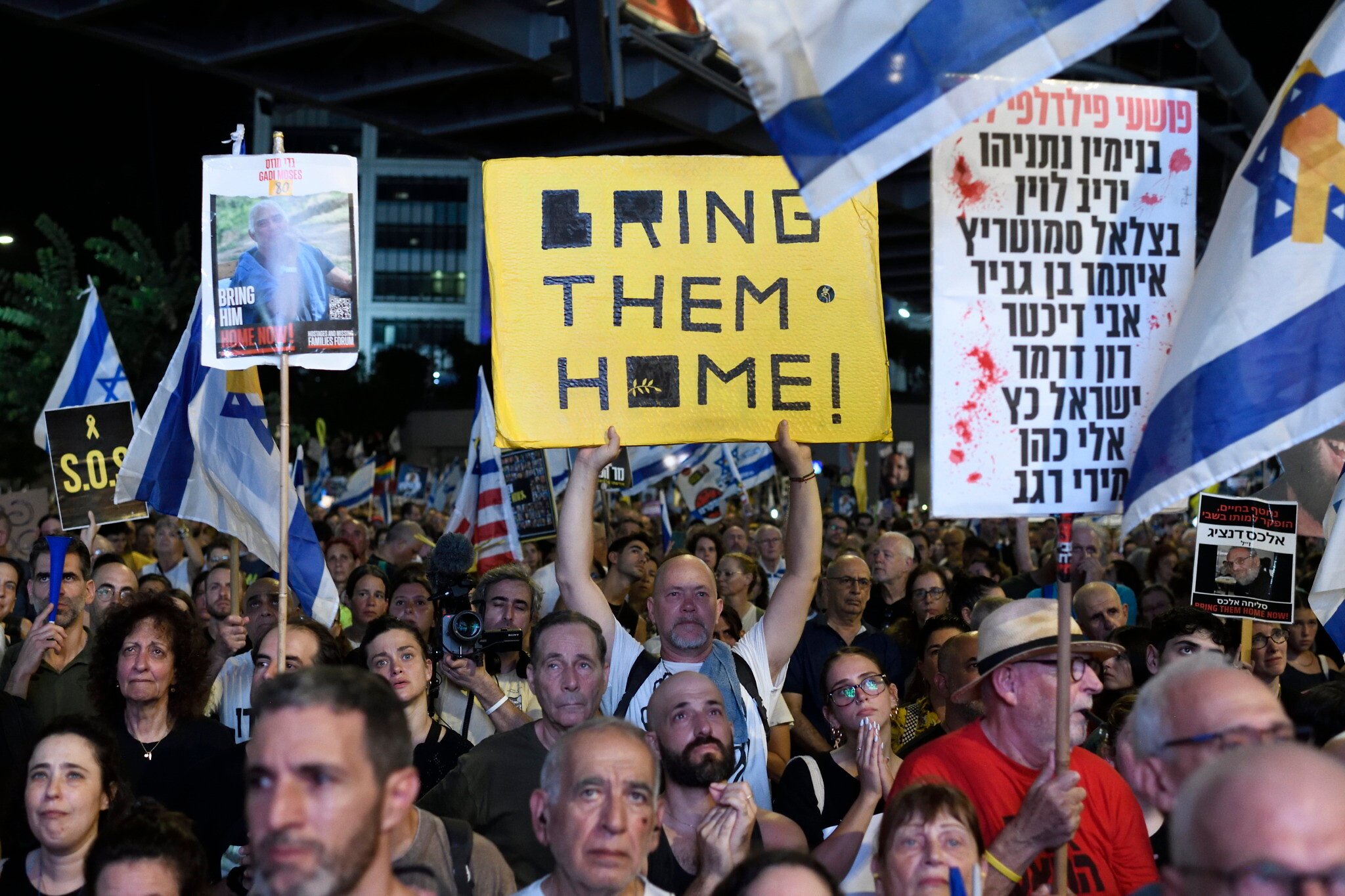
Hundreds of thousands of Israelis protest against the government, calling for immediate release of the hostages that are still being held by Hamas in Gaza, outside IDF headquarters in Tel Aviv, September 7, 2024. (Gili Yaari /Flash90)
Some 500,000 people are currently attending the mass rally in Tel Aviv demanding that the government free the remaining hostages held by Hamas since October 7, according to protest organizers.
This would make the rally the largest in Israeli history.
At the Tel Aviv rally, organizers claim that the estimate has been confirmed by police.
Activists on social media say tens of thousands are simultaneously protesting in Jerusalem, Haifa and Kfar Saba, while thousands are also gathered in cities including Beersheba, Netanya, and Rishon Lezion.
At a protest in Carmei Gat, former hostage Adina Moshe, who was released in the November truce, says she told the Shin Bet official who debriefed her of the danger posed to hostages when IDF troops approach tunnels where they are held. “When the IDF enters those tunnels, it is impossible to save the hostages,” she recalls saying, because Hamas “will kill them right away.”
She added: “All my friends who were together with me in captivity in that tunnel were murdered — murdered by Hamas because the IDF approached. Even though I warned — but who am I? — that that would happen.”
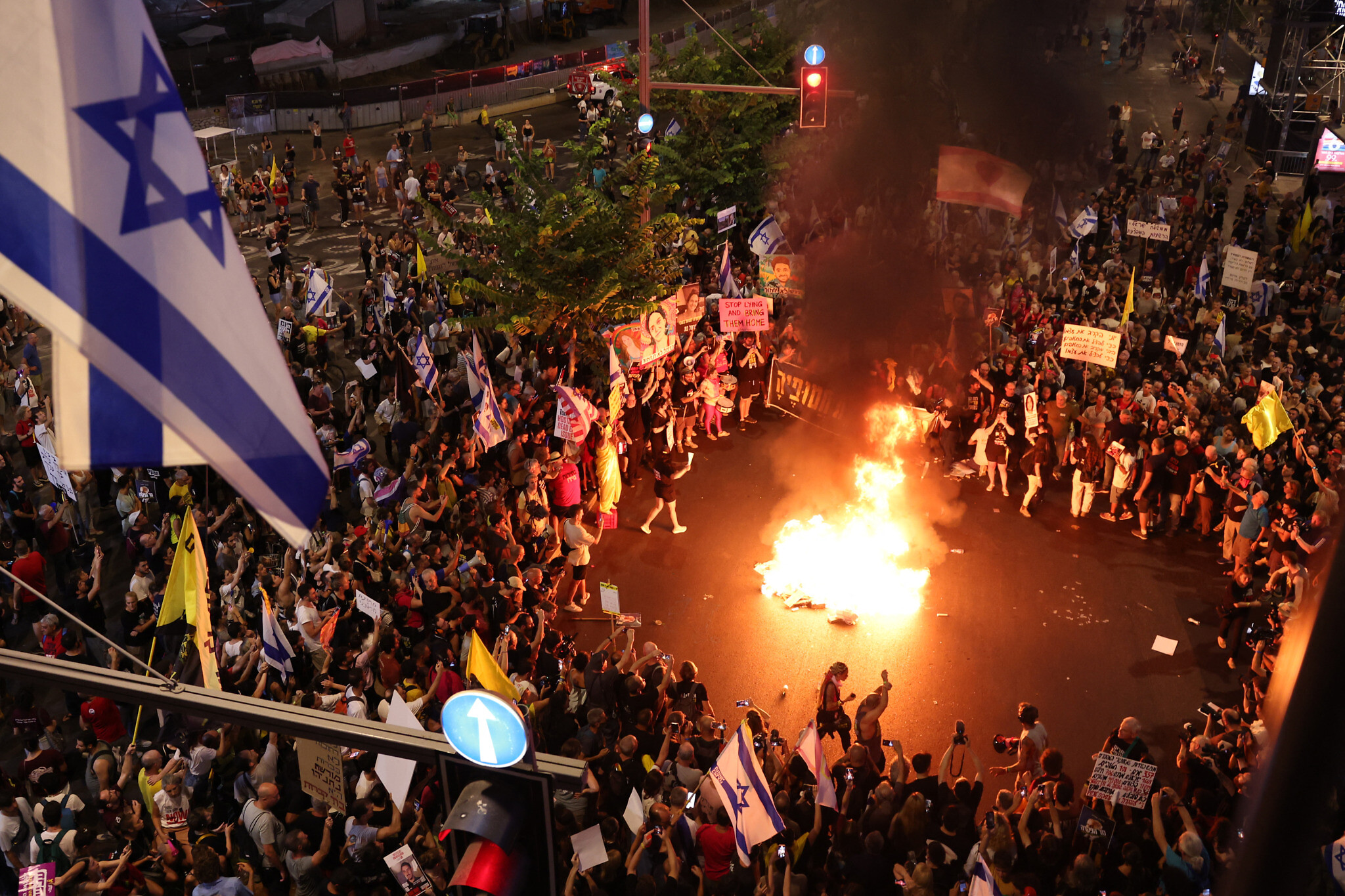
Activists light bonfire on Tel Aviv’s Begin Road as Hostage Forum protest joins anti-government rally

Demonstrators raise placards and Israeli flags during an anti-government protest calling for action to secure the release of hostages held captive since Hamas's October 7 massacre, Tel Aviv, September 7, 2024. (Jack Guez/AFP)
TEL AVIV – Protesters light a bonfire on Tel Aviv’s Begin Road, during a mass rally that organize say is attended by 500,000 people, which would make it the largest in Israel’s history.
After a host of speeches, the Hostages Families Forum demonstration merges with anti-government protesters rallying on nearby Kaplan Street.
כעת מתחת לשער בגין עם משפחות חטופים pic.twitter.com/Jr4AW4MIvC
— לירי בורק שביט (@lirishavit) September 7, 2024
Actor Lior Ashkenazi, who emcees the event, pledges after the speeches that “the night is only beginning.”
Speakers accuse Prime Minister Benjamin Netanyahu of insisting Israel remain on the Philadelphi Corridor, separating Gaza from Egypt, as a way to thwart a hostage deal and keep his right-wing government intact.
One man in the audience interrupts a speaker, yelling: “Netanyahu is a murderer!” He draws some applause.
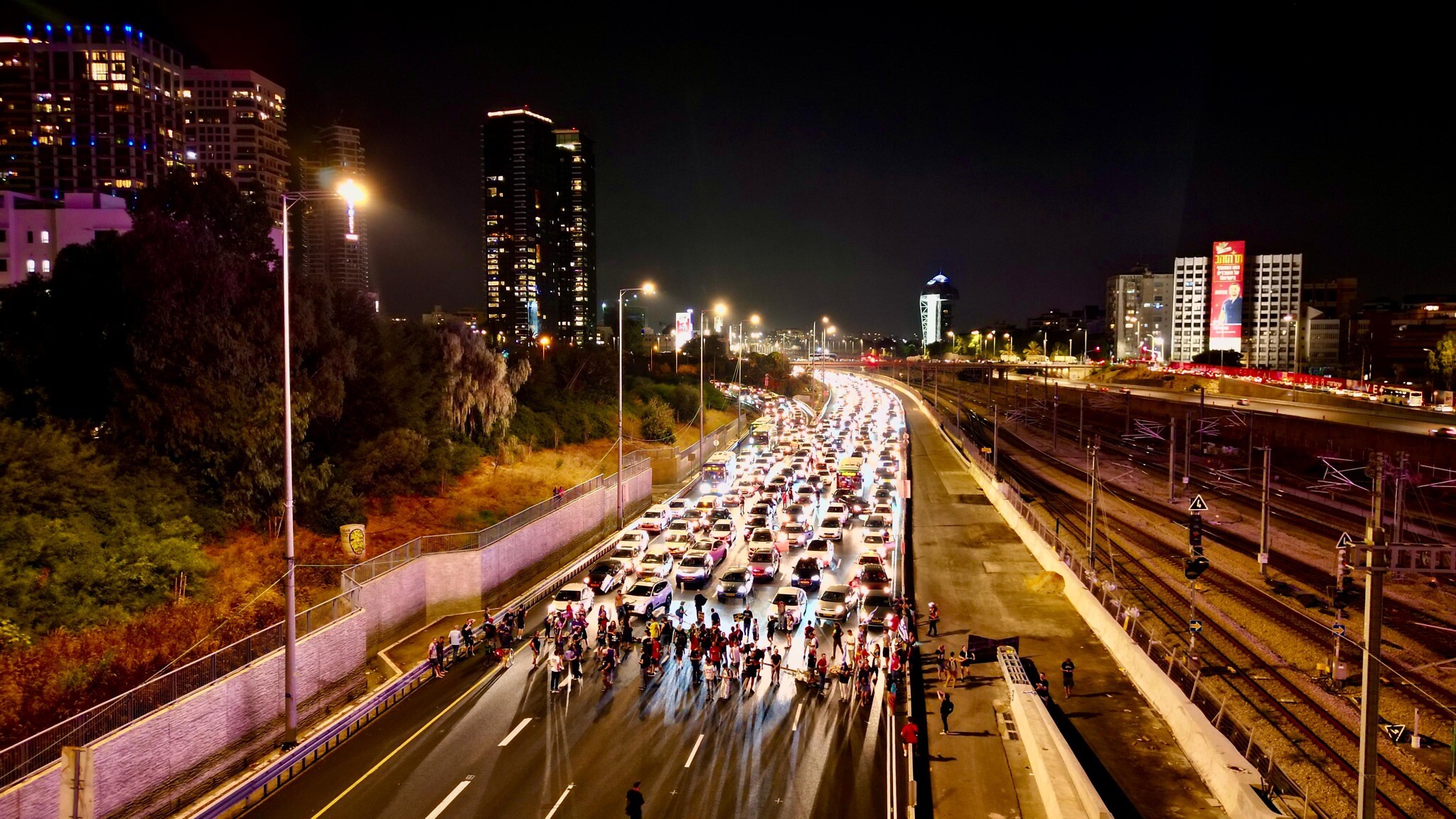
There appears to be little police presence at the demonstration. Officers stand guard slightly north of the intersection, at the exits leading to the Ayalon Highway, which is routinely blocked by anti-government protesters at weekly rallies.
No mounted officers appear to be on site.
The Hostages Families Forum rally in Tel Aviv began.
Hundreds of thousands of supporters are now singing the national anthem, HaTikva.The meaning of HaTikva is "the hope", and we all hope for a deal that will bring all 101 hostages back home 🎗️
Credit: Adar Eyal pic.twitter.com/H48b0ZXmlK
— Bring Them Home Now (@bringhomenow) September 7, 2024
Addressing the hostages, Einav Zangauker, mother of hostage Matan Zangauker, says, “Our prime minister wants to kill you instead of save you.”
Varda Ben Baruch, grandmother of hostage Edan Alexander, accuses the government of failing its Jewish heritage by not redeeming the hostages.
“Have you forgotten what the Jewish people have persisted on?” she asks.
The final speaker is Yifat Calderon, cousin of hostage Ofer Calderon and a harsh critic of Netanyahu.
She says her cousin is held hostage “by Hamas and by the prime minister, Mr. Abandonment.”
2 וחצי דקות של עינב צנגאוקר בבגין:
11 חודשים אני בלי הבן שלי בגלל בן אדם אחד, בגלל בנימין נתניהו
11 חודשים בהם 27 חטופים נרצחו בשבי ושוב בגלל נתניהו
11 חודשים שאין לנו משפחות החטופים חיים
פונה לחטופים: ראש הממשלה בוחר להרוג אתכם
ואתם הציבור, צאו לרחובות. צאו לזעוק אתנו. די! pic.twitter.com/7S7esMHfsj— 🇮🇱חגית קלימן – Hagit Klaiman🇮🇱 (@klaiman14) September 7, 2024
Calderon calls on “all my activists to get up on the stage.” It is unclear to whom she was referring, but she’s clearly irked that they are blocked from coming up. A police officer could be seen arguing with people, including hostage relatives, at the entrance to the stage.
“Instead of finding ourselves fighting for the hostages, people think we need to fight for other irrelevant things,” says Calderon, before her mic was cut.
Two arrested at Tel Aviv anti-government protest for blocking road; parallel protest in Jerusalem disperses

A police officer puts out a fire set by demonstrators during an anti-government protest calling for action to secure the release of hostages held captive by Hamas since October 7, Tel Aviv on September 7, 2024. (Jack Guez/AFP)
Police arrest at least two protesters at a massive rally in Tel Aviv that calls for the government to secure the release of hostages held by Hamas in Gaza since October 7.
According to Hebrew media outlets and reports on social media, protesters briefly block the entrance to the Ayalon Highway, though it has apparently been cleared since.
At a parallel demonstration in Jerusalem, dozens of pro-hostage-deal demonstrators march through the streets of Jerusalem, beating drums and chanting for the hostages’ release.
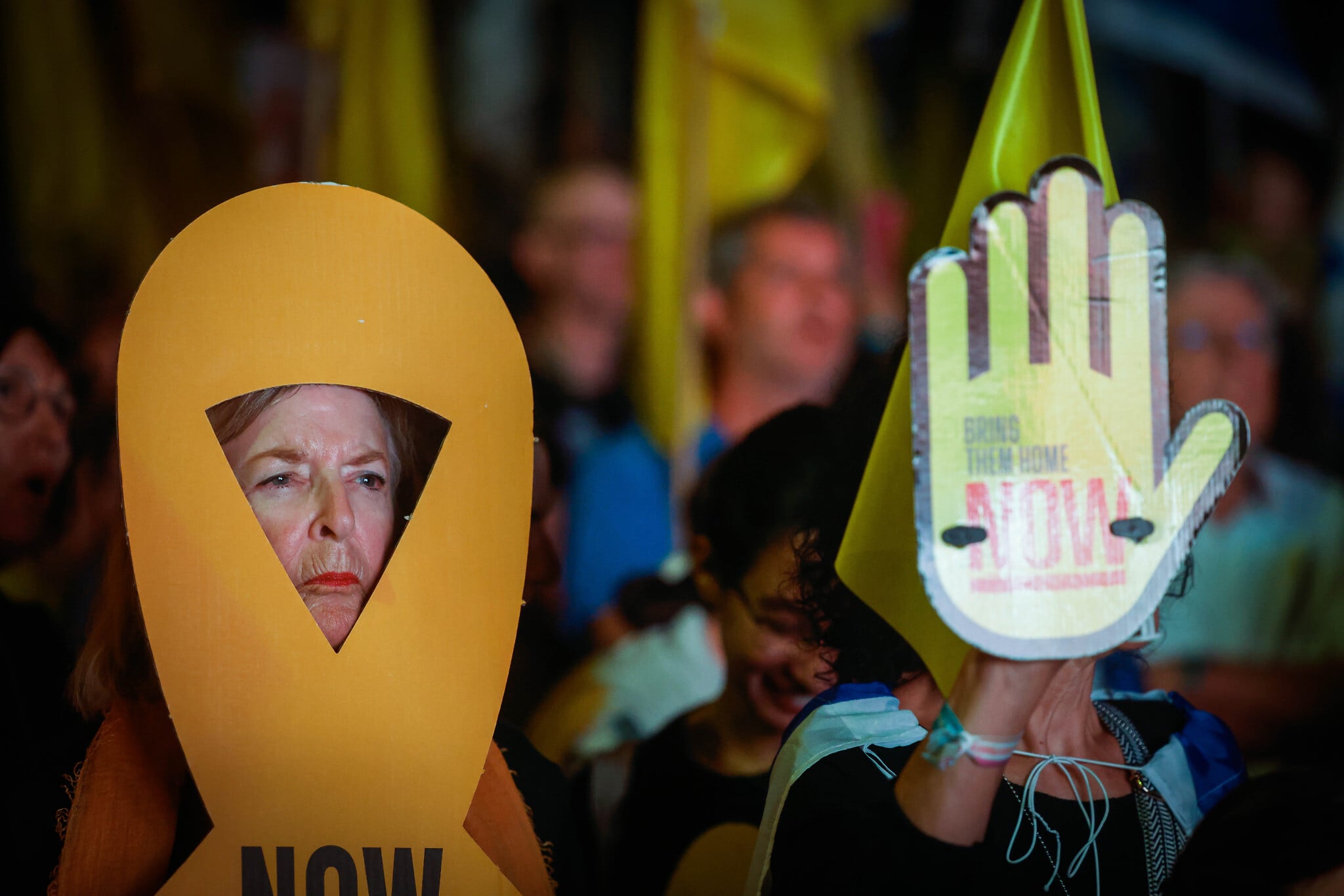
Protesters briefly block King George St. but are forcefully shoved to the sidewalk by police. The protest disperses.
According to protest organizers, hundreds of thousands of Israelis are attending rallies tonight around the country, marking the 11-month anniversary of Hamas’s devastating October 7 massacre.
Activists toss sand on photos of Ben Gvir at demo over hearing for woman suspected of ‘assaulting’ minister
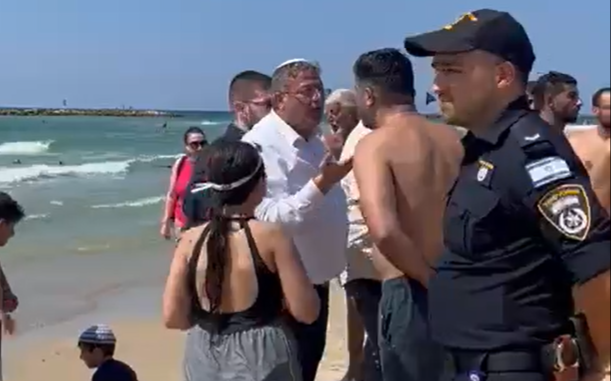
National Security Minister Itamar Ben Gvir talks to beachgoers at Tel Aviv's Geula beach, September 6, 2024. (Screen capture: X/Josh Breiner, used in accordance with Clause 27a of the Copyright Law)
Dozens of protesters gather outside the Tel Aviv Magistrate’s Court, where a remand hearing is being held for a 27-year-old woman who was arrested yesterday for allegedly tossing wet sand at National Security Minister Itamar Ben Gvir on a Tel Aviv beach.
The protesters outside the courthouse throw sand at pictures of the ultranationalist minister.
The suspect, Noa Goldenberg, was held overnight at Neve Tirtza Women’s Prison in Ramle.
מפגינים משליכים חול על תמונותיו של בן גביר מחוץ לבית המשפט, לקראת הדיון בהארכת מעצרה של הצעירה החשודה pic.twitter.com/ZJXyJxQiUq
— אורי סלע Uri Sela (@uri_sela) September 7, 2024
Far-right youth briefly clash with anti-government protesters in Tel Aviv before police chase them away
Far-right youth briefly clash with people at the anti-government, pro-hostage deal protest on Tel Aviv’s Begin Road, before being chased away by police.
Officers are stationed at a nearby parking lot where protesters alert them to the group’s presence. Some protesters accuse the police of slacking on the job.
The officers promptly march toward the youth, who run southward, toward the Kaplan interchange, where they loiter for a few minutes.
Officers order them to disperse, detaining at least one who failed to leave the area. Police chase them away again.
Chief Superintendent Avi Ofer, deputy commander of the nearby Lev Tel Aviv police station, can be heard asking, “Where are there more rightwing activists?” as he charged the group at Kaplan interchange. As they disperse, he taunts the teenagers, “Shouldn’t you be in school tomorrow?”
פעילי הימין בקפלן, כמו בכל שבוע, מגיעים לייצר פרובוקציות. לרוב הם תוקפים בסיום ההפגנה, אך הערב כבר בשעה תשע וחצי תועדו תוקפים מילולית מפגינה שצעדה לבדה
"יא בת זונה בת שרמוטה"
תל אביב 07/09/24 pic.twitter.com/Mf6iIBB0RD
— אלימות ישראל (@Alimut_Israel) September 7, 2024
Woman arrested for allegedly throwing sand at Ben Gvir released to house arrest
A 27-year-old woman who was arrested yesterday for allegedly tossing wet sand at National Security Minister Itamar Ben Gvir on a Tel Aviv beach has been released to house arrest.
“There’s nothing here, there’s really nothing here… I’m not convinced that there is a reason for the arrest,” Judge Menachem (Mario) Klein of the Tel Aviv Magistrate’s Court says at Noa Goldenberg’s remand hearing. We can settle for an alternative of 48 hours of supervised house arrest.”
During the hearing, dozens of activists protested outside the court against Goldenberg’s arrest.
Police had asked for Goldenberg to be remanded for another day on allegations including assaulting a public servant and preventing the police from carrying out its work.
As Tel Aviv hostage rally disperses, police say 5 arrested, call on protesters to ‘stop the riots’
The anti-goverment, pro-hostage deal demonstration on Tel Aviv’s Begin Road disperses after several clashes between police and protesters.
In a statement, police say five protesters have been detained.
Police are working to prevent protesters from breaking through security barriers and blocking the Ayalon Highway, according to the statement.
“We call on the protesters to stop the riots that endanger the police and the rest of the protesters,” the statement says.
שער בגין – הובלה למעצר
22:30. יעל גדות pic.twitter.com/E9eAZQ4BFn
— אלימות ישראל (@Alimut_Israel) September 7, 2024
Among those arrested is a minor who crossed the street after police said to clear off of it.
The minor’s friend began arguing with the officer and was shoved aside by other officers.
Officers who drag detainees toward the nearby Azrieli Towers are frequently followed by angry protesters chanting: “Officer! Officer! Whom are you protecting?”
As police drag the minor away, another pair of officers attempts to clear the few remaining protesters in front of the IDF headquarters.
In a rare moment of camaraderie, protesters use the officers’ amplification system to urge those present to attend the coming demonstrations. The protesters then thank the officers and disperse.
Some of the anti-government activists can be seen arguing with far-right counter-protesters as firemen put out a bonfire lit during the mass demonstration.
Palestinian AFP photographer wins prestigious prize for Gaza war coverage
Palestinian AFP photographer Mahmud Hams has won the prestigious Visa d’Or News prize for his coverage of the ongoing war in Gaza, the Visa pour l’Image Association announces.
The 44-year-old, who has worked for AFP in Gaza since 2003, thanks the jury for the award in a recorded video message aired at the ceremony in Perpignan, France.
In a statement issued by AFP, he denounces the alleged targeting of journalists during the conflict. Israel denies targeting the press in its war against Hamas in Gaza and has presented evidence in the past that journalists killed in the ongoing fighting were also terror operatives.
“I spent my childhood in Gaza, and in 23 years of photojournalism, I have witnessed every war, every conflict there,” Hams says in the statement.
“But this war is unlike any other, without precedent from the very first day.
“My colleagues and I have had to face incredibly difficult conditions, with no red lines and no protections for anyone,” he adds.
🏆 Palestinian AFP Photographer @MahmudHams Wins Visa d’Or News Award
👉 https://t.co/Pujh8veOsO pic.twitter.com/1DoMm3Q6Qs— AFP Communications (@AFPcom) September 7, 2024


read more: