

Israel said blocking US firm from breaking ground on Gaza base for international force
COGAT claims Palestinian merchants halted coordination on shipment of goods due to Hamas intimidation, but Gaza truckers union says Israel made the decision
 Add ToI as a Preferred Source on Google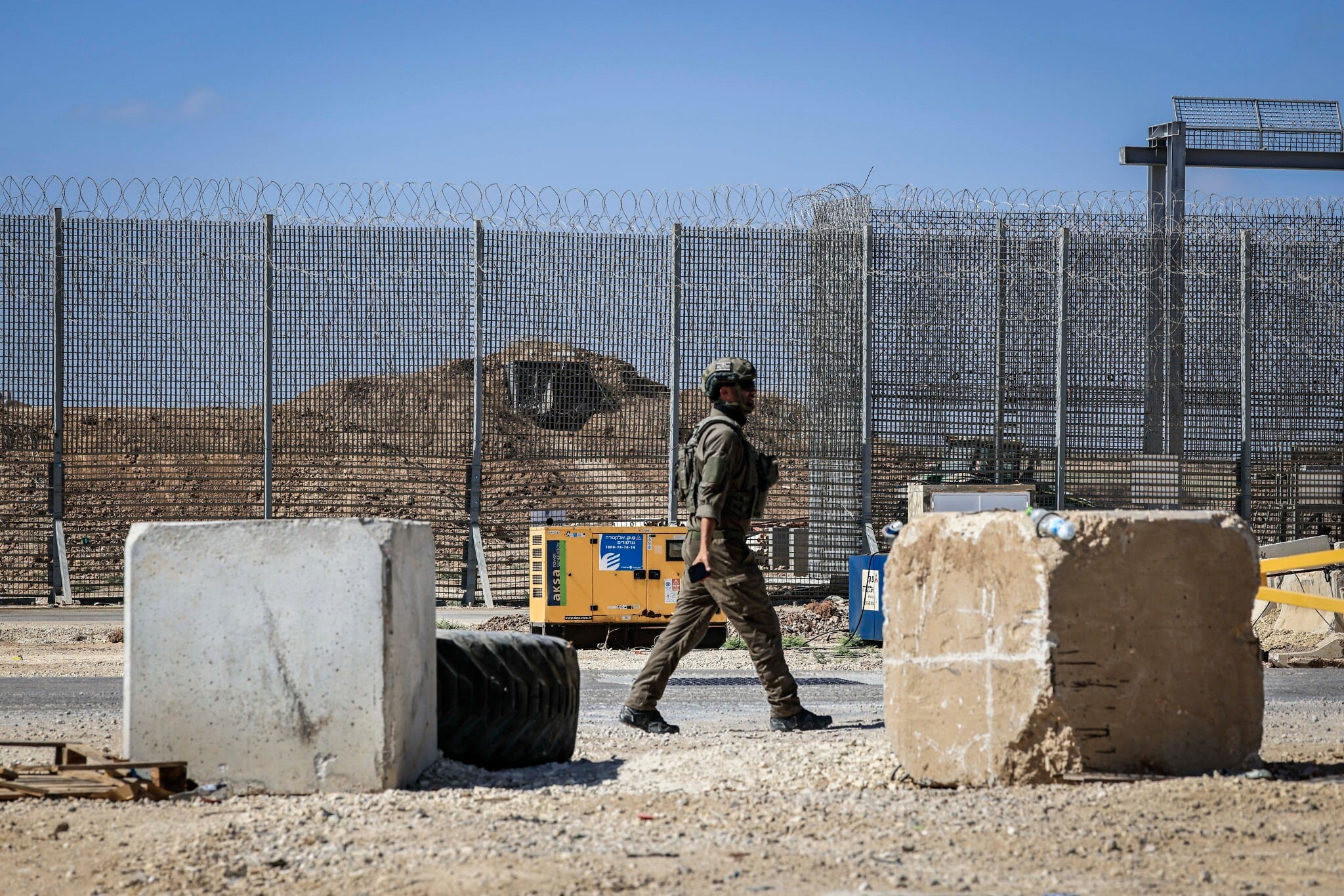
Israel is holding up the construction of a military base in Gaza intended for international forces as part of the US-led Board of Peace’s plan for the coastal enclave, according to a report on Thursday.
Citing a person with knowledge of the matter, The Guardian newspaper said Jerusalem hasn’t authorized construction to begin on the project, two months after a US company won a tender to build an outpost for 150 foreign troops, with contractors and trucks blocked from entering Gaza.
“Israel won’t open the border,” the source was quoted as saying, lamenting that without the deployment of the International Stabilization Force in Gaza, “You can’t rebuild.”
“There’s no security. There’s no deliveries of construction equipment. You can’t even start putting utilities. You can’t start putting in basic life-support facilities… because without the ISF you can’t go in,” the source continued, adding that the Board of Peace believes Israel will give the go-ahead for the project after the Knesset election on October 27.
The Board of Peace, the Israel Defense Forces and Israeli government declined to comment on the British newspaper’s report.
Meanwhile, the Coordinator of Government Activities in the Territories (COGAT) said Wednesday that private-sector merchants in Gaza announced they were suspending coordination for the entry of goods into the Strip until further notice, following what it described as a forced taxation mechanism imposed by Hamas and escalating threats against merchants.
A Gaza trucking official challenged the Israeli claim.

According to COGAT, Hamas security personnel arrested and imprisoned the son of one of the merchants on Tuesday after the merchant refused to pay taxes to the terror group on goods brought into Gaza. As a result, the merchants announced that they would suspend coordination activities.
COGAT said that according to the merchants, Hamas demands approximately NIS 10,000 ($3,200) for every truck entering Gaza and requires merchants to sell around 30 percent of their goods in cash, apparently to enable the terror group to gain control of the proceeds.
These demands directly contradict the commitments made by merchants approved to operate, who are required to make and receive payments exclusively through bank transfers.
The head of Gaza’s private truckers union, Nahed Sheheiber, disputed COGAT’s claim, saying Israel had made the decision.
“The merchants are not the ones who stopped the shipments,” he said. “The Israeli coordinator is claiming that Gaza’s merchants are responsible, but the truth is that the Israelis are the ones who imposed the restrictions.”
Following COGAT’s announcement, Shehaiber’s union met with Gaza’s Hamas-run Economy Ministry to express concern and say Israel was citing fees levied by the ministry as a pretext to cut off commercial goods.
The ministry had been asking merchants to pay NIS 10,000 per truck entering Gaza, Shehaiber said. At the meeting, Economy Ministry Undersecretary Khaled Al-Raqab told the union that the amount was not a tax, but rather a donation sought by the ministry to help pay civil servants in the Strip.
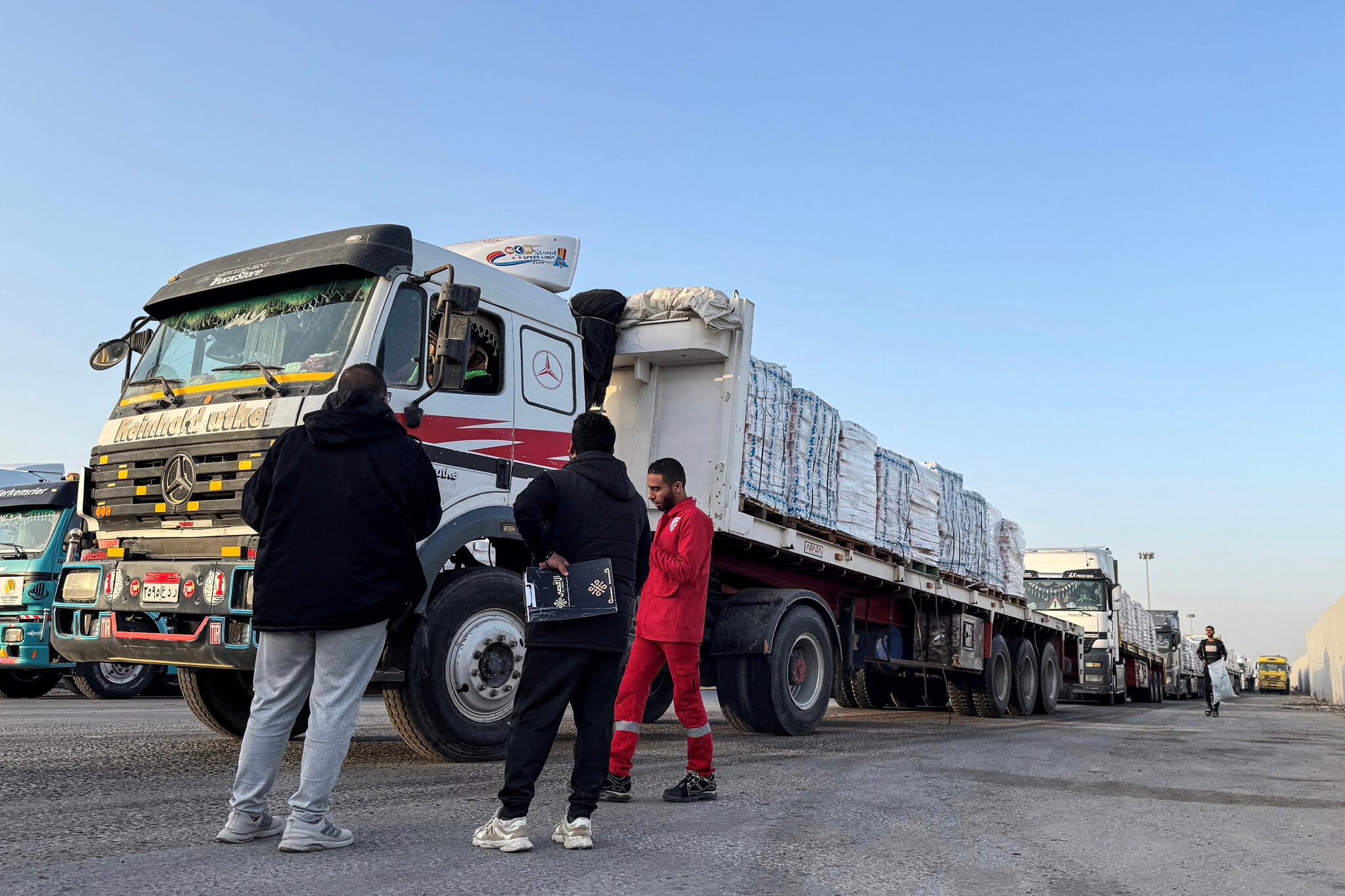
For most of the war following October 7, Israel refused to allow goods into Gaza through private merchants. In August 2025, it began allowing private merchants who had undergone security screening to bring in goods, alongside humanitarian organizations.
According to COGAT, the private sector currently accounts for 50 percent of all trucks entering the Strip. Under the ceasefire agreement reached last October, Israel committed to allowing approximately 600 trucks a day into Gaza.
Wednesday’s move stands to immediately reduce Gaza’s supplies, because the closed-off territory is completely reliant on whatever goods Israel allows in through border crossings. The suspension also raised fears about affordability, with humanitarian workers saying a combination of aid and a robust commercial market is needed to keep prices under control.
“The humanitarian sector on its own cannot meet the needs of all the people,” said Shaina Low, a spokesperson for the Norwegian Refugee Council, an aid group. “The markets need to be functioning.”
COGAT chief Maj. Gen. Yoram Halevi sent a letter to Nickolay Mladenov, the Board of Peace’s high representative, and to the commander of the ISF and the UN humanitarian coordinator for the region, informing them of the development and warning that Hamas would seek to exploit the suspension of private-sector operations to spread false claims that Israel was failing to comply with the agreement.
COGAT also said that according to assessments supported by professional evaluations conducted by the UN and other international experts, approximately 250 trucks a day entering through humanitarian organizations are sufficient to meet the humanitarian needs of Gaza’s population.
It was not clear from the COGAT announcement if aid agencies would be allowed to increase shipments into Gaza to compensate for the loss in commercial goods.

The world’s leading authority on food insecurity reported earlier this year that conditions in Gaza had improved since it declared famine in the territory in August 2025, but were still at crisis levels. Israel strongly rejected the famine claim made at the time by the Integrated Food Security Phase Classification system (IPC).
But most families in the war-battered enclave weren’t getting nearly enough to eat, said the report, adding that “even small disruptions to humanitarian access could rapidly reverse recent gains.”
“As I have warned repeatedly, such practices are unacceptable and must end immediately,” Mladenov said in response to the cessation of coordination for the entry of goods into the Strip reported by COGAT. “The intimidation of merchants and interference in the supply chain only deepen the suffering of Gaza’s civilians.”
Mladenov called for a Board of Peace-backed Palestinian technocratic committee, the National Committee for the Administration of Gaza, to take charge in the Strip, secured by a multinational peacekeeping force.
“These developments demonstrate why the rapid deployment of the National Committee for the Administration of Gaza (NCAG), supported by the International Stabilization Force, is urgently needed,” Mladenov continued on X. “Civilian supplies, humanitarian assistance and commercial activity must be protected from coercion, exploitation and interference.”
Mladenov called for the implementation of the Gaza peace plan, “including the arrangements required for NCAG and ISF operations in Gaza. This includes the decommissioning of weapons, the transition to legitimate transitional governance and the protection of humanitarian and commercial supply chains.”
I have a received a letter from @cogatonline on the suspension of private-sector goods coordination into Gaza as a result of reports of threats and coercion by Hamas. As I have warned repeatedly, such practices are unacceptable and must end immediately. The intimidation of…
— Nickolay E. MLADENOV (@nmladenov) October 15, 2026
Only 19% of Palestinians support Hamas — poll
Support for Hamas among Palestinians continues to decline, according to a poll published on Wednesday by the Palestinian Center for Policy and Survey Research, headed by Khalil Shikaki in Ramallah.
Overall, 19% of respondents said they support Hamas, compared to 24% in a poll conducted this August, and 35% in August 2025.
Among Gaza residents, 27% said they support Hamas, down from 33% in August and 41% in October last year. Support was lowest in the West Bank, where just 13% of respondents said they support Hamas, compared to 32% in October last year.
Similarly, the proportion of Palestinians who believe Hamas emerged victorious from the war with Israel, which erupted with the terror group’s October 7, 2023, massacre, continued to decline. Just 16% of respondents said Hamas won, compared to 39% in October 2025 and 70% in December 2023, early on in the war. Meanwhile, 17% now believe Israel emerged victorious, while 62% believe neither side won.
Some 53% of respondents said they support a two-state solution involving a Palestinian state along the 1967 lines, with East Jerusalem as its capital — 56% in the West Bank and 48% in Gaza — while 44% opposed it.

The poll was conducted between October 7 and 11, 2026, with 1,400 respondents interviewed face-to-face — 909 in the West Bank and 488 in Gaza.
Hamas tunnel demolished
A Hamas tunnel that crossed into the Israeli-held portion of the Gaza Strip was recently demolished by combat engineers, the military said on Thursday.
The IDF said the tunnel, which featured several rooms where Hamas operatives would reside, spanned a kilometer and a half and crossed the Yellow Line.
Combat engineers of the Gaza Division and the elite Yahalom unit in a recent operation blew up and sealed the underground passage, the military said.
הושמד תוואי תת-קרקעי שחצה את מרחב הקו הצהוב: פעילות כוחות החטיבה הדרומית ויהל"ם ברצועת עזה
כוחות החטיבה הדרומית בפיקוד יחידת ההנדסה של אוגדת עזה (143) ופיקוד הדרום, ממשיכים לפעול לטיהור מרחב הקו הצהוב מתשתיות טרור בדרום רצועת עזה.
כוחות ההנדסה בשיתוף יחידת יהל"ם אטמו והשמידו… pic.twitter.com/N2dFcNb6Rd
— צבא ההגנה לישראל (@idfonline) October 15, 2026
An October 2025 US-backed ceasefire halted major fighting in the shattered territory, but it failed to end strikes by the Israeli military, which the army says aim to thwart attacks by Hamas and other Gaza terrorists. Gaza remains bisected into Israeli- and Hamas-controlled areas.
US-led efforts to reach a comprehensive deal that would see Hamas disarm and Israel withdraw have stalled amid disagreements over the process.
The Hamas-run Health Ministry in Gaza says nearly 1,500 people have been killed by IDF strikes and gunfire in the Strip since the ceasefire took effect on October 11, 2025. The toll does not differentiate between combatants and civilians.
The IDF has not released figures on the number of strikes carried out or the number of terror operatives killed in the Gaza Strip since the start of the truce.

Former IDF chief of staff Gadi Eisenkot pledged on Thursday to end Hamas rule in the Gaza Strip within 18 months of taking office as prime minister, accusing Prime Minister Benjamin Netanyahu of failing to achieve his own war objectives three years after the October 7 massacre.
“Within 18 months of taking office as prime minister, Hamas will no longer rule the Gaza Strip. We will bring about the destruction of Hamas’s military wing,” Eisenkot pledged in a statement delivered at the Gaza border.
The Yashar chair said this will be achieved either through US President Donald Trump’s Gaza framework to demilitarize and rebuild Gaza, which was accepted by the Netanyahu government, or through military action.
Hamas remains in control of roughly a third of the Gaza Strip and retains military capabilities, even as Israel holds more than 60% of the territory, according to IDF figures from June.
Ariela Karmel contributed to this report.










The Times of Israel Community.