

Funding Haredim and others threatens Israel’s status as advanced economy, researcher claims
Calling for single education system and funding transparency, Prof. Dan Ben-David reveals benefits for Haredim outstripped funds for hospitals and higher education combined in 2024
 Add ToI as a Preferred Source on Google
Sue Surkes is The Times of Israel's environment reporter

Israel’s long-term viability as an advanced economy is at risk because it relies on a shrinking tech sector, while education standards plummet and demographic shifts favor those who lack the skills to contribute to a 21st-century economy, new research has warned.
Saying political priorities that have shifted from national to sectoral ones over recent years, Prof. Dan Ben-David, president and founder of the independent Shoresh Institution for Socioeconomic Research, noted that in 2024 the government spent NIS 37.5 billion ($12.2 billion) on subsidies, benefits and discounts for the ultra-Orthodox community, large numbers of whose members neither work nor serve in the IDF. That was NIS 10.83 billion ($3.5 billion) more than the state invested in hospitals and higher education combined that year.
Also in 2024, Israel’s labor productivity ranked below all G7 countries except Japan, according to Ben-David. It lagged 34 percent behind Germany, 30% behind the US, 28% behind France and 20% behind Italy. While that year saw mass call-ups for reserve duty amid the war in Gaza, labor productivity didn’t significantly change from the figure for 2022.
Ben-David explained that decades of public investment in national infrastructures that enabled Israel to close the productivity gap, and even eclipse the G7 countries by the mid-1970s, have reversed, leading to underinvestment in physical infrastructure, healthcare, higher education and the human capital needed to sustain high-level living standards.
He dismissed the oft-heard claims that Israel’s unusually high defense spending explains shortfalls in civilian investment, saying: “The problem was never a lack of resources, but a diversion of public funds from national priorities to sectoral and personal ones by the nation’s leaders.”
He added: “For decades, until recent years, when the developed world entered the Great Recession (from late 2007 to mid-2009), Israel’s civilian expenditures exceeded or equaled the OECD average.”
Education
Ben-David pointed out that Israel’s average scores in math, science and reading came near the bottom of the OECD in the most recent (2025) OECD PISA exam, as it has been over the past two decades. (The 2025 results were Israel’s worst).
The national average would have been even more dismal had Haredi boys, who tend not to study these core subjects, been included, he said.
He said around half of children — including Arab Israelis, Haredim and pupils in Israel’s geographic and social peripheries, who belong to the fastest-growing population groups — are receiving a subpar education.

“When they become half of the adults, and eventually a majority, they will only be able to maintain a third-world economy, which will not be able to support first-world healthcare or welfare, or the first-world defense necessary for Israel’s physical survival.”
Between 1988 and 2025, the share of primary school pupils in the secular Jewish education stream in Jerusalem alone fell from 33% to just 9%. In 2025, Arabs made up 37% of the city’s primary school pupils, and Haredim another 41%.
Demography
The Haredi fertility rate is three times higher than those of nearly all other population groups in Israel, Ben-David noted. It is over 80% higher than those of national religious Jews, over double the Muslim rates (which have been falling rapidly for two decades) and three times those of Jews in the traditional and secular streams.
While Haredim comprised just 6% of the 50- to 54-year-old population in 2023, their grandchildren comprised 26% of the toddlers.
Economy
Ben-David found employment rates among Haredi men fell from over 80% in 1979 (the earliest year for which such data exists) to about 60% in recent years., a trend he ascribed to government incentives not to work.
He said that while more Haredim are pursuing higher education, few can overcome the lack of core education in childhood. Given this sector’s fast growth, the country’s future labor-force skills “are being shaped – and constrained – decades before these children enter the labor market,” he explained.
While the tech sector, representing just 10% of the workforce, is 22% more productive than the OECD average, the remaining 90% of the Israeli workforce averages 24% less.
Just 20% of workers fund 93% of all income tax revenue, while half earn too little to pay any income tax, Ben-David found.
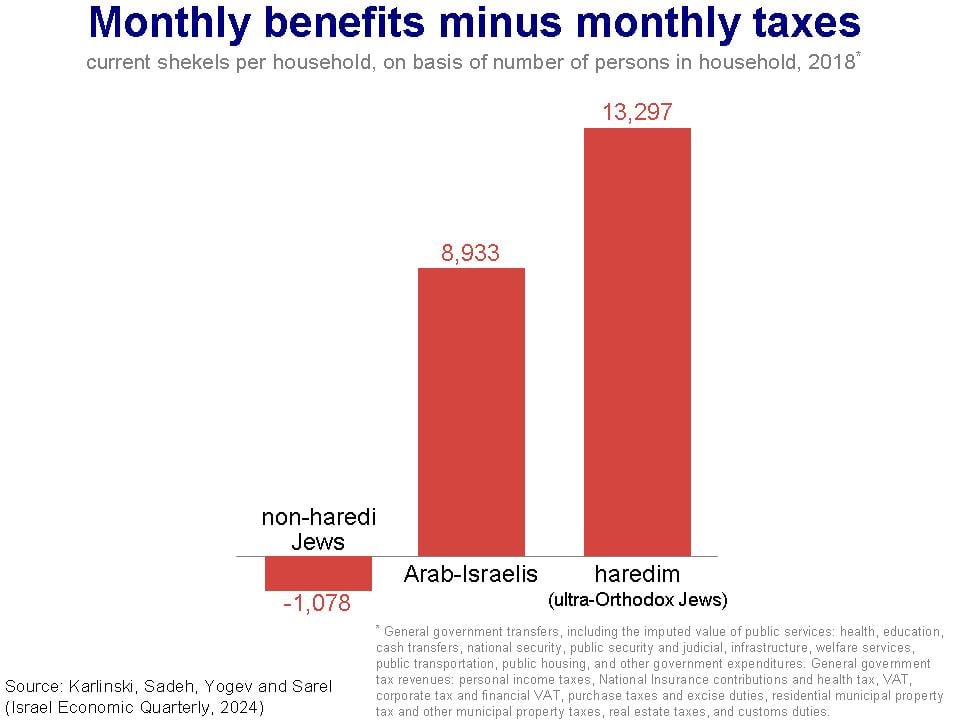
At the same time, he said Arab and Haredi citizens — particularly the latter — receive more than they contribute.
Brain drain
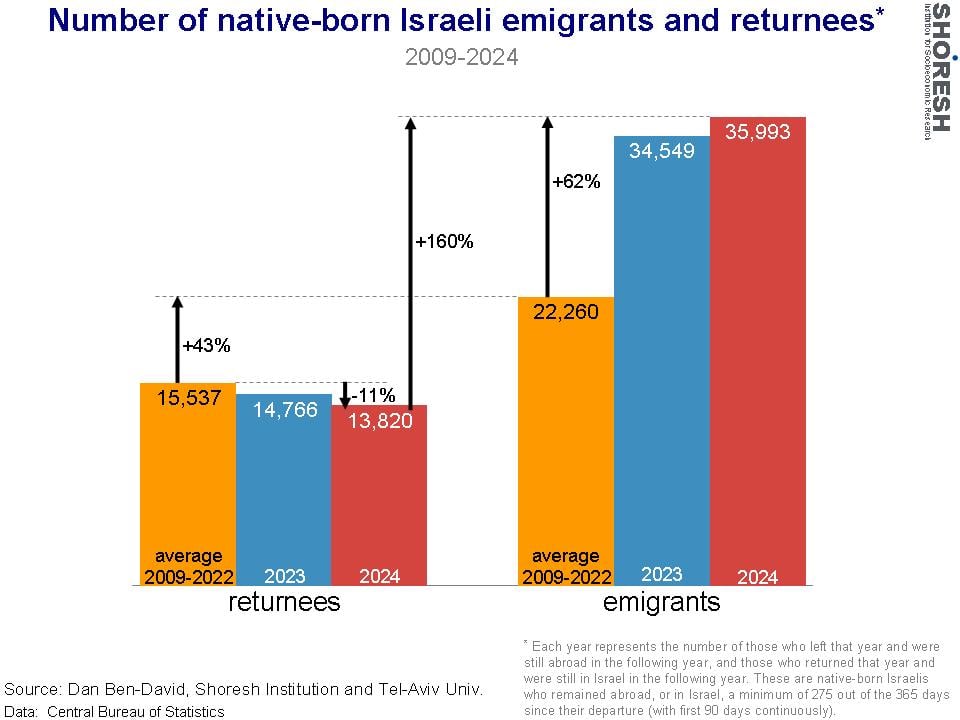
The government’s controversial judicial overhaul effort that began in January 2023, followed by multifront wars sparked by the Hamas invasion and massacre on October 7 that year, has seen the number of native-born emigrants from Israel — many highly educated professionals — exceeding returnees by 160%, Ben-David said.
Previously, between 2009 and 2022, the annual number of emigrants exceeded the number of returnees by 43% (with the exception of the COVID pandemic year of 2020).
Ben-David’s recommendations include amalgamating the four current educational streams — public secular, religious, Arab and independent Haredi schools (which receive differing levels of public support) — into a single one and imposing a largely uniform curriculum, with room for parental preferences; and shifting government funding from sectoral to national priorities while enforcing full public transparency.










The Times of Israel Community.