

Online antisemitism hits record high three years after October 7, study finds
No social network has dipped back to pre-Oct. 7 hate level, Australian Online Hate Prevention Institute says, adding the data refutes claim that legitimate criticism of Israel is mislabeled as Jew-hatred
 Add ToI as a Preferred Source on Google
Zev Stub is the Times of Israel's reporter on diaspora affairs and Israeli real estate.

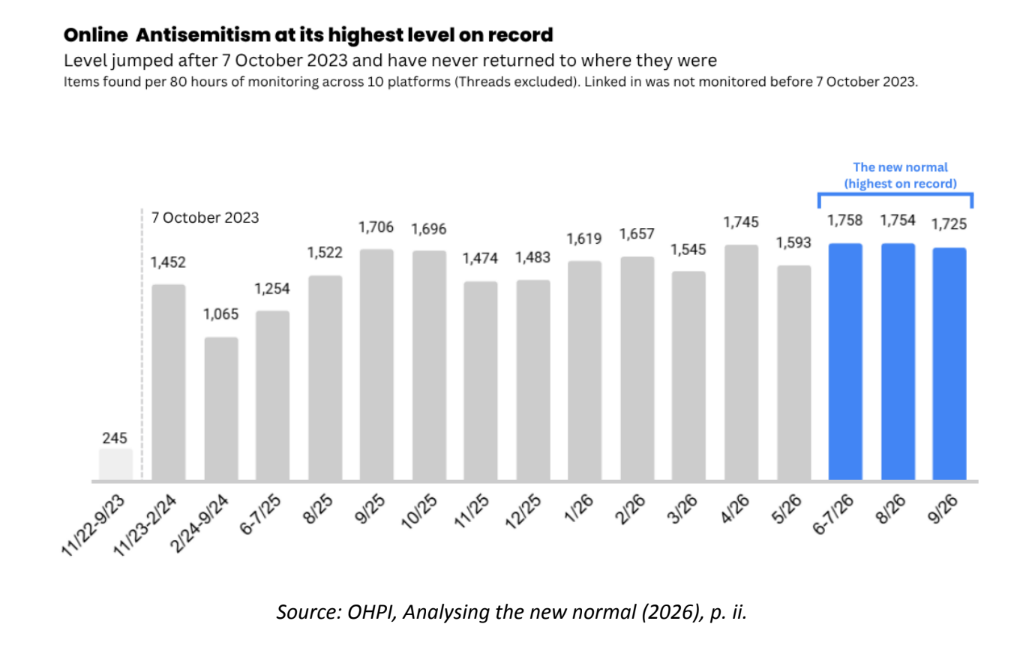
Online antisemitism has reached record levels three years after Hamas’s October 7, 2023, attacks on Israel, with none of the major social media platforms monitored returning to their prewar baselines, according to a new report by an Australian research institute.
The Online Hate Prevention Institute (OHPI) found that July-September 2026 recorded the highest levels of antisemitic content in any three-month period since it began monitoring social media in 2022.
The findings challenge claims that rising antisemitism figures are largely attributable to the misclassification of legitimate criticism of Israel, the report said.
OHPI’s analysis drew on more than 29,500 items of antisemitic content collected across 11 platforms: Facebook, Instagram, X, TikTok, YouTube, LinkedIn, Reddit, Telegram, Gab, BitChute and, for the first time, Threads. Each item was reviewed and classified by expert analysts.
OHPI said it used a consistent monitoring methodology, measuring the number of antisemitic items identified per eight hours of monitoring to track changes over time. Analysts individually reviewed and classified the material, allowing researchers to compare levels and types of antisemitism before and after October 7, it said.
Although the monitoring was conducted in Australia, the material analyzed originated around the world, reflecting international trends, OHPI said.
Antisemitism surged immediately after the October 7 onslaught and never returned to previous levels, the report said. While Facebook, X, Gab, Telegram, Reddit and BitChute have remained persistently elevated, antisemitism on Instagram, TikTok and YouTube has continued to rise beyond the initial post-attack spike.
Traditional antisemitic tropes, including conspiracy theories about Jewish power and influence, blood libels and accusations of collective Jewish responsibility for the death of Jesus, remain the dominant category on most platforms.
This challenges claims that the rise in recorded antisemitism can largely be explained by legitimate criticism of Israel being incorrectly classified as antisemitic, the organization said.
On LinkedIn, Israel- and Zionism-related antisemitism accounted for more than 70 percent of the antisemitic material collected. The report also found that most Holocaust denial content identified through its monitoring appeared on mainstream social media rather than fringe platforms. Violence-related antisemitism, including content promoting Nazi ideology, increased on YouTube and TikTok, particularly in comment sections.
The report also identified temporary declines in antisemitic content on Facebook, Instagram and Threads during June and July, when Meta representatives testified before Australia’s Royal Commission on Antisemitism and Social Cohesion. Those reductions subsequently reversed.
OHPI also recorded increases on Facebook, Instagram, TikTok, Gab and Reddit between December 2025 and January 2026, following the December 14 Bondi Beach Hanukkah massacre and the Australian government’s announcement of the royal commission on January 8.
The report recommends stronger government regulation, significant penalties for platforms that fail to cooperate with regulators, and renewed investment in content moderation. It also calls on Meta to reinstate automated removal systems it discontinued in January 2025.








The Times of Israel Community.