

Netanyahu’s balancing act
The fast-approaching Ulpana deadline deepens government fractures; if the buildings come down, will the coalition stay up?
 Add ToI as a Preferred Source on Google
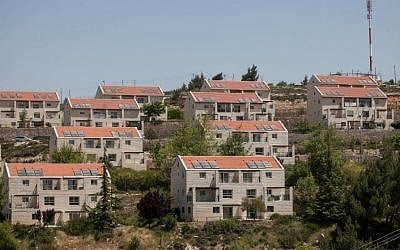
ULPANA OUTPOST, West Bank (AP) — A fast-approaching deadline to demolish the homes of 30 families in the unauthorized West Bank settlement outpost of Givat Ha’Ulpana is deepening fractures in Prime Minister Benjamin Netanyahu’s government, with some hard-liners warning the ruling coalition will fall if the buildings come down.
As he enters his fourth year in office, Netanyahu is walking a fraying tightrope, declaring himself committed to making peace with the Palestinians while making concessions to settlers who have illegally staked claim to territory Palestinians want for a future state.
Now he faces a May 1 deadline by the Israeli Supreme Court to destroy the houses. The future of the 30 apartments built north of Jerusalem have become a test of whether he can continue this balancing act.
The Israeli leader wants the court to defer the deadline to give officials time to save the five apartment buildings in the Ulpana outpost, built on the fringes of the religious Beit El settlement.
“We are looking for ways to prevent the demolition of the houses,” Netanyahu told Israel Radio.
The buildings were ordered demolished because they were erected on privately owned Palestinian land, something the court outlawed decades ago, even as it authorized building on other West Bank territory. A 2005 government report also

found Ulpana was erected without following proper government procedures.
The battle over the settlements is at the heart of the current impasse in peace efforts.
The Palestinians say there is no point negotiating with Israel if it continues to expand settlements in the occupied West Bank and east Jerusalem, areas they claim for their future state. A string of Israeli governments have pledged not to build any new settlements. But Palestinians accuse the settler movement, with tacit government support, of using outposts to grab more land.
With more than 500,000 Jewish settlers now living in these areas, captured by Israel in the 1967 Mideast war, the Palestinians say their dream of an independent state is quickly fading as it grows more difficult to partition the land between Israelis and Palestinians. They refuse to resume peace talks without a settlement freeze. The international community also views settlements as illegitimate.
For Netanyahu’s hardline allies, Ulpana has become a rallying cry for the larger issue of their right to build settlements
Netanyahu, whose government is dominated by parties sympathetic to the settlers, says negotiations should begin without conditions. Talks have been stalled for three years because of the settlement dispute.
The prime minister opposes any division of Jerusalem, and in a speech on Israel’s Memorial Day, reiterated Israel’s claim to all of the city. “We will not move from here. We will not stop building,” he said.
For Netanyahu’s hardline allies, Ulpana has become a rallying cry for the larger issue of their right to build settlements. A succession of ministers and lawmakers from Netanyahu’s coalition have made pilgrimages to Ulpana in recent days, and hundreds, including senior officials from Netanyahu’s Likud Party, turned up for a solidarity rally.
“We said we wouldn’t evacuate the neighborhood,” Vice Prime Minister Moshe Yaalon said Saturday. “Should this happen, the government will fall.”
Netanyahu himself has been a longtime ally of the settlers. But under heavy
international pressure, he has endorsed the concept of a Palestinian state. Netanyahu even borrowed a line from his dovish opponents recently, warning that if there is no peace, Israel would in effect be forced to absorb millions of Palestinians and destroy the Jewish character of his country.
Netanyahu, who has presided over a remarkably stable coalition of six parties, spoke for the first time Tuesday of the possibility of moving up elections from their scheduled date of October 2013.
Settlers who live at Ulpana insist the land was purchased legally from its Palestinian owners, something the court disputes. Like some other enclaves built in defiance of official procedures, Ulpana was built in memory of Israelis killed in a Palestinian attack.
Ulpana resident Sarit Ovadiah said she does not want to contemplate the possibility her family will be expelled and their home destroyed.
“What we’re occupied with now is saving the neighborhood. We’re bolstered by our faith. The Lord gave us this land,” said Ovadiah, who has lived in the outpost for four years with husband and daughter.
Ulpana spokesman Harel Cohen predicted the buildings would not be razed, saying Netanyahu would not let his government fall.
The Muslim call to prayer from nearby Palestinian villages floated over the air as he spoke, dramatizing the conflicting claims to lands at the core of the Palestinians’ struggle for statehood.
It’s not clear if the court will grant Netanyahu’s delay request.
Last month, the court rejected the state’s request to postpone dismantling Migron, a large West Bank settlement also built on private Palestinian land, without government approval. It must be destroyed by Aug. 1.
Netanyahu got further into trouble with settlers earlier this month after police evicted dozens of settlers from a building they illegally occupied in the West Bank city of Hebron, a frequent flashpoint of violence between Jews and Palestinians.
Shortly before security forces kicked these settlers out, Netanyahu promised to find a solution to Ulpana and to “formalize the standing” of three other settler enclaves built in defiance of official procedures. Late Monday, the government legalized these outposts.
Palestinian condemnation came swiftly.
“Netanyahu is pushing things into deadlock once again,” said senior Palestinian official Nabil Abu Rdeneh.
Copyright 2012 The Associated Press.










The Times of Israel Community.