

Defense think tank: Gaza war, West Bank violence making life harder for Jews abroad
Co-author of INSS report optimistic that elections will lead to a new government that will be more attentive to security concerns
 Add ToI as a Preferred Source on Google
Andrew Silow-Carroll is the editor-in-chief of JTA

JTA — The devastating war in Gaza and broader Israeli-Palestinian conflict are increasingly fueling antisemitism, dividing Jewish communities and weakening their ability to advocate for Israel, according to a new report by the Tel Aviv University-affiliated Institute for National Security Studies (INSS).
The report, “No Longer on the Sidelines: How the Israeli-Palestinian Conflict Impacts Diaspora Jews,” argues that Israel’s action in Gaza, inaction in the West Bank and failure to offer a “diplomatic path forward” for the conflict are fueling worldwide condemnation for the Jewish state.
In turn, Diaspora communities pay a price — in security threats and social and political turmoil — for policies that seldom take their concerns into account.
“The conflict is not only over there in the Middle East — it is local all over the Jewish world now, and Diaspora Jewry has skin in the game,” Theodore Sasson, one of the report’s authors, said in an interview.
“We are arguing that the Israeli government can do a better job balancing the needs of the Diaspora with the needs of the State of Israel for its own security, and that indeed an enlightened self-interest would lead it to do so,” Sasson said.
The report reflects the perceptions of members of a year-old “Joint Working Group.” Participants included 20 senior leaders from 15 Jewish communal and advocacy organizations in the United States, Canada, Britain, France and South America.
The discussions were held under the Chatham House rule — named for the storied British think tank — meaning participants cannot be identified or quoted by name.
Sasson said the report fell under the purview of INSS’s Israel-United States Research Program, where he is a senior researcher, because it considers the role of the Diaspora as one of the critical dimensions of the US-Israel strategic alliance.
The argument that Diaspora Jews are paying a price for Israeli policies arrives at a fraught moment: Jews in the United States and elsewhere fear rising antisemitism, while Israel faces growing international isolation over its conduct in Gaza. For Jews who believe Israel has made choices that accelerate both trends, the study may affirm a painful truth many may hesitate to articulate.
Others are bound to reject its conclusions, insisting that Israel cannot be held responsible for the chronic scourge of antisemitism — or warn that drawing any link between the two will hand Israel’s enemies a weapon.
Among such critics is David Bernstein, founder and CEO of the North American Values Institute. US Jews, he said on Friday in an email exchange, are not agents of Israel, and no disagreement over a foreign conflict justifies harassment, threats or violence against innocent civilians.
“If an African country was engaging in actions that many disapproved of, we would not see that as an excuse to harass African Americans in the US,” Bernstein told JTA. “We would not say that that African country was endangering African Americans. That very notion is deeply bigoted. The problem with bigotry lies with the bigot who will grasp any and all pretexts to express their bigotry.”
Anticipating such pushback, the report insists that “Jews and Israelis are not to blame for antisemitism.” Rather, it continues, Israeli policy “provided antisemites with incendiary material, contributed to a climate of anxiety and insecurity among Jews, and provided convenient cover for the spread of antisemitic sentiments and ideas.
“What we’re saying is that Israel is not the cause [of antisemitism], but enlightened Israeli policy can seek to maintain robust Diaspora support for the state of Israel and can deny the antisemites the material that fuels their mostly spurious claims,” Sasson said.

INSS has a reputation for Zionist, nonpartisan policy frameworks, and Sasson said the Jewish leaders who took part in the discussion reflected the ideological diversity of the Diaspora Jewish establishment.
Nonetheless, “there was broad agreement about the ways in which the Israeli-Palestinian conflict is affecting the Diaspora, and [about] the argument that the conflict is harming Israel’s image and standing in the world,” Sasson said.
Sasson and his co-author, Avishay Ben Sasson-Gordis, identify four effects of the conflict on Diaspora Jewish life based on the perceptions of the study participants: normalizing hostility toward Israel, dividing Jewish communities, diminishing the political influence of pro-Israel organizations and fueling antisemitism.
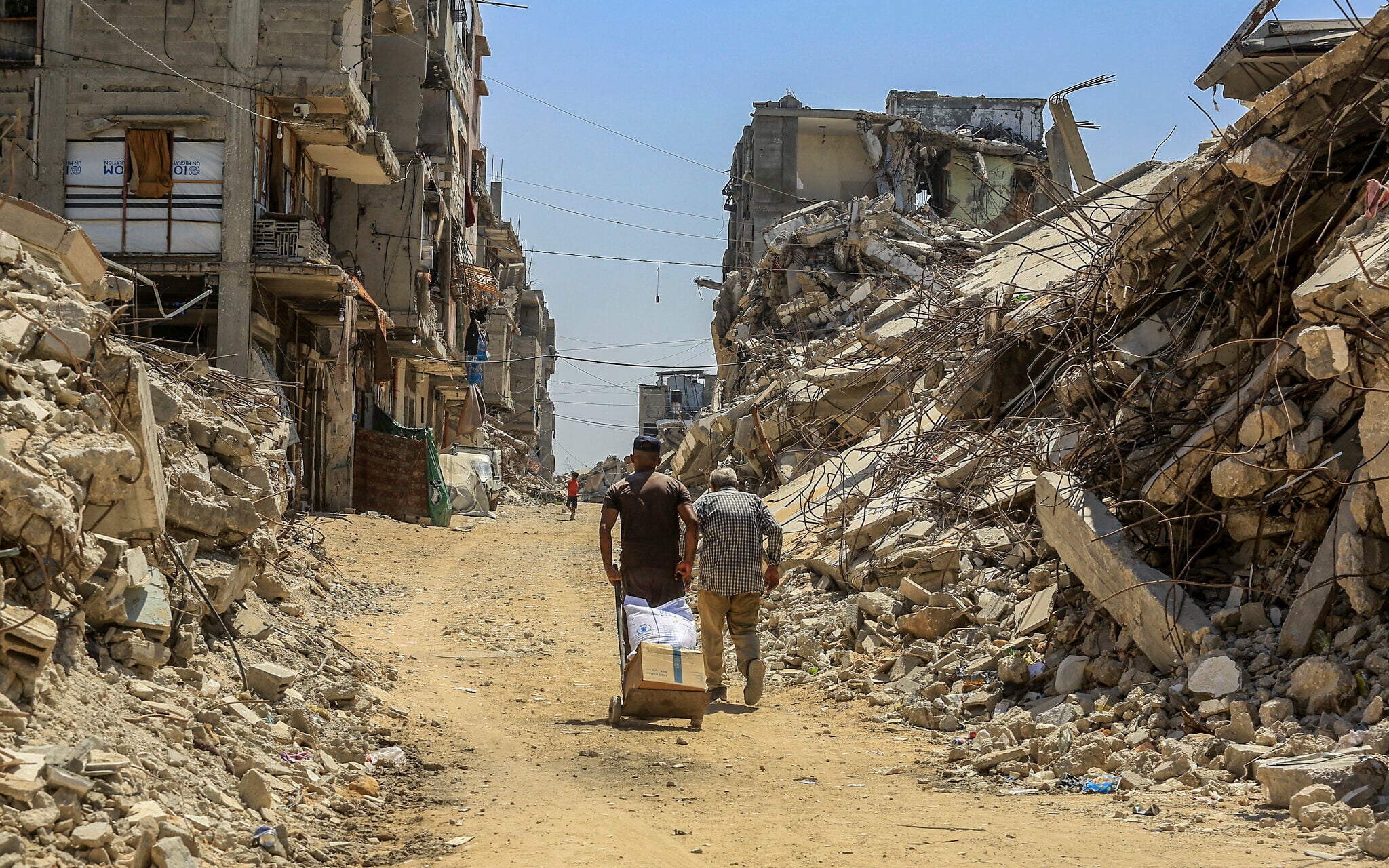
Participants offered numerous examples of Israeli policies that “seemed to confirm the worst allegations against Israel on human rights and international law,” the report said. These include damaging statements by government officials, Israel’s limits on humanitarian aid to Gaza at the height of the war, widespread damage to civilian infrastructure in Gaza and an explosion of unchecked settler violence against Palestinians in the West Bank.
Combined with the lack of a clear plan for Gaza after the war, said Sasson, such decisions undermine the ability of Diaspora Jews to defend Israel and, by extension, their own interests.
Participants also lamented that Israel has formally rejected “any resolution to the conflict that includes Palestinian statehood” without offering an alternative vision that maintains a Jewish, democratic state.
“The lack of an articulated political horizon — beyond continued occupation — is harming Jewish communities abroad,” one unnamed participant told the researchers. “If two states seem unimaginable within our lifetime, this will affect Jewish engagement and willingness to participate in communal life. It is already creating distance. Ironically, this damage may be greater than anything Israel’s opponents can do.”

According to a poll by the Mellman Group cited in the report, a majority of American Jews share the report’s conclusions. In that poll, conducted in August and early September, 56% of Jewish voters expressed a “great deal” of concern that “Israel’s actions under [Prime Minister Benjamin] Netanyahu have increased antisemitism and anti-Israel sentiment in the US.”
Although Netanyahu otherwise goes unmentioned in the INSS report, he has been prime minister for the period scrutinized by the working group.
The report articulates a position that surfaced periodically during the war sparked by the Hamas-led onslaught of October 7, 2023. In a June 2025 New York Times column, Thomas Friedman warned that Israel’s conduct in Gaza could fundamentally change how both Israel and Jews are viewed around the world. He predicted that Israel, “instead of being seen by Jews as a safe haven from antisemitism, will be seen as a new engine generating it.”
Daniel Pipes, the founder of the hawkish Middle East Forum, wrote in a Jewish Telegraphic Agency essay last October that Diaspora Jewry has become “collateral damage of the Gaza war.” He argued that attacks on kosher restaurants and synagogues outside of Israel are carried out by those who “cannot readily strike at Israel or its interests abroad” and “mostly attack the soft targets in their midst.”
Speaking that same month at the 39th World Zionist Congress in Jerusalem, Michal Bar-Asher Siegal, a scholar of rabbinic Judaism at Ben-Gurion University, asserted that both Israel’s conduct of the war and the inflammatory rhetoric of its leaders have consequences for Jews in the Diaspora. “When a minister in the government talks about the destruction of Gaza, or the relocation of its residents, what does this do to the Jew sitting in Toronto? What does this do to the Jew in New York?” she said, according to an account in The Jewish Independent.

One of the participants in the INSS Joint Working Group, the head of a large North American Jewish federation, told JTA that while they did not believe that Israel’s actions are causing antisemitism, they agreed with the premise that “in an interconnected world, what happens in Israel and the policies in Israel do affect global Jewry, and vice versa.”
“I do believe that there’ve been certain Israeli government actions or inactions over the past years that have led more people to distance themselves,” said the executive. Asked for an example, the executive spoke of “the lack of action in terms of the settlers’ behavior in the West Bank.”
“When I speak to people, there is a lot of discomfort with not only what’s been happening in the West Bank, but also the lack of Israeli government action to address it,” said the executive, who requested anonymity because they were not authorized by their employer to speak publicly.
And while Israel would and should put its own citizens’ security interests first, the leader said, the impact of Israeli policies on the Diaspora should be part of its calculus.
“Israel is the homeland for the Jewish people,” they said. “If the Israeli leadership believes that, then they also need to understand or take into consideration what are the implications of different things that they do, not just around ‘who is a Jew’ or [the Western Wall], but other actions that they take and the implications that it has on global Jewry.”

Sasson and Sasson-Gordis turned such perceptions into policy recommendations. The INSS report urges Israel to curb inflammatory statements by government officials, crack down on illegal settler violence, maintain a credible diplomatic “horizon” for resolving the Israeli-Palestinian conflict and establish procedures to assess how government policies affect Jews abroad.
The diplomatic question is particularly important, Sasson said. While participants did not share a consensus on a two-state solution, he said, there was broad concern about the difficulty Diaspora communities would face in defending a permanent one-state outcome that leaves Israel in control of the lives of millions of non-citizen Palestinians.
“Failure to provide the diplomatic horizon that envisions Israel as a Jewish and democratic state with a secure border,” said Sasson, “is enabling a discourse to crystallize in much of the world that Israel is an apartheid state. We don’t endorse that, but we also believe that the Israeli government could do a better job confronting that.”
With Israeli elections on October 27, Sasson, who in addition to his role at INSS is a professor of Jewish studies at Middlebury College in Vermont, is optimistic that a new government might take Diaspora concerns into consideration when making policy decisions.
Last week, former prime ministers Naftali Bennett and Yair Lapid pledged to strengthen Israel-Diaspora cooperation if their B’Yachad party returns to power. “The challenges of the last few years have shown that we share a fate as a people and a responsibility for our people’s future,” Lapid told JTA.
Sasson said: “Where the Joint Working Group has a really broad agreement is around the notion that the conflict is having a devastating effect on Jews globally and their relationship to Israel and ability to represent Israel, and that a new Israeli government should seek a reset.”









The Times of Israel Community.