

Divided judicial panel set to approve 4 new justices
Justice minister and members of appointments committee debate compromise deals ahead of high-stakes vote
 Add ToI as a Preferred Source on Google
Sue Surkes is The Times of Israel's environment reporter
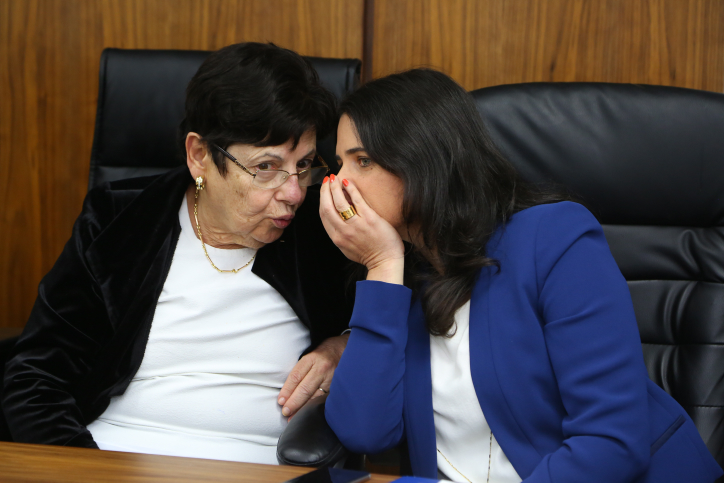
The high-level, divided judicial appointments committee was set to vote Tuesday on the appointment of four justices to Israel’s High Court and Supreme Court.
The nine-member panel was tasked with selecting replacements for four justices approaching the mandatory retirement age of 70, out of a list of 27 candidates.
In recent years, right-wing lawmakers have accused the top legal body of interventionist judicial activism as pioneered by Aharon Barak, president of the High Court from 1995 to 2006, after the courts torpedoed a series of Knesset laws it deemed unlawful.
The current nine-member panel consists of Justice Minister Ayelet Shaked; Finance Minister Moshe Kahlon; two lawmakers from the governing coalition, Nurit Koren (Likud) and Robert Ilatov (Yisrael Beytenu); representatives of the Bar Association; and three Supreme Court judges, President Miriam Naor (due to retire in October), Elyakim Rubinstein (due to retire in June) and Salim Joubran (due to retire in August).
Seven out of the nine — or two less than those present — must approve judicial appointments, with the Supreme Court justices usually voting as a bloc. In practice, this prevents the appointment of judges without the Supreme Court’s approval.
Shaked of the right-wing Jewish Home Party has frequently spoken out in favor reining in the High Court or changing the makeup of the justices to incorporate more conservative views.
Out of the 27 candidates, Shaked’s favorites reportedly include Bar-Ilan University law professor Gidi Sapir, Official Receiver David Hahn and Bar-Ilan law faculty dean Shahar Lifshitz.
Hahn, according to the Israel Hayom newspaper, is religious, right-wing and conservative in his views.
Sapir is a leading opponent of the court’s judicial activism, according to the Haaretz newspaper.
The judges are said to oppose the Bar Association’s candidate — Yosef Alron, president of the Haifa District Court — who was backed by Kahlon.
A third area of contention which is pitting the justices against the politicians and the Bar Association, according to Haaretz, is over which Arab judge will replace Salim Joubran when he retires.
Several possible deals were on the table for discussion and the voting was expected to last for hours, the daily said.
Shaked is expected to back one of the judges’ candidates — either Ruth Ronen from the Tel Aviv District Court or Nava Ben Or of the Jerusalem District Court — in return for the justices’ support for Sapir, according to Haaretz.
In the event that the sides fail to reach agreement, another vote will be held in a month and Shaked might resuscitate a bill to change the composition of the judicial panel.
In November, Shaked and Naor locked horns over the bill, lodged by three Yisrael Beytenu MKs and apparently supported by the justice minister, which would see judges appointed with a regular majority of votes from the nine-person Judicial Selection Committee.
In a letter to Shaked, Naor wrote, “Submitting this bill at the current time represents, under the circumstances, ‘placing a gun on the table.’ It means that if some of the committee members do not agree to appoint certain candidates, preventing the appointments through a special majority, then the constitutional ‘rules of the game’ will be changed, such that they can be appointed with a regular majority by the committee members.
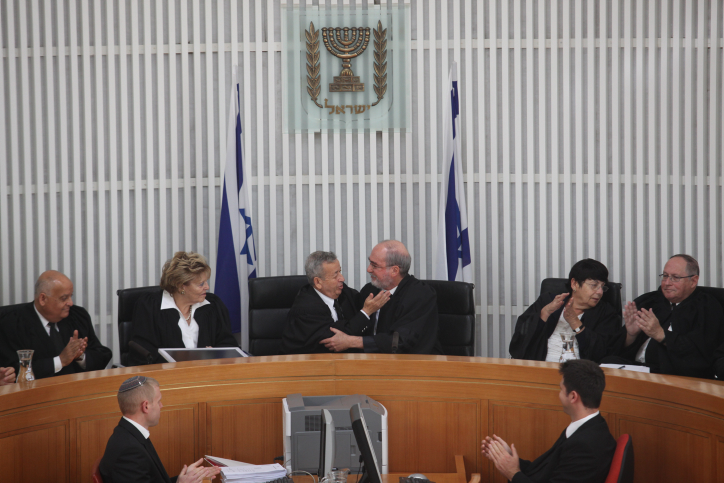
“Therefore, I must inform you — with the support of [court] Vice President [Elyakim] Rubenstein and Justice [Salim] Joubran — that we have no intention to continue at this time with the dialogue and early consultations to formulate a list of candidates and regarding possible agreements,” she wrote.
Ilatov, who was involved in the drafting of the bill, pointed out at the time that it had not yet been presented to the Ministerial Committee for Legislation and was therefore not yet an issue to create an uproar.
The bill was later shelved and the judicial committee discussions resumed.
Israel’s highest court has 15 members, though only some of the judges are assigned to each case. The chief justice post is traditionally appointed automatically, based on seniority.
For the Israeli right, the Supreme Court represents the old left-leaning political elite, a bench of like-minded figures that it is determined to replace.
The left and opposition politicians fear that clipping the court’s wings will threaten Israeli democracy, upturn the system of checks and balances and leave open key issues that the fractious Knesset is unable to resolve, such as those pertaining to civil liberties, religious freedom and the rights of Palestinians.









The Times of Israel Community.