 Add ToI as a Preferred Source on Google
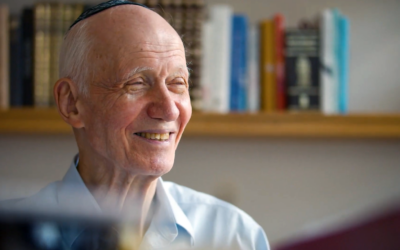
Michael Marmur knows that some of the theological questions he raises in his new book may not be entirely palatable to readers.
The Jerusalem-based Reform rabbi likens them to crunchy peanut butter.
“Smooth theology answers all of your questions,” Marmur said in an interview. “It spreads over everything, encompassing all the things you need to know.”
He continued, “I’m not capable of producing that kind of theology. This work is more crunchy, which means it’s more uneven, and there are bits in it that may be hard to digest, but this is where we are at the moment in our current reality.”
Among the difficult, crunchy questions Marmur broaches in “Living The Letters – An Alphabet of Emerging Jewish Thought” (Palgrave Macmillan) are whether Judaism is a viable project in modern times, what the moral price of Jewish sovereignty is, and how to address what he calls “the palpable dearth of Jewish literacy in liberal circles.”
The book is framed around the competing and sometimes contradictory meanings of a series of Hebrew terms and, following in a millennia-old Jewish tradition, is framed as an acrostic: Each of the book’s 22 chapters is titled with a Hebrew letter from alef to tav.
Can Judaism be modern?
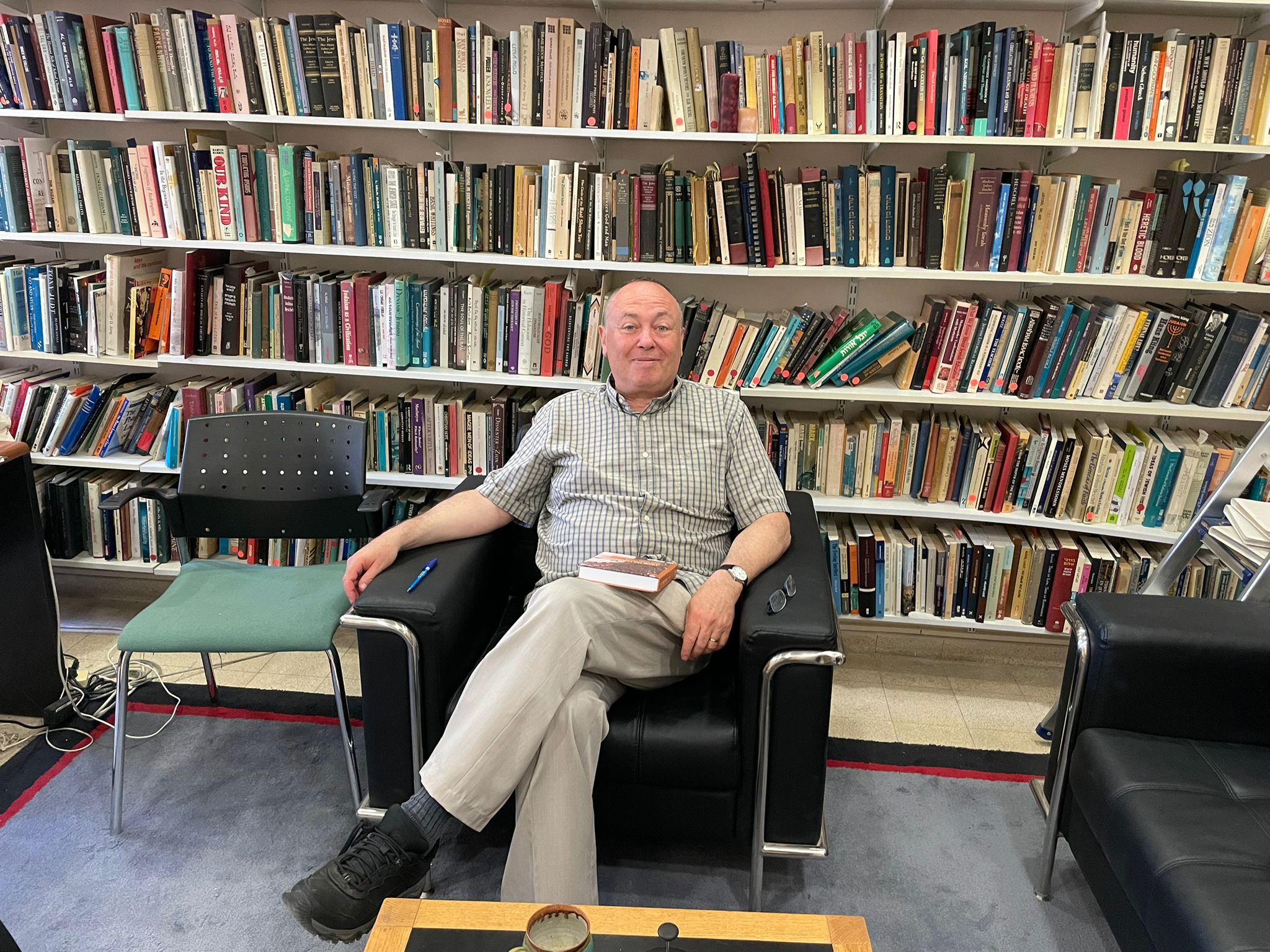
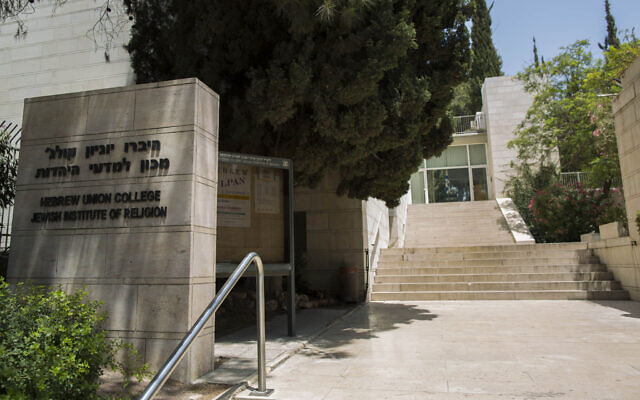
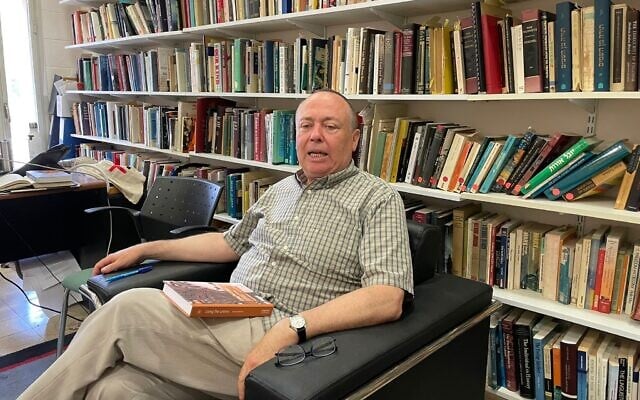
Marmur met with The Times of Israel in his office at Hebrew Union College, the Reform movement’s flagship rabbinical school, where he formerly served as provost and dean of the Jerusalem campus.
Behind him stood a rich library, showcasing many of the 20th-century Jewish thinkers whose works are cited throughout the book’s exploration of what it means to be both Jewish and modern — from Emmanuel Levinas to Franz Rosenzweig to Rabbi Abraham Joshua Heschel.
“This book is primarily intended for Jews who are looking for a way of exploring a creative approach to Judaism,” Marmur said. “If someone already knows all the fundamental truths they believe in, probably this is not for them.”
Marmur wrote the book following a long career as an academic and activist. Born and raised in the United Kingdom, he moved to Israel in 1984 and in 1992 was ordained in the Israeli rabbinic program at HUC, where he has taught philosophy and theology since 1997. He is a former board chair of Rabbis for Human Rights, which is best known for aiding West Bank Palestinians.
‘This is my attempt to explain what it is I think I’m doing by living this kind of Jewish life’
On a fundamental level, Marmur said, he wrote the book for his children. “This is my attempt to explain to them and to myself what it is I think I’m doing by living this kind of Jewish life,” he said.
In “Living the Letters,” Marmur writes that he hopes to advance a “theology based on reason and experience, not eternal authority, which offers a third way between orthodox authority religion and secular disbelief.” The rabbi said that, in a sense, his book could also be seen as an attempt to answer the question of how to be “passionate moderates.”
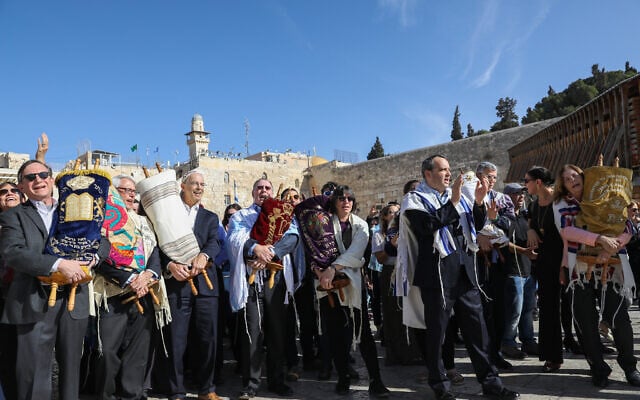
He acknowledged that maintaining that commitment to Jewish tradition and moderation can pose both intellectual and practical challenges for some, including his children, who value personal choice.
“The Torah of life that I want more than anything to impart can only be received by them on their terms, at their pace, with their will,” the rabbi writes in the book. “I reject any theology of Jewish commitment which bypasses individual personal liberty. The price for this value is the awareness that my children might choose to abandon all vestiges of Jewish life. While that prospect fills me with dismay and despair, I acknowledge that this is indeed the case.”
Marmur also acknowledged that the liberal emphasis on personal freedom may mean that Orthodox Jews are more successful in retaining their children’s identity than non-Orthodox Jews.
‘People who are successful in explaining their worldview usually do so without too much nuance’
“People who are successful in explaining their worldview usually do so without too much nuance,” he said.
“In a sense, I envy them, their educational success, the degree of retention,” he added. “This book, however, is for people like me, for whom some of those commitments are impossible, and instead, want to live in a world of possibility and still be able to articulate it [their worldview] in a passionate, hopefully, quite informed way.”
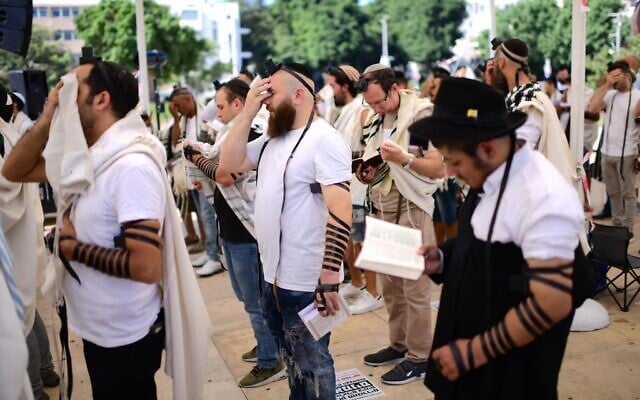
Marmur’s favorite chapter of the book, for example, begins with “the letter lamed, with the word lehaniach,” (to lay).
The verb lehaniach is used in the blessing before the ritual act of wrapping the leather straps of tefillin (phylacteries) — but also means “to let go.”
“I ask a question that is apparently very simple: will I put on tefillin tomorrow morning?” he said.
“Hebrew is full of ambiguity, and I play with this ambiguity,” Marmur continued. “Someone who feels commanded to wear tefillin every day will not ask themselves the question of whether they will do so tomorrow. The same is true for people for whom tefillin is not a relevant concept.”
Marmur explained that, for his whole life, he has been drawn to the physicality of the ritual and repelled by its arcane choreography. The central verb in its blessing, however, feels meaningful to him.
“I do not pray every day with tefillin, but every day I recite a blessing involving lehaniach,” he wrote in the book. “I thank God for opportunities lehaniach, to assume the tradition. And I thank God for the freedom lehaniach, to let go.”
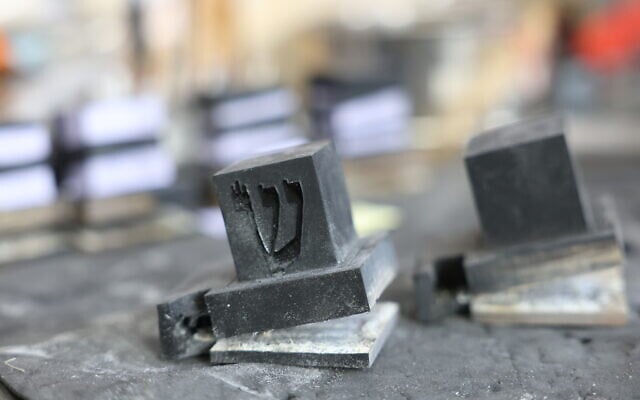
Does Israel pose an insurmountable moral challenge?
In the book’s introduction, Marmur explains that it was largely born out of existential anxieties. One centers on the tension between Judaism and modernity, another on the uncertain moral fate of the State of Israel.
“I am afraid that the establishment of the State of Israel may prove to be not only the most consequential Jewish event in over a millennium but also a challenge to which we may not be equal,” Marmur wrote.
The rabbi acknowledged the deep fears arising from the threats Israel faces from states and terror groups that openly call for its destruction. At the same time, he highlighted dangers he sees within Israeli society, which he enumerated as the “palpable erosion of democratic norms” as well as the large number of Jewish Israelis who “countenance continued inequalities between Jews and Arabs.”
The rabbi said those questions keep him up at night.
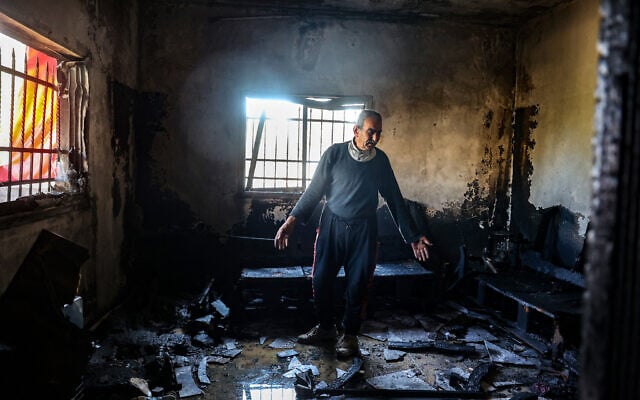
“Most of the beautiful things of Judaism did not develop under conditions of sovereignty,” he said. “Now we need to repurpose some of these ideas and come up with new ones.”
Marmur fears that Israel will succumb to what he described as “dark forces of chauvinism and brutal nationalism.”
‘Most of the beautiful things of Judaism did not develop under conditions of sovereignty’
The onslaught of October 7, 2023, when thousands of Hamas-led terrorists attacked southern Israel, killing some 1,200 people, mostly civilians, and kidnapping 251, happened while he was working on the book.
“I have questions about the particular moment we are living,” Marmur said. “Of course, they are about October 7, but they go beyond the way the war is conducted, the hostages, and the displaced people in Israel. There is a question of how we relate to the moral and political challenge of a couple of million people living across our border.”

Marmur said some avoid facing that moral challenge by looking at everyone in Gaza as a potential terrorist. “In my view, these opinions need to be resisted with all our energy,” he said.
“Another way of making the problem easy is to portray Israel as a demonic power in the Middle East that needs to be defeated, and everything will have a happy ending,” he continued. “This is also impossible for me.”
In the book, Marmur devotes the chapter of the letter ayin to the biblical concept of Azazel, playing on the similarity between the word and the Hebrew name for Gaza (Aza).
Azazel appears in the Book of Leviticus and other Jewish sources. Ahead of Yom Kippur, a goat is selected as a scapegoat and sent off to Azazel, figuratively laden with all the sins of the Jewish people.
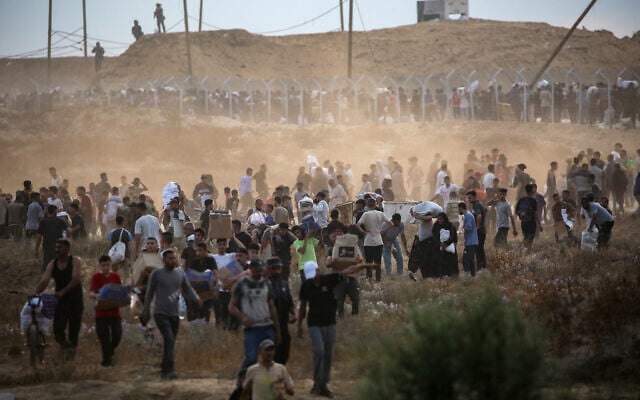
“We Israelis have to grapple with lots of trauma and challenges and adopt different mechanisms to deal with it,” said Marmur. “One of these mechanisms is to send these traumas and challenges away, banishing them from us. But on October 7, all the stuff that we tried to send to the periphery of our consciousness marched over the border and came straight back to us.”
The rabbi stressed that he was not a military expert and was not attempting to propose a battle plan.
‘On October 7, all the stuff that we tried to send to the periphery of our consciousness marched over the border and came straight back to us’
“I’m trying to ask the question of who we need to be and how we need to behave to find a way through this crisis,” he said. “I believe that any solution which completely dehumanizes the other is unacceptable on moral and Jewish grounds. So I’m left looking for another way of grappling with this.”
The rabbi said he purposely chose not to discuss antisemitism in the book.
“I don’t deny that there is real antisemitism out there,” Marmur said. “I am alarmed at how we too often use antisemitism to justify all sorts of things.”
He added, “My book is an attempt to build together a Judaism which is not founded on a response to antisemitism.”
Asked about how he thought his readers outside of Israel would react to his reflections, Marmur said he was not sure but looked forward to finding out.
The last chapter of the book, called “The twenty-third letter,” is inspired by a Jewish mystical tradition of a letter yet to be revealed, or “a way of thinking about what happens next,” Marmur said.
There, Marmur invites readers, non-Orthodox Jewish movements and the entire nation of Israel to step up and respond to the challenges of the present.
“My proposed twenty-third letter is one to help engender a new way in which the Jew faces the other, be they in Israel or anywhere else,” he said. “We have to find new ways of articulating our commitments, passionately Jewish and compassionately human.”
Living The Letters: An Alphabet of Emerging Jewish Thought by Michael Marmur
This article contains affiliate links. If you use these links to make a purchase, The Times of Israel may earn a commission at no additional cost to you.

The Times of Israel Community.