

Finding gold in Israel’s ties with the Hashemites
Despite outwardly chilly relations between Jerusalem and Amman, the two states enjoy close cooperation

 Add ToI as a Preferred Source on Google
Avi Issacharoff, The Times of Israel's Middle East analyst, fills the same role for Walla, the leading portal in Israel. He is also a guest commentator on many different radio shows and current affairs programs on television. Until 2012, he was a reporter and commentator on Arab affairs for the Haaretz newspaper. He also lectures on modern Palestinian history at Tel Aviv University, and is currently writing a script for an action-drama series for the Israeli satellite Television "YES." Born in Jerusalem, he graduated cum laude from Ben Gurion University with a B.A. in Middle Eastern studies and then earned his M.A. from Tel Aviv University on the same subject, also cum laude. A fluent Arabic speaker, Avi was the Middle East Affairs correspondent for Israeli Public Radio covering the Israeli-Palestinian conflict, the war in Iraq and the Arab countries between the years 2003-2006. Avi directed and edited short documentary films on Israeli television programs dealing with the Middle East. In 2002 he won the "best reporter" award for the "Israel Radio” for his coverage of the second intifada. In 2004, together with Amos Harel, he wrote "The Seventh War - How we won and why we lost the war with the Palestinians." A year later the book won an award from the Institute for Strategic Studies for containing the best research on security affairs in Israel. In 2008, Issacharoff and Harel published their second book, entitled "34 Days - The Story of the Second Lebanon War," which won the same prize.
AMMAN — Our cab driver sounded very certain. “A treasure worth tens of billions of dollars in gold has been found,” he told us on Sunday, just three days ago. At first I had no idea what in the name of God he was talking about. But Ahmed the driver was insistent.
“The army found a golden treasure, in the northwest of the country, not far from Irbid, in a place known as Ajloun. The amount of gold found there,” he said, “is worth something like $60 billion.”
That’s an amount that would cause a significant spike in the Jordanian national budget.
Another rumor milling about, we were told, was that a giant golden statue of Herakles had been uncovered at an archaeological site called Khirbet Herakla.
My overactive imagination, doubtless like that of Jordanian citizens who heard the news, soared. Unfortunately, as of this writing, however, neither of the treasures has been located.
But on Tuesday, according to the Jordanian army chief of staff, slightly more realistic discoveries were confirmed: Israeli spy installations, that were set up in the 1960s on Jordanian soil for fear of attack on the eastern front — the movement of Iraq and/or Syrian forces into Jordan to strike at Israel from Hashemite territory.
It may be that these installations were of the same type as those that failed to provide Israel with adequate intelligence ahead of the Yom Kippur War. Equipment of this kind was also installed in Egyptian territory by elite Israeli forces, but because it wasn’t activated in time, it didn’t provide Israel with sufficient warning about the impending conflict.
Since the Yom Kippur War, a great many things have changed. The threat of an Iraqi Army infiltration through Jordan into Israel no longer exists. Syrian Army action against Israel, through Jordan or the Golan Heights, is highly unlikely, in part because of the domestic preoccupation and considerable disintegration of Assad Jr.’s forces. Most importantly, Egypt and Jordan have since become allies of Israel, on the defense level at least, and to a certain degree on the political level.
And while many words have been written and spoken about the security coordination between Cairo and Jerusalem, especially during the summer’s Israel-Hamas conflict, deep cooperation exists between Amman and Jerusalem, as well.
The discovery, and subsequent removal, of those spy installations is an example of such cooperation. According to the Jordanians, this only took place after an explosion took place at one of the sites, but the fact remains that coordination between the IDF and the Jordanian military was able to bring about a jointly agreed solution to the problem. That would have been unthinkable before the 1994 treaty.
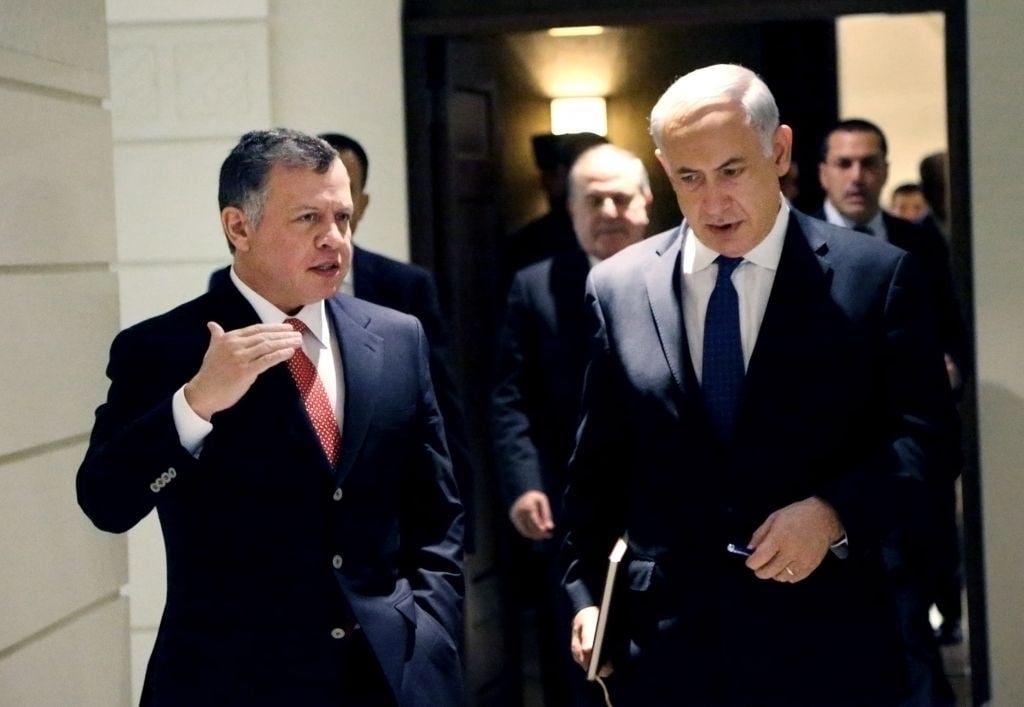
Similarly, it may well be that the two countries’ intelligence agencies share information concerning Islamist terrorist threats. Even relations between Prime Minister Benjamin Netanyahu and King Abdullah II have improved drastically — away from the media’s gaze.
Despite the denials from Jordan, Israel and Ramallah, Jordanians here in the capital insist that toward the end of this summer’s war in the Gaza Strip, Netanyahu and Abdullah met and were joined at some point by Palestinian Authority President Mahmoud Abbas.
The events of Operation Protective Edge caused a certain degree of damage to Israel-Jordan relations. The flow of Israeli Jewish visitors to Jordan decreased, even in places such as the Red Sea resort of Aqaba. The Jordanian opposition, principally that which identifies with the Muslim Brotherhood, has continuously attacked Israel and demands that relations with the Jewish state be severed. But peace between the two countries broadly maintains a constant tepid temperature, with no cold snaps and intermittent warmth.
Even the lions from the Bisan Zoo in Gaza, who were harmed during the war in Gaza, traveled through Israel on their way to a new home in Jordan, at the request of the Hashemite Kingdom. And most dramatically of all, there was the $15 billion-$18 billion gas deal signed between Jordan and Israel this very summer — essentially making Israel the chief energy supplier to Jordan.
A new Middle East, right? Even if that colossal sum still doesn’t come close to the value of the storied gold bullion treasure of Ajloun.




The Times of Israel Community.