EU paves way for sanctions against Lebanese political elite over ongoing crisis
Bloc’s foreign policy chief says top diplomats from 27 nations gave green light to establish legal framework for measures against Beirut leaders who have driven economic collapse
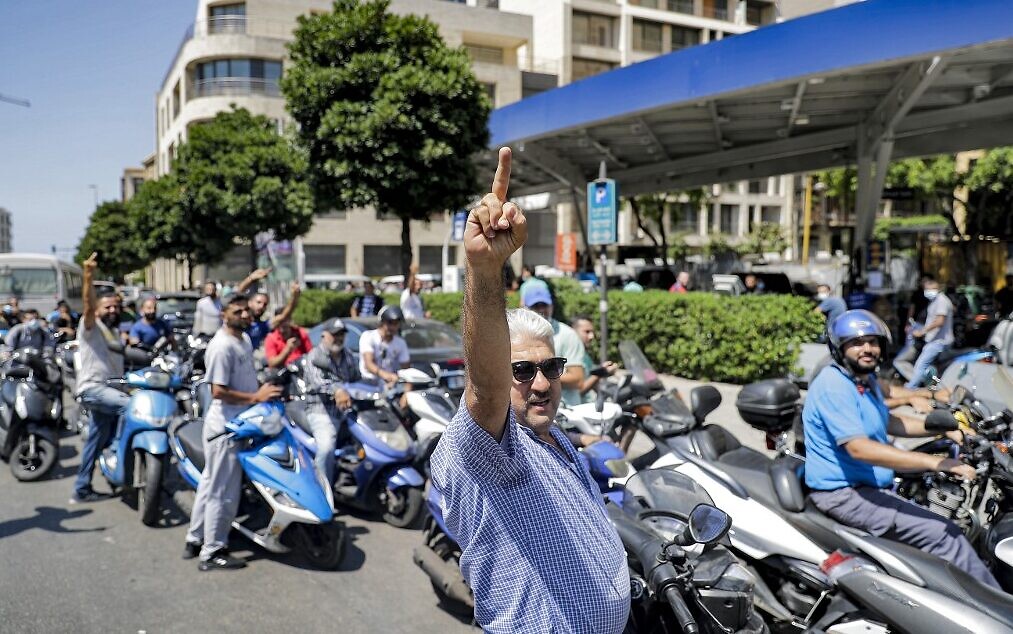
Scooter drivers waiting outside a gas station in Lebanon's capital Beirut raise their middle fingers in protest against hikes in the price of fuel, June 29, 2021. (Joseph Eid/AFP)
BRUSSELS — EU foreign ministers on Monday agreed to move ahead towards sanctions against Lebanon’s ruling elite over the political crisis wracking the country, the bloc’s foreign policy chief said.
Josep Borrell said the top diplomats from the 27 nations gave the green light at a meeting in Brussels to establish a legal framework for measures against Lebanese leaders who have driven their nation into economic collapse.
“The objective is to complete this by the end of the month,” Borrell said.
A political crisis has left the country without a functioning government since the last one resigned after a massive explosion killed dozens and destroyed swathes of Beirut in August 2020.
“The economy’s imploding and the suffering of the people of Lebanon is continuously growing,” Borrell said.
Get The Times of Israel's Daily Editionby email and never miss our top stories
“They need to have a Lebanese government in order to avoid the breakdown of the country, (one that is) fully able to implement reforms and protect this population.”
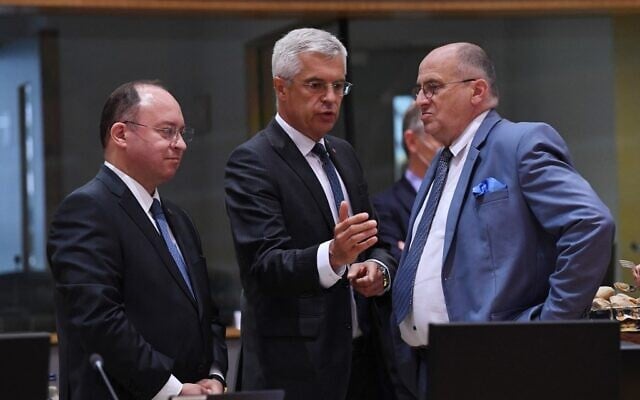
Romanian Foreign Minister Bogdan Lucian Aurescu (L) talks with Slovakian Minister for Foreign and European Affairs Ivan Korcok (C) and Polish Foreign Minister Zbigniew Rau during a Foreign Affairs Council meeting at the EU headquarters in Brussels on July 12, 2021. (JOHN THYS / AFP)
Lebanon is mired in what the World Bank has called one of the worst economic crises since the 1850s, and the cash-strapped state is struggling to buy enough fuel to keep the lights on.
The economic crisis has seen the Lebanese pound lose more than 90 percent of its value against the dollar on the black market, and left more than half the population living below the poverty line.
Advertisement
In April, France imposed sanctions by restricting entry of Lebanese figures it says are responsible for the political crisis.
Help us report truthfully on social media
As a multimedia journalist, my job is to take the quality, fact-based journalism produced by The Times of Israel newsroom and make it accessible across every platform — from Instagram posts to podcasts to short-form videos.
This is how many, especially young people, consume news these days. But misinformation is rampant on social media. Our team at ToI produces accurate, responsible short-form reporting on Israel and the Jewish world.
If you believe in the importance of factual social media journalism, please consider joining our reader support group, The Times of Israel Community. Your financial support is essential to sustain responsible multimedia reporting.
We’re really pleased that you’ve read X Times of Israel articles in the past month.
That’s why we started the Times of Israel - to provide discerning readers like you with must-read coverage of Israel and the Jewish world.
So now we have a request. Unlike other news outlets, we haven’t put up a paywall. But as the journalism we do is costly, we invite readers for whom The Times of Israel has become important to help support our work by joining The Times of Israel Community.
For as little as $6 a month you can help support our quality journalism while enjoying The Times of Israel AD-FREE, as well as accessing exclusive content available only to Times of Israel Community members.
Thank you, David Horovitz, Founding Editor of The Times of Israel


 Add ToI as a Preferred Source on Google