 Add ToI as a Preferred Source on Google
VATICAN CITY — For Francois and Fanny, a Catholic couple from Montreal, their first time on a pilgrimage to Rome has been deeply meaningful.
“We are devout Catholics, and it feels great to be here,” Francois said as they sat under the imposing colonnade in St. Peter’s Square, waiting for their group to enter the 16th-century basilica. They had come for the prayer vigil of the Jubilee of Consolation, a three-day gathering dedicated to those who have faced loss and hardship.
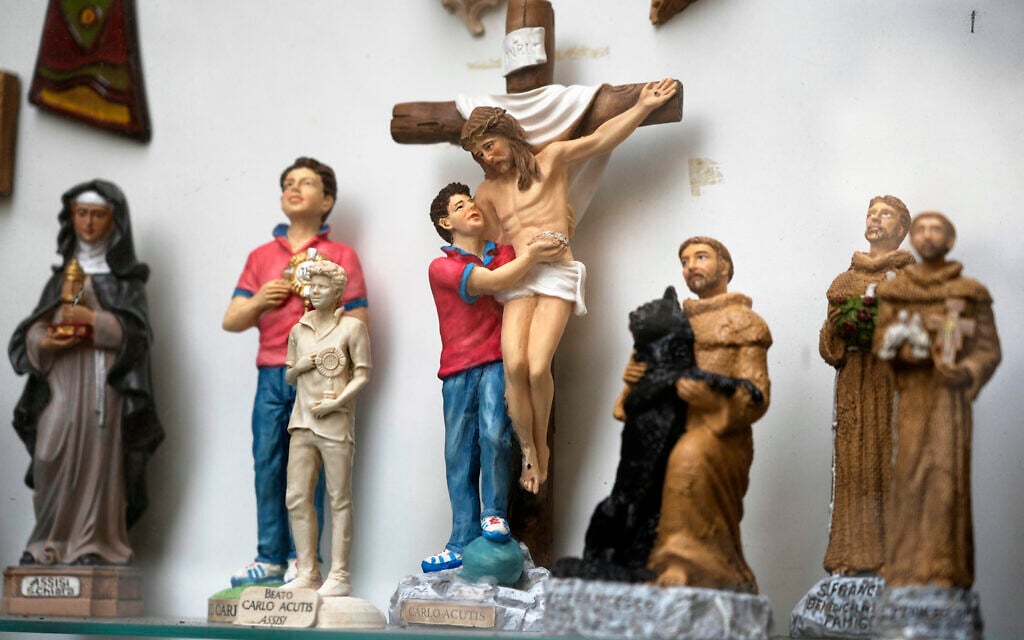
Before reaching Rome, the group stopped in Assisi, the birthplace of St. Francis, located approximately 130 kilometers northeast of the Italian capital. There, they prayed at the sanctuary of the Church’s newest saint, Carlo Acutis.
The Catholic Church has declared 2025 a Jubilee Year, drawing millions of pilgrims to Rome for special celebrations. Among them was the canonization of Acutis, a 15-year-old Italian who died of leukemia in 2006 and has since been hailed as the first “millennial saint” and the “cyber-apostle.”
Part of an effort to reinforce the Christian message among the new generations, Acutis’s canonization attracted an estimated 60,000 worshipers to St. Peter’s Square on September 7, many of them youths. His body and heart are now permanently enshrined at the Church of Santa Maria Maggiore in Assisi.
“We saw his body and prayed in the place where he is resting,” Francois said.
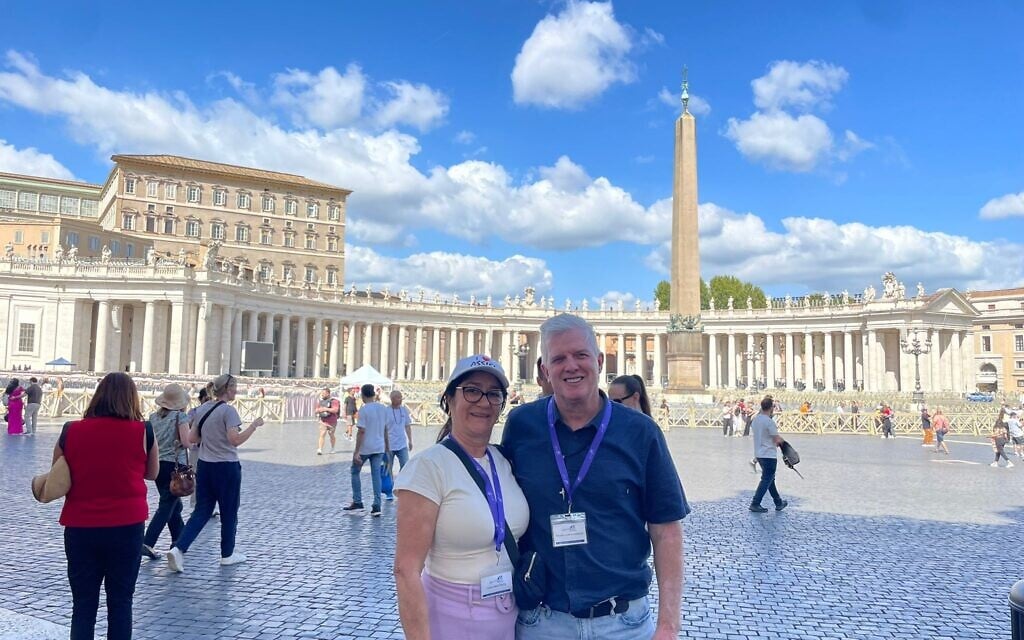
“Right out of the womb of his mother, he was inspired by the Holy Spirit,” Fanny echoed. “One of the big problems of our society is that the youth no longer believe in any religion, God, or Jesus Christ.”
“We hope that he becomes an inspiration for the younger generations,” Francois added, noting that they prayed that all of their children and grandchildren, some of whom are less devout than they are, return to faith.
Yet Acutis’s canonization has also stirred criticism, with some noting that the Church has not addressed the antisemitic roots of certain “Eucharistic miracles” Acutis helped promote by creating accessible online databases.
A central Christian rite, the Eucharist consists of a memorial action in which worshipers partake of special bread and wine, representing Jesus’ flesh and blood.
Before his death, Acutis compiled accounts describing consecrated wafers said to bleed or turn into flesh — sometimes after being allegedly desecrated. In several of these tales, those accused of the profanation were Jews, who were then said to have paid with their lives.

An untold history?
Just over a week after his canonization, several pilgrims, like Francois and Fanny (who declined to share their last name), described Acutis as an inspiration. Speaking with The Times of Israel, they said they were completely unaware of the antisemitic history of the Eucharist miracles he focused on — or of the broader history of overt antisemitism within the Catholic Church.
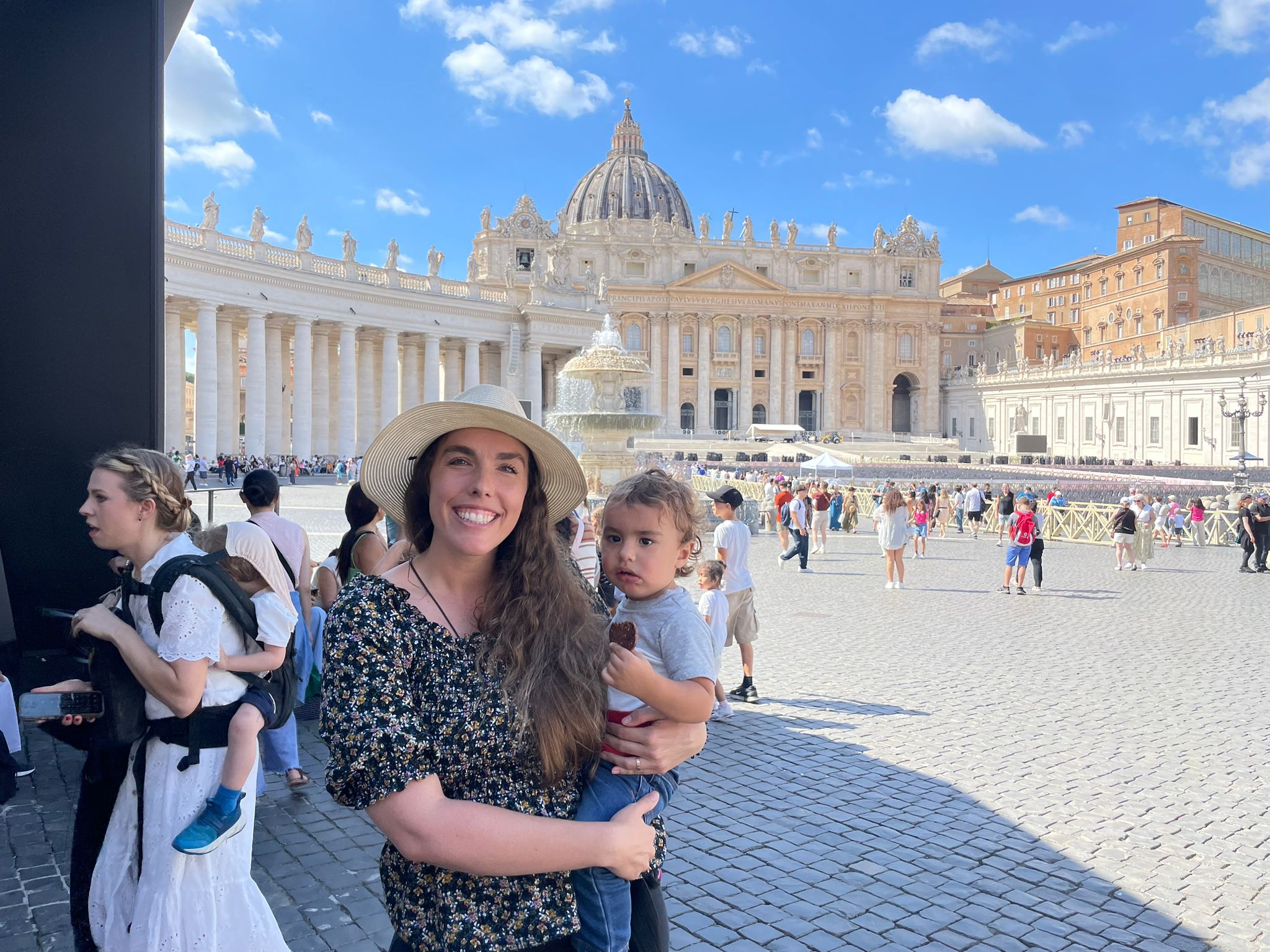
“Everyone I know has a very good feeling about Carlo, that he is someone so close to our generation that we could very much relate to him,” said Mariah Dolenc, 38, an American living in Slovenia with her husband and children.
Dolenc noted that, while she was familiar with the concept of Eucharistic miracles, she was not aware of any antisemitic roots associated with them.
Asked about whether she believes antisemitism was part of the history of the church, she said that “there is a lot of antisemitism in the history of the world, and that’s not exclusive to the Church.”
“I feel Catholicism is very much the fulfillment of Judaism, because, from our perspective, it started with Abraham, and when you go to a Catholic mass, you see a lot of Torah included,” Dolenc said.
Also at St. Peter’s Square on Sunday, Anne Doliwa, 35, said that she considered her Catholic faith as a fulfillment of Judaism — with an additional layer. Her grandmother, a German Jew, converted to Christianity with her family during World War II.
“Her grandmother and her aunt were in concentration camps, and one of them died in Auschwitz,” she told The Times of Israel.
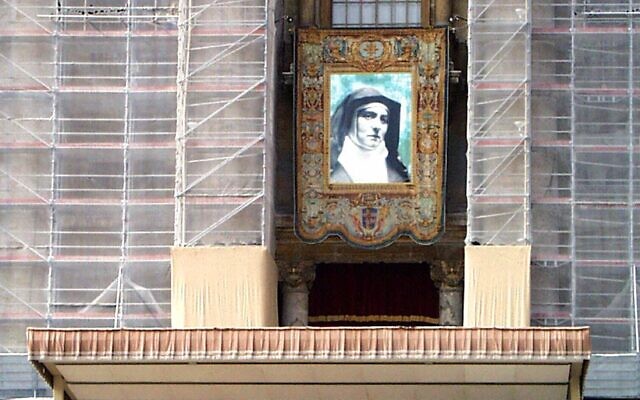
Doliwa said she was visiting Rome for the first time with her husband and five children to attend the Jubilee of Consolation. She was also preparing for her final profession as a secular Carmelite, a layperson member of the order, next month, adding that Edith Stein was one of her patrons.
Born and raised Jewish, Stein converted to Catholicism as an adult and became a Carmelite nun. She was killed in Auschwitz in 1942. The Catholic Church canonized her in 1998, in a move that drew criticism as it was seen by many as an attempt by the Vatican to Christianize the history of the Holocaust.
Doliwa, however, saw no contradiction between her Jewish roots and her present beliefs.
“I have a deep respect and reverence for the Jewish faith and for Jews, and I view them as our elder siblings,” Doliwa said. “I’ve never encountered any animosity [against Jews]. In fact, all the Catholics that I know have deep reverence for our elder brothers in faith.”
Doliwa was not familiar with the antisemitic undertone within Eucharistic miracles, nor the connection with Acutis.
“From all I’ve heard, Carlo Acutis was a young boy who fell in love with Christ, and who used technology and the internet to promote Eucharistic miracles,” she said. “I don’t really know much about him.”
‘There is a lot of ignorance’
Over the centuries, Christian persecution has caused the ghettoization, displacement, torture, and death of millions of Jews. The animus historically stemmed from the conviction that Jews were responsible for the death of Jesus, from their refusal to convert to Christianity, and other prejudices — such as the accusation of desecrating communion wafers.
An official turning point only came with the Second Vatican Council in 1965, when the Catholic Church issued a document, Nostra Aetate, repudiating antisemitism and stating that the Jewish people were not responsible for Jesus’s death.
Asked about the history of the Church’s persecutions against Jews, Doliwa said that it was important to distinguish between individual people and the institution.
“When I look at the Church, its ideals and everything that it has spread throughout time, I believe that it is open, inclusive, and welcoming for everybody,” she said. “When you’re talking about particular people falling into sin, everybody falls into sin. We have had popes who have been awful hundreds of years ago. Still, when you look at the official teachings of the Church and its mission, I say that it has always been looking at our elder brothers with respect.”

According to Chief Rabbi of Rome Riccardo Di Segni, the low level of awareness about issues related to antisemitism among Catholic pilgrims is not surprising.
“There is a lot of ignorance,” Di Segni said. “Many people who come on a pilgrimage are simple people. They know very little.”
While he agreed there is a need for better education about antisemitism in the Church’s context, he did not think it was right to focus on Acutis’s story and canonization.
“We are talking about a teen who died prematurely after showing a strong religious feeling early on in his life and who got passionate about miracles related to the Eucharist, which is an essential theme in the Catholic faith,” the rabbi said. “It appears that he focused more on the miraculous aspect of the events rather than the story behind them.”
In his work, Acutis never mentioned the Jewish identity of the “desecrators.”
“The church decided to canonize him in light of his virtues and passion, without mentioning the antisemitic background of the miracles, and those who celebrate him do not know anything about it,” he explained. “For this reason, attacking the Church and charging that it did something antisemitic, in my view, is an exaggeration, especially in a moment of celebration.”
A saint for six continents
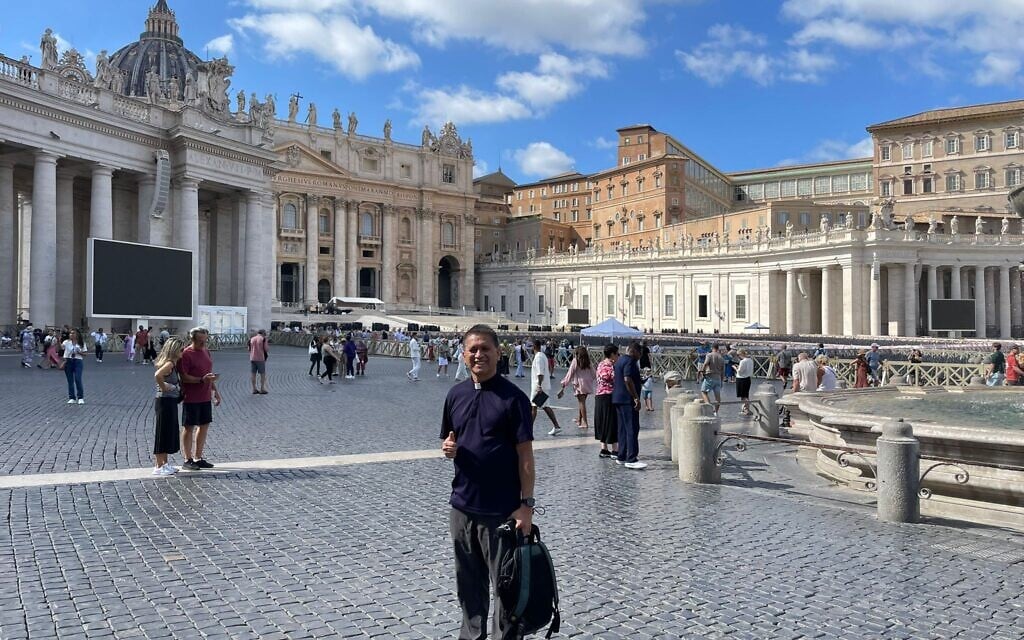
Father Romeo Kentilitisca from the city of Malaybalay in the Philippines said that bringing the younger generation closer to the Church was a challenge in his country too, and he hoped that Acutis’s story could help.
“[Acutis] is a good example to the youth in this post-modern world, especially with his use of technology for evangelization, for spreading the good news about God and Christ and His love to the youth,” he told The Times of Israel.
Kentilitisca, 54, was visiting Rome for the first time with a group of fellow Filipino priests to celebrate 25 years since their ordination.
The priest said he was not aware of any antisemitic connection to the Eucharistic miracles and Acutis’s work.
He noted that Christians are grateful to the Jews.
“Jesus was also Jewish,” he said. “I have been to Israel myself, in 2018, and it was a remarkable experience, exploring the roots of Christianity.”
According to Acutis’s official website, the exhibit devoted to Eucharistic miracles created by the boy, which showcases dozens of such stories in panels that can be downloaded online, has been on display across six continents, including in thousands of parishes and dozens of college campuses in the US.
Fanny and Francois had also not heard about any controversy surrounding Acutis.
Francois said that ultimately, all monotheistic faiths share the same core beliefs, and if everyone were truly devout, there would be no conflict.
“We all believe in the same God,” Francois noted. “We don’t have to fight each other. If everybody adhered to the basics of religion, whether Jewish or Catholic or Muslim or whatever, I don’t think there would be any war or conflict.”

The Times of Israel Community.