

 From the Liveblog of
Sunday, November 8, 2026
Receiving mandate to form government, Eisenkot acknowledges task ‘requires creative and unconventional political moves’
 Add ToI as a Preferred Source on Google
Ariela Karmel is a political correspondent at The Times of Israel. She previously reported for Calcalist and Haaretz. She holds an MA in Middle Eastern and African History from Tel Aviv University and a BA in Political Science from the University of British Columbia.
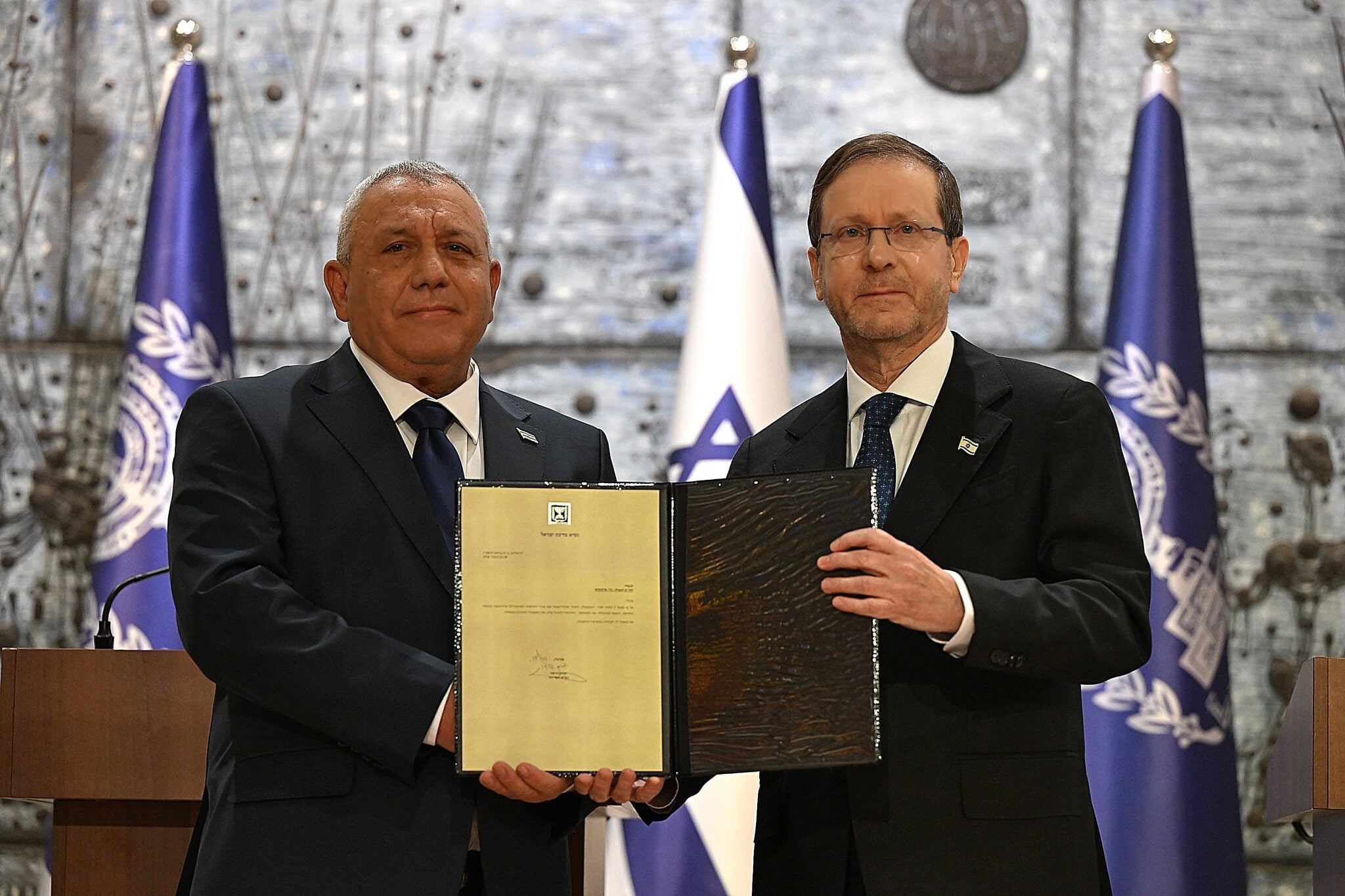
President Isaac Herzog formally tasks Yashar leader Gadi Eisenkot with forming Israel’s next government at the President’s Residence in Jerusalem, after 67 lawmakers recommended him for the role, compared to 46 who backed Prime Minister Benjamin Netanyahu.
Eisenkot has received the “clear and unequivocal support” of a majority of Knesset members on the question of who has the best chance of forming a government, Herzog says, acknowledging that Likud remains the largest party. He urges Eisenkot to establish a government that serves all Israelis, whether they voted for the outgoing government or for the bloc of parties that opposed it.
“I wish with all my heart that whatever government is formed will lead to unity, connection, and healing among all parts of the nation,” Herzog says.
In his remarks, Eisenkot warns that Israel faces a “challenging and fateful state of emergency,” pointing to ongoing wars, unfulfilled military objectives and a “devastating diplomatic crisis,” with “even some of Israel’s closest allies” reconsidering their relations with the country.
Domestically, he says, Israel is experiencing “one of the most vulnerable moments Israeli democracy has ever known,” warning that efforts to delegitimize democracy and growing distrust of state institutions have brought the country to an “extremely dangerous point.”
“With the mandate entrusted to me here today, I will lead the establishment of a national emergency government,” Eisenkot declares, stressing that “this will require creative and unconventional political moves.”
“Israel does not have the privilege of wasting time or repeating endless election rounds.”
Eisenkot adds: “To all parliamentary factions and elected representatives: my door is open and my hand is extended, wholeheartedly and willingly, to anyone who understands the gravity of this moment and is prepared to take courageous action for the State of Israel.”
In a notable appeal to Netanyahu’s bloc, Eisenkot specifically invites members of Netanyahu’s bloc to support his government if they are willing to accept his four main principles.
“For me, unity is neither a political bargaining chip nor an empty gimmick, but a supreme value that embodies genuine partnership. If members of Likud and Religious Zionism truly believe that this is a time for unity, as they declared before the president, I cannot imagine any reason why they would not come forward and support a government under my leadership and the principles I have laid out,” he says.
He does not mention National Security Minister Itamar Ben Gvir’s Otzma Yehudit. Yashar No. 2 Yoram Cohen previously ruled out a coalition with the party.
Eisenkot previously said that Likud without Netanyahu could join his coalition.
The Yashar leader also appears to direct a warning at his prospective coalition partners, amid disagreements with Yisrael Beytenu chairman Avigdor Liberman over the composition of the next government.
“Anyone who tries to thwart the formation of a government for personal rather than substantive reasons will be remembered by history as someone who failed to save Israel at a time of emergency,” he says, stressing that no party will be able to fulfill all its election promises and that compromise will be essential.
Eisenkot pledges to navigate the political challenges ahead with patience, humility and composure, and with a “deep commitment to a Jewish, democratic, egalitarian, liberal and secure Israel.”





The Times of Israel Community.