

Bennett resigns from Knesset, will stay education minister
Move comes after new law allowing coalition parties one non-MK minister; Shas head Aryeh Deri expected to follow suit
 Add ToI as a Preferred Source on Google
Raoul Wootliff is a former Times of Israel political correspondent and Daily Briefing podcast producer.
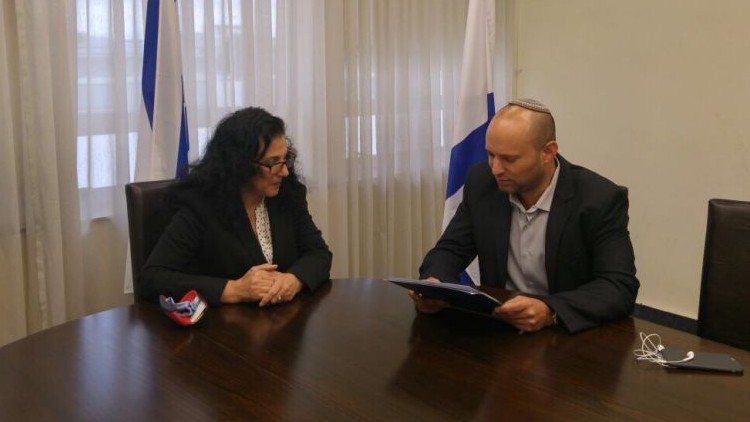
Education Minister and Jewish home party chair Naftali Bennett ceded his Knesset seat Wednesday morning, allowing former MK Shuli Moalem-Refaeli to enter the legislature, in line with a recently passed procedural rule change.
Bennett delivered a letter of resignation to Knesset Speaker Yuli Edelstein requesting he give up his seat but continue to serve as minister for education. The arrangement was made possible by the so called “Norwegian Law” passed by the Knesset in July.
The law allows one minister from each coalition party to resign their Knesset seat — effectively granting government ministers’ parties a stronger presence in the halls of power.
Moalem-Refaeli was number nine on the party’s Knesset slate, which received eight votes in March elections.
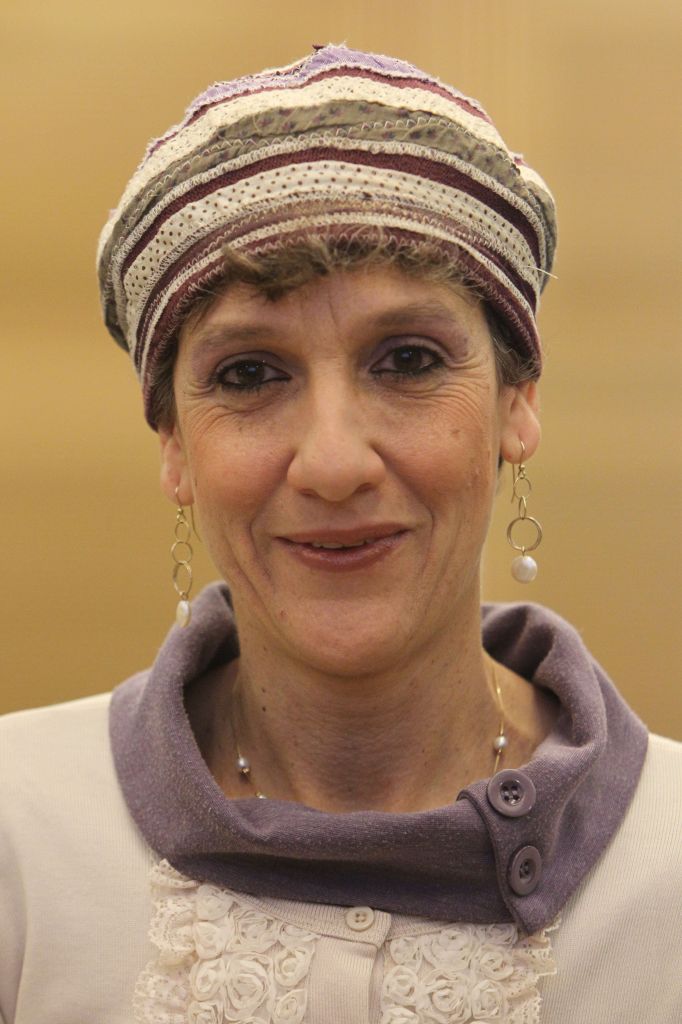
The bill was advanced by Justice Minister Ayelet Shaked of Jewish Home and was intended to enable Moalem-Refaeli to enter the Knesset in this term.
Bennett said the resignation fulfilled his promise to guarantee Moalem-Refaeli a place in the parliament.
In a similar move, Shas leader Aryeh Deri plans to resign his seat next week to allow former MK Avraham Michalli a seat, the Ynet news site reported.
The law takes its name from Norwegian legislation mandating all government ministers resign their seat in the parliament. The process is intended to create a separation of powers between the executive and the legislature.
Critics of the Israeli version of the law say it was pushed through the legislative process to appease coalition partners and — by only allowing one non-MK minister — fails to create any real separation of powers.
Zionist Union MK Merav Michaeli called the law “a wheeling-and-dealing law courtesy of Netanyahu, and there is nothing farther from equality.” She added, “This isn’t a blonde-haired, blue-eyed Norwegian law, but an ugly law — superficial and lacking seriousness.”
A broader “Norwegian Law” was proposed in past years to address what many believe to be a short-handed Knesset, with many parliamentary seats effectively inactive because their occupants serve as cabinet ministers.
Under current law, serving cabinet ministers are not allowed to serve as Knesset speaker or deputy speaker, to sit on committees or even to propose bills. Ministers are not required to be Knesset members, save for the prime minister.
By definition, this legislative manpower problem is felt most acutely by the ruling coalition. The current 61-seat coalition conducts its parliamentary work without the 20 lawmakers serving in cabinet posts and seven more in deputy ministerial positions. The 59-seat opposition suffers no such pressures.
Meanwhile, the 120-member strong Knesset is itself relatively small compared to the parliaments of similarly-sized democracies. Austria, with roughly Israel’s population at 8.6 million, has a parliament with two houses and 245 members. Switzerland’s similarly bicameral federal legislature has 246 members serving its 8.2 million citizens. And Sweden, home to 9.8 million Swedes, has 349 lawmakers in its single house.
Times of Israel staff contributed to this report.







The Times of Israel Community.