

What Netanyahu will say to Obama on Iran
The PM will set out a series of arguments to bolster his demand that Tehran dismantle its rogue program. The president will hear him out, politely unmoved

 Add ToI as a Preferred Source on Google
David Horovitz is the founding editor of The Times of Israel. He is the author of "Still Life with Bombers" (2004) and "A Little Too Close to God" (2000), and co-author of "Shalom Friend: The Life and Legacy of Yitzhak Rabin" (1996). He previously edited The Jerusalem Post (2004-2011) and The Jerusalem Report (1998-2004).
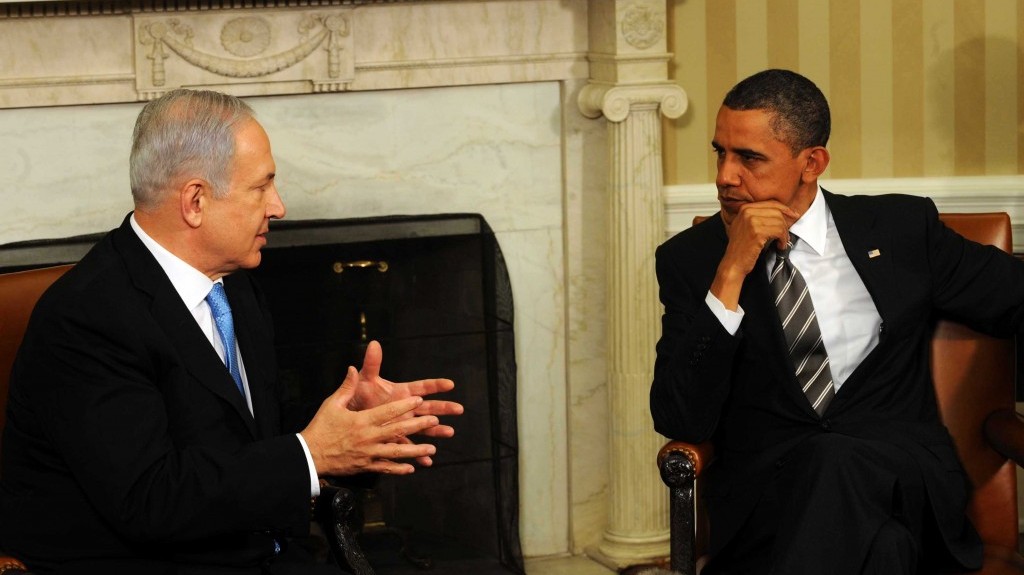
WASHINGTON — In an appearance at the Saban Forum here two months ago, US President Barack Obama declared that Iran might be allowed to have a peaceful nuclear program with “modest enrichment” capabilities under a permanent deal. He indicated that Prime Minister Benjamin Netanyahu’s all-or-nothing demands were unrealistic: “You’ll hear arguments, including potentially from the prime minister, that we can’t accept any enrichment on Iranian soil. Period. Full stop. End of conversation,” said Obama. “In an ideal world,” he said, “Iran would destroy every element and facility, you name it.” But, Obama went on, “We have to be more realistic.”
With that in mind, the president said, “We can envision an end state that gives us an assurance that, even if they have some modest enrichment capability, it is so constrained and the inspections are so intrusive that they, as a practical matter, do not have breakout capacity.”
Obama acknowledged it was “probably a good bet” that he and the prime minister would analyze the interim nuclear deal, reached in Geneva a few days earlier, rather differently — a “more than 50-50” likelihood, the president said with a broad smile. Indeed, Netanyahu has publicly and repeatedly characterized that deal as “a historic mistake.”
On Monday, at the White House, the Israeli prime minister will entreat Obama not to repeat the mistake with the permanent accord now being negotiated in Vienna.
Netanyahu will likely cite the State Department’s own newly issued annual human rights report to underline his contention that nothing has really changed in Iran since President Hassan Rouhani succeeded Mahmoud Ahmadinejad last year — that the Iranian regime remains the same bleak, intolerant, homophobic, misogynistic, dissenter-executing, terrorism-orchestrating, would-be globe-dominating threat.
He will warn the president that Iran’s negotiators are playing for time on the permanent deal in the hope — buoyed by the recent spate of visits to Tehran by international businessmen — that the punishing sanctions regime that brought them to the table will collapse.
He will remind the president that the entire Iranian leadership has said there will be no dismantling of their nuclear facilities — a defiant negotiating position that reflects their confidence that the international community will blink first.
He will note that much of the Iranians’ uranium enrichment program began in secret facilities, meaning that they breached the trust of the international community, and will likely have no compunctions about continuing to do so.
He will stress his concern that the Geneva interim deal did not cover weaponization, missile development, or even key aspects of R&D, enabling Iran to get very close to the bomb even within the constraints of that accord, and will thus reiterate his insistence that Iran’s entire “military nuclear” capabilities must be ordered dismantled under a permanent deal. Iran, after all, had a declared goal of running 54,000 centrifuges, which would give it the capacity to quickly build not a bomb or two, but an arsenal, should it choose to break out.
He will assuredly highlight to the president that the Saudis, the Egyptians, the Turks and others in the incendiary region can reliably be expected to demand the “right” to their own nuclear programs if that “right” is granted to Iran — and without fear of sanctions pressure, of course, since they would be enriching openly, under supervision.
He might underline the progress made in Iran’s missile program, which now has not just all of Israel in range, but much of Europe too, and could be capable of delivering warheads to parts of the United States in as little as four years.
He will certainly stress how much more dangerous a nuclear-empowered Iran would be — able to orchestrate terrorism with relative impunity, and to provoke confrontation with Israel and with the United States with the swagger of an untouchable power.
Israel’s arguments in favor of an all-or-nothing deal — a deal that ensures that this regime must not attain a nuclear weapons capability — are entirely “realistic,” Netanyahu will doubtless insist. What’s unrealistic, he might argue, is to believe that Iran can be trusted with any kind of potential nuclear weapons program.
And Obama, polite and earnest, will hear out the Israeli prime minister. And, supremely confident that his course is the right course — he is, after all, the two-term president of the United States — will likely bid his Israeli guest graciously on his way while remaining entirely unmoved.









The Times of Israel Community.