

Central bank again holds rates as governor warns prolonged Gaza war weighs on growth
Amir Yaron says high geopolitical and economic uncertainty, alongside volatile inflation trends, do not justify cutting interest rate; central bank reduces 2025 growth forecast
 Add ToI as a Preferred Source on Google
Sharon Wrobel is a tech reporter for The Times of Israel
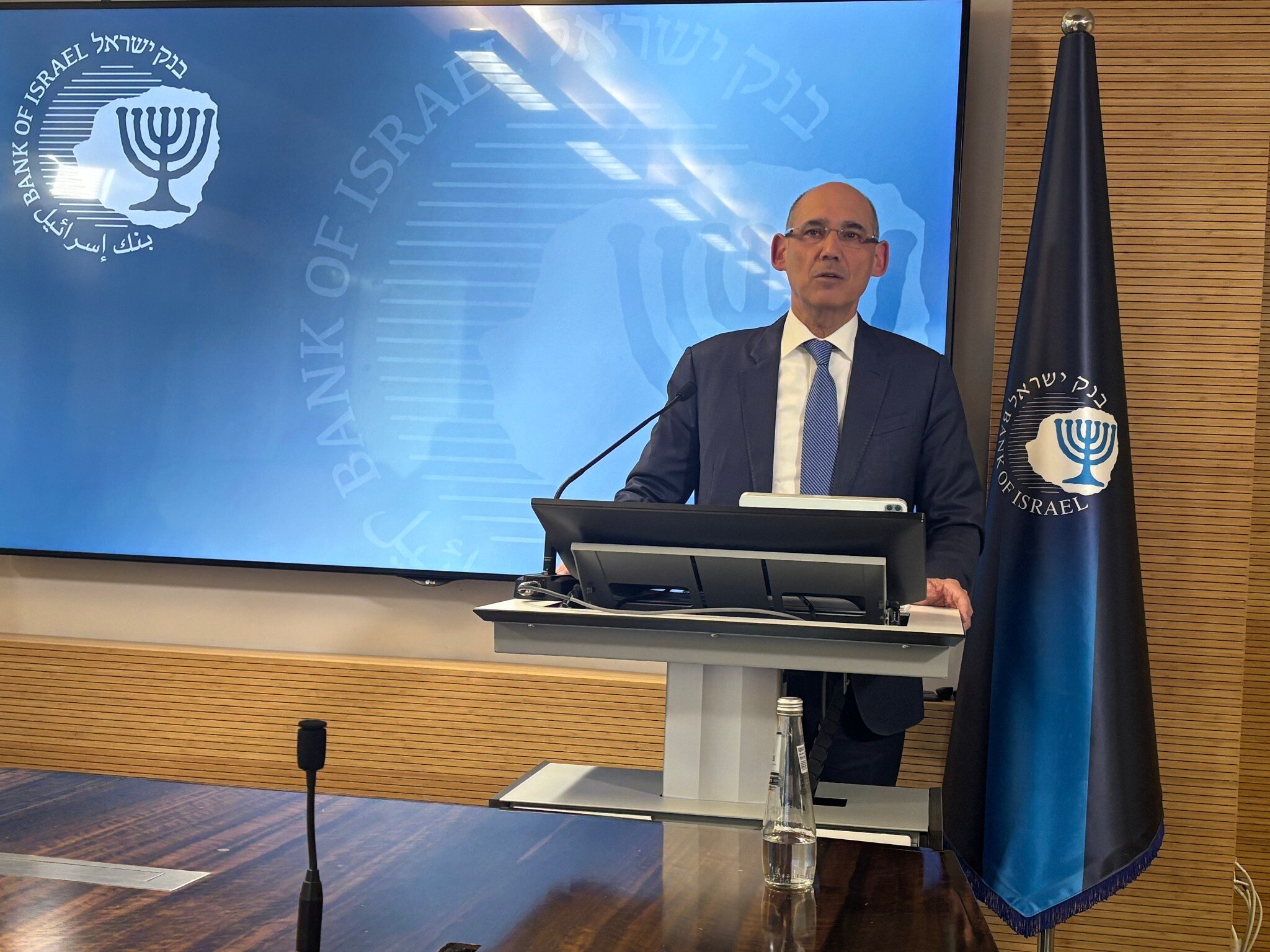
The Bank of Israel on Monday left interest rates steady as Governor Amir Yaron warned that prolonged intense fighting with the Hamas terror group in Gaza and a worsening international sentiment will continue to take a toll on investments and prevent economic recovery.
“Israel’s economy continues to act in an environment of high geopolitical and economic uncertainty, [and] international sentiment toward Israel [that] has recently deteriorated,” said Yaron. “As a small and open economy, Israel depends to a considerable extent on its participation in the global economy — in terms of international trade, foreign investment in the economy, and various collaborations.
“Therefore, Israel must do all that it can to strengthen its international standing, and thus ensure that the economy is open, entrepreneurial, and robust,” he urged.
Yaron made the comments at a press conference in Jerusalem as the Bank of Israel kept interest rates steady for the 14th consecutive time, arguing that current “economic conditions do not yet justify a rate cut.” The rate decision was announced just hours before Prime Minister Benjamin Netanyahu was scheduled to meet US President Donald Trump at the White House to discuss a potential deal to end the war in Gaza.
Yaron has come under fierce scrutiny for failing to lower borrowing costs as households and businesses struggle to make mortgage and loan repayments during the ongoing two-year war with Hamas. Finance Minister Bezalel Smotrich threatened to lower taxes if the central bank did not start cutting interest rates to ease the pressure on borrowers.
“Reducing taxes now is like drinking espresso after taking a sleeping pill,” said Yaron, in response to questions from journalists.

The central bank last reduced interest rates in January 2024, the first cut in almost four years, to support households and businesses as the economy was getting battered by the war, triggered by Hamas’s October 7, 2023, onslaught.
“In light of the economic and geopolitical challenges, there is room to examine whether the current monetary policy is consistent with the needs of the economy, industry, and exports,” Manufacturers Association of Israel President Ron Tomer said, following the rate decision. “The law defines a dual role for the Bank of Israel — maintaining price stability, while supporting growth and employment.”
“At a time when exporters are facing cancellations of deals from European partners, it is important to ensure that monetary policy does not add to these difficulties,” Tomer said.
In recent weeks, European countries have ramped up pressure on Israel amid the fighting in Gaza, warning of sanctions and downgraded trade ties alongside arms embargoes already going into effect.
Alongside the rate decision, the central bank cut its growth forecast for the economy for this year. The economy will grow by 2.5 percent in 2025, down from a previous growth estimate in July of 3.3%, according to the updated outlook. In 2026, the economy is expected to grow by 4.7%, up from a previous estimate of 4.6%.
“The forecast was formulated following the broad mobilization of reserve soldiers and the beginning of a significant ground campaign in the Gaza Strip, and under the assumption that the fighting in Gaza will continue at varying intensity and will end during the first quarter of 2026,” said Yaron.

The Bank of Israel chose not to lower borrowing costs even as annual inflation in August retreated to 2.9%, and moved within the government’s target range of 1% to 3% for the first time in more than a year.
“In view of the considerable uncertainty and volatility, we are not relying on one or another data point,” Yaron explained. “Inflation will remain around the upper bound of the target in the coming months, and is forecast to even move above the upper range, before moderating at the beginning of 2026.”
The central bank updated its forecast and now expects year-over-year inflation at the end of 2025 to hover around 3%, up from 2.6% in the July outlook. Assuming intense fighting will end at the beginning of next year, inflation is forecast to retreat to 2.2% in 2026, versus 2% in the previous forecast.
“Geopolitical and economic uncertainty in Israel is still at a very high level…in such an environment, it is necessary to have a clearer picture of the economic trends and of the convergence of inflation to within the target range,” said Yaron. “Lowering interest rates too early could backfire and fuel high inflation, which adversely impacts economic activity, particularly among the weaker population groups.”
The two-year multi-front war has already taken a toll on the economy. Economic growth contracted an annualized 4% in the April to June quarter, as 12 days of fighting with Iran in June led to a shutdown of many businesses and hurt consumer spending, exports, and investment.
Yaron noted that current economic indicators show a continued moderate recovery, citing increased credit card expenditures and volatile real estate and housing prices.
“Given that the Bank of Israel now expects that inflation in Israel will not move significantly from the upper limit of the inflation target [of around 3%] in the coming months, it will be difficult to see that the central bank will lower interest rates in the near future,” said Mizrahi Tefahot Bank chief markets strategist Ronen Menahem.








The Times of Israel Community.