

Ecuador confirms it cut internet access for WikiLeaks founder
Quito implies Assange, who’s based in the Ecuadorian embassy in London, interfered in US elections by leaking Hillary emails
- See more Times of Israel on Google - add us as a Preferred Source
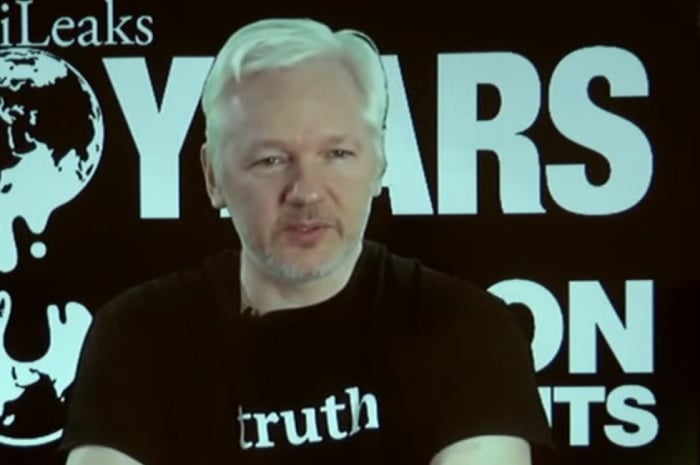
QUITO, Ecuador (AP) — Ecuador’s government acknowledged on Tuesday that it cut off WikiLeaks founder Julian Assange’s internet access at its embassy in London after the whistle-blowing site published a trove of damaging emails from Hillary Clinton’s presidential campaign.
The foreign ministry said that while it stands by its 2012 decision to grant Assange asylum based on legitimate concerns he faces political persecution, it respects other nations’ sovereignty and does not interfere or support any candidate in foreign elections.
“The decision to make this information public is the exclusive responsibility of the WikiLeaks organization,” the foreign ministry said in a statement.
The recognition of the action comes less than 24 hours after WikiLeaks tweeted that Ecuador had cut off Assange’s access to the internet on Saturday after the publication of Clinton’s speeches to Wall Street investment bank Goldman Sachs.
In follow-up messages posted Tuesday, the group claimed US Secretary of State John Kerry had personally intervened to ask Ecuador to stop Assange from publishing documents about Clinton. Citing “multiple US sources,” WikiLeaks said the request was made on the sidelines of a visit by Kerry and Ecuadorean President Rafael Correa last month to Colombia to show their support for a peace deal with leftist rebels.
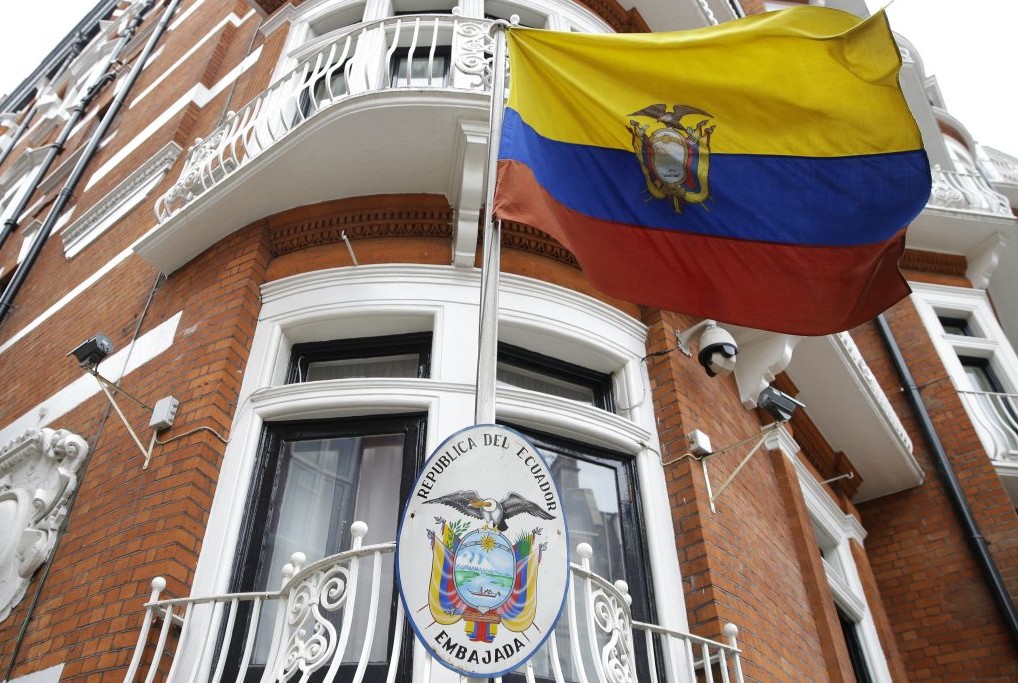
The State Department denied the allegation and Correa’s leftist government said it was acting on its own and not ceding to foreign pressures. The foreign ministry did not specify the extent of the “temporary restrictions” on Assange, saying only that they would not affect WikiLeaks’ ability to carry out its journalistic activities.
“While our concerns about Wikileaks are longstanding, any suggestion that Secretary Kerry or the State Department were involved in shutting down Wikileaks is false,” US State Department spokesman John Kirby said in an email. Speaking to reporters later, deputy spokesman Mark Toner said Kerry never even raised the issue or met with Correa during his visit to Colombia.
“There just was no meeting,” he said. “They didn’t discuss any of this stuff.”
Assange has been holed up at the modest embassy suite at No. 3 Hans Crescent for more than four years after skipping bail to avoid extradition to Sweden over sex crimes allegations, a position which — until now — has not prevented him from continuing to play a pivotal role in exposing state secrets and backroom trade deals.
WikiLeaks said unspecified “contingency plans” were in place and the site and its Twitter feed appeared to be working as usual. On Tuesday it released another tranche of emails from Clinton campaign chairman John Podesta, suggesting that the group’s ability to publish has yet to be compromised.
The disclosure was the 11th installment in a series of leaks that have captured the workings of Clinton’s inner circle. Those leaks themselves are part of a wider cascade that have embarrassed the Democratic Party and which the American intelligence community has recently described as an attempt by the Russian government to interfere in the US election.
Staff at WikiLeaks and the embassy either declined comment or did not return messages.
Assange fled to the Ecuadorean Embassy on June 19, 2012, after a drawn-out and ultimately unsuccessful legal battle against being sent to Sweden, where he remains wanted over an allegation of rape. Ecuador granted him asylum, but British authorities have made clear they would arrest him if he tried to leave. London’s Metropolitan Police used to maintain a visible presence outside the building, although officers were nowhere in sight when an AP journalist visited on Tuesday.
Assange has carved out a life at Hans Crescent, dining on delivered food, welcoming famous well-wishers and even occasionally addressing the media from the embassy’s balcony. On Saturday, former television star Pamela Anderson paid a visit.
But evidence of mutual suspicion with his hosts surfaced after BuzzFeed News drew on leaked documents to detail tensions between Assange and Ecuadorean embassy staff.
In targeting Clinton, Assange may have run afoul of Correa’s own preference for the Democratic candidate and a renewed effort to repair strained relations with Washington. The president recently said that while a Trump victory would energize Latin Americans to reject overhanded US policies in the world, much in the way George W. Bush’s invasion of Iraq did, he personally would like to see Clinton prevail.
“For the good of the United States and the world, and for my personal appreciation of her, I’d like to see Hillary win,” he told the Moscow-backed RT broadcaster last month.
Assange isn’t likely to submit to the internet ban quietly. Over the weekend WikiLeaks released three lines of code it described as “pre-commitments,” labeling them “John Kerry,” “Ecuador,” and “FCO” — an apparent reference to Britain’s Foreign and Commonwealth Office. Pre-commitments are cryptographic functions that can be used to verify the integrity of material released subsequently.
Thomas White, a UK-based security researcher and transparency activist, saw the posts as a warning to the named parties that WikiLeaks had ammunition in reserve if Ecuadorean authorities “do not continue to offer him political asylum.”
Joshua Goodman in Bogota, Colombia, Matt Lee in Washington and Alastair Grant in London contributed to this report. Raphael Satter reported from Paris.
Copyright 2016 The Associated Press.



The Times of Israel Community.