

Sweating it out: 7 things to know for May 29
Deadline for PM to form coalition expires at midnight but Liberman and Haredi parties are still refusing to strike a deal to avoid elections
 Add ToI as a Preferred Source on Google
Jacob Magid is The Times of Israel's US bureau chief
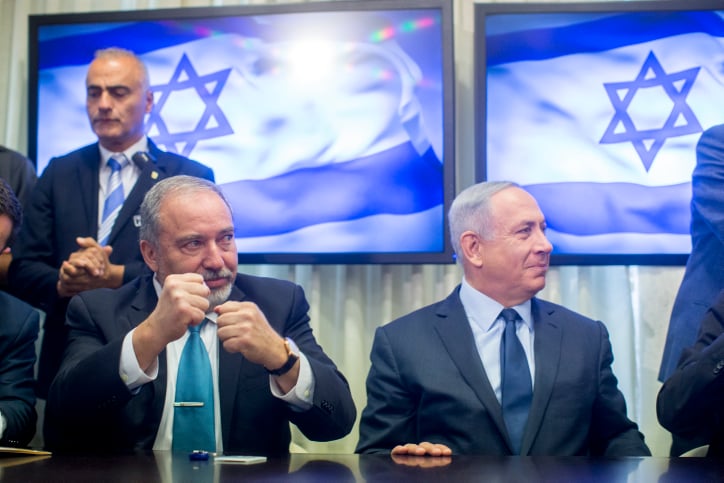
1. ‘Elections or government’: That has been the headline on every news channel in Israel for at least the past week. Newspapers across the political spectrum appear to have given up predicting what will happen in the less than 12 hours that remain for Prime Minister Benjamin Netanyahu to form a coalition and instead focus more on who is to blame for bringing us to this point.
- The pro-PM daily Israel Hayom, which Avigdor Liberman likened just yesterday to “Stalin’s Pravda,” is locked and loaded on the Yisrael Beytenu chairman, with an above-the-fold op-ed (in addition to three others) calling him out for ignoring the will of the public by sending the country back to elections.
- “If there is no respect for the victor of the elections and there is no respect for the voter [that elected him], we no longer live in a democratic world but in a world where all the forces that claim to defend democracy try with all their might to thwart the will of the voter,” writes Amnon Lord.
- Yedioth Ahronoth’s Merav Batito says that the coalition negotiation standstill has nothing to do with a bill regulating exemptions from military service for yeshiva students that Liberman and the Haredi parties have been bickering over, and everything to do with the prime minister’s legal situation.
- “Only a person who believes with all of his heart that the citizens of Israel are the ones that should pay for his legal defense — and that that is the ultimate, and most important mission at the current time — would allow them to go once again to elections,” she writes, arguing that Netanyahu’s determination to get his coalition partners to agree on passing legislation granting him immunity has left him without any cards to effectively negotiate.
- Haaretz’s editorial castigates Netanyahu for shoving through legislation to dissolve the Knesset as the clock ticks toward midnight in a move that would prevent President Reuven Rivlin from tasking another MK to form a coalition.
2. No eyes on the Haredim: While just about all of Israeli media is focused on asking what it will take for Liberman to fold, Channel 12’s Ofer Hadad suggests that the onus should be on the ultra-Orthodox Shas and United Torah Judaism parties, who seem to have been given a pass from scrutiny.
- In a Twitter thread, Hadad first points out that the disagreements over the IDF draft law are largely over several hundred Haredi soldiers that the ultra-Orthodox parties think would be too many.
- Throughout the latest deadlock, the ultra-Orthodox have leaned heavily on the argument that they are bound to the will of the Admor from Gur, the UTJ’s spiritual leader, and he is the one who refuses to budge on the issue.
- Hadad argues that the Haredi MKs had no problem dismissing the Admor’s views on various issues that came up during the municipal elections last year and managed to survive just fine without him.
- “They have too much to lose,” Hadad writes. “They are in the position of their dreams right now. A dream that they are risking for the sake of hot air.”
3. ‘Forget everything I said before about not joining Likud’: Hebrew dailies, news sites and channels are showing no mercy for Kulanu chairman Moshe Kahlon after his center-right faction, which he vowed just weeks ago would not merge with Likud, did just that yesterday in a move that critics claim showed the ugliest side of Israeli politics.
- Army Radio digs into the still-fresh archive of Kahlon speeches from the days leading up to last month’s elections to find the Kulanu chairman convincingly saying more than once, twice or three times that his party would run independently since joining with Netanyahu or Gantz would mean “burying his social-minded agenda.”
- But that was all before Kahlon’s party hobbled across the finish line on April 9 with just four seats — the fewest cards with which to play the game. With Netanyahu vowing to obliterate all small parties if elections are again called, Channel 12 explains that Kahlon felt that he had no choice.
- Channel 13 reports that more than several Likud ministers and MKs deeply opposed the move and were forced to hold their noses as they voted in favor of Netanyahu’s proposal, not prepared to stand up to the premier.
- In the Globes business daily, Tal Schneider explains just how the Likud secretariat managed to pass the merger when authority to green-light such proposals lies with the far-broader Likud Central Committee: by simply ignoring the rules.
- Disgusted by Likud’s merger with Yisrael Beytenu ahead of the 2013 elections and by Liberman’s 2014 decision to pull his 11 MKs from the joint list without any warning, senior party lawmaker Israel Katz fought aggressively to require the central committee to approve all future mergers with a two-thirds majority. But that was then, and now Katz is the head of the secretariat and eager to fulfill Netanyahu’s wishes. So despite objections from Likud’s own ombudsman, the central committee’s right to authorize the merger was stripped from it, Schneider summarizes.
4. This party’s not big enough for the both of us: While the negotiations deadlock could have been an opportunity for the likely opposition parties to serve as spectators to the chaos, the prospect of elections has them squabbling almost as much as Netanyahu’s would-be coalition partners.
- Coming off a unifying rally on Saturday night that drew tens of thousands of Israelis to Tel Aviv in protest of Netanyahu’s legislative efforts to evade prosecution, the wheels began to come off, starting with the Blue and White party, where 2 Yair Lapid is now saying that he “will not promise to continue being No. 2 on the list” if new elections are called.
- Chairman Benny Gantz’s confidants in turn have leaked statements to reporters asserting that the former IDF chief will remain the party’s candidate for prime minister and party No. 3 Moshe Ya’alon tells Army Radio that Lapid’s comments should not have been made.
- In an apparent effort to ease tensions, Lapid tweets a picture with his No. 1 buddy Gantz, with a caption that says the two are preparing for a long night (at the Knesset).
- Hours later, he puts speculation to bed by telling the Ynet news site that he will in fact remain as the party’s second in command if elections are called. But less than 24 hours after Kahlon’s flip-flop, who knows what to believe?
מתכוננים ללילה ארוך. pic.twitter.com/MFIz7BOIR6
— יאיר לפיד – Yair Lapid (@yairlapid) May 29, 2019
5. No such thing as a free election: Yedioth’s Tovah Tzimuki goes through the ramifications — beyond the billions of shekels in economic costs — another round of elections would have on government operations, which have already been paralyzed since the last Knesset was dissolved in December.
- Motti Cohen has been serving as interim police chief since December, waiting for the appointment of a new public security minister after last month’s elections to learn his fate. An additional six months without a permanent commissioner will mean long-term plans for law enforcement will continue to stall.
- While justice officials may be able to breathe a sigh of relief in that floated legislation, such as a bill granting MKs full immunity or a bill allowing the Knesset to override vetoes from the High Court of Justice, would be shelved in the event of elections, Tzimuki points out that various pieces of legislation that have already advanced through various stages in the Knesset will continue to sit on the back-burner. This includes bills to change the appointment of Knesset legal advisers, to legalize Israeli outposts in the West Bank, to expel the families of Palestinian terrorists and to execute those terrorists will be further delayed.
6. Bahrain-ing on their parade: Possibly the most upset by the possibility of another round of elections are Trump officials, who have been coming up with every excuse but the kitchen sink to delay their ever-ready peace plan over the past year. And now that they’ve finally set a date for an economic “workshop” in Bahrain, the prospect of another several months of a non-functioning Israeli government may require them to further hold off on plans.
- To prevent such a scenario, Channel 13 reports that Netanyahu’s confidants are reaching out to Trump officials in an effort to get one of them to call Liberman and explain to him the stakes.
- The premier’s associates already managed to get a tweet out of US President Donald Trump to tweet in favor of an end to the crisis so that the two leaders could continue doing “great things together” and now they’re hoping that another nudge from the White House will help bring Liberman to his knees.
7. It’s not all bad: The Times of Israel’s Melanie Lidman attends a Ramadan break fast meal in Rahat with 2,000 Jewish and Arab employees of SodaStream, where coexistence is in the air.
- “If I could package what you have here, or more appropriately, put it in a bottle, the peace and compassion that you have here, my job would be very easy,” US Ambassador David Friedman says in an address to the crowd.
- “This place is like a family, we laugh together, we cry together, and when we’re together here, there is a feeling of peace,” says Pesach Babayev, a Jewish plant manager who was incarcerated for four years and acknowledged that released prisoners have a lot of difficulty finding jobs. “This place helped me to understand how to accept ‘the other,’ and love so many different types of people,”
- One Bedouin employee, who declined to give his full name, said that while he was grateful for the employment opportunities, it is important to remember that SodaStream still exists within Israeli society, where racism is common and widespread. “You can definitely see parts where coexistence really exists, but in other parts it is more challenging,” said F. “There are some positions of administration that you know will never belong to Arabs, and that’s pretty clear. But in general, there is coexistence here, even though there will never be equality in Israel, and we have to accept that.”







The Times of Israel Community.