

With brazen attack inside Israel, Hezbollah lays down new ground rules
Even if all-out war isn’t on the horizon, the conflicting red lines of Israel and the Shiite group will likely yield more bloodshed
- See more Times of Israel on Google - add us as a Preferred Source

Avi Issacharoff, The Times of Israel's Middle East analyst, fills the same role for Walla, the leading portal in Israel. He is also a guest commentator on many different radio shows and current affairs programs on television. Until 2012, he was a reporter and commentator on Arab affairs for the Haaretz newspaper. He also lectures on modern Palestinian history at Tel Aviv University, and is currently writing a script for an action-drama series for the Israeli satellite Television "YES." Born in Jerusalem, he graduated cum laude from Ben Gurion University with a B.A. in Middle Eastern studies and then earned his M.A. from Tel Aviv University on the same subject, also cum laude. A fluent Arabic speaker, Avi was the Middle East Affairs correspondent for Israeli Public Radio covering the Israeli-Palestinian conflict, the war in Iraq and the Arab countries between the years 2003-2006. Avi directed and edited short documentary films on Israeli television programs dealing with the Middle East. In 2002 he won the "best reporter" award for the "Israel Radio” for his coverage of the second intifada. In 2004, together with Amos Harel, he wrote "The Seventh War - How we won and why we lost the war with the Palestinians." A year later the book won an award from the Institute for Strategic Studies for containing the best research on security affairs in Israel. In 2008, Issacharoff and Harel published their second book, entitled "34 Days - The Story of the Second Lebanon War," which won the same prize.
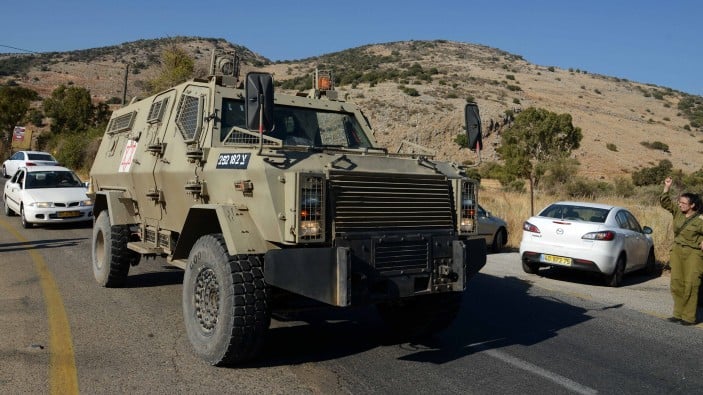
The ring of explosives detonated alongside an IDF patrol on the border with Lebanon on Tuesday was another in a series of messages from Hezbollah to Israel. It was a brazen attack, carried out inside Israeli territory, the message being that, from now on, every incident in which Israel causes Lebanese injuries will be greeted with a response along the Lebanese or Syrian borders.
As opposed to other recent cross-border attacks, in which the perpetrators didn’t claim responsibility, the message this time was loud and clear: a full admission by Hezbollah. The claim of responsibility also gave a reason for the attack.
“The Group of the Martyr Ali Hassan Haydar detonated an explosive device in the Shebaa Farms,” the Shiite group said in a statement, using the Lebanese name for the Mount Dov region, where the attack took place.
Haydar was a Hezbollah sapper killed on September 5 in Lebanon while attempting to defuse an explosive device attached to an alleged Israel spying apparatus discovered that day. Hezbollah vowed revenge.
At first blush, the developments in Mount Dov, including the Hezbollah claim, appear to portend a larger conflagration on the horizon. The potential for a deterioration of the situation is only increasing, with the Shiite group trying to lay down new red lines for Israel — red lines that Israel is likely to cross: Israel will almost certainly continue to disrupt the smuggling of game-changing weapons from Syria to Lebanon (indeed, those violate Israel’s own avowed “red line”), “forcing” Hezbollah to respond the next time it or its allies come under IDF attack.
Still, there are no indications that either side has real interest in a sustained conflict. Israel, fresh out of a 50-day war in the Gaza Strip with a not-insignificant hole in its defense budget, is mostly looking for quiet. The leadership in Jerusalem, which well understands that another war is likely to damage its position, is wary of the consequences of a wide-ranging campaign against Hezbollah, with many more rockets hitting Israeli cities than during the conflict this summer, and many more casualties.
The Shiite organization, meanwhile, is taking advantage of Israel’s wariness in order to establish a new set of ground rules. And yet one doubts whether Hezbollah, which doesn’t have many available fighters, is seeking to escalate the situation to all-out war or even a more limited conflagration. The organization is tied up with a war that has already been raging for three years, fighting alongside President Bashar Assad’s forces. This week, eight of its fighters were killed in battles in Syria’s Qalamoun region. In all, a third of Hezbollah’s forces are currently in Syria, where they’re battling a plethora of Sunni extremist groups, including the notorious Islamic State.
It’s thus likely that in the coming months we’ll see occasional flare-ups along the border but no all-out escalation. And yet, the outcome of Tuesday’s attack, which wounded two soldiers, could have been much worse, and one is forced to recall that in July 2006, no one predicted that a cross-border attack (with far more dire results) would precipitate the Second Lebanon War.





The Times of Israel Community.