

Alternative yeshiva draws protests for teaching secular subjects
Protesters chant ‘traitor’ outside the house of Beitar Illit school’s director
 Add ToI as a Preferred Source on Google
Melanie Lidman is an AP reporter and former Times of Israel reporter
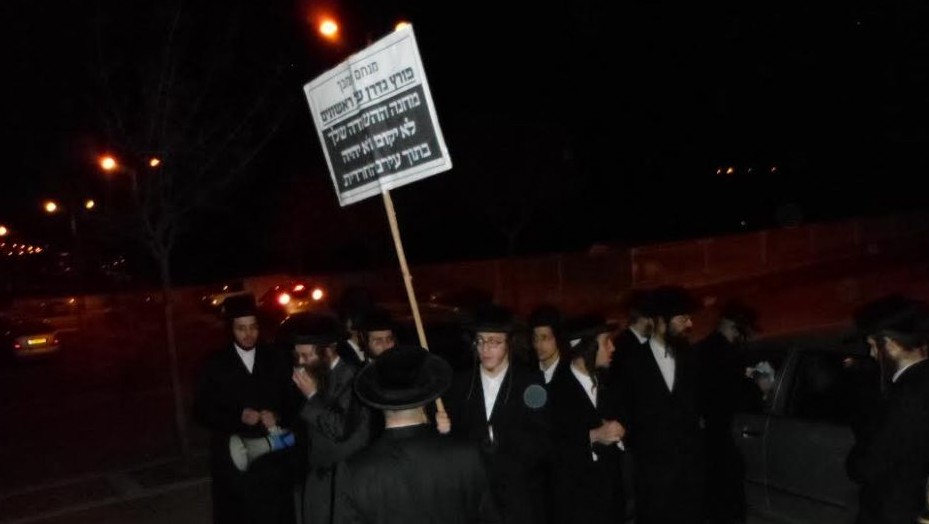
A boys’ yeshiva in the ultra-Orthodox settlement of Beitar Illit has become a target of protests for teaching secular subjects, long a taboo in the community, along with religious instruction.
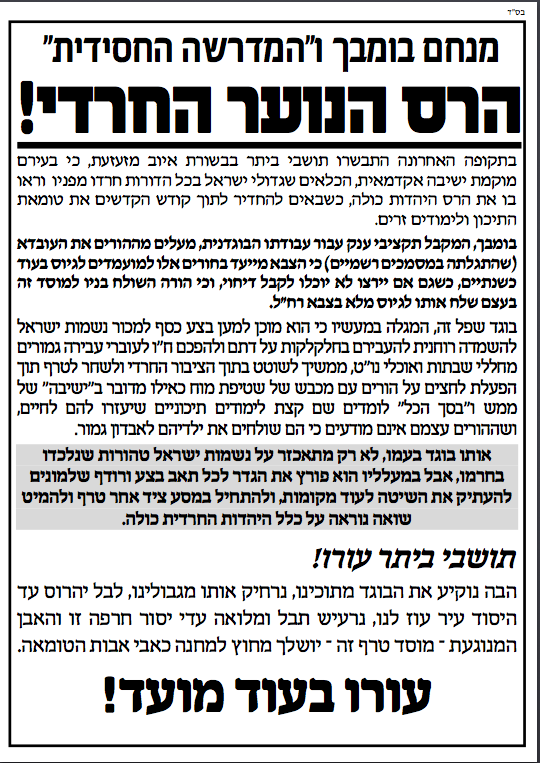
Approximately 25 people demonstrated outside of the home of Rabbi Menachem Bombach, who heads the school, last Thursday, and vowed to return until Bombach is “expelled from the borders” of the community, according to posters denouncing the school plastered around the West Bank city.
The Hasidic Boys Midrasha in Beitar Illit is a new school that was founded in August with the aim of assisting Haredi students who struggled in the traditional yeshiva framework.
Some of the 17 students have attention deficit disorders while others simply do not fit into the intensive learning of traditional yeshivas, said Rabbi Yonason Herschlag, whose son Yochanan attends the midrasha.
The school also teaches “secular” subjects such as math and English, as well physical education courses like boxing, swimming and basketball, which are beneficial for teenage boys who need to work off extra energy.
Traditionally, Haredi yeshivas exclusively teach religious subjects, believing that any time not dedicated to this is wasted time. The vast majority of students in the Haredi school system do not receive any instruction in math, English or the sciences. This puts Haredi students at a severe disadvantage if they want to enter the work force rather than learn in a kollel, or seminary.
“Because we have a combination of secular subjects and religious subjects, of course it inspires objections in the community,” said Bombach. He said he expected the posters denouncing the school, but the protest in front of his house was a new level of hostility.
“Last Thursday they came and they were shouting ‘traitor!’ with signs against me,” Bombach said. The protesters refused to identify themselves or their sect, but vowed to come back. Bombach expects them to return this Thursday night.
Bombach and other witnesses believe that the protesters are not from Beitar Illit, a town of some 45,000 south of Jerusalem, which has almost exclusively ultra-Orthodox residents.
Based on the protesters’ mode of dress, including white kippot and a certain type of black coat, parents believe the protesters are from extremist factions in Beit Shemesh or Jerusalem. White kippot are sometimes worn by the extremist Toldot Aharon sect, though there are no members of Toldot Aharon in Beitar Ilit, Herschlag said.
Though the protest has thus far not turned violent, parents are worried that they could snowball into vandalism, rock throwing or spitting on the students, as occurred in recent years in Beit Shemesh in a dispute over a national religious school.
Alternative schools that provide secular as well as religious education have long been a target for ultra-Orthodox extremists. In August, similar protests over a blended secular-religious studies yeshiva called Haredi Hochmei Lev in Jerusalem forced the municipality to withdraw a plan to give the yeshiva municipal buildings in the Ramot neighborhood.
National police spokesman Micky Rosenfeld said the police were unaware of any issues regarding the midrasha in Beitar Illit.
“If there is any threat, police will respond, but so far no one has made any reports,” he said.
“This [protest] is something the police need to deal with, because it’s an assault on these boys,” said Herschlag. “What is their objective to close down the school? This is the only school where these boys can function. We need to know who’s behind sending them and we need to explain to them why [these protests] are a crime.”
Bombach said the school is expected to double its enrollment next year.
“The staff has been very sensitive about making kids feel good about themselves, which is something they were not getting from other school systems that are not built to handle their needs,” Herschlag added. “The kids are having such a great time, they end up learning so much more in terms of religious studies. [My son] is learning English and math now, when before he wasn’t learning anything at all.”
Herschlag noted that the physical education periods made a huge difference for his son and others, allowing them to concentrate better on the religious subjects.
The school is associated with the Education Ministry’s national religious schools and receives a budget from the ministry. Students pay to attend, but tuition is much lower than a private institution.
The posters denouncing Bombach and the school, which accuse Bombach of “destroying the Haredi youth” and “destroying Judaism” are unsigned, and the protesters refused to identify themselves or their sect at the protest.
Herschlag said the location of the protest at Bombach’s house at night was meant to intimidate the rabbi, though Bombach said he was not worried as long as the protests stay peaceful.
“They said they’re going to come back,” Bombach said. “But when someone is doing what they believe in, and knows it is important, there’s nothing that can keep you from this or stop you from this path.”




The Times of Israel Community.