

Getting it from all sides
Israel strikes Syria after rockets hits Golan and Galilee; tensions high in the West Bank and South as Allaan ends his hunger strike
- See more Times of Israel on Google - add us as a Preferred Source
Ilan Ben Zion is an AFP reporter and a former news editor at The Times of Israel.
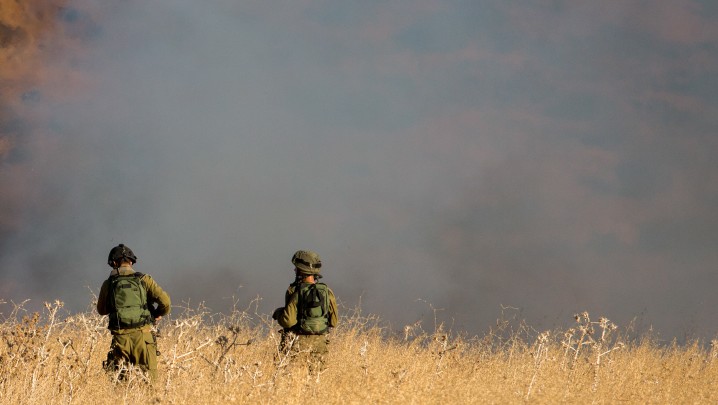
Renewed conflict on the border with Syria brings northern Israel back into focus in the Hebrew press on Friday, following a series of rocket attacks on the Golan Heights and the Upper Galilee. But while the attack came from Syria, the Israeli press points the finger at Iran.
The IDF said the rockets were fired by the Palestinian Islamic Jihad group “with Iranian funding and guidance.” In response the military struck Syria. The papers report that it was the first time since 1973 that rockets fired from Syria hit the Galilee.
The front page of Israel Hayom makes it out as if war is about to break out on all fronts, with a headline screaming “The IDF attacks Syria, Iron Dome in the South; peak alert in the West Bank.” Yedioth Ahronoth‘s headline, backed by a raging inferno ignited by the rockets, says “Iran initiates, Syria pays.”
A senior IDF official is quoted in Haaretz saying that the Israeli retaliation was broader than what Israel has done previously in response to attacks from Syria. “Tanks, artillery and Air Force aircraft struck targets identified as Syrian Army at a distance of several kilometers from the Israeli border.”
The rocket fire at the Upper Galilee and Golan Heights was “a clear warning from Iran: the rules of the game have changed. The Syrian border is a front in every sense with Israel,” Yedioth Ahronoth says.
Israel Hayom says Syrian reports claimed 20 Syrian Army soldiers were killed in the Israeli retaliation. It quotes a senior Syrian official telling a Lebanese news agency that “the Israeli attack is the end of the ceasefire from 1974. Israel declared war on us. We will respond in turn.”
The paper’s defense correspondent writes in an op-ed that Israel must make sure not to get itself entangled in the Syrian civil war when it strikes back against those who attacked it from the Golan Heights.
“The situation on the northern border is more complex, as Israel must maneuver between multiple sovereign entities,” he writes. “Only a fraction of the border is controlled by the Syrian military, as most of it has fallen to the Nusra Front and the Islamic State group-affiliated Yarmouk Martyrs Brigade.”
“While the IDF mounted a forceful response to the rocket fire, striking multiple Syrian military targets, Israel has no desire to be dragged into the bloody war in Syria, and the strikes sought to send a clear message to the Assad regime and re-establish deterrence.”
He says Israel must use intel to prevent future attacks and “continue to highlight Iran’s involvement in the terrorism destabilizing the Middle East and undermine Tehran’s efforts to regain its foothold in the international community.”
In a rambling Haaretz op-ed, Yoel Marcus writes that the Palestinian Authority President Mahmoud Abbas is losing his grip on the West Bank and that Israel might as well reach a long-term ceasefire with Hamas which would serve its long-term interests of quiet in the south.
He writes that “the more Jewish blood is spilled [in the West Bank], the more seriously Israel might consider Tony Blair’s proposal to relate to Gaza as a ‘state.’ Those who rule there will have no choice but to come to the negotiation table.”
“The expression ‘there is no one to talk to’ is bankrupt. We talked to [Anwar] Sadat, we talked to Assad and to [Yasser] Arafat. We’ll probably end up talking to Hezbollah leader Nasrallah and to Iran’s leader [Ayatollah Ali] Khamenei as well. Maybe even with Obama. Certainly with Hamas. Who knows? Maybe we’ll end up with three states for two peoples. Actually, it’s four states, since the hilltop youth also want one.”
Yedioth Ahronoth buries a quote from an Islamic Jihad spokesman in Gaza who denied that his organization was behind the attack on the Golan Heights, saying that Israel was trying to eclipse the group’s victory over Israel in Mohammed Allaan’s hunger strike.
In that respect, the group is right: the attacks in northern Israel did eclipse the news of Allaan ending his two-month-long hunger strike, a story which had dominated the news cycle for a week.
The High Court of Justice on Thursday struck down his detention, and he ended his strike. Yedioth Ahronoth reports that it remains unclear whether he’s suffered brain damage. Allaan’s mother tells Haaretz that her son still can’t eat or drink and is receiving fluids intravenously.
“As far as we’re concerned he’s freed and therefore there’s nothing preventing him from coming with us and recuperating, but we need to wait a few more days to understand exactly what his condition is,” she says.
Israel Hayom headlines its coverage not with his ending the hunger strike, but the IDF deploying Iron Dome batteries in southern Israel out of concern that Islamic Jihad might fire rockets if he dies.





The Times of Israel Community.