

Is Iran sinking in the Syrian quagmire?
At least 50 Revolutionary Guards have been killed in Syria, and despite Russian support, IS is still making gains

 Add ToI as a Preferred Source on Google
Avi Issacharoff, The Times of Israel's Middle East analyst, fills the same role for Walla, the leading portal in Israel. He is also a guest commentator on many different radio shows and current affairs programs on television. Until 2012, he was a reporter and commentator on Arab affairs for the Haaretz newspaper. He also lectures on modern Palestinian history at Tel Aviv University, and is currently writing a script for an action-drama series for the Israeli satellite Television "YES." Born in Jerusalem, he graduated cum laude from Ben Gurion University with a B.A. in Middle Eastern studies and then earned his M.A. from Tel Aviv University on the same subject, also cum laude. A fluent Arabic speaker, Avi was the Middle East Affairs correspondent for Israeli Public Radio covering the Israeli-Palestinian conflict, the war in Iraq and the Arab countries between the years 2003-2006. Avi directed and edited short documentary films on Israeli television programs dealing with the Middle East. In 2002 he won the "best reporter" award for the "Israel Radio” for his coverage of the second intifada. In 2004, together with Amos Harel, he wrote "The Seventh War - How we won and why we lost the war with the Palestinians." A year later the book won an award from the Institute for Strategic Studies for containing the best research on security affairs in Israel. In 2008, Issacharoff and Harel published their second book, entitled "34 Days - The Story of the Second Lebanon War," which won the same prize.
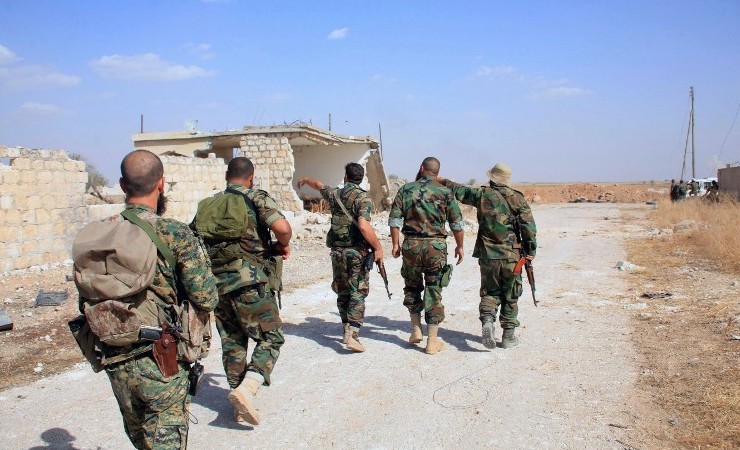
The Russian-Iranian coalition could breathe a small sigh of relief this week. On Tuesday evening, the world found out about the first tangible achievement by the Iranian-Syrian forces fighting on Syrian soil: Bashar Assad’s troops, accompanied by members of Iran’s Revolutionary Guards, lifted the siege that Islamic State had imposed for months on Syrian troops at the Kweiris military airport east of Aleppo.
With ceremony, Syrian television reported on the reopening of the link with the approximately 1,000 troops that had been surrounded by IS fighters at the Kweiris air base, and who had been supplied through these months with food and arms dropped from the air.
The events surrounding the siege had created a fair amount of tension, specifically among Assad’s supporters: The troops who had been killed there, some of whom belonged to the Alawite elite, had to be buried in the airport. That created foment among Assad’s supporters in cities such as Tartus, a loyal stronghold of the Russian and Alawite troops. The inhabitants of those cities put pressure on the regime to bring their relatives’ bodies to proper burial.
But the relief of the siege is where the good news ends for the Russian-Syrian-Iranian “axis.” That same day, 23 people were killed in Latakia, another stronghold of the Syrian regime, in two separate strikes. There will likely be a price to pay for the military effort of this “axis” in the area north of Latakia and Tartus, in the general direction of the northeast. It has drawn a tough response from the Islamic State and from other groups fighting against the axis.
That is not the full extent of the bad news for the Iranians and the Russians. Iran, it turns out, has lost roughly 50 combat troops, including a senior general, in the fighting in Syria in recent weeks. At least half of these deaths have been reported by Iran’s official media outlets. In other words, this is no longer something that can be kept from the public or ignored. This is a heavy price in blood for the Revolutionary Guards and mainly for the Iranian regime, which must now explain to its citizens why so many troops — roughly 2,000 — are thousands of kilometers from home.
While these numbers will not lead to a revolution against Iran’s spiritual leader, Ali Khamenei, any time soon, they are certainly making President Hassan Rouhani sweat. Rouhani, who has been trying to push an internal Iranian policy focused on improving the economy, never reckoned on the Syrian quagmire.
Siege-lifting apart, the Syrian-Iranian military effort on the ground, with the Russians providing heavy air support, has had no significant results. The axis has made no progress in the fighting. Its efforts to break out in two directions — on the axis between Homs and Latakia; and from Latakia northward — have not brought about the longed-for change. Even under heavy aerial attack by the Russians on the Syrian opposition, the Islamic State has managed to rack up impressive accomplishments on the ground, the latest of them in the Homs region.
How can this be explained? One likely reason is the massive military aid that Arab countries such as Saudi Arabia, Qatar and even Turkey are providing to the many opposition groups that are not affiliated with IS in order to prevent them from being defeated militarily. These countries transferred an impressive amount of advanced anti-tank weaponry to rebel militias such as the Fatah Army.
Another possible reason is that, as an army, the Islamic State seems to be displaying impressive adaptive capabilities. Having survived the bombardments of the US-led Western-Arab coalition, it seems to have survived the Russian bombardments as well.
On top of that, the effort to conduct joint military activity by the axis is presumably no simple matter. We need only take a moment to imagine what a war room in the Aleppo region looks like: officers of Assad’s army alongside commanders from Hezbollah, all of whom speak Arabic, together with Revolutionary Guards officers who speak Farsi, and with them aerial coordination officers from the Russian army, or just radios with Russian-speaking voices coming from the speakers. Such a war room would need quite a few interpreters trying to make sense of all that chaos.
The bad news, as far as the Islamic State and the opposition to Assad are concerned, is that Russia is a key player here, and Russia does not behave like the US. For Russia, this is only the start of the fighting. So far, the number of casualties among the Russian soldiers has been very small. Since the Russian troops are in no significant danger, President Vladimir Putin can afford to keep up the massive bombardments all over Syria. The Russian army recently deployed more troops and weaponry in various locations throughout Syria, and not just at the well-known Humaymim airport north of Latakia.
Among other things, Russian helicopters and APCs were spotted recently near Homs, Hama and Palmyra. The goal of the Russian troops in these locations is to provide assistance from up close to the Syrian and Hezbollah troops who are doing the fighting on the ground.
More bad news for the Islamic State is what appears to be coordination between America and Russia regarding attacks in Syria and Iraq. In other words, there seems to be a clear division on the ground between the Russian and American air forces. While the Russians are focusing their efforts on the Alawite region and eastward as far as Raqqa, the Americans are operating from Raqqa eastward toward Ramadi in Iraq.
It should be noted that the Americans also seem to have changed their tactics, and perhaps their strategy as well, in the fight against the Islamic State. They are no longer waiting for Syrian troops to be trained outside Syria so that they can return to fight there. Instead, they are using a combination of incursions by special forces and aerial attacks on the route between Raqqa and Ramadi. This effort may have borne fruit; just recently, IS was forced to give up its control over the Baiji oil fields.
Still, the significant question regarding the Syrian issue is where all this is headed. Does anyone in Moscow really believe that the Russian military effort can bring about a breakthrough and change the situation that has prevailed in Syria so far? It is true that the Russian campaign brought all the relevant players out of their apathy toward what was happening in Syria and even to come to Moscow to make decisions. All of a sudden, the Americans, the Saudis and everyone else woke up and wanted to reach understandings on a plan to end the civil war in Syria.
But do they really have the ability to reach an agreement among themselves? Each of the players — from Russia and the US to the various Arab countries, along with the Syrian regime and the relatively moderate opposition groups — has conflicting interests, and each one has a different idea of what Syria’s future should be.
According to the draft of a document that reached the Reuters news agency this week, the Russian plan is that Assad’s regime and opposition elements agree to start a process of constitutional reform that will last for up to 18 months and conclude with presidential elections in Syria. The assessment is that Moscow will present the proposal, which contains eight sections, in the second round of talks about the Syrian crisis in Vienna, which is to take place over the next several days. According to the proposal, the parties will agree on measures at a future conference to be organized by the UN.
The major disagreements between all the parties concern the future of Bashar Assad himself. The Russians have hinted that they will not require that he remain in power, while the Iranians and the Syrian regime insist that he stay.
But for a moment, let us imagine that all the parties and various countries taking part in the talks in Vienna agree on the “plan.” Does this mean that the fighting in Syria will end? Quite simply: No.
After all, the Islamic State is not a party to these talks, nor is it expected to be. Even if an agreement could be reached in the meeting rooms in Vienna, we can be absolutely certain that IS will continue its campaigns of massacre and devastation for a long time to come.



The Times of Israel Community.