

New documentary reveals saga behind Elie Wiesel’s world-famous Holocaust memoir ‘Night’
In ‘Elie Wiesel: Soul on Fire,’ airing on PBS in the US on January 27, filmmaker Oren Rudavsky examines the Nobel laureate through his ‘lifelong attempt to give his life meaning’
 Add ToI as a Preferred Source on Google
Reporter at The Times of Israel
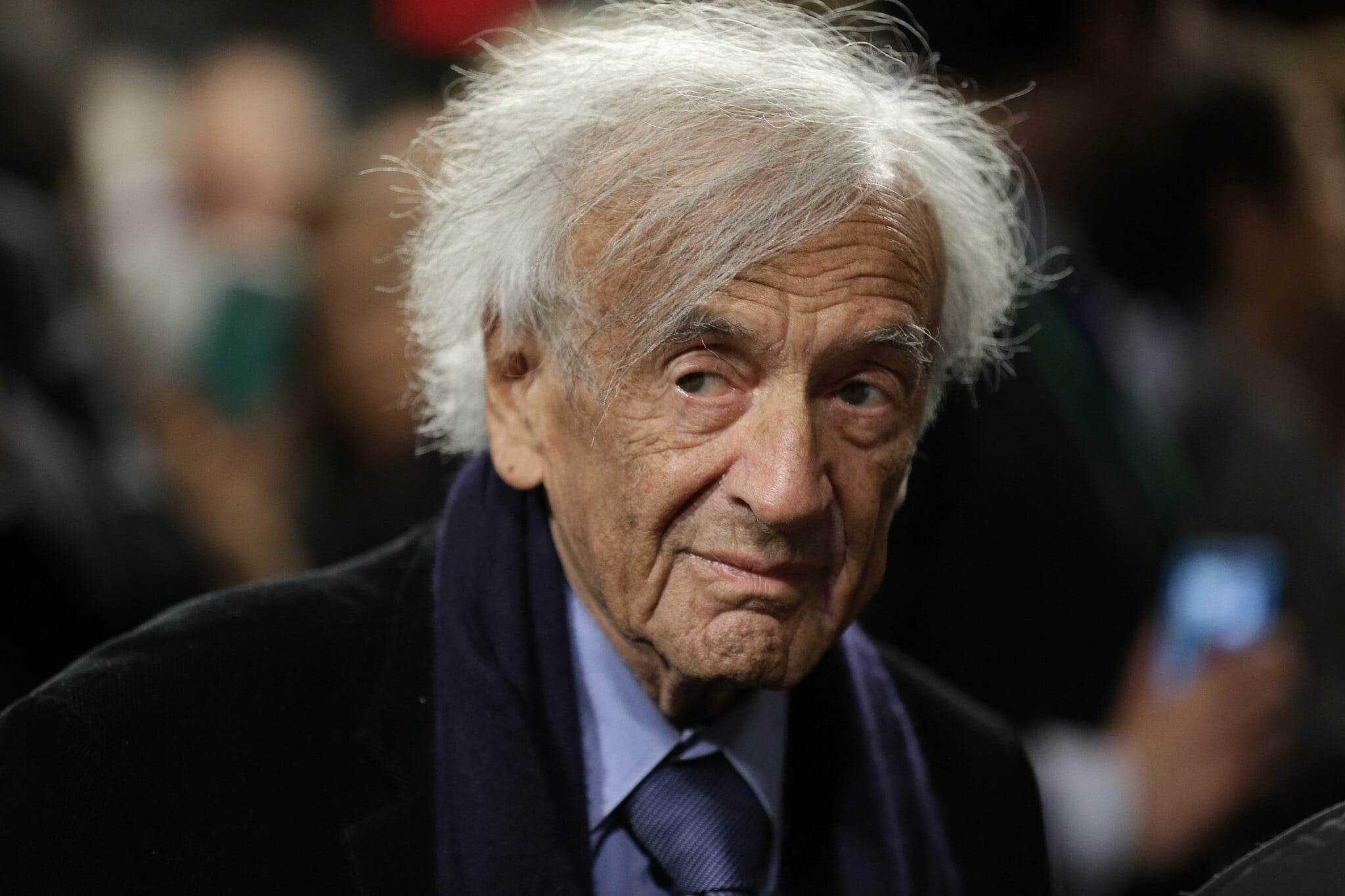
Elie Wiesel’s now-ubiquitous Holocaust memoir “Night” is taught in schools across the United States, but its mass publication and success were hardly preordained. About 10 years after the end of World War II, the Romanian-born Wiesel was making a living as a journalist in Paris when he decided to write a manuscript about surviving the Holocaust — and survival’s costs.
The ensuing text, an 862-page Yiddish-language tome titled “And the World Remained Silent,” was trimmed in length, published in Argentina, and struggled to find a wider audience. Wiesel cut the page count further and changed its focus. After numerous rejections from publishers, a small press finally accepted what the world has come to know as “Night.” Almost 10 years after Wiesel’s death at age 87 in July 2016, the book remains a mainstay of Holocaust education.
The origin story of “Night” is part of a renewed spotlight on Wiesel through a new documentary set for release on International Holocaust Remembrance Day.
“Elie Wiesel: Soul on Fire,” directed by veteran filmmaker Oren Rudavsky, will air on the PBS documentary series, “American Masters” on January 27, as part of “Honoring Our Stories: Jewish Culture and Remembering the Holocaust,” a recently launched initiative of The WNET Group.
“As Elie would say, suffering confers no privileges — it’s what you do with your suffering,” Rudavsky told The Times of Israel in a Zoom interview. “Elie’s lifelong attempt to give his life meaning is one way to understand him.”
Rudavsky has made numerous documentaries related to the Holocaust, including “Witness Theater,” about a program that connects high school students with Holocaust survivors to create plays about their experiences. “Elie Wiesel: Soul on Fire” will air on TV following a festival run with stops at the Hamptons International Film Festival and DocAviv.
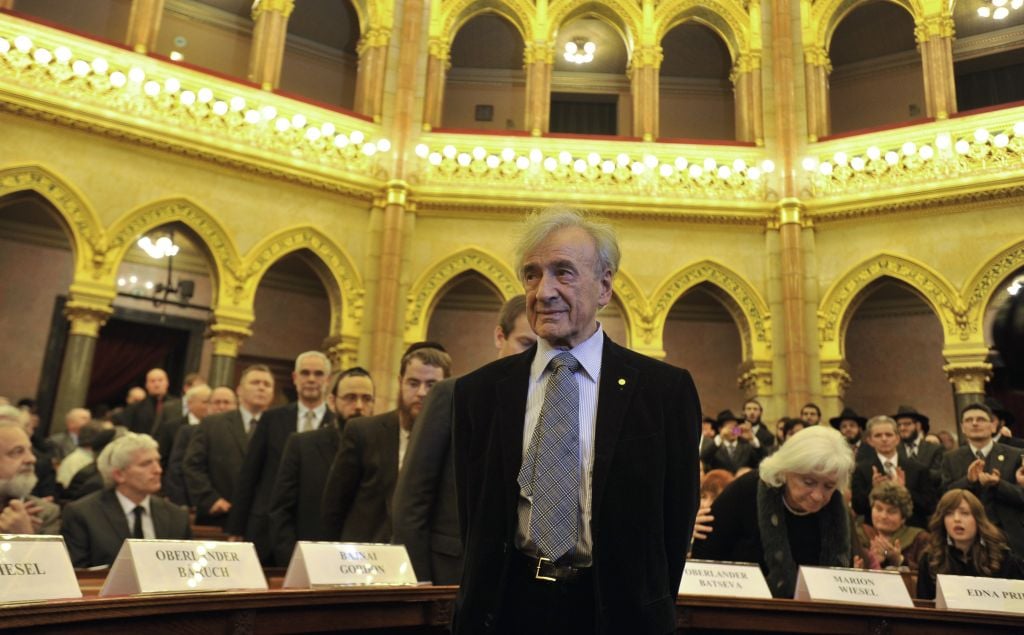
It begins with a quote from Wiesel: “Whoever listens to a witness becomes a witness.” Over the next hour and a half, it features perspectives from immediate family members, as well as scholars and some of the students Wiesel mentored as a professor at Boston University. Animated paintings are used to illuminate key moments in his life. The film incorporates numerous clips of Wiesel, from public appearances to family milestones, including some sweet moments with his wife Marion, son Elisha, and grandchildren, Elijah and Nova. The footage of Marion is bittersweet: She died almost a year ago, in February 2025.
Throughout the film, Elie Wiesel is shown as the “soul on fire” of the title — a man who felt compelled to speak up and speak out against injustice.
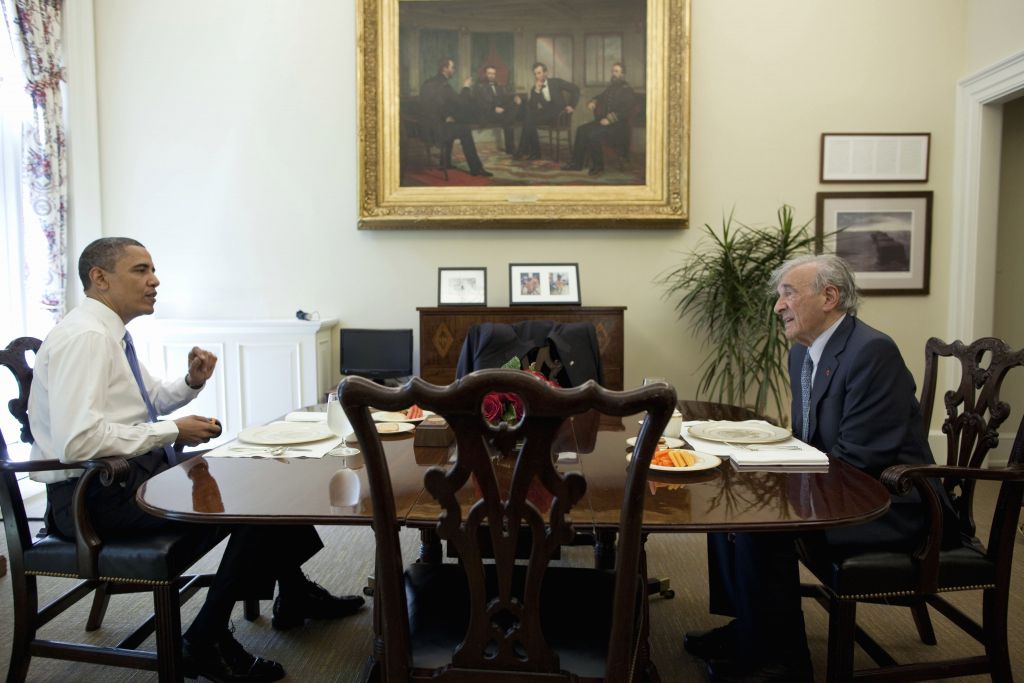
One such moment occurred 40-plus years ago. Then-US president Ronald Reagan was making a state visit to West Germany that included a cemetery in the city of Bitburg. It was discovered that the cemetery contained the graves of SS soldiers. American Jews protested, in vain. Wiesel used the occasion of his receiving the Congressional Gold Medal at the White House to deliver a polite yet forceful plea, urging Reagan to forsake the cemetery visit.
“It evoked everything which mattered to Elie,” Rudavsky said of the speech, “in terms of memory and Jewish history and speaking truth to power and speaking up for those whose voices are not heard.”
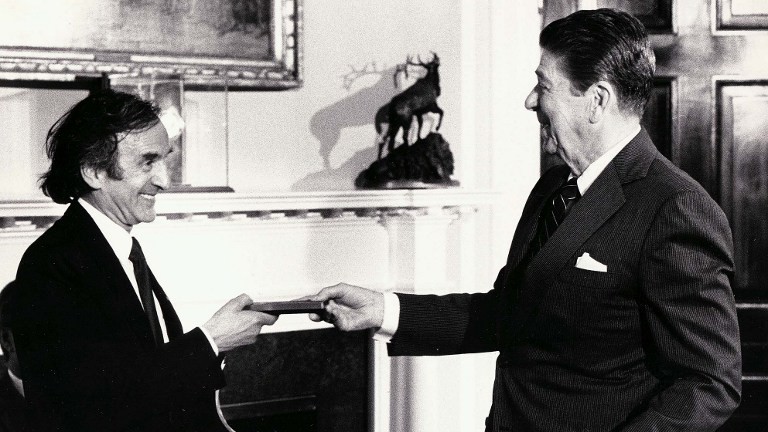
While Reagan did not cancel the visit to Bitburg, he added a stop at the former concentration camp site of Bergen-Belsen. A year later, in 1986, Wiesel was awarded the Nobel Peace Prize.
“Bitburg was a significant moment in Elie’s life,” noted Rudavsky, who was in his 20s during that time and vividly remembered the speech. “He was already a well-known figure in the Jewish world, and maybe in the Christian religious world.” But that relative prominence “was nothing like what happened after that speech, because of that speech, broadcast live on national television [and] because of the Nobel Peace Prize.”
‘Violence is not the answer’
In his December 10, 1986, Nobel acceptance speech, the laureate addressed the tragedy of the Holocaust, as well as contemporary human rights crises from apartheid South Africa to the Soviet Union.
In footage of the speech shown in the film, Wiesel also mentions “the Palestinians, to whose plight I am sensitive, but whose methods I deplore when they lead to violence. Violence is not the answer. Both the Jewish people and the Palestinian people have lost too many sons, shed too much blood. This must stop.”
Throughout Wiesel’s life, “he did not criticize Israel publicly,” Rudavsky said. “That was something he did not do. Some people think he was inconsistent in that. Others support that conviction.”
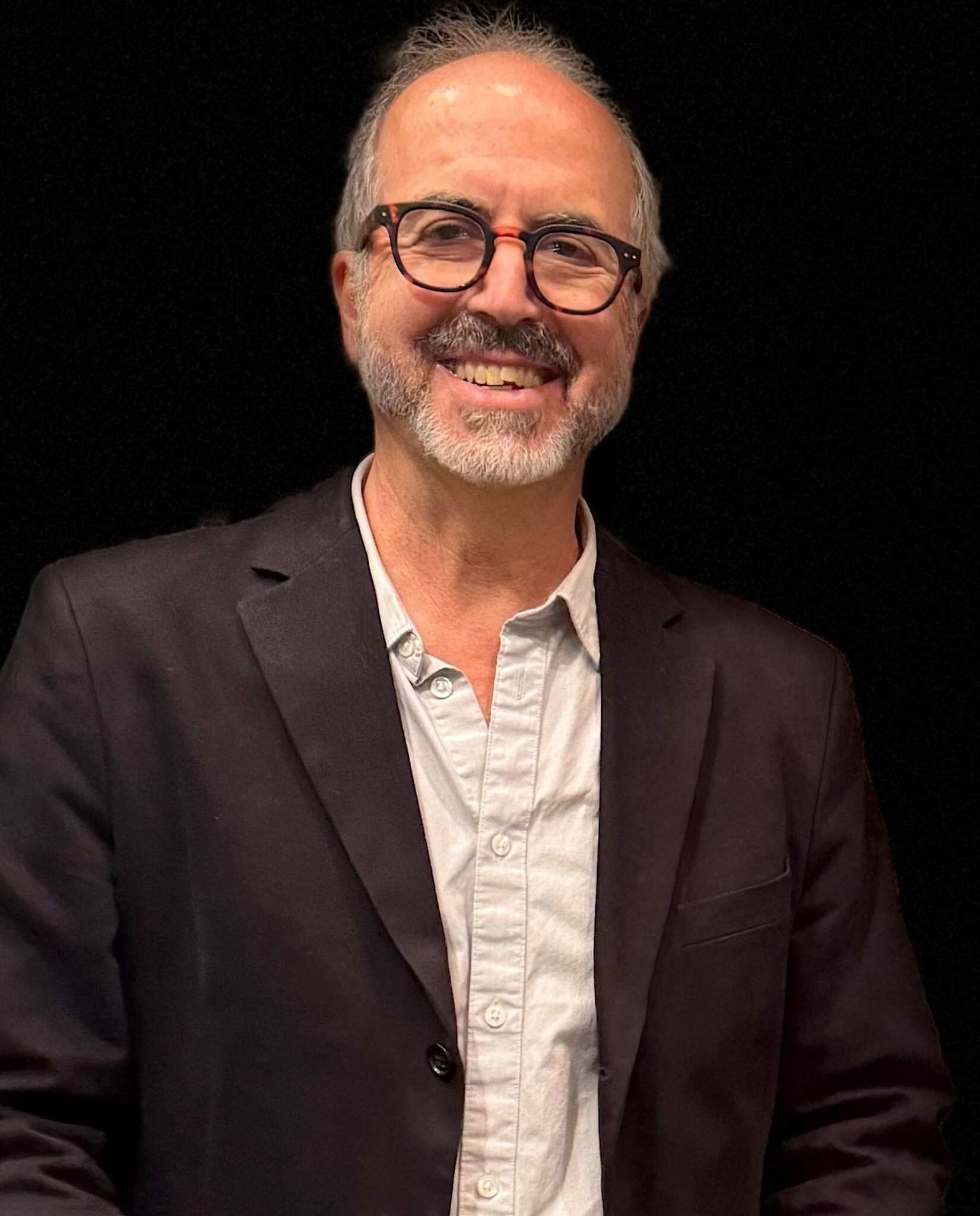
“There is a range of opinion in the Jewish and the non-Jewish world about that,” the director reflected. “What he spoke about, what he did not speak about, and his firm support of the State of Israel. He believed Israel would find a way to do the right thing and also expressed his concern for the Palestinian people. He passed away in 2016, well before everything that’s been confronting Israel since that time, and the Middle East, and the Palestinians.”
“Israel was significant in his life,” Rudavsky noted. “Very early on in the film … I include a clip in which he spoke about what he cared about. It’s a clip of children in Hungary singing what became the Israeli national anthem … When Elie was growing up, he said, ‘I knew the streets of Jerusalem in my youth better than I knew the streets of my hometown.’”
The crucible
As the film explains, its protagonist was born Eliezer Wiesel in the town of Sighet in present-day Romania. He was the grandson and namesake of a rabbi. According to his Holocaust Encyclopedia entry, Sighet had been absorbed by Hungary during World War II, but in 1944, Germany seized control over its nominal Hungarian ally, resulting in mass deportations of Hungarian Jews. That included the Wiesel family — parents Shlomo and Sarah, son Eliezer and daughters Beatrice, Hilda, and Tzipora, all sent to Auschwitz. Sarah and Tzipora perished in the gas chambers, and Elie was separated from Beatrice and Hilda, who both survived the war.
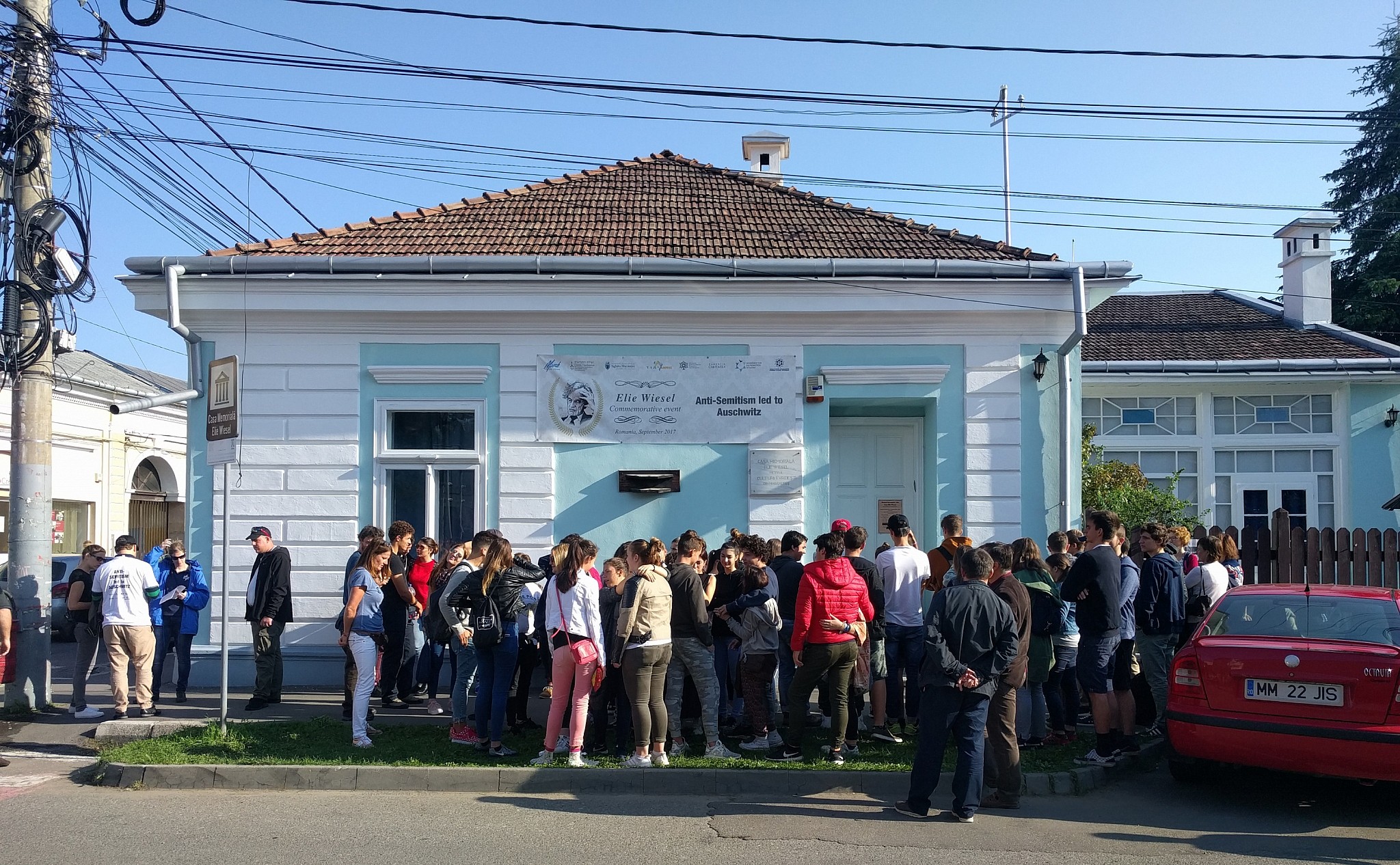
The film poignantly describes how Wiesel and his father stayed together. However, in 1945, as the German situation crumbled, the Nazis led concentration camp inmates on death marches westward. After one such march, to Buchenwald, Shlomo Wiesel died — a loss that left his teenage son agonized.
After the war, Elie found a new home in France as one of 400 former youth inmates collectively called the “Buchenwald Boys.” He studied at the Sorbonne and became a journalist, eventually writing for media outlets in France, the US, and newly independent Israel. Yet he never forgot a vow he had made: after 10 years passed, he would write a memoir of what he had experienced during the war.
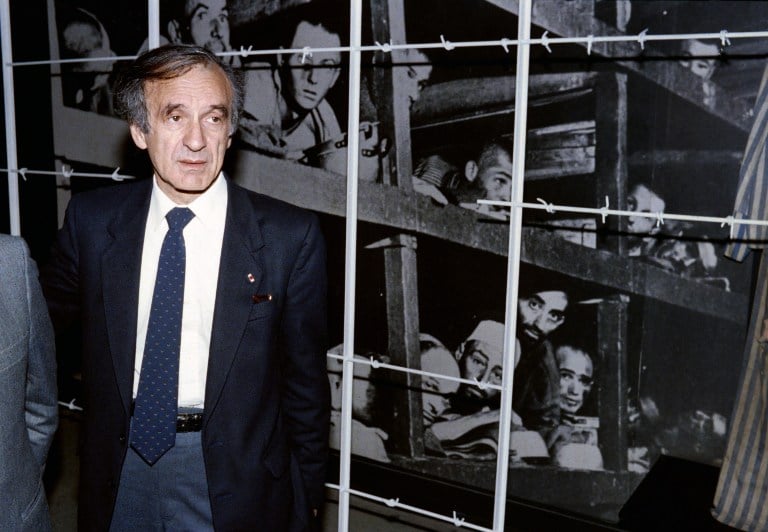
The original Yiddish manuscript “speaks of Elie’s anger at the non-Jewish world… the betrayal by mankind” during and after the Holocaust, Rudavsky said, adding that the revised French version “La Nuit” focused on “a more universal theme — questioning God, rather than a critique of the non-Jewish world.”
The first printing only sold a few thousand copies and earned its author all of $250.
“[It] did not become the bestseller it became until later, after the Six Day War in 1967,” Rudavsky noted. “There was a beginning of more interest in the Holocaust at the time in the US and throughout the world. It kept growing in popularity.”
The interest continued into this century, when Oprah Winfrey highlighted it through her book club in 2006. The film shows how the next generation is learning about Wiesel’s life and legacy, through a COVID-era reading at a middle-school classroom in Newark, New Jersey.
The classroom Rudavsky filmed is “not a Jewish classroom in a Jewish day school,” he said, “but in the city of Newark,” at the North Star Academy. Teacher Paris Murray devotes five weeks to “Night,” which Rudavsky calls “unheard-of at virtually any other place. They read it quite carefully. The students are quite immersed in it.”
As Murray leads a discussion of the first chapter, she notes that it begins when Wiesel was 13 years old — the same age as some of her students. The discussion progresses from the collective tragedy of the Holocaust to its personal impact on Wiesel, including the death of his father.
One student, Madison, notes that in the narrative, Wiesel refers to himself as Eliezer, yet the world knows him as Elie — and that this represents a crucial distinction.
“Elie is free, Eliezer was never freed from his pain,” Madison says. “Elie Wiesel is free, Eliezer is not.”




The Times of Israel Community.