

‘Rehabilitated’ postwar West Germany’s government was riddled with Nazis, study reveals
Research by German scholars lifts the lid on Third Reich officials’ lingering influence as a recovering country desperate for experienced administrators looked the other way
 Add ToI as a Preferred Source on Google
Robert Philpot is a writer and journalist. He is the former editor of Progress magazine and the author of “Margaret Thatcher: The Honorary Jew.”

The diplomat at the West German Embassy in Washington who wrote the 1965 memo blaming “the type of Jewish liberal who has great influence in the modern communications industry” for a plethora of World War II television shows and films portraying Wehrmacht soldiers as “bad guys” most likely did not fear any repercussions for his antisemitic remarks.
With good reason: Bonn’s envoy to the United States at the time, Georg von Lilienfeld, was a former Nazi member who had worked in the Foreign Office censoring radio programs and devising propaganda aimed at America.
But, German academics have revealed, Von Lilienfeld was hardly unique in the upper echelons of the postwar West German civil service.
Earlier this year, the Institute of Contemporary History Munich-Berlin and the Leibniz Center for Contemporary History Potsdam completed a six-year study of the personnel files of the Chancellery — one of the most powerful and important institutions in Germany.
Their findings, published this summer in “The Chancellery: West German Democracy and the Nazi Past,” show that, during the first decade of the new federal republic, two-thirds of those hired to work for Chancellor Konrad Adenauer had previously belonged to the Nazi party.
Among the bureaucrats working for the chancellor, who was elected in West Germany’s first postwar elections in 1949, were lawyers who had played a pivotal part in the implementation of the Nuremberg Laws, administrators who had overseen the theft of property owned by Jews murdered in the Holocaust, and journalists and filmmakers who had worked in Josef Goebbels’ Propaganda Ministry.
Reflecting the German chancellor’s central role in the country’s politics, the Federal Chancellery of Germany is comparable to the White House and No.10 Downing Street.
Gunnar Take of the University of Stuttgart, one of the four academics to conduct the research, analyzed the backgrounds of 107 senior staff in the Chancellery. Of the 73 people hired up to the year 1958, 66 percent had belonged to the Nazi party, and 20 had also belonged to party bodies such as the SS, SA or organizations such as the NSKK, or National Socialist Motor Corps, and the NSV, or National Socialist People’s Welfare.
During the remaining four years of Adenauer’s time in power, that figure fell to 32%, a function of the fact that, by that point, most of the top civil servants had begun their careers after 1945, says Take.
Among the senior staff recruited to, and serving in, the Federal Chancellery up to 1969, writes Take, Nazi membership was “the rule rather than the exception” in the older cohorts.
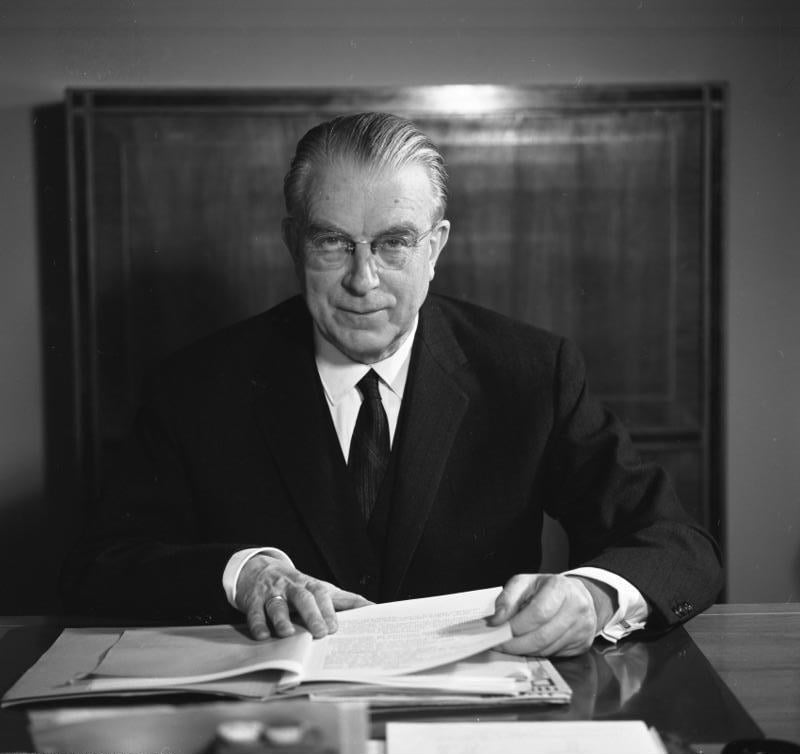
Take has also dug deep into the biographies of senior figures in the long-serving center-right chancellor’s office. He found that of the 50 civil servants born before 1918, only three had resisted the Nazis. The remainder either went along with the regime, joining the party or its professional bodies to advance or preserve their careers, or were officers in the Wehrmacht, high-ranking Third Reich officials or had served as administrators in Nazi-occupied Europe.
The most prominent senior Nazi official to have served in the Chancellery was Hans Globke. Adenauer’s top aide for a decade, he played a pivotal role in civil service recruitment.
During his time as a senior official in the Reich Interior Ministry, Globke helped draft laws and ordinances and provided legal commentaries on Nazi legislation. His commentary on the antisemitic 1936 Nuremberg Laws, “became ubiquitous in Nazi Germany’s courtrooms, offer[ing] many harsh interpretations of the rules,” notes a 2021 profile in The Times.
Globke’s work in the ministry was focused on ensuring that racial definitions were as clear as possible and their victims easy to identify. He was, for instance, responsible for drafting a 1939 law that required all Jews to adopt the first names “Israel” or “Sara.”
As the Reich expanded, Globke helped ensure the swift implementation of Nazi race and citizenship laws throughout Europe. Under Allied interrogation in 1948, he eventually admitted that he had known about the mass killing of Jews.
Brains behind the rent-a-Jew program
Less well-known than Globke is Friedrich Vialon, who served as head of the finance and economics department of the Chancellery Ministry of Finance under Adenauer.
After the Nazi seizure of power, Vialon swiftly demonstrated his loyalty to the regime by joining the Nazi Party and the SA. His obeisance paid off: steadily promoted, in 1937, he was working in the Reich Ministry of Finance in Berlin.
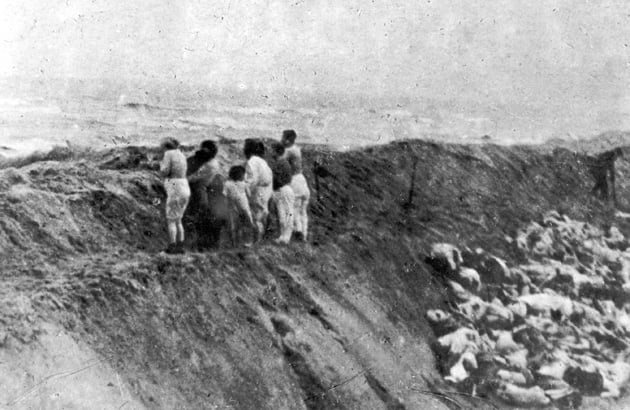
By 1941, Vialon was serving in the finance department of the new Reich Commissariat Ostland. It had been established to administer the occupied Baltic States, where the Nazi killing machine was already operating at full throttle. As Take notes, Vialon’s later attempts to deny knowledge of the Holocaust ring hollow: unlike elsewhere, there was little attempt to cover up the genocide, with Jews brutally murdered in public view.
Vialon himself was at the center of the effort to exploit Jewish slave labor — and plunder the possessions of deported and dead Jews. He was also a “frequent guest” at the Salaspils concentration camp near Riga, a survivor later testified, and had witnessed the degrading manner in which Jews were robbed of their clothes and jewellery.
On Vialon’s watch, the number of Jews “rented” out by the administration to various companies as slave laborers more than doubled to nearly 14,000.
While Vialon was initially classified as a “zealous Nazi supporter” during the denazification process, he managed to clear his name through self-reported statements and witness accounts, which, Take argues, couldn’t be verified by extensive research. After his retirement — his postwar career ended as state secretary at the Federal Ministry for Economic Cooperation — Vialon slipped through the judicial net once again. Charged with perjury for having claimed to be unaware of the extermination of the Jews, he was acquitted in 1971 and died in 1990, several months after the fall of the Berlin Wall.
Postwar careers unhampered by roles in the Holocaust
While Globke and Vialon’s crimes are perhaps the most egregious, the study provides other examples of those whose postwar careers weren’t hampered by their participation in the Nazi genocide.
Rudolf Kriele, for instance, was an administrator sent to run a district in Sudetenland — a post which he held, apart from a brief stint in occupied Normandy, from July 1939 until the end of the war. As postwar prosecutors claimed during denazification proceedings, this was a key position that could only have been occupied by reliable party members. But Kriele escaped accountability and, within a decade, was working in the Chancellery handling the business of the Federal Defense Council.
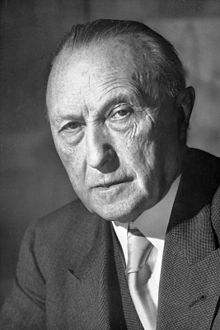
Josef Rust worked in the Reich Ministry of Economics’ banking department, which helped oversee the systematic plundering of German Jews’ commercial activities. He was later involved in schemes to exploit Soviet forced laborers. Within five years of the Nazis’ defeat, Rust was at the heart of the West German state, working in the Chancellery on finance, economics and the Marshall Plan.
The federal press office, which fell within the remit of the Chancellery, was more often staffed by journalists and writers than civil servants.
But some of these had equally awkward relationships with the Nazi past.
Felix von Eckardt, who became head of Adenauer’s press office in 1952, was a talented screenwriter who worked on more than 20 films during the Third Reich. Goebbels was heavily involved with his film “The Dismissal,” which was one of only a handful of films awarded the accolade of Film of the Nation by the Propaganda Ministry.
Hans-Heinrich Welchert, who drafted speeches and articles for Adenauer and later became head of publications in the press office, had served as a political editor on Goebbels’ Berlin newspaper, Der Angriff.
And Hans Schirmer, head of the foreign department at the press office, had joined the Nazi party in 1933 and went on to work in the Propaganda Ministry and in the radio policy department of the Foreign Ministry.
“It was problematic that people who had previously defended Hitler’s campaigns of conquest were now responsible for the image of the Federal Republic [and] that those who had previously engaged in antisemitic propaganda were now supposed to represent a sincere policy of confronting the past,” historian Dr. Jutta Braun of the Leibniz Centre for Contemporary History Potsdam, who authored the chapter on the federal press office in the study, tells The Times of Israel.
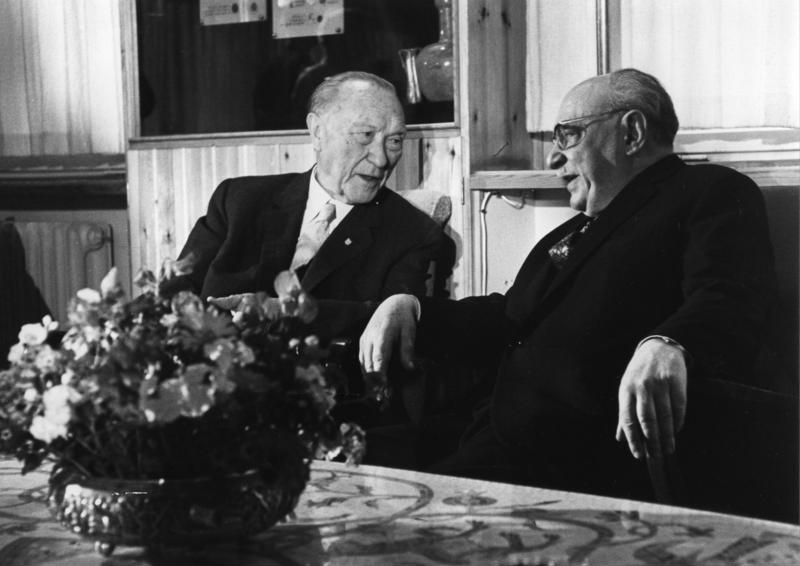
Adenauer himself had been a victim of the Nazis. Ousted from his post as mayor of Cologne soon after Hitler came to power, he was twice arrested and imprisoned following the Night of the Long Knives and the failed July 1944 plot to assassinate Hitler.
But once he had been elected to head the government of the new Federal Republic of Germany in 1949, Adenauer was also keen to draw a line under the Nazi period, pressing for an end to denazification, the release of convicted war criminals, and allowing all but the most serious offenders back into civil service posts. This was coupled with a push for reconciliation with the Western allies and the new State of Israel and a willingness to accept responsibility for the Nazis’ crimes and pay reparations to their victims.
Adenauer and his supporters claimed that establishing a stable and functioning administration required experience and competence. But Take’s research indicates the chancellor and Globke also favored those who would be politically reliable and sympathetic to the Christian Democrats. Most were conservative, upper-middle-class lawyers who hailed from Adenauer’s native Rhineland. Those who had clear anti-Nazi credentials were recruited into the Chancellery — but received no special treatment or preference.
As the Cold War enveloped East-West relations, a commitment to anti-communism provided a “bridge that allowed even the worst antisemites to return to a position of power,” says Braun. Adenauer’s willingness to turn a blind eye to some of his subordinates’ dubious roles in the Third Reich also provided “a signal to citizens with a Nazi past that they would be given a second chance,” she says.
At the same time, though, Braun emphasizes that Adenauer had no desire to spread Nazi ideology. Suspicious of his compatriots’ lack of democratic sentiments, he, paradoxically, adopted authoritarian and paternalistic methods in order to cement the new democratic order.
The war of public opinion
But, as the study shows, the chancellor’s desire to draw a line under Germany’s darkest hour often translated into a desire to “look good abroad.” For all the talk of coming to terms with the Nazis’ crimes, the press office and the country’s embassies abroad appeared at times to prioritize “the image of the perpetrators, not the perspective of the victims.”
The reputation of the Wehrmacht proved particularly contentious, with the government and wider society eager to cling to the myth that the regular army’s hands were clean and the bloody trail of mass murder which streaked across occupied Europe had been the responsibility of the SS.
Adenauer managed to secure an important imprimatur for this claim: in 1951, Dwight Eisenhower, the head of NATO, former Allied supreme commander in Europe and future US president, was persuaded to issue a statement claiming the great majority of the Wehrmacht had acted honorably.
“Anti-German” films and programs shown overseas consequently became a focus for the federal press office and the Foreign Ministry’s embassies.
In 1963, for instance, the German embassy in Canada complained bitterly to senior figures at the Canadian Broadcasting Corporation about “unfair” and “offensive” broadcasts after a week in which it had shown a documentary about the Warsaw Ghetto uprising and a 1944 feature film about the then-fictitious prosecution of Nazi war criminals. The embassy was particularly incensed that the programs had aired during a week when NATO’s council was meeting in Ottawa. It accepted the historical accuracy of the broadcasts but claimed that they perpetuated the notion that Germany had not changed. The diplomats’ missive won an apology from TV bosses.
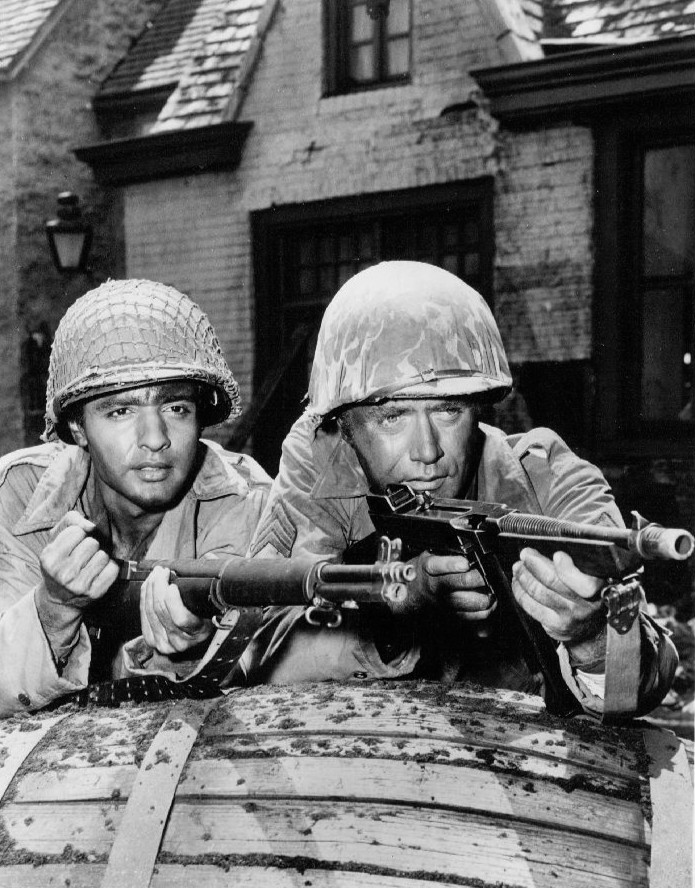
The US show “Combat!”, which dramatized the wartime experiences of American soldiers in Europe, particularly irked German diplomats not only in the US but throughout Latin America. The embassy in Caracas, for instance, complained that Germans were portrayed as “looting, plundering, and murdering women and children,” while in Guatemala the combination of the show’s alleged malice and undoubted popularity worried diplomats. When “Combat” was discontinued, attention switched to “The Rat Patrol,” which focused on the exploits of an Allied unit seeking to harass Rommel’s “Afrika Korps,” and “Jericho,” an espionage series set in occupied Europe.
Potential responses were banded around. There was discussion about what economic pressure could be brought to bear on US companies that distributed “Combat!” as well as those — such as Coca-Cola, Colgate and General Electric — that sponsored the show. The embassy in Washington — which pinpointed the negative influence of “Jewish liberals” in the film and TV industry — discussed with the press office putting the issue on the agenda for Adenauer’s successor, Ludwig Erhard, to raise with US President Lyndon Johnson at a White House meeting. And a New York-based newspaper for German Americans worked with diplomats on a campaign urging readers to complain to TV stations, advertisers and their congressional representatives about “anti-German TV broadcasts.”

As Braun’s chapter notes, it wasn’t just dramas that concerned the German government. Documentaries, such as one which examined life in a concentration camp, risked providing a touch of authenticity to the “smears” about the “German national character” contained in more sensational dramas, it was feared.
But for all the energy it spent on monitoring the programs, the press office had little impact on them.
“The employees of the press office were largely unsuccessful, as they were dealing with a network of state and private media outlets abroad that could not be influenced in this way,” Braun says. “These episodes say more about Germans’ self-image than about the influence of the Federal Press Office. German society had not yet developed a generally self-critical approach to German crimes.”
The press office was not, however, wrong to recognize the power of television to shape perceptions — although not, perhaps, in the way it anticipated. As Braun notes, the screening in West Germany of the 1978 NBC drama miniseries “Holocaust,” which starred Meryl Streep, James Woods and Sam Wanamaker, “brought about a significant change in the culture of remembrance and an insight into German guilt,” forcing the country to finally confront its worst crimes.
Ironically, some of those responsible for those crimes had been allowed to work in the highest office in the land — and had played a role in building the democracy that now allowed Germans to wrestle with their collective past.










The Times of Israel Community.