

Theater maven Moss Hart’s kids happy to ‘hear him again’
‘Act One,’ the Tony Award-nominated adaptation of their late father’s early life, is considered a theatrical bible
 Add ToI as a Preferred Source on Google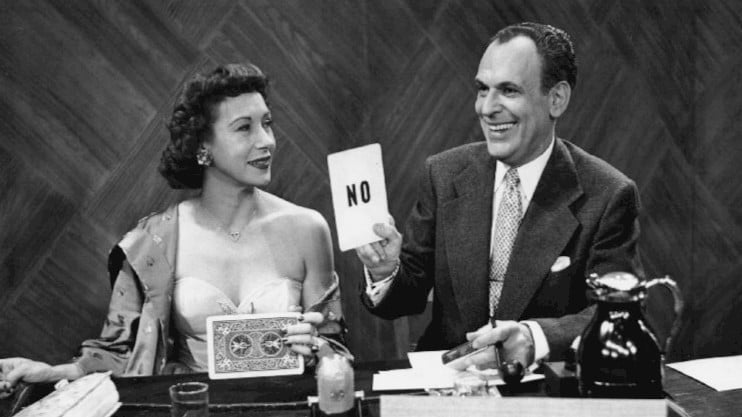
NEW YORK (AP) — The Moss Hart that emerges during the Broadway play “Act One” is a wordsmith, a theater addict and a connoisseur. For two people in the audience, he is another thing entirely — dad.
Catherine and Christopher Hart, one a doctor and the other a theater producer and director, have become backstage cheerleaders for the new Tony Award-nominated adaptation of their late father’s early life.
“I can hear him again and it’s lovely,” says Christopher Hart during a joint interview at Lincoln Center Theater. “Everybody loses their parents, but they don’t have this ability to keep them alive.”
Moss Hart was one of Broadway’s most successful creators, co-penning such hits as “You Can’t Take It With You” and “The Man Who Came to Dinner,” and directing “Camelot” and “My Fair Lady.” He died at age 57 of a heart attack in 1961.
“Act One,” his memoir that ends with the grand opening of his first Broadway hit in 1930, has become a theatrical bible, a tale of a man who brushed off a poor childhood with Jewish immigrant parents in the Bronx to become a Broadway legend.
The show — starring Santino Fontana as the playwright on the verge of fame, and Tony Shalhoub looking back — is the first time the book has been made into a stage show and the Hart children were not about to hand over the rights to their father’s story so easily.
“I just didn’t want to disappoint anybody and didn’t want to feel as though this somehow diminished the book in some way,” says Christopher Hart, who was 13 when his dad died. “It was HIM.”
Tony-winner James Lapine was trusted with the book and story that has now earned five Tony nominees, including best play. The Hart siblings have found themselves looking back these days, rereading the memoir and digging through old letters. Both cried at the first read-through of the show.
‘I’m getting to know him again as an adult, which is really special’
“I’m getting to know him again as an adult, which is really special,” says Cathy Hart, an internist who was 11 when her father died and has two grown children of her own. “I feel like I’ve rediscovered him.”
The Hart children — whose mother was the Jewish socialite and performer Kitty Carlisle Hart — were raised in an era when their father was firmly part of the glamorous New York show business scene.
Actor Danny Kaye was a family friend and once took Cathy to an ophthalmologist. Singer Frank Sinatra planted a kiss on her cheek on her 16th birthday. (“That I will never forget. I still haven’t washed my face,” she says, laughing.) Actress Joan Crawford would come over for dinner and instruct young Christopher to guard her bottle of vodka.
They saw nothing strange with this upbringing: “They were just Mom and Dad,” says Christopher Hart, who has a daughter about to graduate high school. Later, as a young man working in the theater, Christopher initially rebelled from his father’s legacy. “I got over that,” he says with a smile.
Moss Hart’s children say their father never planned for a second volume of memoirs — an “Act Two,” if you will — but there were decades more stories as the playwright and director rose to giddy heights of wealth and fame.
Hart’s wife was very protective of his legacy until her death in 2007 and only two biographies have been written, one that suggested Hart suffered from severe depression and was a closeted gay man. Both his children are open to the idea of a new biography.
“Clearly, my father was troubled a lot of his life,” says his son. “But I don’t think his personal life or personal issues affected his work in any way. And therefore, I don’t really care about the gossip.”
For now, Hart’s children are happy to share their father with a new audience, including their own children, who have seen the show. “One of the wonderful things about the production is introducing our father to our kids,” says Cathy Hart.
Copyright 2014 The Associated Press







The Times of Israel Community.