

Clinging to life, a master produces a wrenching memoir of the War of Independence
Yoram Kaniuk, the prize-winning author of ‘1948,’ rises from his bed to discuss ‘the fist of the conflict’
 Add ToI as a Preferred Source on Google
Mitch Ginsburg is the former Times of Israel military correspondent.
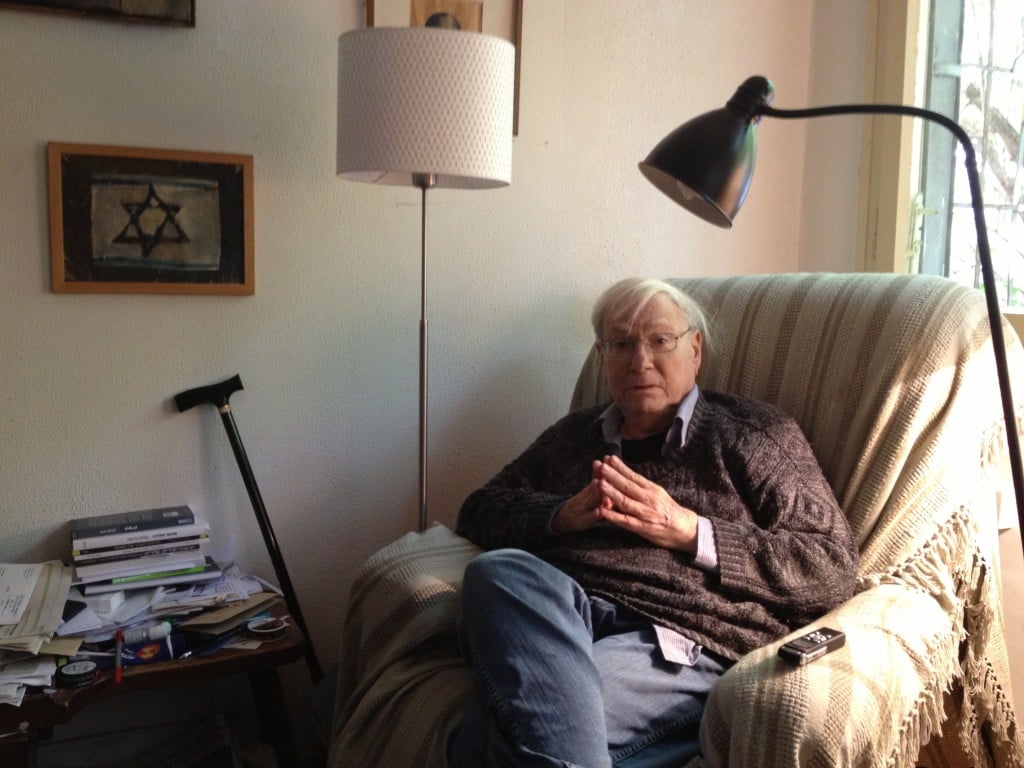
Several years ago, Yoram Kaniuk, the author of a masterful new memoir of the War of Independence, “1948,” was stuck in the corridor between life and death.
“It was a warm place, large and dark,” he said in a recent interview at his Tel Aviv apartment, “and I was happy.”
Kaniuk was nearly 80, and he had lived: He befriended Charlie Parker in New York City in the fifties and made out with Billie Holliday, who wrote him a song. He brought Holocaust survivors to Israel on the SS Pan York, and fought his way into besieged Jerusalem. He was wounded in battle. He buried friends whose names he didn’t know. He had been spared death by the good graces of a British sniper, and stripped of his sabra arrogance by a story a young man told him about pulling diamonds from the rectums of his dead parents in order to stay alive in Nazi-occupied Europe. But despite his 17 novels and numerous works of criticism, he was unable to commit his memories to paper in a way that felt right.
Or was he? In 1949, he gave a manuscript about the war to “a beautiful woman from the village of Kfar Yehoshua.” All he remembers today is the fact of her beauty, not what befell that piece of writing, which has vanished.
At any rate, while Kaniuk was connected to life support in 2009, a familiar voice pulled him out of the dark and he rejoined the living. Several months later he watched an Israeli film called “Frozen Days.” The daughter of the surgeon who had just operated on him had a part in the movie. Her eyes, seen in a close-up, were identical to her father’s, which Kaniuk remembered seeing over him before the surgery. The likeness, he said, threw open the drawers of his memory and brought this remarkable memoir of war to life.
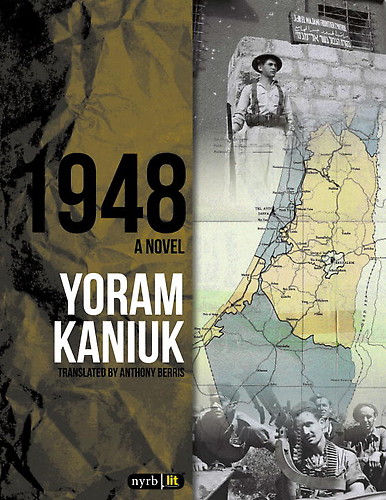
“1948” begins by questioning the veracity of memory: “Did it happen or not” are the first words in the Hebrew version of the text, which has now been translated into English by Anthony Berris and published in the U.S. earlier this year.
“Memory is what I am interested in these days,” explained Kaniuk, a frail man, now 83, who rose from his bed and used a walker to get to his reading chair. “Memory is deceitful and mocking and it can change reality for us.”
For this reason, and in order to allow himself some leeway in the narrative, Kaniuk had the book labeled “fiction.” But it is, aside from one major deviation, the honest telling of an octogenarian who writes, “you think, and a moment later you remember only what you want to.”
Perhaps that is true. But it seems that rather than clouding the memory, rather than betraying history, time has sifted all extraneous material from his six months of war, and the voids in the narrative — the names of the people who died and the places where they were killed — serve only to amplify the brief scenes of battle and revelation. Yashka the Partisan, for instance, died right beside Kaniuk. That is true. The author might not remember where, but he recalls the exact nature of Yashka’s laugh and the precise rhythm of his final breaths.
The book, for which Kaniuk was awarded Israel’s highest literary honor when it was published in Hebrew in 2011, is flecked with post modernism — “And what is memory? Memory is what I write is memory” — and hewn from the Hebrew of old, a brutal yet elegant style that employs Psalms and slang in equal measure.
That, Kaniuk writes, ‘was the funniest thing that happened to me in that war, that I established a state while asleep and danced the hora next to an unknown comrade who’d been sliced into two’
The milestones of the war are present throughout. Yitzhak Rabin, David “Dado” Elazar and Rafael “Raful” Eitan, three future commanders of the IDF, fought shoulder-to-shoulder with Kaniuk. The battles in which he took part were some of the formative fights of the state’s existence, with locations that reverberate in Israel’s collective memory: the Castel, San Simon, Mount Zion. And yet one of the elements that make the book shine is the way Kaniuk’s wartime recollections — his observations upon reaching Jerusalem and Ramle, for instance — are set beneath a twinkling sky of vignettes and character sketches.
In Tel Aviv, there was a German-Jewish hot dog vender who, before serving a customer, would first ask them who was greater, “Goethe or Shakespeare?” The civil guards, in their black berets, used the polite Hebrew word “na,” or please, before telling passers-by to take cover from attacks, employing “an ancient verbal beauty” that was native to Berlin and was “only renting a place in Tel Aviv at the time.”
In uniform, Kaniuk, only seventeen-and-a-half years old, meets “that sweet lunatic Benny Marshak,” who tells him “in the terrible darkness” of the Bab el-Wad battlefield, over a fresh corpse covered by a greatcoat, that “someone had heard on a battery radio that Ben-Gurion had established a state.”
Marshak, a socialist ideologue and the Palmach’s education officer, drags the tired men into a hora circle dance “in the middle of nowhere, at four or five in the morning, in the asshole of the world, next to a body that had begun to stink.” And that, Kaniuk writes, “was the funniest thing that happened to me in that war, that I established a state while asleep and danced the hora next to an unknown comrade who’d been sliced into two.”
In the book and in conversation, Kaniuk, the son of the first curator of the Tel Aviv Art Musuem, a Heine-quoting liberal who before enlisting believed in the binational ideology of the Hashomer Hatzair movement, does not aim to strip the Palmach of its lore, but merely to expose the more complex truth.
During the April 1948 battle for the Castel, a pivotal hilltop on the road to Jerusalem, Kaniuk is encircled near the peak along with seven or eight other men, their ammunition nearly gone. He knew throughout the war what happened to the wounded who were left on the field — “the same thing that happens to the wounded in Syria today. They were brutalized.” All of the fighters, he said, always kept a grenade for the end: “Many committed suicide.”
But at the Castel, a call on the radio informed him and his mates to hold on; a group of officers and non-commissioned commanders was on the way. They ran directly into the line of fire and shouted: “Privates retreat. Commanders cover them.”
It was in that battle, more than any other, that the IDF ethos of leading from the front was sanctified. “The officers commanded by Nahum Arieli stood like a human avenue on both sides of the path, between charred buildings and amid an inferno of firing, and we passed between them as if on our way to the wedding canopy,” he wrote.
“Slowly, one after the other they were hit and fell and those left standing continued to cover us and at the same time went on firing at the attackers but also to die.”
In our conversation, Kaniuk preferred to focus on two different chapters of the book, both devastating.
The first takes place in a town he chose to call Beit Yuba, a made-up name for the real-life village of Beit Machsir. It involves death, mutilation, an “Eretz Yisrael landscape that no longer exists,” and a war-time murder of a child that the text suggests Kaniuk perpetrated.
Except, he said, he didn’t.
“I didn’t kill that boy,” he said. “I took it upon myself because of the guilt.”
Without revealing too much of the story, as it is better read in the book, Kaniuk explained that he took the killing on himself, both publicly and privately, because he still feels guilty for having failed to prevent someone else from doing it. (In the English version there’s an epilogue where he expalined that “I’ve written that I killed a child. But everyone who was in that battle knows it wasn’t me who killed him.)
I asked him if he didn’t believe in a binational solution anymore. He said, “I don’t believe there’s anything that I really believe in.”
Even more important, in his eyes, is the chapter on the battle for Ramle.
Toward the end of the book, in July 1948, Kaniuk escaped from a military hospital and joined other members of his unit in the empty Arab city, where hastily abandoned food congealed on plates and the barking of lost dogs reverberated through the empty streets. Residents who wanted to return to their homes after the fighting were held behind concertina wire. Several days later, a convoy of trucks arrived and let off 1,500 Holocaust survivors fresh from a ship that had arrived that day — “people who had emerged from hell to return to history, which lay beaten and weeping on the barbed-wire fences.”
Thinking of that scene just before the country’e 65th Independence Day, Kaniuk described it as depicting “the fist of the conflict.”
“That moment shaped the rest of my life,” he explained. “I understood that there was no solution. Two peoples, both wanting a home.”
I asked him if he didn’t believe in a binational solution anymore. He said, “I don’t believe there’s anything that I really believe in.”
“I want things to be better, but I don’t believe it will happen,” Kaniuk said. “How can we make peace? And how can we not make peace?”





The Times of Israel Community.