

IDF says it killed Oct. 7 Hamas operative identified as journalist, vows to expose others
Army sets up website revealing ‘unprecedented number’ of Palestinian journalists it says also served terror groups; separate strikes kill 3 Hamas commanders and Islamic Jihad rocket-launching operative
 Add ToI as a Preferred Source on Google
Emanuel (Mannie) Fabian is The Times of Israel's military correspondent
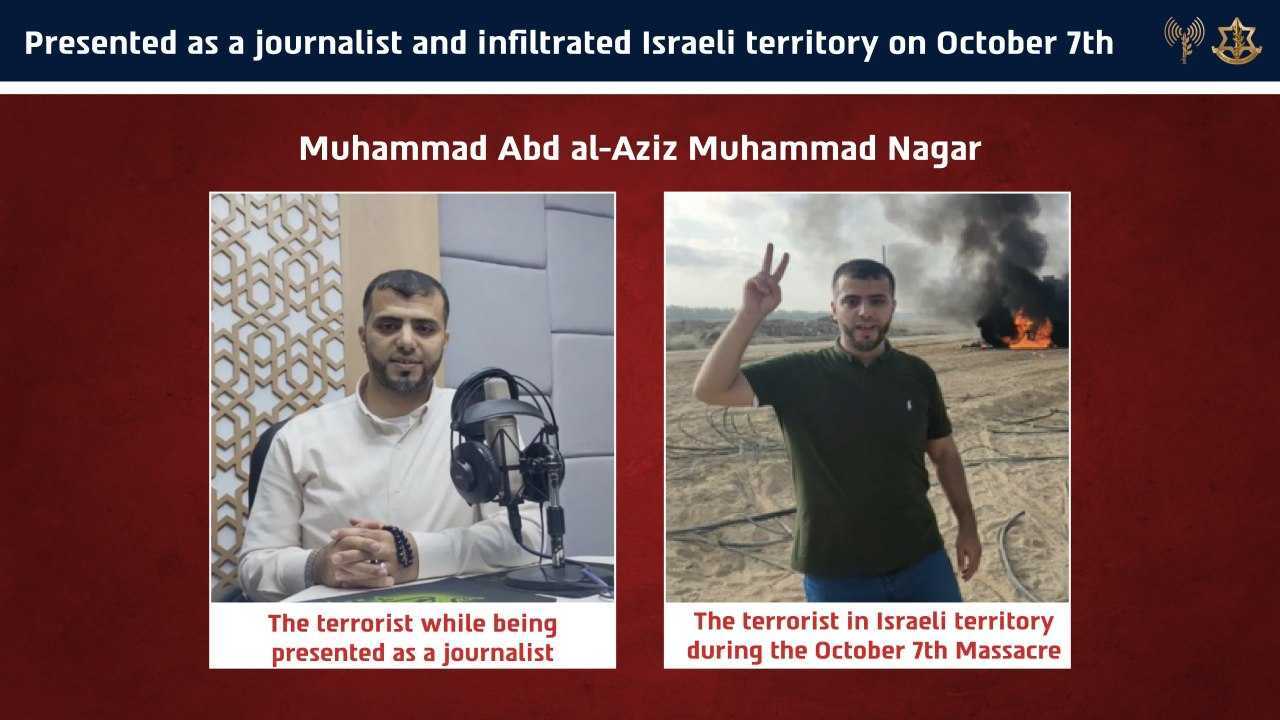
A Palestinian journalist who the Israeli military said participated in the Hamas-led October 7 onslaught was killed in an Israeli airstrike in the southern Gaza Strip on Wednesday as the IDF vowed to expose the terror affiliations of dozens more Palestinian journalists killed in the war.
The strike in Khan Younis killed Mohammad al-Najar, who Palestinian media identified as a journalist following his death. The Israel Defense Forces said Najar was a member of Hamas’s military wing and had invaded Israel during the October 7, 2023, attack in which terrorists killed some 1,200 people and took 251 hostages.
According to the military, Najar had recently been advancing attacks against Israeli troops and civilians and working to restore Hamas’s military capabilities.
The IDF said he was carrying out those activities “while systematically violating the ceasefire agreement.”
The military meanwhile announced that it would be revealing “an unprecedented number” of Palestinian journalists killed during the war in the Gaza Strip who were actually members of terror groups.
“Following extensive research, the IDF is now revealing the identities of Gazans killed during the war who were presented around the world as innocent journalists and media personnel, but who also held roles in the military wings of terrorist organizations, primarily Hamas and the Islamic Jihad,” the military said.
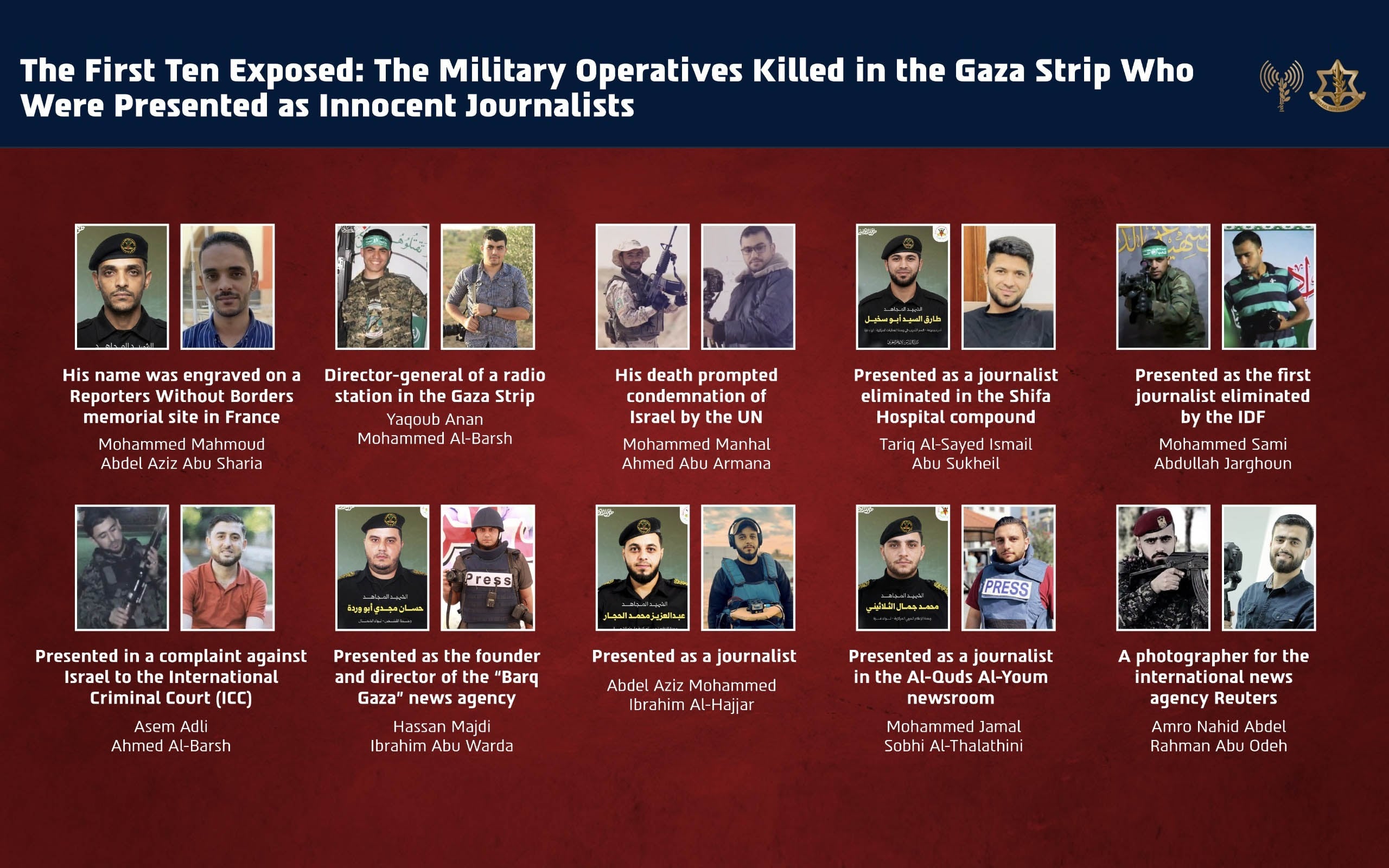
The first ten cases of such individuals are published by the IDF on a dedicated website. Each case includes the name and role of the journalist/terror operative, along with their civil and military ID numbers.
“In the next few hours, the IDF will reveal a large number of additional cases in which individuals who were presented as innocent journalists operated as military operatives. Their names will be published alongside intelligence information, documents, photographs, and additional evidence exposing their terrorist affiliations and the roles they held within the military wings of terrorist organizations,” the IDF said.
A Times of Israel investigation published in June identified multiple Hamas and Palestinian Islamic Jihad operatives previously reported as slain journalists. Another study, by the Meir Amit Intelligence and Terrorism Information Center published last year, asserted that a majority of Gaza-based journalists killed since the outbreak of the current war were operatives in, or closely affiliated with, terrorist organizations.
In a separate strike on Wednesday, the IDF, said it killed a Hamas commander in Gaza City.
The military identified the man as Ammar Mahmoud Muhammad al-Sharafi, saying he served as a company commander in Hamas’s military wing. According to the IDF, Sharafi had also been advancing attacks against Israeli troops and civilians while working to rebuild Hamas’s capabilities.
He was killed to “remove the threat he posed,” the army added.
Palestinian media reported Wednesday that an Israeli strike in Gaza City killed four people. It was not immediately clear from the reports whether Sharafi was among the four and whether others were killed alongside him.
The same day, a Palestinian Islamic Jihad rocket-launching operative was killed in an Israeli strike in the southern Gaza Strip, the IDF said.
The strike in Khan Younis killed Bilal Mahmoud Suleiman Samiri, identified by the IDF as a member of Islamic Jihad’s rocket array.
The IDF said Samiri was also involved in advancing attacks “in systematic violation of the ceasefire,” as well as taking part in “ambushes targeting IDF troops” operating in the Strip.
“The terrorist was eliminated to remove the threat he posed,” the military similarly added.
The IDF also said that two terrorists who participated in the October 7 onslaught, including one who abducted hostages, were killed in Israeli strikes in the Gaza Strip earlier this week.
One strike on Tuesday in Gaza City killed Muhammad Jamal Mahmoud Abu Al-Shaar, identified by the IDF as a commander of a cell in Hamas’s military wing.
On October 7, 2023, Shaar invaded Kibbutz Be’eri and took part in the abduction of hostages Sharon Hertzman-Avigdori, Noam Avigdori, Adi Shoham, Nave Shoham, Yahel Shoham, and Shoshan Haran, according to the military.
A separate strike in Jabalia on Tuesday killed Musab Abd al-Jalil Saqib Balbisi, who the IDF said was a commander in the Palestinian Islamic Jihad.
Balbisi also invaded Israel on October 7, the IDF said.
Both terrorists had recently been involved in advancing attacks against Israeli troops and civilians “in systematic violation of the ceasefire,” and they were killed “to remove the threat that they posed,” the military added.
The strikes come as Israel has carried out a series of strikes against Hamas operatives in Gaza in recent weeks, with the IDF repeatedly accusing the terror group of advancing attacks and rebuilding military infrastructure in violation of the ceasefire.
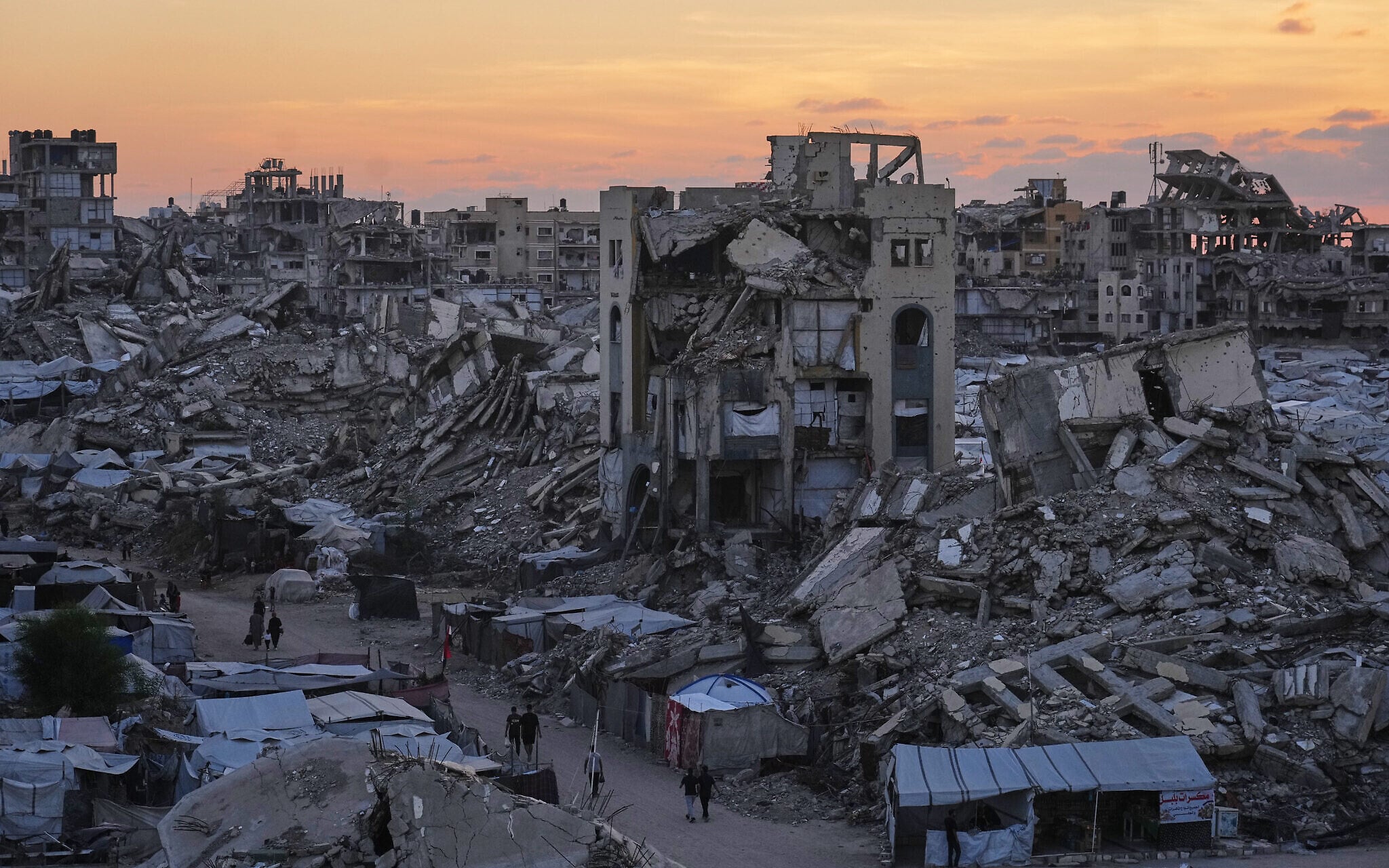
While an October 2025 US-backed ceasefire halted major fighting in the shattered territory, it hasn’t ended strikes by the IDF, which the military says are meant to thwart attacks by Gaza terrorists.
The IDF in recent months has ramped up strikes on terror operatives in Gaza, including numerous October 7 terrorists, saying they posed a threat to Israeli forces.
In September alone, the IDF said it killed 70 terror operatives in the Gaza Strip, including three Hamas brigade commanders, two battalion commanders, and nine company commanders.
The IDF said that 17 of those killed had participated in the October 7, 2023, onslaught, kidnapped hostages, or held hostages in captivity.
Those 17 terrorists were killed due to the efforts of a unit in the Shin Bet security agency known as Nili, which aims to track down and eliminate all of those who took part in the Hamas-led attack that sparked the Gaza war.
The military said the targeted killings come following “prolonged intelligence and operational work that matured into several opportunities over a short period of time.”
Some of the operatives and commanders have been hiding in tunnels or densely populated areas, requiring the IDF to employ “prolonged surveillance… to achieve a high degree of certainty regarding their identities and locations and to create conditions that enable a precise strike while minimizing harm to uninvolved individuals,” according to the military.
According to the military, many of the strikes in the past month focused on Hamas operatives involved in building up the terror group’s force, as well as secret headquarters and Hamas’s civil control mechanisms in the Strip.
The IDF has assessed that Hamas is no longer the military and governing organization it was before October 7, but the terror group “continues attempts to rebuild and rearm.”
Gaza remains bisected into Israeli- and Hamas-controlled areas, and talks to bring about Hamas’s disarmament and the territory’s reconstruction have made only limited progress.
Israel has also expanded its control in the Strip amid the ceasefire, from an original 53% to around 63% currently. The IDF maintains some 40 army posts in the Israeli-held portion of the Strip.





The Times of Israel Community.