

Flocking tourists driving birds away from Hula Valley
Fewer visiting birds could mean fewer visiting humans, report warns
 Add ToI as a Preferred Source on Google
Stuart Winer is a breaking news editor at The Times of Israel.
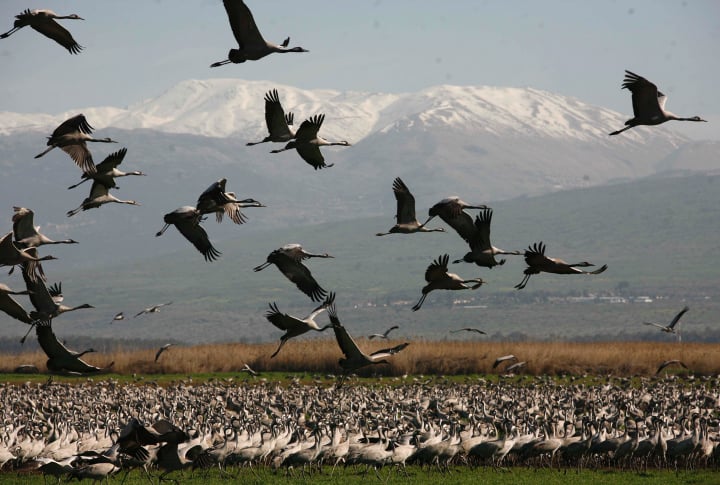
The high number of visitors to the Hula Lake are disturbing migrating birds and keeping them away, according to a report cited in Haaretz on Monday.
The report found that the birds – among them coots, mallards, ducks, thrushes, and cranes – are very sensitive to their surroundings and, in particular, to noise and disturbances. The research, sponsored by the Jewish National Fund, was conducted by Noga Collins-Kreiner of Haifa University, the Society for the Protection of Nature in Israel bird center, and Dan Malkinson, also of Haifa University.
Collins-Kreiner noted that during peak visitor hours, between 6 and 9 a.m. and in the afternoons, the birds preferred to stay away from observation spots and park pathways. When more than 20 visitors gathered at any spot the birds tended to maintain a distance of 40-80 meters, and for every 100 visitors in an area 65 birds would stray beyond visual range. In areas where foliage provided cover, the birds remained closer to the visitors.
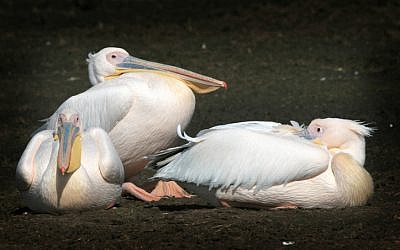
The marshlands in the Hula Valley were drained during the 1950s to prevent malaria, but 20 years ago the JNF flooded a section in the southern area of the valley to preserve the ecosystem, which was fragile and dying. The resulting Hula Lake Park attracts some of the hundreds of millions of migrating birds traveling between Europe, Africa, and Asia. Every year over 400,000 visitors come to view the birds that stop at the lake.
[mappress mapid=”177″]
The report noted that fewer birds could lead to fewer return visitors to the park. The researchers recommended enclosing observation points to minimize noise, and encouraging foliage to grow near the paths to provide better cover for the birds.









The Times of Israel Community.