

Grabbing more than just the headlines
Donald Trump again captures the attention of the Hebrew media with his latest vulgar comments sending some publications into a sensationalist tabloid frenzy
- See more Times of Israel on Google - add us as a Preferred Source
Raoul Wootliff is a former Times of Israel political correspondent and Daily Briefing podcast producer.
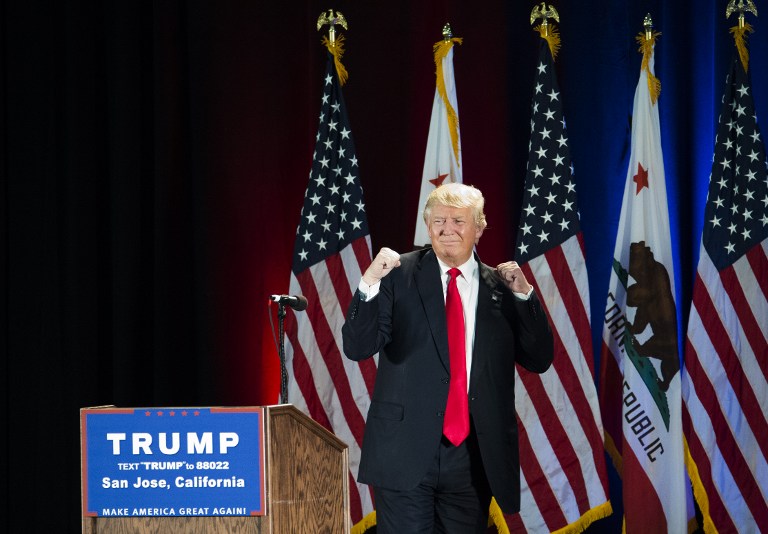
With exactly a month remaining until Americans cast their votes in perhaps the most extraordinary US election in living memory, Donald Trump is once again spread across the front pages of every major Hebrew daily Sunday with his vulgar comments, captured on tape over 10 years ago, suggesting he may have used his celebrity status to sexually assault women.
While Israel has had its share of scandals — sexual, political and a potent combination of the two — the incredible nature of the latest kerfuffle to shake the Republican candidate’s campaign for the White House seems to have pushed some of the Hebrew media to new levels of sensationalism.
Yedioth Ahronoth goes full tabloid braggadocio (to use a recent Trumpism), highlighting its front page spread with a garish fluorescent star with the words “Trump storm,” inside, the full quote complete with stars blocking out the filthy words used by the billionaire businessman and a screen shot from the video in which the outburst was captured showing Trump alongside actress and model Arianne Zucker. The visuals are completed with an insert of a cartoon by the paper’s Yotam Fishbein showing Trump apparently making a move on a disgusted-looking Statue of Liberty.
To complement this New York Post-esque mashup, a sidebar on the front page invites readers to delve deeper into the paper to find out why “50 Shades of Grey” star Dakota Johnson has “no problem being naked,” and whether “Botox or surgery” is the right choice or them.

Inside, the paper seems to make to make no bones about its position on the comments, leading its report with a declarative headline, “The recording that could…” in small blue letters, “…TAKE DOWN TRUMP,” in giant red font.
Yedioth’s US correspondent Orly Azulay describes the revelations as a potential game-changer that could lose Trump any last shred of support, even referring to his followers in the past tense.
“It is not good manners, respectful behavior or lofty oratory that spellbound the supporters of Donald Trump; in fact, they loved the way that he boorishly trampled on the transitional rules of politics,” Azulai writes. “But yesterday something changed: America has been left shocked at the brash and unprecedented words that were heard in the old recording that was uncovered — words that will yet become the key turning point in this election cycle.”
https://www.youtube.com/watch?v=t7PM9kwFwnc
Israel Hayom, owned by the Republican patron Sheldon Adelson and having already hinted at a strong liking for the Trump, takes a very different angle from Yedioth (and indeed from the vast majority of US publications) in leading with Trump’s apology-of-sorts rather than the comments themselves.
Trump declared in a Saturday video after the tapes were released, “I was wrong and I apologize.” Yet even as he did so, he claimed the astonishing recording was “nothing more than a distraction” and argued his words were not nearly as egregious as former president Bill Clinton’s marital affairs.
“Trump apologizes, America storms,” reads the front page headline of Israel Hayom, which accompanies a selective summary of the story: “[Trump] said in the recording: ‘When you are a star you can do what you want to women’ — and gave details.”
Foreign affairs editor Boaz Bismuth, who pens the paper’s main coverage of the incident, seems to downplay the effect on the election.
“One of the big stories in the 2016 US presidential race is the number of times Republican candidate Donald Trump has ‘earned’ political eulogies in the American media and yet has continued to run, despite remarks and observations that would ostensibly have wiped out any other candidate’s chances,” he writes, saying that Trump has survived because he is a unique candidate.
While Israel Hayom has not officially endorsed Trump for president, it has, on a number of occasions, run overtly pro-Trump features praising the Republican for his tough stance on Islamic fundamentalism in the same glowing language the paper has often used to describe another of Adelson’s beneficiaries, Prime Minister Benjamin Netanyahu.
In his analysis, Bismuth even adopts Trump’s own argument, saying that “there is a lot of hypocrisy in the story.”
“Trump was indeed taped saying crude things. But Clinton’s husband, then-president Bill Clinton, was caught with his pants down in the Oval Office,” Bismuth writes.
Haaretz’s US correspondent Chemi Shalev leads the paper’s coverage with both a news report on the comments and his own analysis, which differs somewhat from Bismuth’s.
Shalev says that the ramifications of the recording could be “profound and long-lasting, threatening Republican majorities in both the Senate and the House of Representatives in the short term, splitting the GOP apart and wreaking havoc on the Evangelical church in the long term as well.”
And in the only comment in the major papers linking the incident to Israel, Shalev says the revelations could even harm Netanyahu.
“The prospective implosion of the Republican Party completely decimates Prime Minister Benjamin Netanyahu’s GOP-centered American strategy. Though we have pointed out in the past that Netanyahu’s fortress GOP approach is being upended by Trump this did not take into account the devastating effect the New York tycoon’s candidacy might have on the party as a whole,” Shalev writes. “Given that Netanyahu firmly aligned Israel with the GOP and created deep dissatisfaction with Israel in the Democratic Party, especially after his March 2015 speech to Congress, on November 8 his decision to burn bridges with Democrats might emerge as the most shortsighted foreign policy ever undertaken by an Israeli leader.”







The Times of Israel Community.