

Israel Museum tells story of ‘Sapiens’ via archaeology and art
Artifacts, paintings and videos illustrate Hebrew University Prof. Yuval Noah Harari’s sweeping, bestselling ‘Brief History of Humankind’
 Add ToI as a Preferred Source on Google
Jessica Steinberg, The Times of Israel's culture and lifestyles editor, covers the Sabra scene from south to north and back to the center

When Yuval Noah Harari wrote “Sapiens: A Brief History of Humankind,” he intended it as a textbook for his Hebrew University history students and hoped it would be sold to other universities and schools. That was before it became a bestseller and was translated into 30 languages.
Now it is also the subject of one of the Israel Museum’s newest exhibits, “A Brief History of Humankind,” which melds Harari’s thoughts about civilization with archaeological objects from the museum’s enormous collection and contemporary art pieces borrowed from local and international artists.
It’s an ambitious project. The book, which runs 464 pages, is a sweeping history of human evolution. The exhibit, curated by Tania Coen-Uzzielli in honor of the Jerusalem museum’s 50th anniversary, offers a physical and artistic rendition of that history that attempts to explain an immense topic with authentic, thought-provoking visuals.
It took some time to figure out how to do that.
Coen-Uzzielli, an archaeologist by training who is head of curatorial affairs at the museum, first thought of the exhibit after reading “Sapiens.”

“I immediately thought of the museum and its collections, about its archaeological collection and its contemporary art,” said Coen-Uzzielli. “Contemporary art often expresses the contradictions and problems of human beings; It was a very broad concept.”
She consulted with Harari to make sure the Hebrew University history professor was on board with the plan. He liked the idea but warned her that he wasn’t a man of material culture and couldn’t help her with any concrete ideas.
“Because the exhibition is based on my book, it was important for me to make sure that their interpretations of history don’t contradict the book,” Harari told the Times of Israel in an email. “But other than that, they had a completely free rein. I am not an expert on art, and the exhibition is a dialogue between art and history.”
Harari said he didn’t want to constrain the exhibit’s dialogue by imposing his own views. He was, however, curious to see what new ideas and directions would come out of Coen-Uzzielli’s reading of the book.
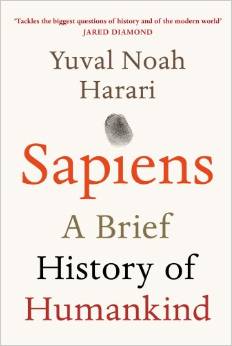
Harari’s book tells the story of human evolution through the three major revolutions, Cognitive, Agricultural and Industrial, and theorizes that while those revolutions have taken us toward eternal life, better living hasn’t necessarily made us more content.
In fact, Harari posits in his book that humans will change so much that Homo sapiens will probably cease to exist.
Coen-Uzzielli touches on that idea at the end, but focuses on 14 pivotal objects that illustrate the development of civilization until modern times. Drawing from the museum’s rich, varied holdings, she chose remains of the first use of fire, a bone that allows humans to speak, the earliest evidence of writing and numerals, the first coins, the invention of electricity and the manuscript of Albert Einstein’s Special Theory of Relativity.
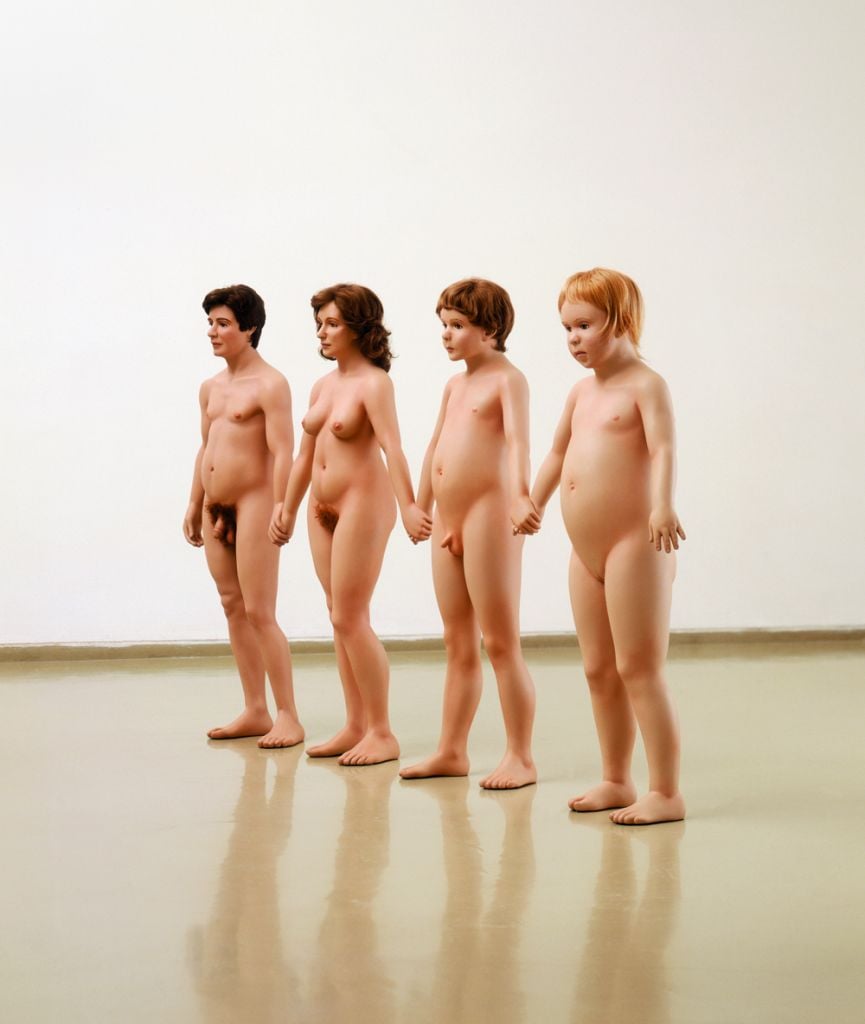
Coen-Uzzielli said she chose items that “are very iconic and emblematic, which present a crucial moment in the history of humankind. Those were the icons and the art was going to dialogue with it.”
She wanted viewers to look at the archaeological objects and learn from them, and then think about them further through the related works of art. Contemporary art, she commented, asks questions of the viewer and may offer alternate explanations of its subject.
According to Harari, choosing objects to illustrate a complex process makes sense in the context of a museum exhibit.

“I believe that scientists should communicate with the general public, especially in fields like history,” he wrote. “What’s the point of reaching profound insights, if hardly anyone is aware of them? In order to reach a large audience, however, it is often necessary to simplify at least some ideas and theories. In a museum exhibit, you sometimes need to convey a very complicated story through a single object. In a TV interview, you might have just one minute to answer a question such as ‘are people today happier than in the past?’ A single object in a museum or a single minute on TV is an incredible resource when it is watched by thousands of people. You can say a lot in one minute.”
Coen-Uzzielli took his point one step further.
“It’s about how we, the creators of the objects, cannot survive without them, and these objects are surviving us,” she said. “What is the relationship between nature and humanity?”
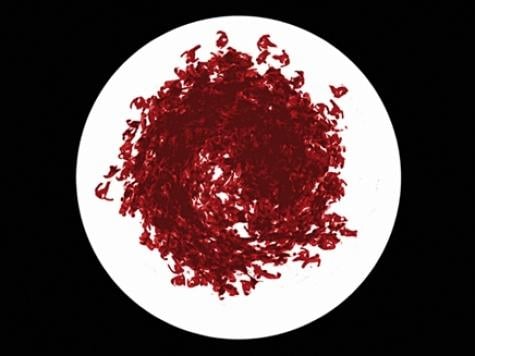
And so the exhibit, shown in one of the museum’s main exhibit halls, begins with Israeli artist Michal Rovner’s “Culture Plate,” a series of petri plates inlaid with moving figures, meant to represent the examination of human culture rather than the expected selection of microbes.
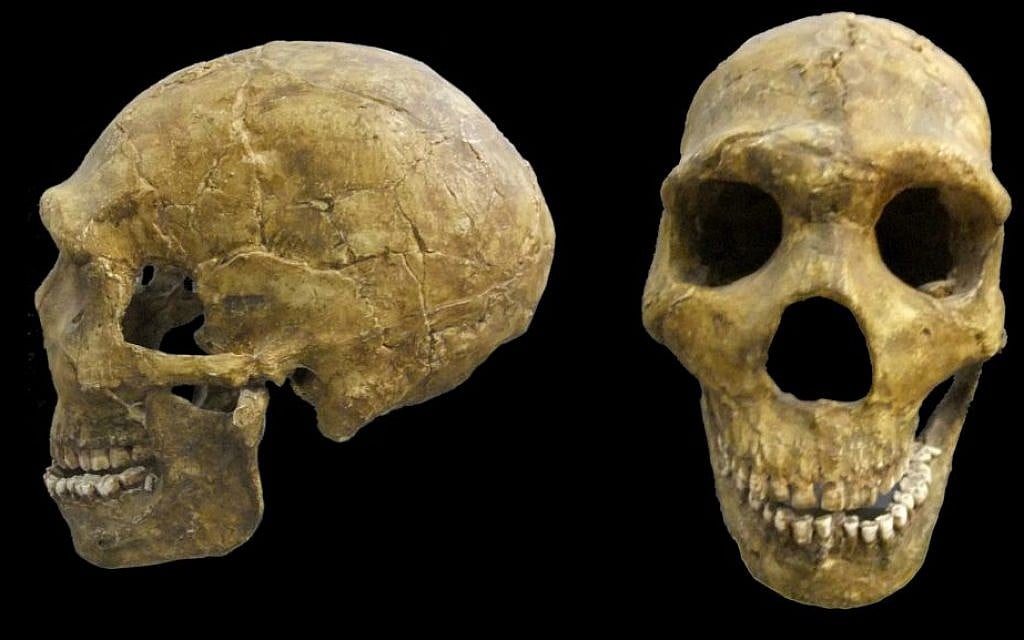
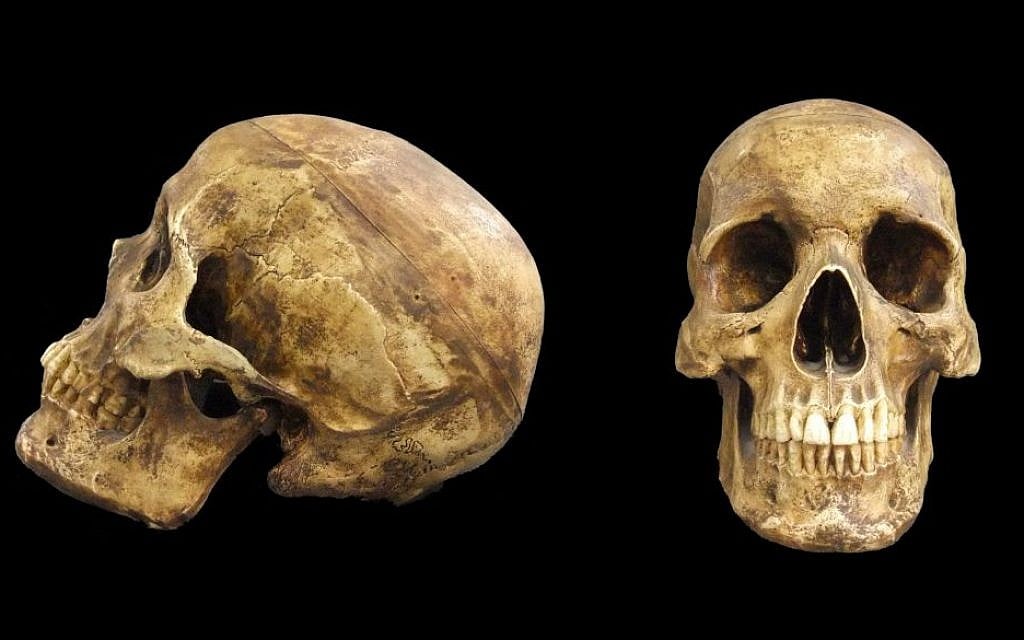
From there, the exhibit takes on the Cognitive Revolution and the evolution of the human brain as discussed by Harari, with the first appearance of humans and the first tools — two regular stones that were sophisticated in purpose though simple in appearance, said Coen-Uzzielli.
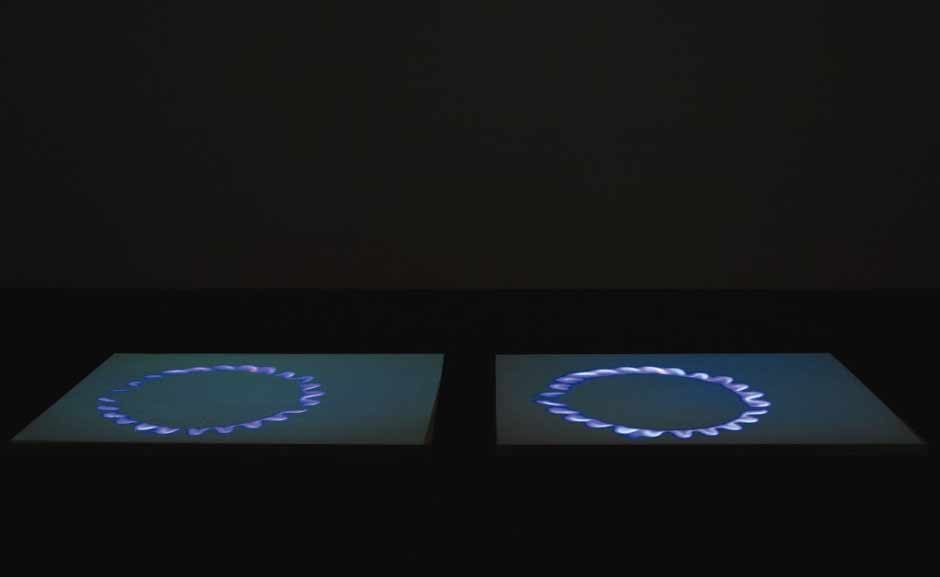
There’s a discussion of fire, the manipulation of nature to produce warmth and light, shown by remains of the first use of fire, and works of contemporary art like Miroslaw Balka’s “Blue Gas,” a video representation of gas burners.
Coen-Uzzielli placed quotes that Harari made about the exhibit on the walls of the various rooms, thereby including him in the conversation created by the works of art and archaeology.
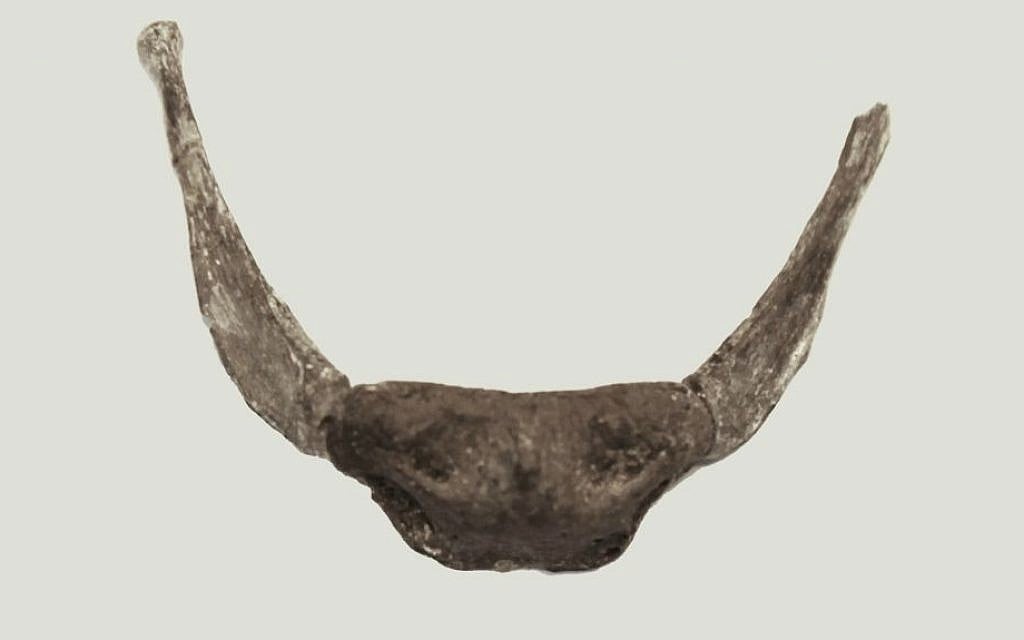
The Cognitive Revolution and the development of linguistics begin with the display of an ancient hyoid bone that is suspended in the human throat, allowing the tongue to move and articulate sounds and words.
“Probably the most important part of Yuval’s book is about gossip and reality and memory, how we build memory,” said Coen-Uzzielli. “How we speak about people, and have dreams and use Facebook. How we shape our identity in our image.”
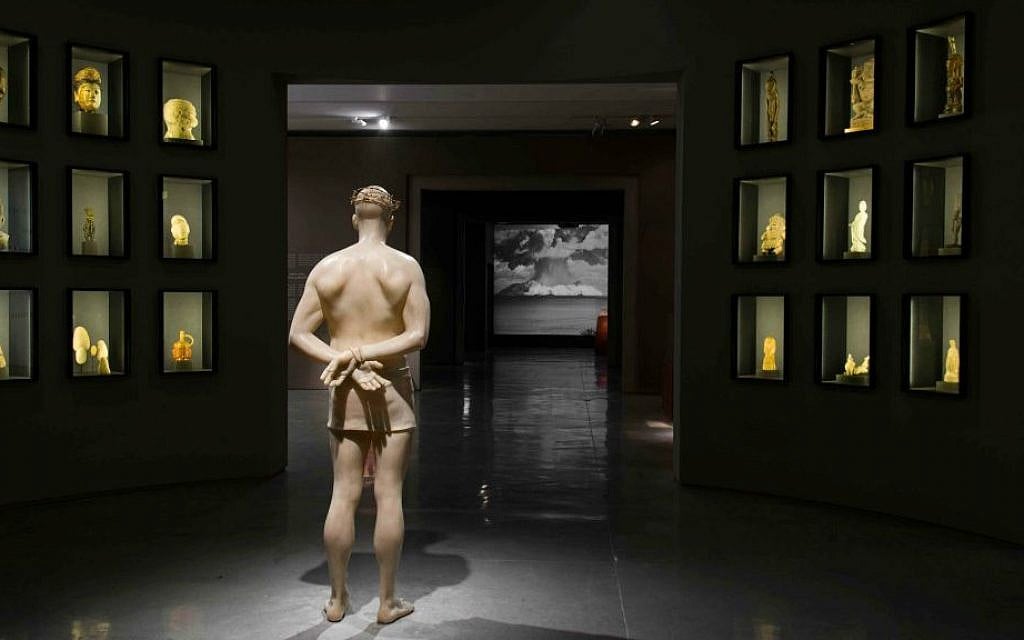
On the subject of religion, Coen-Uzzielli created a gallery of sculpted gods from the museum’s collection, surrounding a golden, modern depiction of Jesus as man, sculpted by Mark Wallinger.
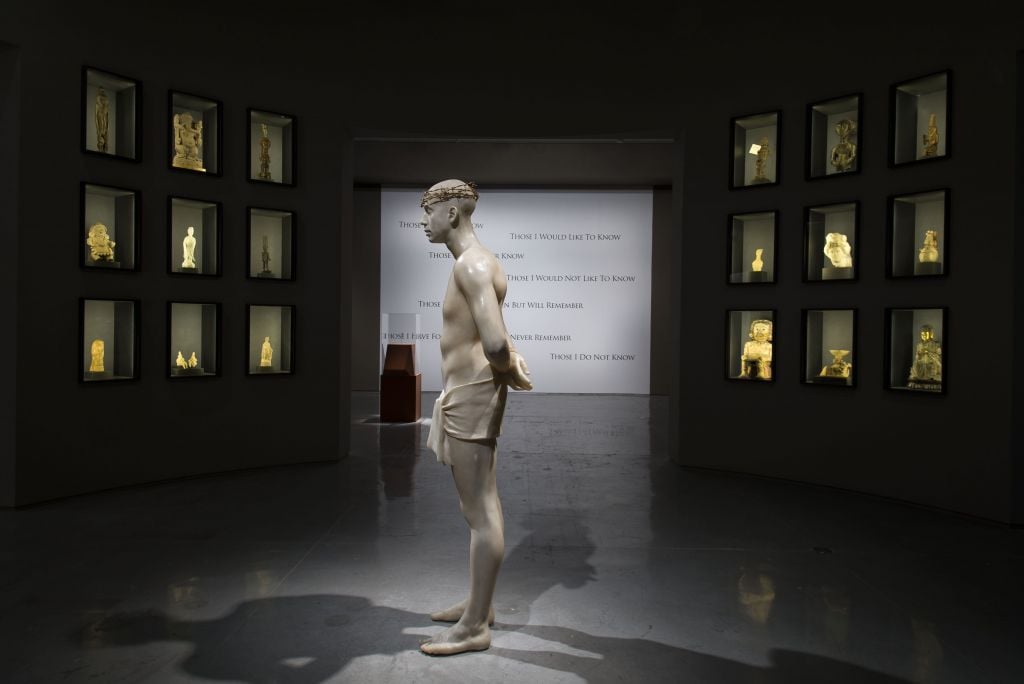
White marbleized resin, gold-painted barbed wire, life size (Courtesy Israel Museum)
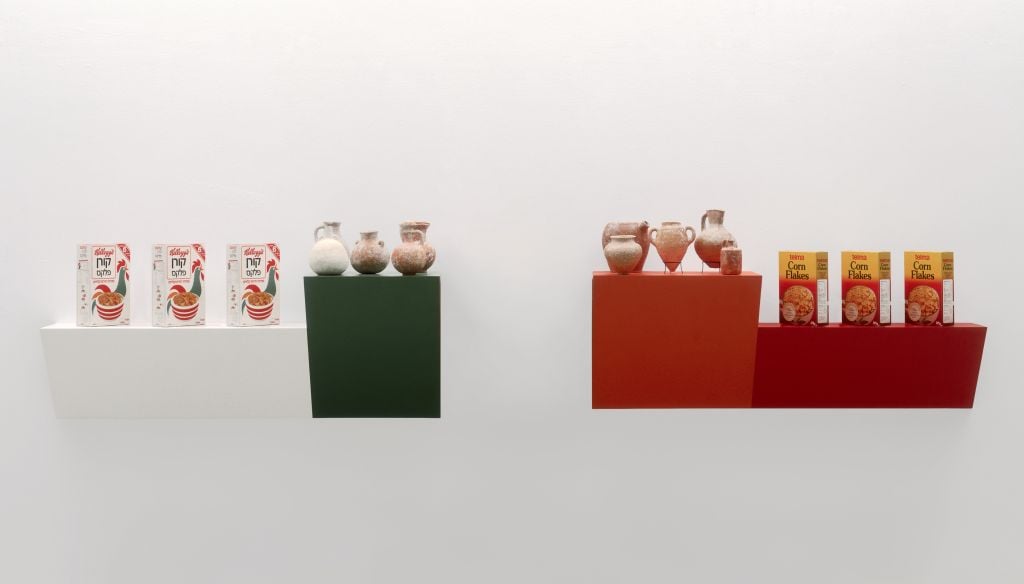
Once those initial stages of human evolution are complete, the exhibit moves into the later human revolutions. To depict the Agricultural Revolution, a 9,000-year-old sickle symbolizes how farming was a major turning point in human evolution, next to Haim Steinbach’s “Stay with Friends (Kelloggs and Telma)” to show society’s move to food products.
The objects echo Harari’s thoughts about the Agricultural Revolution and how civilization’s move into farming has forced humans to produce and eat more than necessary, said Coen-Uzzielli.
“We’re storing a lot and working, conquering the land, and that stratifies society,” she explained.
The exhibit then moves through the next stages of human evolution, the building of homes, the establishment of money and credit, and then into the Industrial Revolution and how the invention of the steam engine completely changed the concept of time and space.
There’s the clever “Running Against Time” by industrial designer Mark Formanek, one of many video installations that are part of the exhibit (Harari’s personal favorite is a videoclip telling the fictional story of a Neanderthal living in modern Israel, relating to his discussion of the relations between members of our species – Homo sapiens – and Neanderthals, and what would have happened if that species had survived, creating another layer of coexistence).
Later on, toward the end of the exhibit, there’s the more sobering “Crossroads,” a 1976 work by Bruce Conner, about an underwater nuclear test carried out in 1946 at Bikini Atoll in the Pacific Ocean.
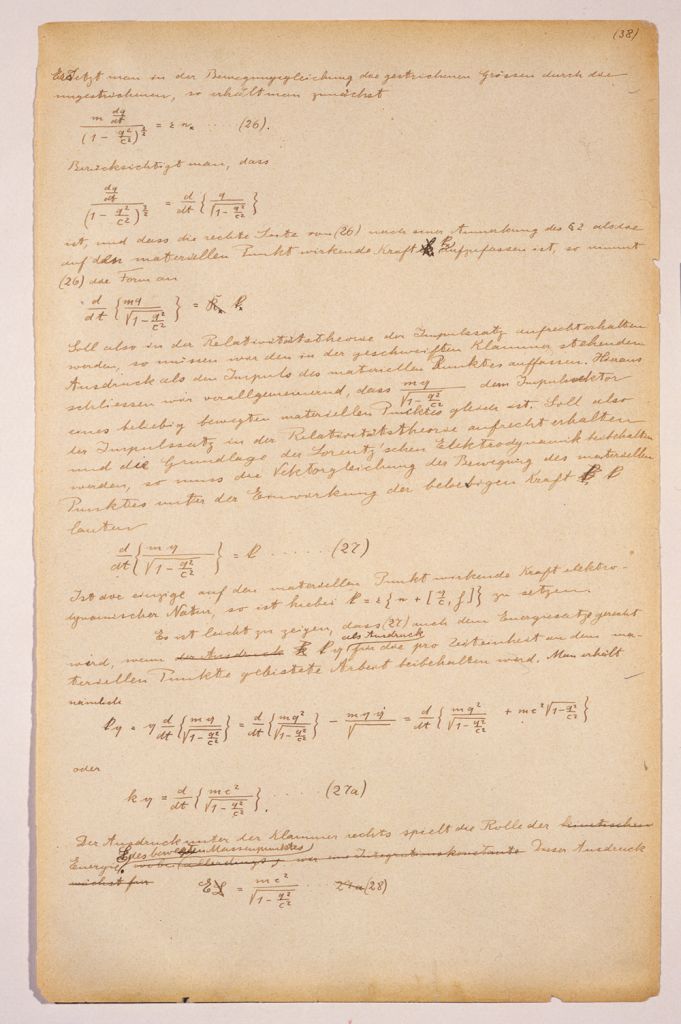
And finally, the exhibit ends with Albert Einstein’s scribbled pages on the Theory of Relativity, from the museum’s own collection — another comment on Israel and its place in the ongoing science and technology revolution.
“It’s a very legible exhibition,” said Coen-Uzzielli. “It’s very literal. You don’t need to read the book to understand it, and it’s not too conceptual, either.”
There are regularly scheduled talks and tours of the exhibit, in Hebrew and English, in order to help viewers understand and process the concepts introduced in the exhibit. And Harari offers (besides his book) free, online courses. The exhibit is open through January 2, 2016.










The Times of Israel Community.