Emirati official said to confirm Netanyahu approved US sale of F-35s to UAE
But PM reportedly tells security cabinet that he’ll oppose any American decision to sell stealth fighters to Abu Dhabi, will lobby Congress to oppose it
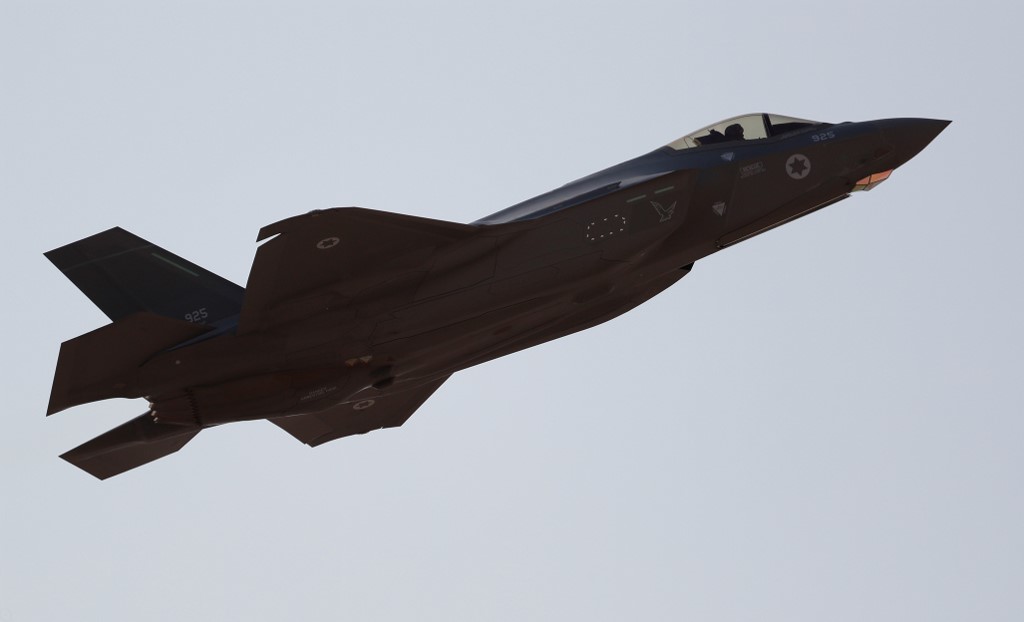
An Israeli F-35 fighter jet takes off during the "Blue Flag" multinational aerial exercise at the Ovda air force base, north of the Israeli city of Eilat, on November 11, 2019. (Emmanuel Dunand/AFP)
The Times of Israel liveblogged Tuesday’s events as they happened.
LEIDSCHENDAM, Netherlands — The presiding judge at a UN-backed tribunal in the Netherlands begins delivering verdicts in the trial in absentia of four members of the Hezbollah terror group accused of involvement in the truck bomb assassination of former Lebanese prime minister Rafik Hariri, saying the evidence against them was “almost entirely circumstantial.”
The verdicts were delayed by nearly two weeks as a mark of respect for victims of another devastating explosion — the detonation of nearly 3,000 tons of ammonium nitrate stored at Beirut’s port. The August 4 blast killed around 180 people, injured more than 6,000, left a quarter of a million with homes unfit to live in and plunged a nation already reeling from economic and social malaise even deeper into crisis.
Presiding Judge David Re calls for a minute’s silence to start the hearing to honor victims of the blast and their families as well as those made homeless by the port blast.
He says the written judgment in the long-running trial amounted to more than 2,600 pages with some 13,000 footnotes.
Sketching the complex political backdrop for the assassination, Re says that in the months before his death, Hariri was a supporter of reducing the influence of Syria and Hezbollah in Syria.
Judges were “of the view that Syria and Hezbollah may have had motives to eliminate Mr. Hariri, and some of his political allies,” Re says. But he adds that “there was no evidence” that the Hezbollah leadership or Syria was involved in the truck bombing.
Guilty verdicts could compound tensions in the tiny country. Hariri was Lebanon’s most prominent Sunni politician at the time of his February 14, 2005, assassination, while the Iran-backed Hezbollah is a Shiite Muslim terror group.
The trial centered on the alleged roles of four Hezbollah members in the suicide truck bombing that killed Hariri and 21 others and wounded 226 people. Prosecutors based their case largely on data from mobile phones allegedly used by the plotters to plan and execute the bombing.
Defense Minister Benny Gantz warns that the proliferation of the F-35 fighter jet was “not good for Israel,” following reports that the United States would sell the advanced aircraft to the United Arab Emirates.
“It’s not good for Israel that the plane is going around in other places. We need to talk to the Emiratis, to the Americans, and make sure that our security interests are being upheld,” Gantz tells reporters in a press conference.
Gantz criticizes the fact that he’d been kept in the dark about the normalization agreement until it was announced last Thursday. Prime Minister Benjamin Netanyahu told the Israel Hayom newspaper that Gantz and Foreign Minister Gabi Ashkenazi were not informed of the deal in order to prevent them from leaking the information.
“The prime minister informed me of this after the decision was made, so that from the start I couldn’t have known about things that are happening,” Gantz says.
“I believe that it was improper that we weren’t updated. I know that I’ve never in my life leaked anything. When I want to give a briefing, I call you [journalists]. Leaks are other people’s games,” he says.
BERLIN — German authorities arrest a Syrian national on suspicion he was a member of two militant groups that fought against the government of Syrian President Bashar Assad during the early stages of the conflict in Syria.
The suspect, named only as Khaled A. for privacy reasons, was arrested in the city of Potsdam, just southwest of Berlin, on allegations of membership in a terrorist organization, war crimes and weapons violations, prosecutors say in a statement.
A. is suspected of having been a member of Ahrar al-Tabqa from January to August 2013, documenting the eviction of civilians to house fellow militants. The group — one of many rebel groups that emerged during the Syria conflict — was based in the northern town of Tabqa.
He is accused of later joining the larger Ahrar al-Sham and acting as one of their spokespeople until at least October 2013.
Both groups sought to overthrow the Syrian government and replace it with an Islamist system. They are deemed foreign terrorist organizations by Germany.
Prosecutors don’t state whether the suspect was among hundreds of thousands of Syrians who sought asylum in Germany from 2015 onward.
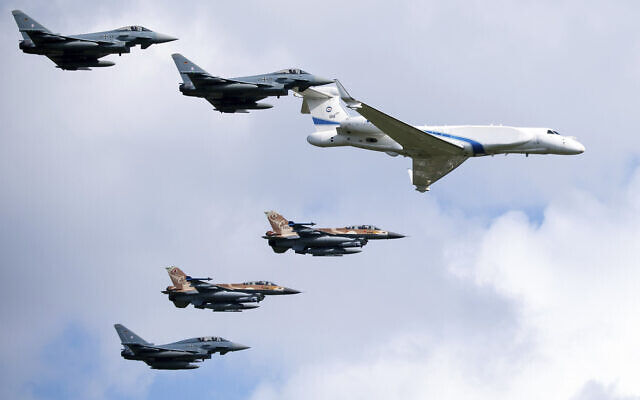
BERLIN — German and Israeli Air Force jets fly over the former Nazi concentration camp Dachau in tribute to the Jews and others killed there in the Holocaust.
Two Israeli F-16s and two German Eurofighters escort an Israeli Air Force Gulfstream G-550 carrying the commanders of both air forces over the camp memorial outside Munich, while a third Eurofighter films the formation from the sky.
They also fly over the nearby Fuerstenfeldbruck airfield to pay tribute to the 11 Israeli athletes killed during the Munich massacre attack during the 1972 Summer Olympics.
Two athletes were killed and another nine taken hostage by the Palestinian group Black September from the Olympic Village on September 5, 1972. During a botched rescue attempt at the airfield by German police, the other athletes, along with five of their captors and a West German police officer, were killed.
The Israeli aircraft are part of a group of six F-16s, two Gulfstreams and two Boeing 707 tanker jets that arrived in Germany yesterday for two weeks of exercises.
Operating out of a German air base in the western state of North Rhine-Westphalia, they will be conducting exercises with the German air force for the first week, and additional planes from the Hungarian air force in the second week.
It is the first time ever that the Israeli Air Force has participated in such exercises in Germany. A total of around 180 Israeli personnel are involved.
— AP
German air force Bundeswehr Eurofighters and an Israeli Air Force jets fly in formation over the Fuerstenfeldbruck airbase in commemoration of the 1972 Olympic Games assassination attempt in Fuerstenfeldbruck, Germany, August 18, 2020. (Sven Hoppe/dpa via AP)
The head of the Defense Ministry’s Institute for Biological Research says the Ness Ziona-based laboratory’s aim is to produce an effective vaccine against the coronavirus, not to be the first to develop one.
“I think our goal is not to be first, but to bring a good vaccine for the citizens of the State of Israel,” Shmuel Shapira tells the Knesset Science and Technology Committee, according to the Ynet news site.
The institute announced earlier this month that it would begin human trials in mid-October for the COVID-19 vaccine it is developing.
“We hope the second phase will finish toward the end of the year,” Shapira says. “The third phase is much more complicated and takes time.”
Coronavirus cases among Palestinians have reached a new daily high of 612 infections, the Palestinian Authority health ministry says.
East Jerusalem, which is rapidly becoming a new center of the coronavirus outbreak among Palestinians, recorded 312 new cases, according to the PA Health Ministry, though there are concerns there may be vast underreporting of infections.
Due to inadequate testing, last week saw 41 percent of tests conducted in East Jerusalem come back positive, according to reports in the Hebrew media. The Jerusalem municipality has sought to increase testing by opening a new station in the East Jerusalem neighborhood of Sheikh Jarrah run by the IDF Home Front Command.
Another 140 new cases are recorded in the Hebron governorate, which still has the highest number of active cases in the West Bank.
Most concerning is the geographical spread of new coronavirus cases. Previous stages of the second wave in the West Bank saw the vast majority of cases centered in the Hebron governorate, with most other areas registering only single-digit daily increases.
Over the past week, however, other governorates have begun to report dozens of daily cases. Today, the Nablus governorate registers 57 and the Bethlehem governorate 45, while Ramallah and the Al-Bireh governorate record 40.
Israel and Ukraine call on Israelis not to travel to Uman next month for the annual Rosh Hashanah pilgrimage to the grave site of Hasidic Rebbe Nahman of Bratslav due to the ongoing coronavirus pandemic.
“The epidemiological situation in Ukraine and Israel, like in the rest of the world, unfortunately doesn’t allow us to mark the holiday as usual this year,” the countries say in a joint statement released by the Prime Minister’s Office.
The statement adds: “We implore pilgrims planning to take part in the Rosh Hashanah festivities this year to avoid visiting Uman because of the threatening epidemiological situation.”
Jerusalem and Kiev stress to any Israelis who do visit that social distancing guidelines will be enforced at any public gatherings.
“We hope for understanding and believe that next year we’ll be able to celebrate Rosh Hashanah, like other holidays, together and without any restrictions whatsoever,” the statement says.
The Gaza Strip’s only power plant has ceased functioning as of 10 a.m. this morning, the Gaza Energy Authority announces.
The plant runs on diesel fuel, which Israel has banned from entering the Strip through the Kerem Shalom commercial crossing due to the hundreds of balloon-borne incendiary devices and several rockets launched recently by Gaza-based groups into Israeli territory.
Israel has gradually tightened restrictions on Gaza in an attempt to pressure Hamas, the Islamist terror organization that controls the coastal enclave, to crack down on the balloon-launchers.
Gazans subsist on meager rations of electricity, often around 12 hours a day. Without a functioning power plant, daily electricity supply could plunge as low as three or four hours.
According to Ashraf al-Qidra, a spokesperson for the Hamas-run health ministry, the lack of power could have serious repercussions for premature babies in nurseries, intensive care patients and those needing dialysis or emergency surgery.
LEIDSCHENDAM, Netherlands — There is enough evidence to link two members of the Hezbollah terror group to cellphones allegedly involved in the 2005 murder of former Lebanese prime minister Rafik Hariri, international judges say as they read out verdicts at a UN-backed court.
The judges at the Special Tribunal for Lebanon, however, say there is insufficient proof to tie two other suspects to the network of mobiles that prosecutors say were used to plot the huge Beirut suicide bombing that killed Sunni billionaire Hariri.
Judges also say there is no evidence to directly link Syria — the former military overlord in Lebanon — or Hezbollah’s leadership to the attack.
The final verdicts will be handed down later today at the court just outside The Hague in the Netherlands, where the four alleged Hezbollah members are on trial in absentia.
LONDON — The World Health Organization says the global population has nowhere near the level of coronavirus immunity needed to induce herd immunity, where enough people would have antibodies to stop the spread.
Herd immunity is typically achieved with vaccination and most scientists estimate at least 70 percent of the population must have antibodies to prevent an outbreak. But some experts have suggested that even if half the population had immunity, there might be a protective effect.
WHO’s emergencies chief Dr. Michael Ryan largely dismisses that theory at a press briefing today, saying we should not live “in hope” of achieving herd immunity.
“As a global population, we are nowhere close to the levels of immunity required to stop this disease transmitting,” he says. “This is not a solution and not a solution we should be looking to.”
Most studies conducted to date have suggested only about 10% to 20% of people have antibodies.
Dr. Bruce Aylward, a senior adviser to WHO’s director-general, adds that any mass immunization campaign with a COVID-19 vaccine would aim to cover far more than 50% of the world’s population.
“We don’t want to be wrong,” he says. “You want to plan to get high coverage and not get lulled into a dangerously seductive suggestion that [the herd immunity threshold] could be low.”
Balloon-borne incendiary devices launched from the Gaza Strip have sparked 18 fires in southern Israel since the morning, according to the Kan public broadcaster.
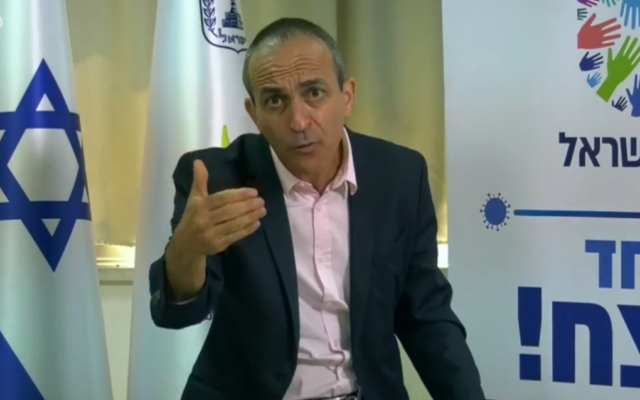
Coronavirus czar Ronni Gamzu says he opposes lockdown measures that could harm the economy in order to combat the coronavirus pandemic, but signals he’ll recommend imposing further restrictions if morbidity rates are high ahead of the High Holidays next month.
“We all thoroughly understand the difficulty associated with going out, movement and family meals,” Gamzu says during a briefing, according to the Ynet news site. “At the moment its too early to talk about the specifics of the restrictions but I may recommend more significant restrictions on gathering and movement.”
Coronavirus czar Ronni Gamzu speaks during a briefing on August 18, 2020. (Screen capture: Facebook)
CONCORD, New Hampshire — Amer Fakhoury, an American who was jailed for months in Lebanon and later released over decades-old murder and torture charges that he denied, has died, his family says. He was 57.
Fakhoury, a restaurant owner in Dover, New Hampshire, died at the Dana-Farber Cancer Institute in Boston. He had been diagnosed with Stage 4 lymphoma while in prison.
He had been visiting family in Lebanon in September when he was detained. Lebanese officials accused him of torturing prisoners in the 1990s at a prison run by the Israeli-backed South Lebanon Army.
Amer Fakhoury holds his granddaughter, Kira, in King of Prussia, Pennsylvania, June 2016. (Guila Fakhoury via AP, File)
Fakhoury’s family and lawyer said he worked at the former Khiam Prison, but had no direct contact with inmates and was never involved in any interrogation or torture. They said he was illegally detained.
In March, a judge dismissed the charges after US officials worked to free him. The US officials felt Fakhoury’s detention in September was instigated by the Hezbollah terror organization, which the South Lebanon Army had opposed in the conflict.
In a statement, Fakhoury’s family says he was tortured “under the hands of Hezbollah.”
“God loved Amer Fakhoury so much that he took him out of the hands of these terrorists and brought him to his family in America to live out his last days,” they say.
Fakhoury became a US citizen last year. His lawyer and family said he fled Lebanon in 2001 through Israel, eventually making his way to the United States, because of death threats he and many other SLA members received after Israel ended its 18-year occupation of southern Lebanon in 2000.
Bank of Israel Governor Amir Yaron issues revised growth forecasts for 2020, warning a worsening of the coronavirus pandemic or significant new restrictions will lead to an even deeper contraction.
Yaron predicts that if the outbreak doesn’t get dramatically worse and there aren’t significant new restrictions, GDP will shrink by 4.5 percent on the year.
If both of those happen, however, and a lockdown is imposed during the fourth quarter, the central bank chief forecasts a 7% contraction in GDP during 2020.
The Keren Kayemet LeIsrael-Jewish National Fund is to invest hundreds of thousands of shekels in the coming month to create relaxation and well-being corners in 24 hospitals.
The idea came from coronavirus czar Prof. Ronni Gamzu and Soroka Hospital in the southern city of Beersheba.
The hospitals on the list include Shaare Zedek and Hadassah Ein Karem in Jerusalem, Kaplan in Rehovot, Sheba Medical Center at Tel Hashomer, Ichilov and Asuta in Tel Aviv, Beilinson in Petah Tikva, Hillel Jaffe in Hadera, Laniado in Netanya, Ziv in Safed, Puria in the Galilee, Soroka in Beersheba and Barzilai in Ashkelon.
Tahnoun bin Zayed, the national security adviser of the United Arab Emirates, met today with Mossad chief Yossi Cohen, says WAM, the official Emirati state news agency.
“His Highness praised the efforts made by Mr. Yossi Cohen, which contributed to the success of the peace treaty between the UAE and Israel,” the agency’s statement says.
According to the statement, the two discussed collaboration to fight the novel coronavirus, as well as “opening new horizons of cooperation between the two countries in various fields.”
LEIDSCHENDAM, Netherlands — A UN-backed tribunal convicts one member of the Hezbollah terror group and acquits three others of involvement in the 2005 assassination of former Lebanese prime minister Rafik Hariri.
The Special Tribunal for Lebanon says Salim Ayyash was guilty as a co-conspirator of five charges linked to his involvement in the suicide truck bombing. Hariri and 21 others were killed and 226 were wounded in a huge blast outside a seaside hotel in Beirut on February 14, 2005.
“The trial chamber finds Mr. Ayyash guilty beyond reasonable doubt as a co-perpetrator of the assassination of Rafic Hariri,” says David Re, the presiding judge of the tribunal.
However after a years-long investigation and trial, three other Hezbollah members are acquitted of all charges that they also were involved in the murder of Hariri that sent shock waves through the Middle East.
President Reuven Rivlin visits the Gaza border area amid rising tensions between Israel and the Hamas-ruled enclave, warning the terror group to be careful what it wishes for.
Among the president’s stops are the Erez border crossing and sites where fires were sparked by balloon-borne incendiary devices launched from the Gaza Strip.
“Terrorism using incendiary kites and balloons is terrorism just like any other,” Rivlin is quoted saying in a statement from his office. “We have nothing against the people living in Gaza. On the contrary, we want them to be able to live in peace and quiet and raise their children. But they are being held by Hamas, which also thinks it has us in its control.”
He adds: “Hamas should know that this is not a game. The time will come when they have to decide, and if they want war — they will get war.”
The Israel Nature and Parks Authority is undertaking restoration and development at the Shivta National Park in the Negev Desert, close to the border with Egypt.
Shivta forms part of the UNESCO-recognized Incense Route and Desert Cities of the Negev, along with Haluza, Avdat and Mamshit.
A central aim of the upgrade will be to explain how Shivta’s residents managed to survive in the harsh desert and harness water over 2,000 years ago.
During the first phase, preservation work will be carried out on an ancient residential building to tell the story of the city’s unique architecture, and on a water pool in the main square to illustrate the water motif.
The Colt delegation house – a stone building to the south of the parking lot, built by archeologists from New York University and Jerusalem’s British School of Archaeology between 1934 and 1936, will be turned into an entrance facility for the site.
After that, work will be carried out on the two magnificent Byzantine-era churches, the northern square and other features, including the campsite. The interpretation will be upgraded to give visitors a better grasp of life in what has been called the “Pompei of the Holy Land.”
Shivta was founded around the 1st century BCE and was home to a mixed population of Romans and Nabateans. It was abandoned, evidently without a fight, after the Muslim conquest and is relatively well preserved.
An unnamed White House official tells Hebrew media the pending normalization agreement between Israel and the United Arab Emirates doesn’t include a secret clause on weapons sales to Abu Dhabi.
“What is in the agreement is what was in the joint statement,” the official is quoted saying by Channel 12 news, referring to last week’s announcement on the Israel-UAE deal to establish diplomatic ties.
The comment comes after a report that as part of the deal, Israel gave the US the green light to sell F-35 stealth fighters to the UAE. Prime Minister Netanyahu has denied the sale of the planes was part of the agreement.
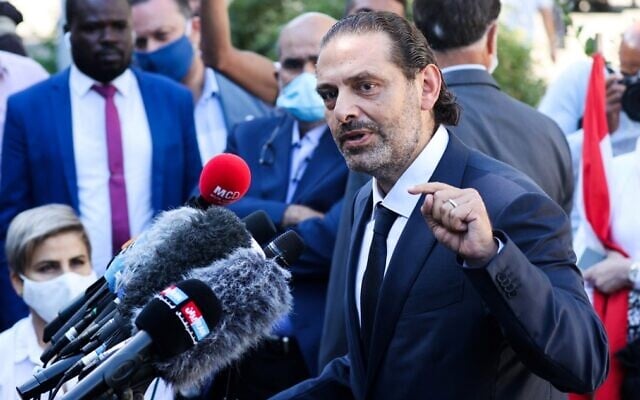
LEIDSCHENDAM, Netherlands — Lebanon’s Saad Hariri says he accepted a special tribunal’s verdict today over the 2005 murder of his father, former prime minister Rafik Hariri.
“The court has ruled, and in the name of the family of the late prime minister Rafik Hariri and on behalf of the families of the martyrs and victims, we accept the court’s ruling,” he says outside the court.
— AFP
Former Lebanese prime minister Saad Hariri leaves the UN-backed Special Tribunal for Lebanon at Leidschendam, Netherlands, on August 18, 2020. (Kenzo Tribouillard/AFP)
Sudan foreign ministry spokesperson Haidar Badawi Sadiq tells Sky News Arabia that Sudan “aspires towards a peace agreement with Israel… a relationship of equals built upon Khartoum’s interests.”
“There’s no reason for the enmity to continue,” Sadiq says, adding “we do not deny the communication between the two countries.”
He also says “both Sudan and Israel will benefit from such an agreement if it is signed, at the end of this year or the beginning of next year,” dovetailing with Intelligence Minister Eli Cohen’s declaration that there could be an agreement between Jerusalem and Khartoum by the end of the year.
Speculation about warming ties between the two countries has been building since Prime Minister Benjamin Netanyahu met earlier this year in Uganda with the leader of the Sudanese transitional government, Gen. Abdel Fatah al-Burhan.
WASHINGTON — The Senate intelligence committee concludes that the Kremlin launched an aggressive effort to meddle in the 2016 US presidential contest on behalf of Donald Trump, as the Republican-led panel releases its fifth and final report in its investigation into election interference.
The Senate panel describes its report, totaling more than 1,300 pages, as “the most comprehensive description to date of Russia’s activities and the threat they posed.” The bipartisan investigation lasted almost three and a half years, much longer than the other probes.
The report purposely doesn’t come to a final conclusion, as the other reports did, about whether there is enough evidence that Trump’s campaign coordinated or colluded with Russia to sway the election to him and away from Democrat Hillary Clinton, leaving its findings open to partisan interpretation.
A group of Republicans on the panel submitted “additional views” to the report saying that it should state more explicitly that Trump’s campaign did not coordinate with Russia. But Democrats on the panel submitted their own views, arguing that the report clearly shows such cooperation.
Former special counsel Robert Mueller concluded in a report issued last year that Russia interfered in the election through hacking and a covert social media campaign and that the Trump campaign embraced the help and expected to benefit from it. But Mueller did not charge any Trump associates with conspiring with Russians.
The Senate investigation also delves into areas of great interest to Trump that were not explored by Mueller. Those include the FBI’s reliance on a dossier of opposition research compiled by a former British spy whose work was financed by Democrats.
Sen. Marco Rubio of Florida, the committee’s acting chairman, says in a statement that the committee was troubled that the FBI had been willing to use the dossier “without verifying its methodology or sourcing” as it applied for secret surveillance warrants against a former Trump campaign adviser.
Foreign Ministry spokesman Lior Haiat welcomes his Sudanese counterpart’s comments that Sudan hopes for a normalization agreement with Israel.
“Israel views positively any step that leads to a process of normalization and peace agreements with regional states,” Haiat says in a statement quoted by Hebrew media.
Prime Minister Netanyahu weighs in on remarks by the spokesman for Sudan’s foreign ministry that Khartoum hopes to reach an agreement with Israel to normalize ties.
“Israel, Sudan and the entire region will benefit from a peace agreement and together can build a better future for all peoples of the region. We’ll do everything needed to turn this vision into a reality,” Netanyahu says in a statement.
Senior PLO official Hanan Ashrawi laments the comments by a spokesman for the Sudanese foreign ministry that Sudan hopes for a normalization agreement with Israel.
“Where is the living revolutionary people of Sudan?” Ashrawi writes on Twitter.
Foreign Minister Gabi Ashkenazi says the comments by a spokesman for Sudan’s foreign ministry that it hopes for normalization with Israel underline “the fundamental change now taking place in the Middle East,” days after the Jewish state and the United Arab Emirates announced an agreement to establish formal ties.
Ashkenazi notes the Sudanese capital Khartoum was the site of a 1967 Arab League meeting at which the “Three Nos” were declared: No peace with Israel, no recognition of Israel and no negotiations with Israel.
“Israeli diplomatic activity led by the Foreign Ministry is creating additional important opportunities like the relationship between Israel and Sudan,” Ashkenazi tweets. “In the near future, we’ll continue to discuss improving ties until the signing of a peace agreement that respects the interests of both sides.”
BEIRUT — Lebanese authorities announce a new lockdown and an overnight curfew to rein in a spike in coronavirus infections.
The new measures will come into effect on Friday and last just over two weeks, the interior ministry says, adding that they won’t affect the clean-up and aid effort following the devastating August 4 Beirut port blast.
The Health Ministry announces seven more deaths from COVID-19 since the morning, raising the national toll to 705.
Ministry figures show 1,064 new cases have been confirmed so far today, bringing the number of infections since the start of the pandemic to 96,093.
Of the 23,417 active cases, 404 people are in serious condition, with 117 on ventilators. Another 164 are in moderate condition and the rest have mild or no symtpoms.
There were 26,038 tests performed yesterday, according to the ministry.
Prime Minister Netanyahu speaks with local leaders in the Gaza border area amid rising tensions between Israel and the Hamas-ruled enclave.
In a statement from his office, Netanyahu is quoted claiming the government has adopted a policy to respond to blazes sparked by balloon-borne incendiary devices in the same way it treats rocket fire from the Gaza Strip.
“Unfortunately, we’re preparing — if necessary — for the possibility of a round or rounds [of fighting]. I hope we don’t get to that,” he says.
He also warns Hamas it’ll be a “very big mistake” on its part if arson attacks from the Strip continue.
The Foreign Ministry reacts to a UN-backed tribunal’s conviction today of a Hezbollah member for involvement in the assassination of former Lebanese prime minister Rafik Hariri.
The Special Tribunal for Lebanon acquitted three members of the Iran-backed terror group and said there was no evidence Hezbollah leaders or Syria were involved in the 2005 suicide truck bombing that killed Hariri and 21 others.
“The Hezbollah terror organization and its people were involved in murder and obstruction of justice,” a ministry statement says. “Hezbollah took the future of the Lebanese people captive in the service of foreign interests. Countries of the world need to act against this terror organization to help Lebanon be freed from this threat.”
The statement adds: “The arming of the organization, its efforts to set up an arsenal of precision missiles and its operations endanger the entire region.”
An unnamed Emirati official is quoted by the Ynet news site as saying that Prime Minister Netanahu gave the green light for the US to sell F-35 stealth fighters to the United Arab Emirates as part of the Israel-UAE deal to normalize ties, despite the premier’s adamant denials that the agreement included any understandings on weapons sales.
In a separate report, the Walla news site says Netanyahu told a meeting of the security cabinet today that he’d oppose any US sale of F-35s to the UAE and would lobby Congress to oppose it.
TEHRAN, Iran — Iran denies reports it paid Taliban fighters to target US forces and allies in Afghanistan.
In a statement carried by Iranian media, Foreign Ministry spokesman Saeed Khatibzadeh calls the claims “entirely false” and says the US tries to hide its “miscalculations” in Afghanistan by resorting to propaganda.
Yesterday, media reports said US intelligence agencies assessed that Iran offered bounties to Taliban fighters for targeting American and coalition troops in Afghanistan.
Iran sees the US forces’ presence in neighboring Afghanistan and Iraq as a threat on its doorstep and routinely calls for their departure.
Incoming rocket sirens sound in the Israeli city of Ashkelon, north of the Gaza Strip, and in the nearby community of Zikim, sending residents to bomb shelters.
The military says it is investigating what triggered the alarm.
RIYADH, Saudi Arabia — Saudi Arabia calls for Hezbollah to be “punished” after a UN-backed tribunal found a member of the terror group guilty over the 2005 murder of Lebanese ex-prime minister Rafic Hariri.
“The government of Saudi Arabia views the ruling as the emergence of truth and the beginning of a process of achieving justice by chasing, arresting and punishing those involved,” the kingdom’s foreign ministry says on Twitter.
“Saudi Arabia, by calling for Hezbollah and its terrorist elements to face justice and be punished, stresses the need to protect Lebanon, the region and the world from the terrorist practices of this group,” it adds.
Hezbollah is a key ally of Syria and Shiite powerhouse Iran, Saudi Arabia’s main regional rival.
Salim Ayyash, 56, was convicted in absentia in the Netherlands, over the huge suicide bombing in Beirut that killed Sunni billionaire Hariri and 21 other people.
But the judges said there was not enough evidence to convict three other suspects — Assad Sabra, Hussein Oneissi and Hassan Habib Merhi.
The court also ruled that there was no evidence to directly link Hezbollah’s leadership or Syria, long the dominant military power in Lebanon, to the attack.
As a multimedia journalist, my job is to take the quality, fact-based journalism produced by The Times of Israel newsroom and make it accessible across every platform — from Instagram posts to podcasts to short-form videos.
This is how many, especially young people, consume news these days. But misinformation is rampant on social media. Our team at ToI produces accurate, responsible short-form reporting on Israel and the Jewish world.
If you believe in the importance of factual social media journalism, please consider joining our reader support group, The Times of Israel Community. Your financial support is essential to sustain responsible multimedia reporting.
We’re really pleased that you’ve read X Times of Israel articles in the past month.
That’s why we started the Times of Israel - to provide discerning readers like you with must-read coverage of Israel and the Jewish world.
So now we have a request. Unlike other news outlets, we haven’t put up a paywall. But as the journalism we do is costly, we invite readers for whom The Times of Israel has become important to help support our work by joining The Times of Israel Community.
For as little as $6 a month you can help support our quality journalism while enjoying The Times of Israel AD-FREE, as well as accessing exclusive content available only to Times of Israel Community members.
Thank you, David Horovitz, Founding Editor of The Times of Israel


 Add ToI as a Preferred Source on Google