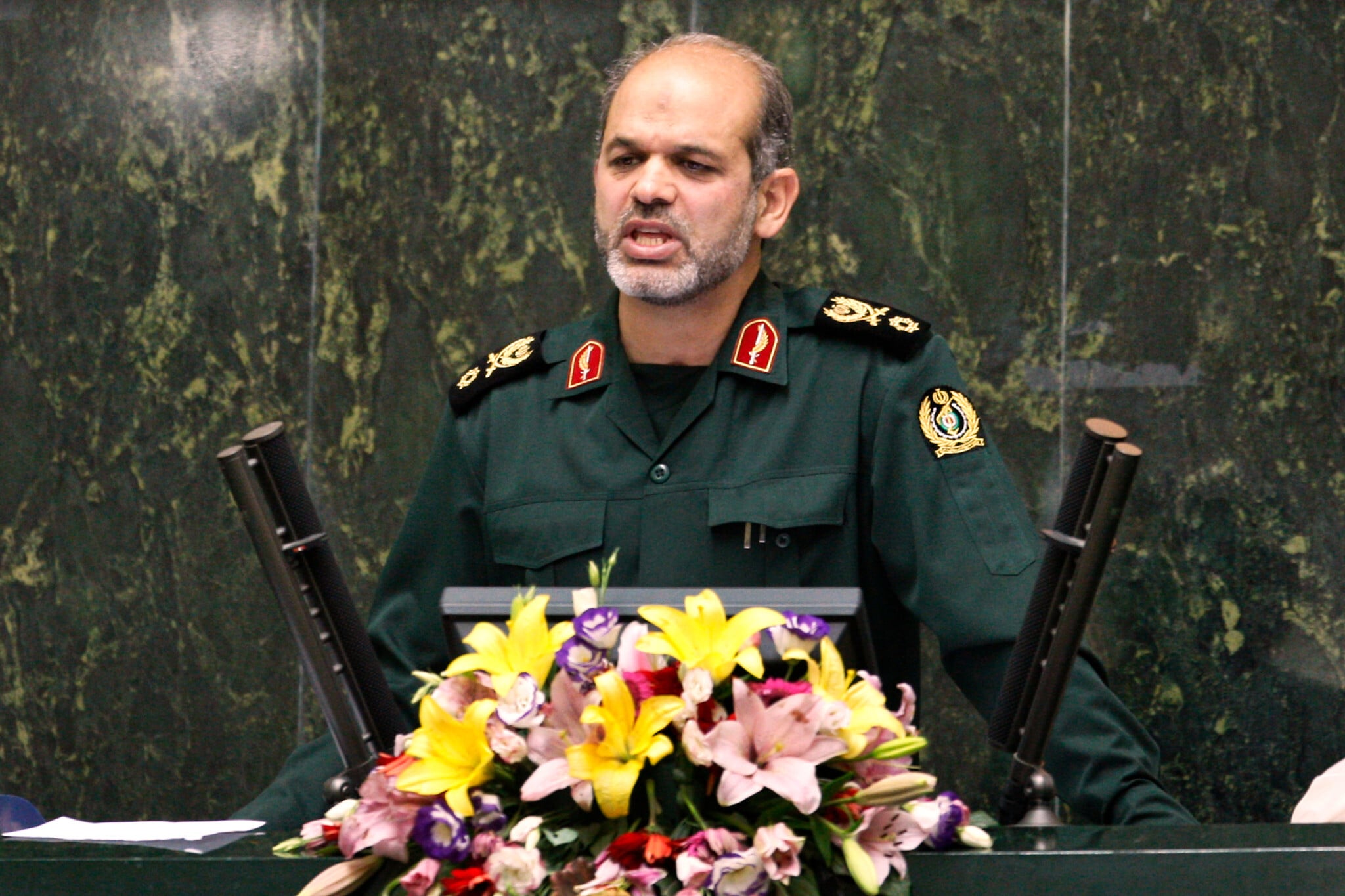
Nominee for defense minister Gen. Ahmad Vahidi delivers a speech to parliament on the qualification of proposed ministers of Iranian President Mahmoud Ahmadinejad, in Tehran, Iran, September 1, 2009. (AP Photo/Vahid Salemi)
The head of Iran’s Revolutionary Guards told the White House that the hardline group backed the Tehran regime in its negotiations with the US for a ceasefire deal, via a secret backchannel between the IRGC and Trump administration, Axios reports, citing three unnamed sources.
According to the report, US officials feared that talks with Foreign Minister Abbas Araghchi and Parliament Speaker Mohammad Bagher Ghalibaf were liable to be undermined by the IRGC, which is thought to be the most powerful group behind Iran’s leadership.
In May, then-director of National Intelligence Tulsi Gabbard reached out to Nechirvan Barzani, the president of the Kurdistan region in Iraq, who has close ties to the IRGC, to attempt to find out the position of its leader, Gen. Ahmad Vahidi.
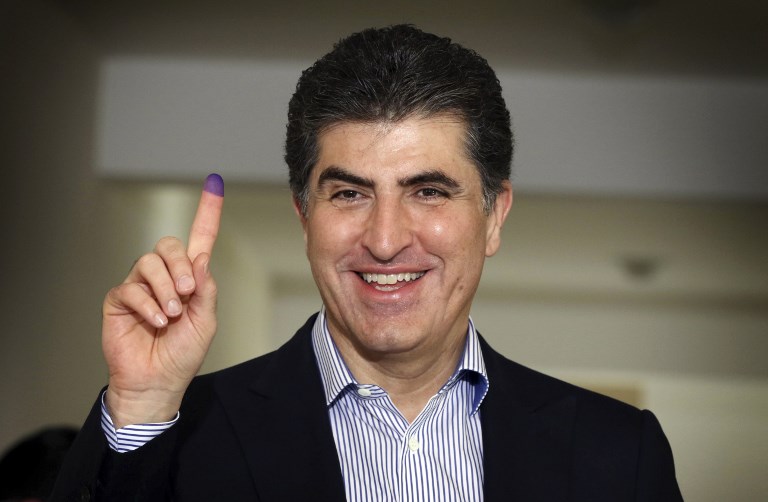
Nechirvan Barzani, prime minister of Iraq’s autonomous Kurdistan Regional Government (KRG), shows his ink-stained index finger after casting his ballot for the parliamentary election at a polling station in Erbil, the capital of the Kurdish autonomous region in northern Iraq, on September 30, 2018. (AFP PHOTO / SAFIN HAMED)
A few days later, Barzani arranged a phone call with Vahidi, during which the general assured him that the IRGC backed Araghchi and Ghalibaf. “I fully support them and this is also the position of the IRGC. We prefer to solve this crisis through negotiations,” he is quoted as having said. His message was quickly passed to the White House via Gabbard.
The Trump administration sought to expand Barzani’s role by having him host direct talks between the US and Iran in Erbil, Iraq, but the Iranians declined due to fears that representatives would be targeted by Israel, which was thought to have a strong intelligence presence in Kurdistan, the report says.
Barzani recently made an offer to the White House to restart talks, Axios reports.
Help us report truthfully on social media
As a multimedia journalist, my job is to take the quality, fact-based journalism produced by The Times of Israel newsroom and make it accessible across every platform — from Instagram posts to podcasts to short-form videos.
This is how many, especially young people, consume news these days. But misinformation is rampant on social media. Our team at ToI produces accurate, responsible short-form reporting on Israel and the Jewish world.
If you believe in the importance of factual social media journalism, please consider joining our reader support group, The Times of Israel Community. Your financial support is essential to sustain responsible multimedia reporting.
We’re really pleased that you’ve read X Times of Israel articles in the past month.
That’s why we started the Times of Israel - to provide discerning readers like you with must-read coverage of Israel and the Jewish world.
So now we have a request. Unlike other news outlets, we haven’t put up a paywall. But as the journalism we do is costly, we invite readers for whom The Times of Israel has become important to help support our work by joining The Times of Israel Community.
For as little as $6 a month you can help support our quality journalism while enjoying The Times of Israel AD-FREE, as well as accessing exclusive content available only to Times of Israel Community members.
Thank you, David Horovitz, Founding Editor of The Times of Israel


 From the Liveblog of
Sunday, August 16, 2026
From the Liveblog of
Sunday, August 16, 2026
 Add ToI as a Preferred Source on Google