

Muslims vs. Crusaders: one stone, two stories
One intriguing slab of limestone kept at Israel’s national museum was touched by two, or possibly three, of the Holy Land’s ancient cultures
 Add ToI as a Preferred Source on Google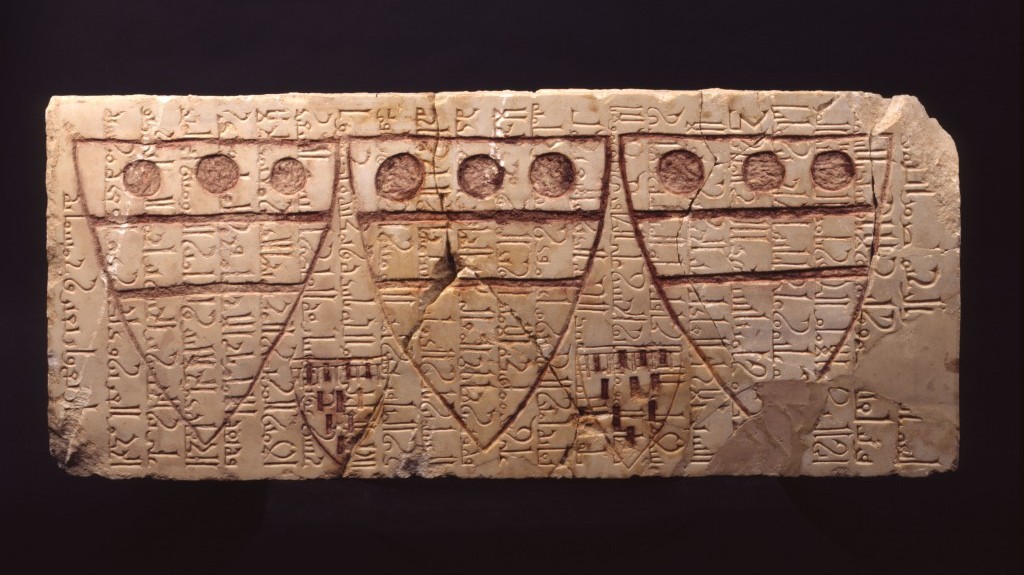
An ongoing series looking at history through a single object in the archaeology collections at Israel’s national museum
Two conquests, and an unlikely meeting of Middle Eastern Muslims with an Englishman from Lincolnshire, are evident on a single rectangular slab of limestone unearthed on the Mediterranean coast and held at the Israel Museum in Jerusalem.
The earliest writing on the slab — neat rows of Arabic script — was carved more than eight centuries ago by the Muslim defenders of the coastal city of Ashkelon. The text commemorates the fortification of the city in 1150 against the Crusaders.
At the time the text was inscribed, Ashkelon was in the frontier zone between the Muslim forces of the Fatimid dynasty in Cairo and the European knights, foot-soldiers, fighting monks and hangers-on who had arrived in the Holy Land a half-century before, capturing Jerusalem and establishing a kingdom they called Outremer: “Across the Sea.” The Crusaders and their Muslim neighbors waged intermittent wars interrupted by unsteady truces.
Ashkelon changed hands several times and was under Christian control by 1241, when a Crusader knight — a certain Sir Hugh Wake, who had come on a new Crusade led by the earl of Cornwall — participated in the construction of new fortifications there, this time to fend off the Muslims. Wake’s workers must have found the Fatimid stone and decided to reuse it. He had it emblazoned with three copies of his coat of arms: three circles atop two horizontal lines, carved right on top of the Arabic text. It was a 13th century nobleman’s way of saying, “Sir Hugh was here.”
The Muslim craftsmen might not, in fact, have been the first to touch the stone: Scholars have suggested it may have originally been a Roman tabletop that predated them by 1,000 years.
Ashkelon later fell to Muslim forces again. Someone threw the stone in a moat. The Crusader kingdom crumbled, finally coming to an end in 1291 with the fall of the port of Acre. The slab was found in 1993 by archaeologists working in Ashkelon on a dig led by a Harvard University professor.
Wake’s descendants still live in England.
______________
Follow Matti Friedman on Twitter.









The Times of Israel Community.