

Racism, anti-Semitism and WWII move to center stage for France’s rival candidates
Macron visits village where more than 600 were murdered; Le Pen rails against mass immigration as her party successor quits amid accusations of Holocaust denial
 Add ToI as a Preferred Source on Google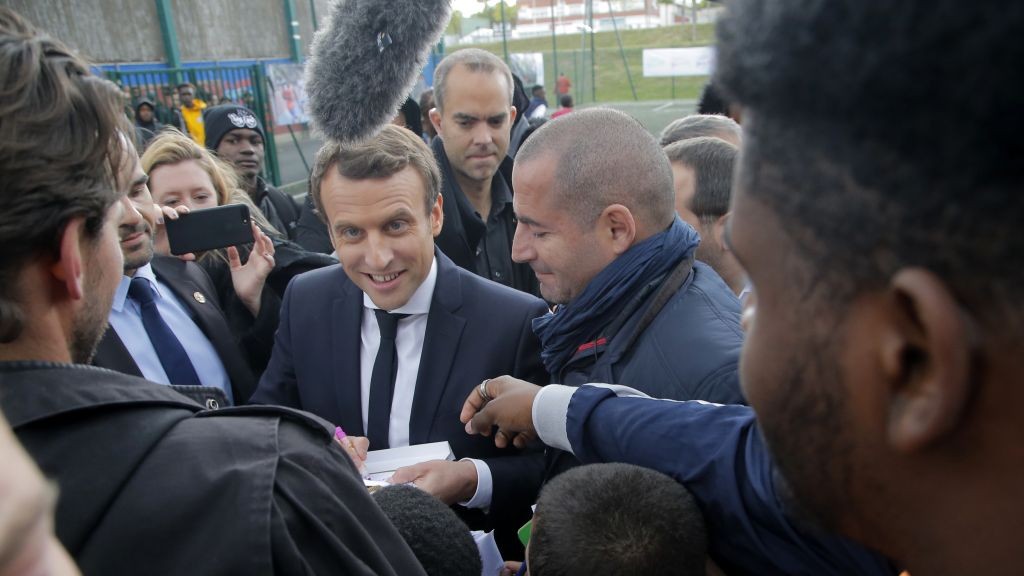
PARIS (AP) — France’s troubled wartime past took center stage Friday in the country’s highly charged presidential race, as centrist Emmanuel Macron visited a Nazi massacre site and Marine Le Pen’s far-right party suffered a new blow over alleged Holocaust denial.
The two candidates facing a May 7 runoff offer starkly different visions of France’s future — Macron’s embrace of a globalized, diverse nation within an open-bordered Europe contrasts with Le Pen’s protectionist, tightly policed France independent of the EU. After courting blue-collar voters earlier this week around the campaign’s No. 1 issue — jobs — the candidates are increasingly focusing on their opposing views of French identity.
Railing against “mass immigration” at a rally Thursday in Nice, Le Pen told supporters, “This presidential election is a referendum for or against France. I call on you to choose France. Not Mr. Macron, that’s for sure, whose platform is about the dilution of France. On his horizon is the deconstruction of France.”
Macron, speaking on TF1 Thursday night, shot back with a vigorous defense of the united Europe and institutions built over the past half-century to ensure peace among long-warring neighbors through free trade.

He also reminded viewers of the racism and anti-Semitism that still stain Le Pen’s party despite her efforts to detoxify it and broaden her base, noting “offensive statements on our history, on our political life” by interim National Front leader Jean-Francois Jalkh.
Jalkh, took over as party leader just this week after Le Pen said she would step aside to concentrate on her campaign, has come under fire this week over comments reported in a 2000 interview in which he allegedly cast doubt on the truth of Nazi gas chambers.

National Front vice president Louis Aliot said on BFM television Friday that Jalkh is stepping down to avoid further damage to the party, but that he is contesting allegations of Holocaust denial, a crime in France.
Jalkh is also among seven people called to trial in an alleged illegal financing scheme for the party — one of the other challenges facing Le Pen’s campaign.
Aliot said Jalkh will be replaced as party leader by Steeve Briois, mayor of Le Pen’s electoral fiefdom of Henin-Beaumont in depressed northern France.
Macron, meanwhile, was taking the moral high ground with a visit later Friday to Oradour-sur-Glane, a ghost town left behind after the largest massacre in Nazi-occupied France seven decades ago. The town is today a phantom village, with burned-out cars and abandoned buildings left as testimony to its history.
In comments to local newspapers published on Friday, Macron said “we don’t want to forget that from here, from Oradour, comes our Republican pride, the National Council of the Resistance that has built our (fundamental) balances, our strength and the European project. That is, everything Marine Le Pen wants to destroy.”
Le Pen prompted an outcry earlier this month by denying that the French state was responsible for the roundup of Jews in World War II, in a reference to the Vel d’Hiv’, the Paris stadium where thousands of Jews were transferred before being sent to Nazi death camps.
More than 75,000 French Jews and others were sent to Nazi concentration camps. Just 2,500 survived.
It wasn’t until 1995 — a half-century after the war’s end — that then-President Jacques Chirac acknowledged the French state’s role in the Holocaust for the first time, in a moving speech at a cycling stadium where thousands of Jews were rounded up in 1942.

Despite Chirac’s gesture, many French still don’t like to associate their nation with the Nazis, and prefer to see the Vichy regime as a historical anomaly.
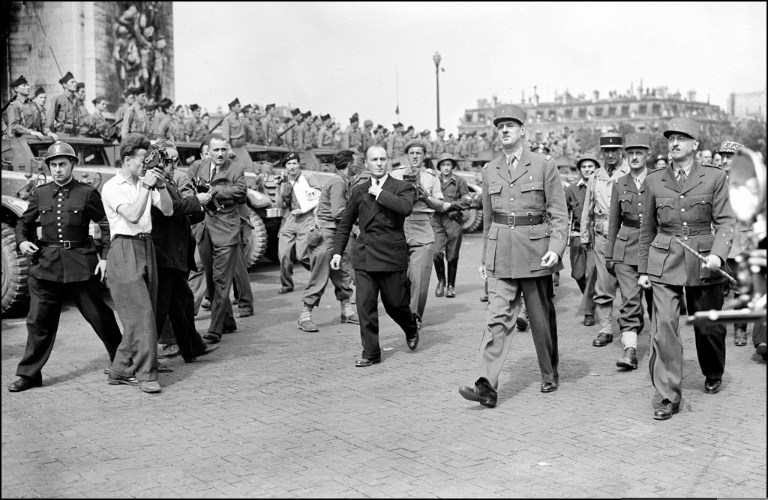
Gen. Charles de Gaulle, who launched the French Resistance from a base in London, and along with the Allies liberated France from the Nazis in 1944, as well as subsequent French leaders did not consider the Vichy regime to represent the French state, so there was no national atonement.
Families across France still have troubling, complex histories of collaboration that are never told to children and grandchildren.
Macron said going to Oradour-sur-Glane is meaningful “when you are facing a candidate who keeps repeating what she said on the Vel d’Hiv’, who is the conscious and direct heir of someone who has supported Holocaust denial.”

Jean-Marie Le Pen, who repeatedly has been convicted of crimes based on anti-Semitism and racism, founded the National Front party that his daughter took over.
On June 10, 1944, four days after the Allied D-Day landings in Normandy, an SS armored division herded hundreds of civilians into barns and a church, blocked the doors, and set the village of Oradour-sur-Glane on fire. A total of 642 men, women and children died.
Only six people survived.







The Times of Israel Community.