

Egypt’s new nationalist icon sets his sights on the presidency
El-Sissi, who threw his hat in the ring on Wednesday, draws comparisons to Nasser, the charismatic pan-Arabist unifier
 Add ToI as a Preferred Source on Google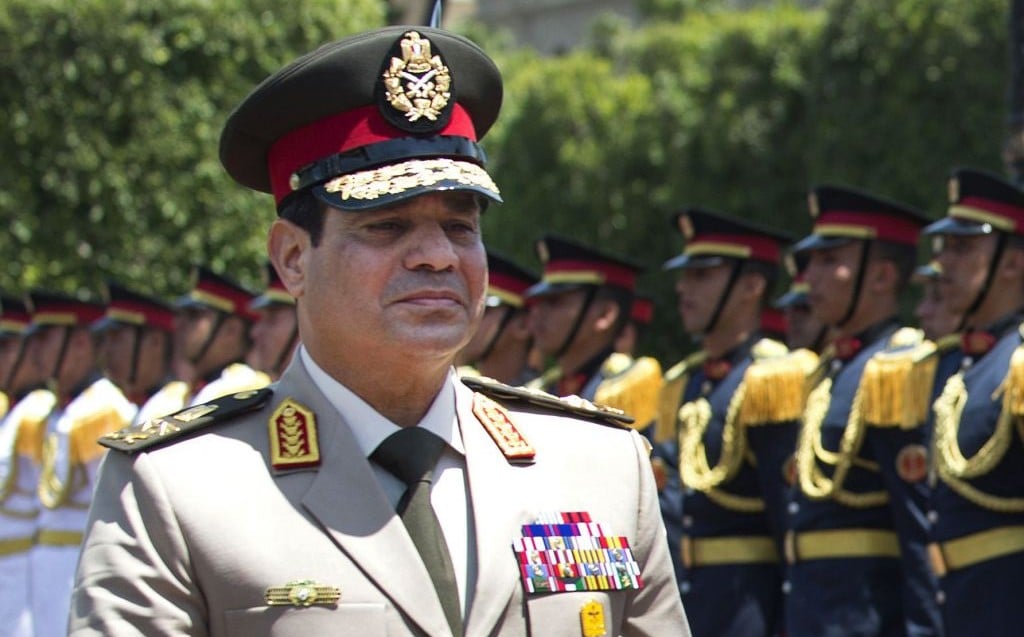
CAIRO — Egypt’s Field Marshal Abdel Fattah el-Sissi, who ended months of speculation Wednesday by announcing he would run for the presidency, has emerged as a nationalist icon in the mold of the country’s first modern military ruler, Gamal Abdel Nasser.
Sissi, 59, became Egypt’s most popular political figure and de facto head of state after he led the July 3 ouster of Egypt’s first freely elected and civilian president, the Islamist Mohamed Morsi.
“Today I stand before you for the last time in a military uniform, after deciding to end my service as defense minister and commander of the armed forces,” Sissi said in a televised address, dressed in field marshal’s uniform.
“With all modesty, I nominate myself for the presidency of Egypt, ” he said, vowing to rid Egypt of “terrorism.”
Sissi and Nasser, the charismatic colonel who deposed King Farouk in 1954 and led the country until his death in 1970, rode to popularity on the back of rising nationalism and both oversaw crackdowns on the Muslim Brotherhood.
But unlike Nasser, a champion of pan-Arabism whose speeches brought people into the streets across the region, Sissi has kept a lower profile, rarely giving public addresses.
Hosni Mubarak, the long-ruling dictator overthrown in 2011, appointed Sissi as his military intelligence chief, making him the youngest officer to hold the post.
Morsi later promoted Sissi to defence minister in what was seen at the time as an assertion of civilian control over the military, which had ruled the country between Mubarak’s overthrow and Morsi’s election in June 2012.
At the time, Morsi’s opponents speculated that Sissi had been chosen because he too was an Islamist, but less than a year later Sissi ousted Morsi as millions of protesters demanded an end to his divisive year-long rule.
Sissi’s supporters celebrate the harsh crackdown on the increasingly unpopular Brotherhood and view him as a tough leader who can restore stability after years of unrest.
Sissi had said for quite some time now that if there is “popular demand” for his candidacy he will stand in election expected before June.
Aides earlier had said he would announce his candidacy only after he was satisfied that he would be able to stabilise the country and repair an economy battered by three years of turmoil.
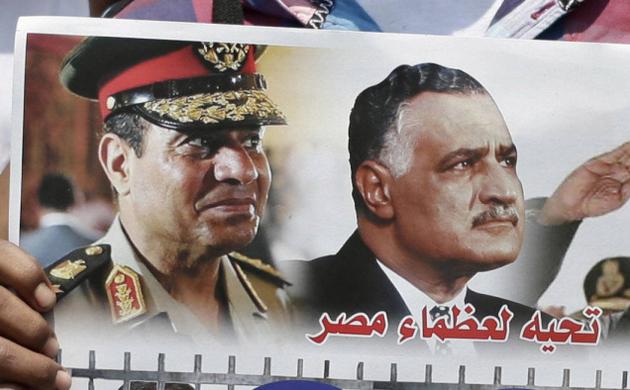
Sissi “wants to unite the people, restore security and Egypt’s international standing,” a general previously told AFP .
New president to rule a polarised Egypt
Egypt’s next president will rule over a deeply polarised country, with Morsi supporters regularly holding demonstrations that set off clashes with police and opponents, and with radical Islamists carrying out increasingly bold attacks on security forces.
The crackdown on the Brotherhood has seen more than 1,400 people, mainly Islamists, killed in street clashes. Thousands more have been jailed, including virtually the entire top leadership of the Brotherhood, Egypt’s most well-organised political movement.
“CC (Sissi’s name in graffiti shorthand) is a killer” reads a slogan scrawled on walls in the capital by protesters who continue to demand Morsi’s reinstatement.
But such slogans are dwarfed by the ubiquitous image of the uniformed Sissi plastered on walls and car windows, and even on cakes in bakeries.
To his supporters, Sissi is a pious and humble man of the people, who addresses them in colloquial rather than classical Arabic.
An aide said he prays five times a day in accordance with Islam practice and his wife, like most Egyptian Muslim women, covers her hair with a scarf.
Morsi supporters have nevertheless compared him to a pharaoh and to villains of Islamic lore.
Sissi was born near the Hussein mosque, a pilgrimage site in Cairo’s old city, in 1954, and entered the military academy in 1977.
During studies at the US Army War College in 2006, he wrote a thesis saying that support from Islamic opinion makers was crucial for democratic governance in the Middle East.
He has four children, including an eldest son in the army who is married to the daughter of the current military intelligence chief.



The Times of Israel Community.