

General apathy and major concern
Israelis may not care about local elections, but Israeli newspapers care a lot about Israelis not caring about local elections
 Add ToI as a Preferred Source on Google
Joshua Davidovich is The Times of Israel's Deputy Editor
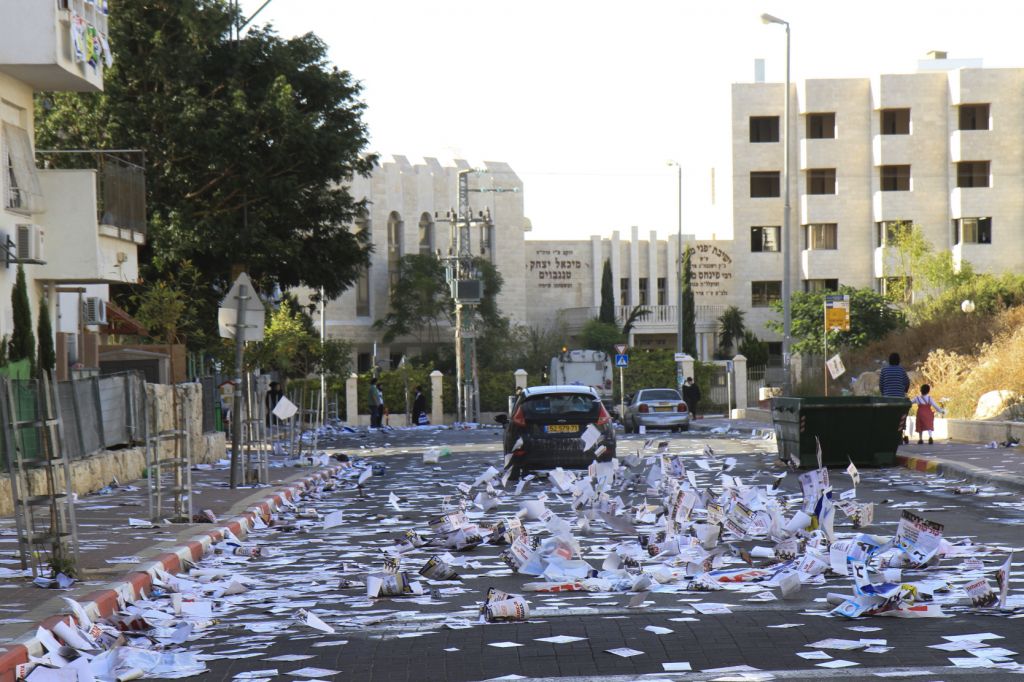
Israeli papers went to bed Tuesday night as ballots across the country were still being counted. While enough of the turnout was in by closing time for most papers to declare provisional winners in the more interesting races, the real story seems to be the low voter turnout, with all the requisite hand-wringing sprinkled throughout the morning editions.
With a national turnout of just around 50 percent, it’s no surprise that the Hebrew word adishim, or “apathetic ones,” is splashed across more than one front page.
Maariv, apparently fearful of a “Dewey defeats Truman”-type faux pas, fills its pages with turnout numbers and not preliminary results of those ballots. Shlomo Yerushalmi, writing without the foresight to know that enough non-ultra-Orthodox cast votes to keep Jerusalem mayor Nir Barkat in power, opines in Maariv that only the ultra-Orthodox cared enough about the vote to come out in large numbers. “My feeling was that it was a game, but only one team came out: the Haredim, who were obligated by their rabbis to vote. The other team, the freemen, aren’t obligated to anybody, and thus nobody will tell them what to do, including Nir Barkat. Had this large group, which makes up most of the city, come out to the polls, it would have been possible to declare Barkat’s victory before the ballots were even counted. Because of the apathy, the Barkat camp spoke yesterday of ‘cautious optimism,’ a preparation for defeat, and also about voter fraud, which is the claim of a potential loser.”
Yedioth Ahronoth, together with Israel Hayom, correctly calls the winners of most cities, but it saves the bulk of its front page real estate to slap Israeli citizens across the face for not voting. Despite recounting that Jerusalem and Tel Aviv both saw double digit drops in voter turnout percentages, though, the paper offers little other coverage of the phenomenon beyond two short columns by a voter and nonvoter on why they did (or didn’t do) what they did (or didn’t do).
“I swear to you that in the last half year I decided I would vote and influence, exercise my civic duty and swing the fate of my city for good or for bad: to have giant towers with not enough parking spots, or the alternative, giant towers with not enough parking spots,” nonvoter Oren Rosenstein writes about his anonymous burg. “It’s not that I’m not politically minded. If I lived in Jerusalem, I would vote. There the difference is clear. … In my city I barely remember who the mayor is, so I gave up my right to vote. “
Israel Hayom goes all Barkat on its front page, all but crowning him the next King David and declaring the city and all her denizens his, proverbially of course. But it also declares apathy to be the real big winner, with Interior Minister Gideon Sa’ar quoted as saying the country needs to consider making Local Election Day a holiday if it wants the numbers to rise.
The paper’s Dan Margalit, though, writes that the low turnout is symptomatic of a much larger disease, and it’s not only laziness. “The mass defection from the voting booths comes from a lack of public trust in the type of democracy on the municipal level. This isn’t just a refraining from going to the polls, but a silent protest.”
In Haaretz, Roy “Chicky” Arad spent the day traipsing from poll to poll and reports back on his results. In Nazareth, he finds a person refusing to vote “since they are all crooks,” in Haifa he find polling stations empty, and in Ramat Gan, a plethora of candidates doesn’t equal oodles of engagement. “Indeed, Ramat Ganians are spoiled for choice, but in the face of all this abundance they demonstrate shocking apathy,” he writes. “They seem to despise the election, saying all the candidates are corrupt. Many people I spoke to said they would not vote.”
Lady of the (late) night
Nearby Tel Aviv saw a surprisingly low turnout of just over 30%, leading to some hemming and hawing (particularly in Israel Hayom) over the fact that pop star Rihanna, who attracted some 55,000 fans in the city Tuesday night, was more popular than democracy (forgetting the fact that not all 55,000 came from Tel Aviv and a good amount of them are probably not of age to vote.)
Yedioth, however, saves some ire for the Barbadian herself, who showed up 3 hours late, and gave a short performance in which she – damn her to hell – didn’t even bother changing her costume once. “Rihanna… stayed in the same mostly similar outfits for all 85 minutes. It’s a big shame, since for many there the show was excellent. Others enjoyed it less,” he writes, quoting two former fans. “The sound was bad … It seems Rihanna didn’t play with much passion. We were very disappointed,” Noah from Givatayyim is quoted complaining. “The producers should be ashamed of themselves over the behavior and unfashionable lateness caused by the missus,” Inbar from Tel Aviv is quoted whining.
Back to actual news, Haaretz Arab affairs correspondent Zvi Barel lays his pen to paper to give his expert opinion on … the appointment of Karnit Flug as Bank of Israel governor, which he says is not a sign of liberalism in Israel.
“Before we pull out the champagne bottles, we should consider the sobering fact that Israel’s relatively high ranking when it comes to the status of women does not turn it into a liberal paradise on earth,” he says. “The reason is that such surveys can be misleading. They tear off a branch from a tree in the forest and display that branch as being representative of the entire forest.”










The Times of Israel Community.