

Simhat Torah brought Jews out to dance in New York City’s streets. Then came 9/11
Jewish New Yorkers remember how the holiday brought together ‘a big mishmash of people’ who otherwise wouldn’t have otherwise worshiped together for a ‘shul crawl’ across the city
 Add ToI as a Preferred Source on Google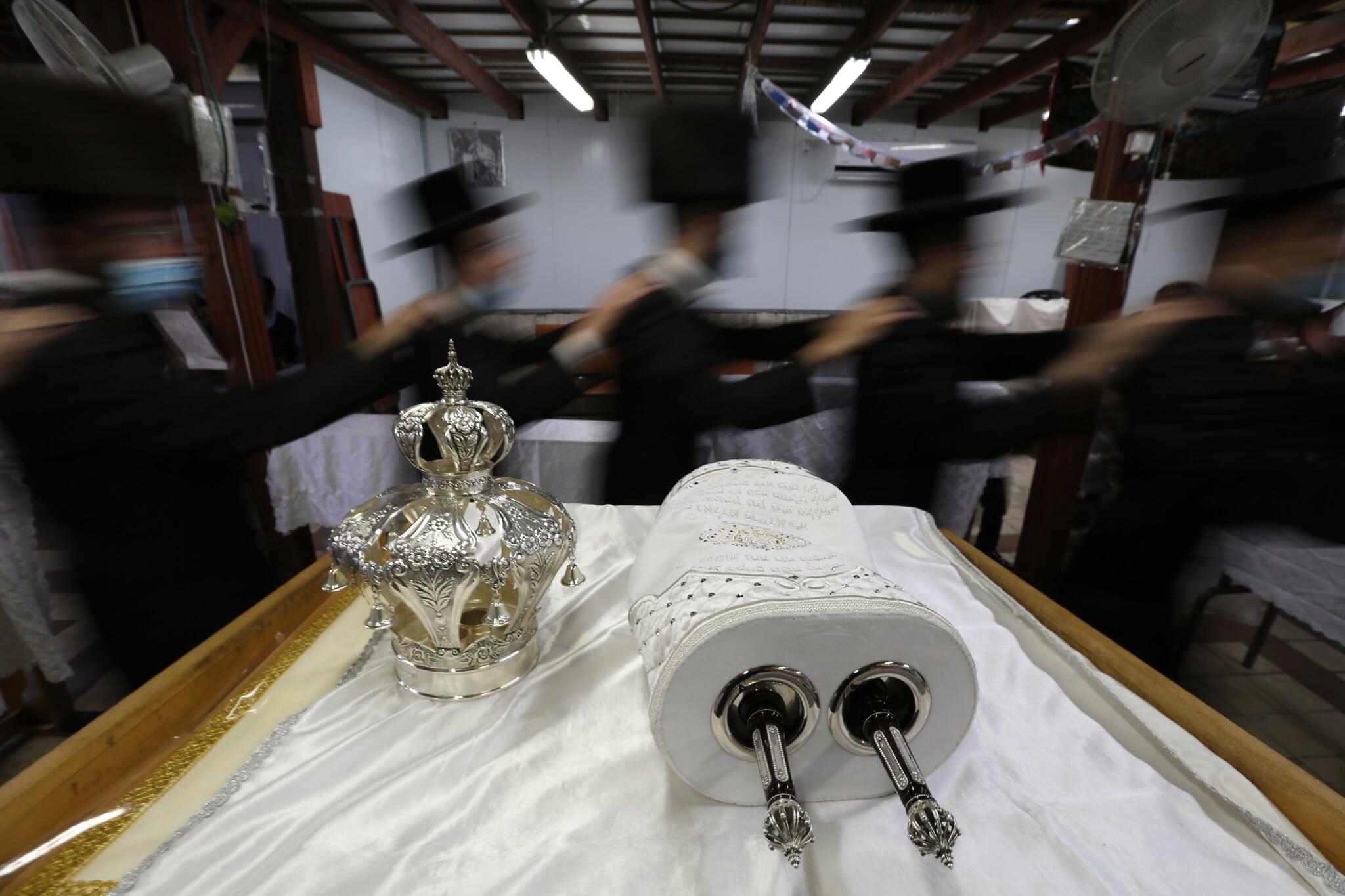
New York Jewish Week JTA — For some it was a singles scene, for others, a way to catch up with people they hadn’t seen all year. But for nearly everyone – toddlers on their dads’ shoulders waving flags, moms pushing strollers, teenagers in tight cliques – it was a chance to dance down the bright night streets of New York’s Upper West Side with thousands of their fellow Jews, dancing with the Torah on one of the most joyous holidays of the year.
In today’s fraught and fearful atmosphere in a tense and divided city, it’s hard to imagine a time when the Jewish community convened not to protest or rally over Israel or against antisemitism, but came together to celebrate a holiday: specifically, Simhat Torah, the last night of Sukkot. Starting in the mid-1990s, on one fall night a year, West End Avenue was shut down to traffic while local synagogues of different denominations brought out Torahs to dance with in the streets.
All that ended after 9/11.
“We can’t really guarantee your safety,” Rabbi J. Rolando Matalon, then the rabbi of Congregation B’nai Jeshurun (BJ), remembers being told by the police after the terrorist attacks (which occurred less than a week before the start of the High Holidays).
With the police no longer granting permission to cordon off the street, BJ was moved its celebration indoors, as did most synagogues.
Although many today credit BJ with starting the Simhat Torah tradition of dancing in the street, according to The Echod, the Lincoln Square Synagogue weekly newsletter, the first outdoor Simhat Torah celebration was a joint effort of five Orthodox synagogues in 1993, with 5,000 people packing 84th-86th streets until 1 AM.
Matalon, who retired in June after more than 40 years at BJ, recalls that the congregation first decided to take their celebration outside in the mid 1990s as the congregation grew. “Dancing inside was not a great option because there wasn’t a lot of space,” he said. So, BJ obtained a permit to close West End Avenue between 86th and 87th streets. Those early years, with live music and dancing, drew crowds, and eventually people from other congregations began joining after completing their own hakafot dancing circles in their synagogues.
“Hakafah means to encircle,” Matalon said, explaining the tradition that takes place the night of the holiday and continues the next day to celebrate starting the reading of the Torah anew. (Simhat Torah literally means “Joy of the Torah.”)
“Basically, the people carry a Torah scroll around the synagogue, encircle the synagogue with the Torah scrolls, and then people encircle the Torahs by dancing around it,” Matalon explained. “First, the Torahs go around the entire perimeter of the synagogue, and people salute it or greet it with reverence, and then the joyful dancing begins.”
The tradition is a simple one, according to Rabbi Mark Wildes, founder of MJE, The Manhattan Jewish Experience, and author of “The Jewish Experience: Discovering the Soul and Thought of Jewish Practice.” “It’s just basically a celebration of being Jewish and celebration of Torah and people dancing around,” he said. “So people just liked it.”
Wildes remembers the West End Avenue celebration as a rare moment when Jews of all different types – “a big mishmash of people” – who usually worshipped separately ended up together. “It was a big deal for all these Upper West Side synagogues to get together and dance together, even though we were different denominations,” Wildes said. “It was a tremendous show of Jewish unity and Jewish strength.”
To him, it felt like the dancing and singing poured out of synagogue, into the streets. “It was a spiritual kind of excitement.”
Rabbi Allen Schwartz of Ohab Zedek (OZ to those in the neighborhood), an Orthodox synagogue on 95th Street which also was a popular singles scene, recalled “dancing in the streets with maybe even hundreds of people with Torahs from about 91st Street all the way down to 79th Street.”
“It was filled with Jews,” Schwartz said. “That was amazing.”
All of the rabbis are sure that many couples must have met at one of the biggest Jewish social gatherings of the year, though no one could say exactly which ones.
“You can’t put a better definition on the word ‘scene’ than what it was,” said Danny Ripps, a longtime Upper West Sider and consultant to nonprofits who works extensively in the Jewish community. He remembers watching the different communities converge on the avenue, with Rabbi Schwartz leading the OZ crowd down from the north, the contingent from The Carlebach Shul coming up from 79th Street and BJ congregants spilling into the street. “I always used to call it the ingathering of the Jews, or the Running of the Jews, in the most positive ways,” Ripps said. “There was a little bit of magic.”
Shira Dicker, a writer, publicist and activist who has lived in Manhattan for much of her adult life, remembers Simhat Torah as a kind of “shul crawl,” with synagogues replacing pubs, starting farther down on the Upper West Side and making her way north, stopping wherever the dancing was good.
“Dancing in the streets was part of what we did in what we now know was the ‘Golden Age of American Jewish life,’” she said. What she remembers most was how easily people intermingled. “It’s where you see people get very porous with their religious boundaries in a way that I find wonderful,” she said, recalling Orthodox Jews joining circles at synagogues whose practices were very different from their own.
Wildes believes some of that cross-denominational connection has returned since October 7, as Jews have faced rising antisemitism together. “When we are attacked as a community, it inspires us to forget some of the differences,” he said, adding that Jewish life is “still pretty segregated, but less so than it used to be before October 7.”
These days most synagogues are doing their hakafot indoors.
Matalon says BJ still draws people who are not regular members of the congregation but he misses what happened when the celebration spilled outside. “It was great to be outside publicly,” he said, “and it was great to feel the freedom to dance outside.”
The shift may feel even more charged now with the heightened security that comes with Jewish life post-October 7.
Schwartz, whose congregation today closes a smaller stretch of West 95th Street for about half an hour on Simhat Torah, says synagogues have to be careful about security, but he also wonders whether this is exactly the moment to bring something bigger back.
“Maybe now it’s like we’re calling out to bring it back so that Jews can feel, ‘Listen, you can’t intimidate us. We’re here,’” he said. “This is our city, and we’ve been here for a long time.”








The Times of Israel Community.