

Opposition chiefs could not agree at meeting who should be candidate for PM — report
Liberman objected to assertion that head of bloc’s largest party gets to form government, but avoided an ‘argument,’ Channel 12 reports; follow-up meeting to be held in coming days
 Add ToI as a Preferred Source on Google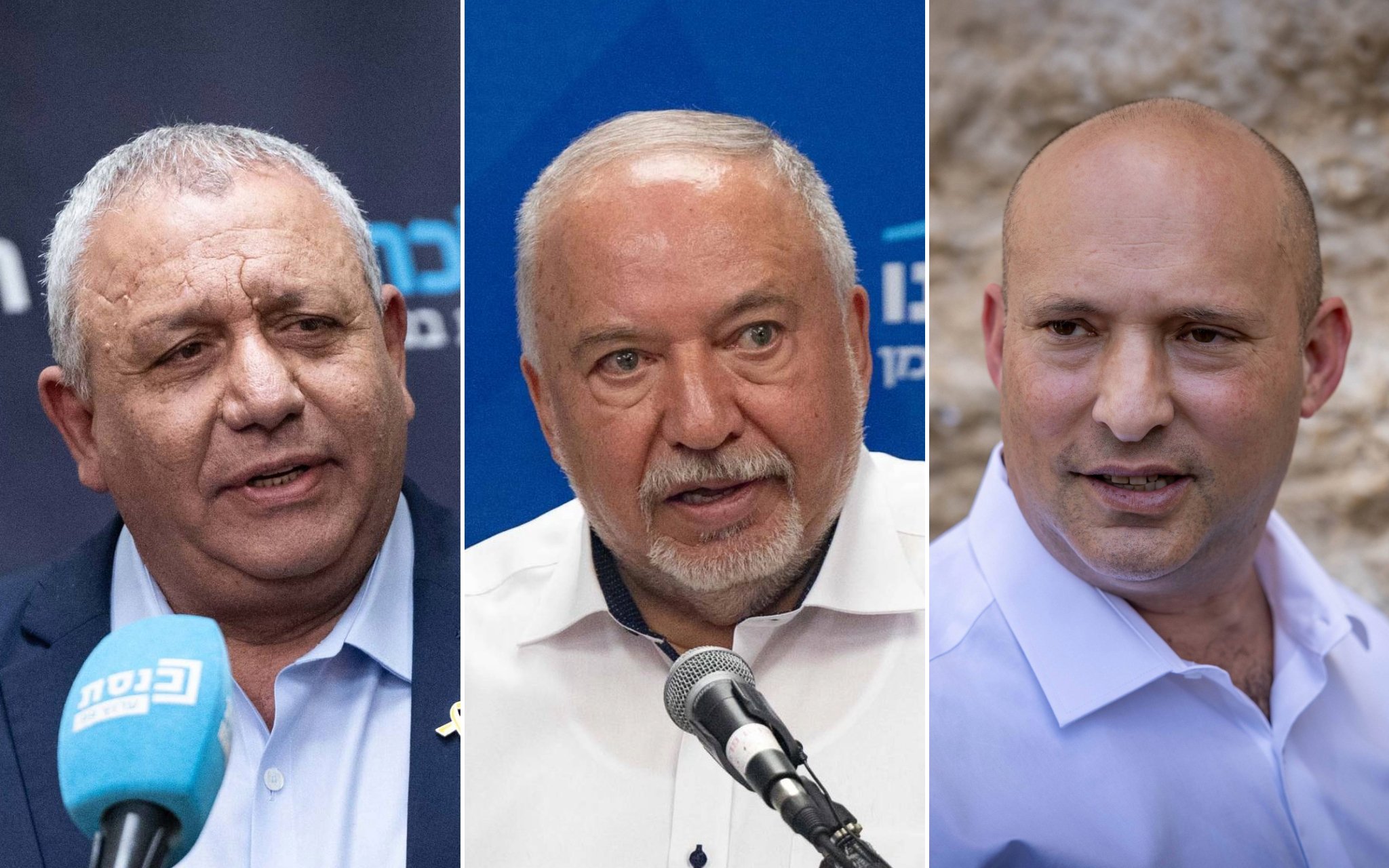
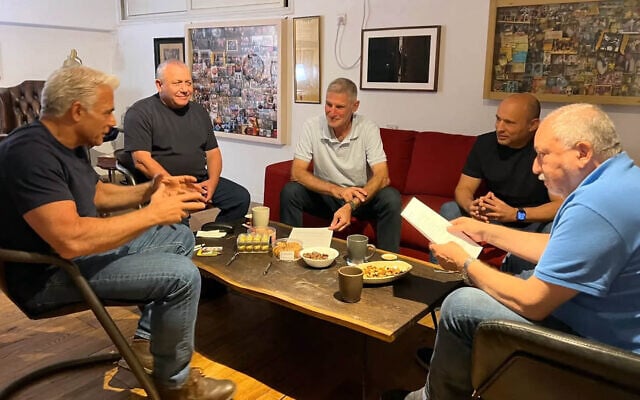
The heads of leading opposition parties, at their meeting on Saturday night, discussed who among them should be candidate for prime minister if their bloc manages to form a government, but did not come to an agreement, Channel 12 reported.
The topic was not included in the party chiefs’ joint statement after the meeting, in which they pledged not to attack each other on the campaign trail, to cooperate ahead of the October 27 vote, and to set up joint working groups to prepare for a future government.
Although they failed to reach a shared conclusion, the discussion did not turn into an “argument,” the Sunday TV report said.
At the meeting, Yisrael Beytenu chief Avigdor Liberman advocated that the bloc focus on running together and shelve the question of the premiership until after the election, while Gadi Eisenkot argued it should be a given that the leader of the bloc’s largest party will put together and lead the government.
Eisenkot’s centrist Yashar party is consistently leading in polls, with a recent Times of Israel survey projecting it would win 23 seats if elections were held today. Naftali Bennett’s B’Yachad and Liberman’s Yisrael Beytenu would be far behind with 12 and 10 seats, respectively. The poll had the pro- and anti- Netanyahu blocs tied at 53 seats each, leaving both short of a government if they fail to rely on defectors or on Arab support.
According to Channel 12, another meeting will be held in the coming days, in which research will be presented on the different parties’ competitive advantages, so that they avoid competing for the same votes at the expense of the bloc as a whole.
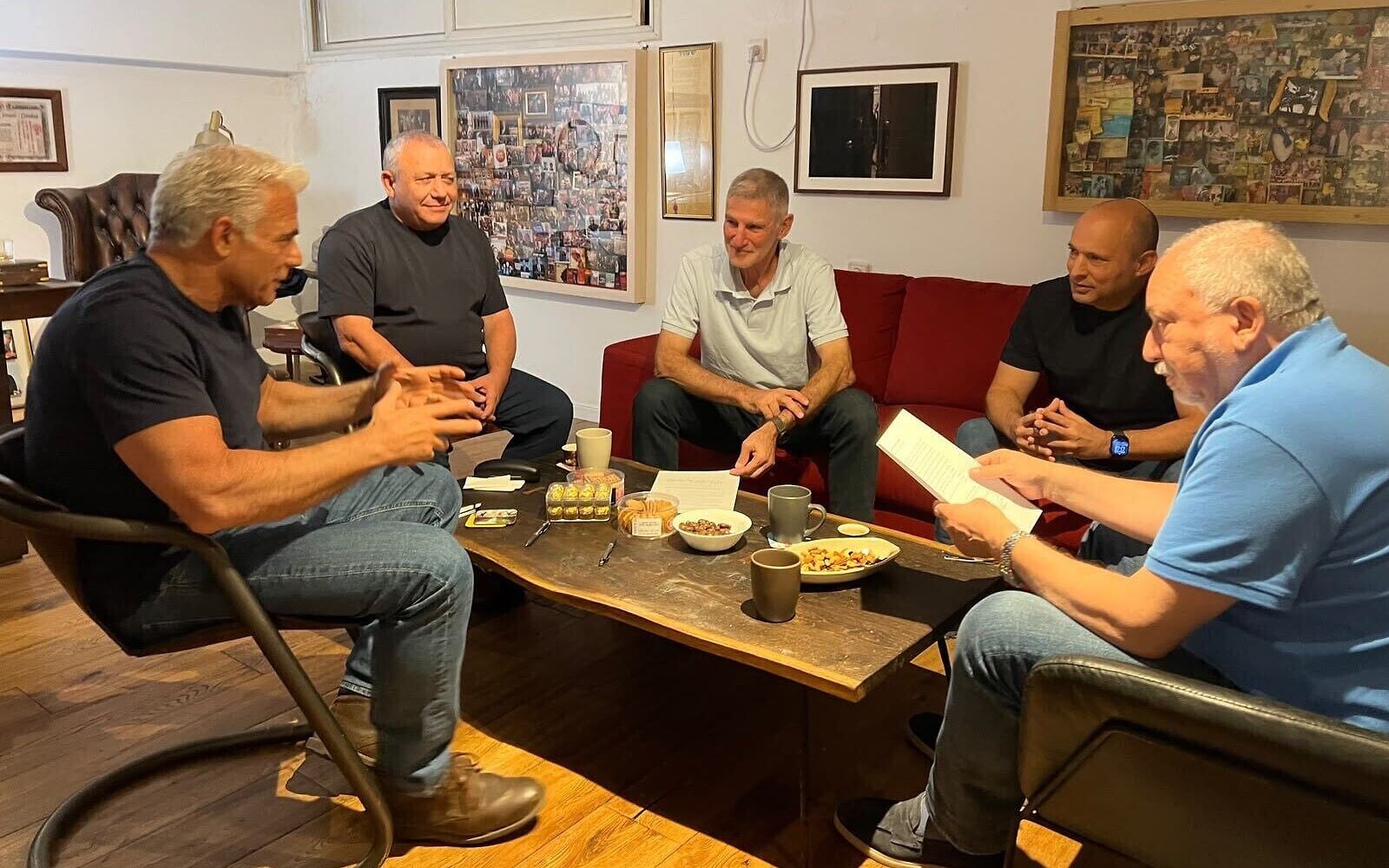
Notably absent from the talks on Saturday was Blue and White party chief Benny Gantz, who has sought to position his party as belonging to neither bloc and as a potential kingmaker, but who has also failed to cross the electoral threshold in nearly all polls. Gantz placed a mobile billboard outside Lapid’s home during the meeting, declaring that “the blocs are holding Israel back” — referring to the rival pro- and anti-Netanyahu alliances of parties.
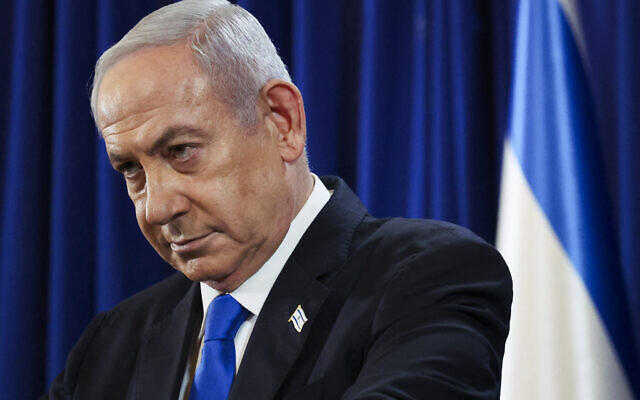
Netanyahu responded to the meeting and the photograph issued from it by posting an AI-generated fake version “showing” Arab MKs Mansour Abbas (leader of Ra’am) and Ahmad Tibi (of the Joint Arab List) participating in the gathering, and claiming that Eisenkot intends to form a governing coalition with the Arab parties. Eisenkot on Saturday publicly said he did not intend to include Ra’am in a potential government, explaining it does not currently meet his criteria for inclusion.
The politically staffed Central Elections Committee, where the current coalition has a majority, has disqualified Ra’am and the other Arab-majority party, the Joint List, from running in the October 27 election. However, the High Court of Justice has reversed many such decisions in the past and is widely expected to do so again.






The Times of Israel Community.