

Route of all evil
Survivors and rescuers describe a fatal bus crash as papers wonder whether anything can solve Israel’s road safety problem and show a strange obsession with the minutiae of Ehud Olmert’s not-too-shabby future life in the clink
 Add ToI as a Preferred Source on Google
Joshua Davidovich is The Times of Israel's Deputy Editor
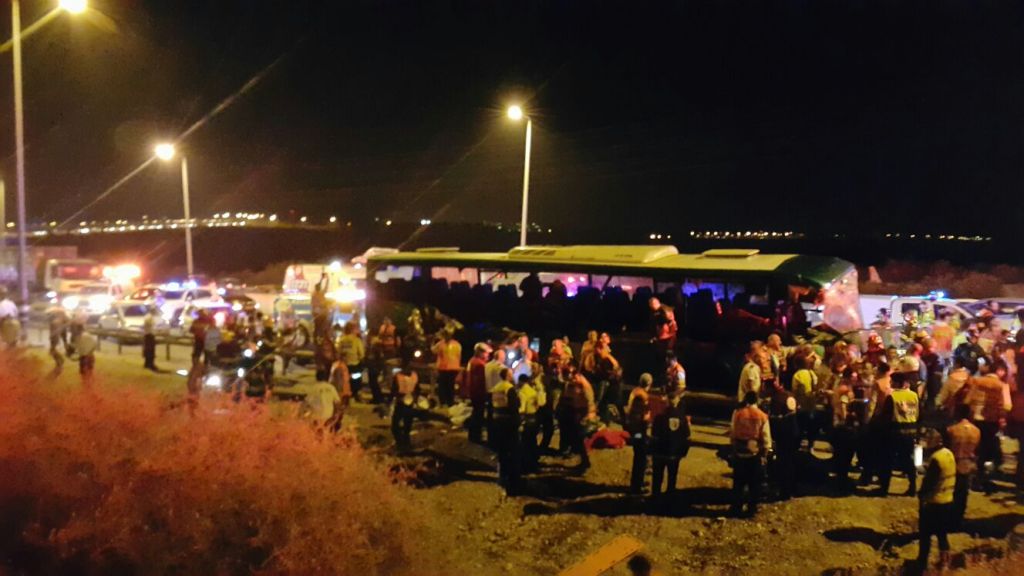
There exists a constant tension in Israel between national security and road safety. Though it’s the former – including national defense and the fight against Palestinian and homegrown terror — that garners the headlines, many like to point out that the number of Israelis killed in road accidents over the last 67 years is higher than the number killed in wars and terror attacks.
As opposition MK Eitan Cabel said at a Knesset hearing less than a week ago, “the danger right now for Israelis on the road is greater than any other security threat.”
That tension was fully on display Sunday, which saw a sharp rise in shooting and stabbing attack attempts alongside a single fatal bus crash. While not a single Israeli was injured in the attacks – though five Palestinians were killed and a sixth critically wounded – the bus crash saw six fatalities, and drove the point home.
Proving the adage that if it bleeds it leads, the crash makes the front page of all three major dailies, pushing off both the attacks and the imminent jailing of former prime minister Ehud Olmert, in itself a historic event.
While not particularly catchy or informative, both Israel Hayom and Yedioth Ahronoth splay the headline “Bus of death” across their front pages (the term was also employed on the cover of the daily Maariv as well as by several websites Sunday evening).
While the exact reasons the bus collided with a crane hanging off a truck parked off the main highway between Jerusalem and Tel Aviv were still being sorted out as the papers went to bed, the horror of the scene was already all too clear.
“Rescuers from United Hatzala are used to, in their work, being exposed to difficult scenes every day. But the horrific road accident on Route 1 managed to crack even their cool,” Israel Hayom reports.
The experience was naturally even worse for the passengers, almost all of them members of the ultra-Orthodox community traveling between Jerusalem and Bnei Brak, some whom describe the bus being “cut in two” during the crash.
“I heard someone yelling ‘save me, save me,’” Yedioth quotes one person who was in the crash saying. “He grabbed my leg and I saw he was covered in blood. So I lifted the seat and pulled him out. He yelled out ‘my wife is between the seats, come let’s get her.’”
The paper continues by describing the unsuccessful search for the wife, Pesha Frankel from a well known Hasidic dynastic family, until it becomes clear that she is one of the six dead.
Israel Hayom also recounts the story of Yaakov Cheshin, 27, who was killed as he was making his way to an arranged shidduch date, noting the coincidence that it happened on Valentine’s Day, though ultra-Orthodox don’t mark the Christian saint’s holiday.
The religious fervor of the victims also comes out in statements from the survivors, many of whom announce plans to say the special “Hagomel” prayer Monday which is reserved for those saved from life-threatening situations.
“Thank God I was saved. I can’t stand right now. I saw yeshiva students crying. My heart is broken. I will say Hagomel,” one is quoted saying in Israel Hayom.
God may have saved them, but there remains the question of whether He also fated the accident to be, or if it was preventable.
Looking at the causes of the crash, Yedioth reports that the bus driver is already being looked at as the culprit, though it cautions that a whole series of unfortunate circumstances led to the crash, some of which were out of the driver’s hands.
“Even if he saw the parked truck in time, it’s not certain he could have veered into the next lane: if it was occupied at the fated moment, it’s safe to assume the driver didn’t have any realistic chance of avoiding the coming disaster without crashing into the car on the other side of him,” the paper reports.
Haaretz zooms out and looks at the rise in the number of road fatalities over the last several years, from 301 in 2012 to 355 last year, and 45 in the first month and a half of 2016 alone. The paper reports that new police chief Roni Alsheich is looking into reforming the Traffic Police and bring it back under the aegis of the regular police force, noting that their current set-up and manpower levels seem unable to keep up with the growing challenge.
“The police chief intends to return the speeding cops, cruisers and motorcycle units to the police districts and stations, so they will be used for the benefit of the public expecting their presence at the entrances and exits of cities,” the paper reports.
Former police commissioner Bruno Stern writes in Israel Hayom that the crash was not fated from above and could have been prevented if the country invested more in traffic safety enforcement and education, especially among the Arab population, which he needlessly singles out.
Noting there is no magic bullet, he still maintains that “it’s possible to influence the number of victims of road accidents. For that, an incisive change needs to be made, one which will change priorities on a national level.”
Up the river, but with a paddle
The crash occurred just a few minutes away from the central Israeli town of Ramle, which Olmert will call home for the next 19 months as he serves out a prison sentence.
All three paper display a strange fascination with the minutiae of Olmert’s life-to-be behind bars, though as if they coordinated, each paper tackles a different aspect.
Haaretz details what Olmert, who will serve his time in a special unit constructed just for him and other major officials, can expect once he enters Maasiyahu prison, and Sing-Sing this definitely is not. The paper reports there can be 18 total prisoners in the unit, with three to each cell, which includes beds, dressers, a table, chairs, a TV and its own bathroom and shower. Among his possible bunkmates will be a motley crew of former city officials, judges, police brass, intelligence officers and others found guilty in the Holyland Real estate scam.
Like other prisoners, Olmert will be allowed to spend up to NIS 1,600 a month in the canteen and will be eligible for his first three-day furlough to re-stock on blue button down shirts after serving one-third of his sentence, in about six months, the paper reports.
Yedioth looks at what personal effects Olmert. along with other prisoners, can bring with him: four pairs of underwear, four pairs of socks, two towels, one jogging suit, one blanket, two pairs of running pants, one pillowcase, seven books, a music player, newspapers, religious effects, soap in a bottle, a toothbrush and toothpaste. Visitors can bring him other items, if they’re approved.
The paper notes that though in prison he can wear whatever he wants, when he shows up to court, he’ll have to wear standard issue prison orange, just one of the many fine lines he’ll walk on the tightrope between common criminal and former leader of the country.
“The prison warden will make sure to train his staff on how to treat with respect a prisoner who was a prime minister while still making sure he sticks to the rules,” the paper reports.
Finally, not to be outdone, Israel Hayom details what Olmert’s day will consist of, from waking up and having breakfast before 7:30 a.m. to cleaning and doing other jobs from 8 until 10:30 to dinner at 5 and locking up the cells for the night between 8 and 11 p.m.
“On the radio they say it’s supposed to be partly cloudy, with nice and mild weather given the winter season. But for Olmert – and all of Israel – the sky is the blackest black on this sad, very sad day,” writes Aviad Hacohen on Israel Hayom’s op-ed page. “It’s not every day that a prime minister is convicted of fraud and breach of trust, aggravated bribe-taking and obstruction of justice, and enters prison.”










The Times of Israel Community.