

Bill subordinating internal police investigations unit to justice minister advances
Legislation would give justice minister full control over appointing head of police investigations agency; senior Justice Ministry official warns of politicization of body
 Add ToI as a Preferred Source on Google
Jeremy Sharon is The Times of Israel’s legal affairs and settlements reporter

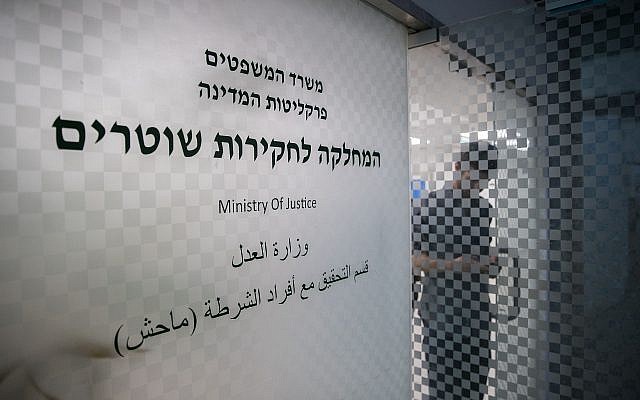
A highly controversial bill that would place the Department for Internal Police Investigations — responsible for conducting criminal probes into police officers — under the direct authority of the justice minister is set to be approved in committee ahead of its crucial first reading in the Knesset.
Under the bill, the head of DIPI would be elected by a five-member committee, with the justice minister having control over the appointment of three members and input on a fourth.
The department director would serve for a six-year term, but could be fired by the committee.
And the head of DIPI would be seen as a prosecutor and have the powers of the attorney general and the state attorney, including the power to file indictments, over the cases coming before the department.
The bill is part of a raft of measures being pushed by the government that would give it greater control over the judiciary and law enforcement. Critics of the judicial overhaul, which was largely in hibernation during the war, claim that it will undermine democracy and destroy the country’s system of checks and balances.
During a joint hearing of the Knesset Constitution, Law and Justice Committee and the Knesset National Security Committee on Tuesday, senior officials in the justice ministry’s civil service expressed concern that the changes to DIPI’s structure would compromise its independence and potentially politicize it.
And the legal adviser to the Constitution Committee said similarly that the bill would give politicians control over the department.
Committee chair MK Simcha Rothman of the Religious Zionism party tried to head off the criticism of the bill, claiming that control over an appointment did not equate to control over the official once in office.
Right-wing politicians have long sought to remove DIPI from the State Attorney’s Office, claiming there is a conflict of interest in it being subordinate to that agency due to its close cooperation with the police.
The opposition has argued, however, that giving DIPI over to the control of the justice minister would politicize criminal probes of the police, and destroy the agency’s independence.
Currently, DIPI operates under the State Attorney’s Office and is professionally and organizationally subordinate to it. The head of DIPI is appointed by a professional committee of the Civil Service Commission.
Under the new law, DIPI would be subordinate to the justice minister.
The three members on the committee appointing the head of DIPI whom the justice minister would have control over would be the director-general of the Justice Ministry, who is directly appointed by the justice minister; an attorney with experience in representing criminal defendants, to be chosen by the justice minister in consultation with the state public defender; and a senior lawyer or retired district court judge selected by the Justice Ministry director general in consultation with the head of the Civil Service Commission.
A fourth committee member would be an academic expert in criminal law appointed by the head of the Civil Service Commission in consultation with the justice minister, while the final committee member would be the Civil Service commissioner themself.
The head of DIPI would be someone qualified to serve on the Supreme Court, meaning someone with ten years’ experience as an attorney or five years’ experience as a district court judge.
“It is important that there be a completely professional and independent body and not under the militia of the attorney general,” declared Likud MK Moshe Saada, a former acting head of DIPI who has long advocated removing the department from under the authority of the professional prosecutorial services.

“We have no interest in the head of DIPI being subordinate to the political echelon, and the basis is [that the head have] the qualification for a Supreme Court judge,” he contended.
Gabi Fissman, the head of the government authorities department in the Justice Ministry’s civil service, said that DIPI did need reform to its “administrative and institutional independence,” but was strongly critical of the changes the legislation would enact.
“The proposed method of appointment [for the head of DIPI] does not ensure the required buffer between law enforcement agencies and political officials,” she said, maintaining that this key appointment was crucial for guaranteeing the agency’s independence from political interference.
“So far, it has not been explained why the existing appointment mechanism under the Civil Service Appointments Law is not good enough. And why it is not possible to choose another mechanism that will ensure the independence of the body,” Fissman said.
Similarly, Constitution Committee legal adviser Gur Bligh noted that a majority of the appointment committee members for the head of DIPI would be controlled by the justice minister.
“Why not structure it in a broader way that won’t create control by the political echelon?” he asked.
“Even if we want to prevent the appointment from being dependent on the attorney general, why do we need to create dependence on the justice minister? On the contrary, I thought the intention was to decentralize control,” Blight continued.
Rothman, however, argued that “being appointed by me does not mean control,” and said that just because the head of the Shin Bet and the police commissioner are appointed by the government does not mean the government controls them.
The final draft of the bill is not yet complete, but once finalized, it will be brought to the committee for approval before being sent to the Knesset for its first reading.









The Times of Israel Community.