

Computers taught to read Dead Sea Scrolls in hunt for clues hidden from human eyes
By combining multispectral imaging with computer vision methods, Tel Aviv University researchers give scholars new tools to read, match, and study the 2,000-year-old artifacts
 Add ToI as a Preferred Source on Google
Rossella Tercatin is The Times of Israel's archaeology and religions reporter.
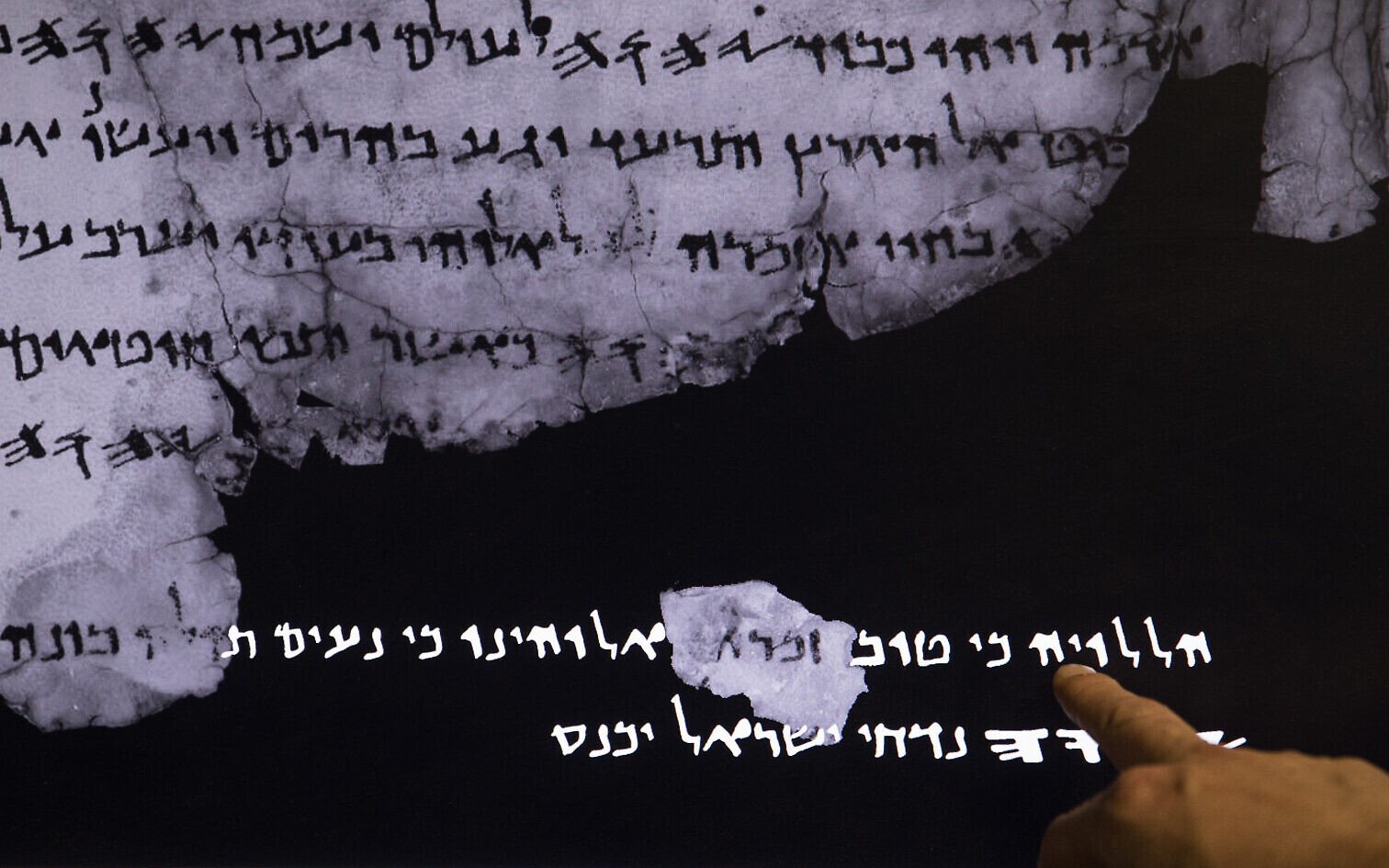
Two researchers from Tel Aviv University’s School of Computer Science have unveiled a new computational method that could transform the study of the Dead Sea Scrolls.
The tool is designed to enable more precise analysis of ancient texts and handwriting, which, among other benefits, could help scholars see if fragments once belonged to the same scroll or were written by the same scribes. The technology is still in its infancy, but researchers hope extracting such information can unlock new insights into the people and communities behind the Dead Sea Scrolls, their level of literacy, and ultimately Jewish life in the Second Temple period.
“Scholars have been studying the Dead Sea Scrolls for 70 years,” Prof. Nachum Dershowitz, who developed the method along with Berat Kurar-Barakat, told The Times of Israel. “One of the great unsolved challenges has been comparing and matching handwriting across different fragments or scrolls. This remains one of the field’s giant questions.”
The research, now under review for publication in a peer-reviewed journal, was presented last month at the 19th World Congress of Jewish Studies at the Hebrew University of Jerusalem.
Dershowitz spoke to The Times of Israel on the sidelines of a presentation by Kurar-Barakat, a postdoctoral researcher in his lab.
Their project seeks to bridge the gap between the physical scrolls and the writings they preserve, offering scholars a technological tool to access and analyze the texts with far greater ease.
The Dead Sea Scrolls comprise thousands of fragments from approximately 950 manuscripts. To protect them from further deterioration, the Israel Antiquities Authority stores the ancient texts under strictly controlled conditions.

As a result, scholars have only limited access to the originals and must rely on high-resolution photographs. But even these present their own challenges for research.
For technology to help analyze the scrolls’ handwriting, computers must first learn to do what the human eye does instantly: recognize where the letters are, where the parchment begins and ends, and separate both from the black background and other visual noise.
“In the 1950s, a skilled photographer at the Rockefeller Museum, where the scrolls were then kept, documented them extensively,” Dershowitz said. “In recent years, the Israel Antiquities Authority has also been photographing the scrolls.”
The IAA now uses multispectral imaging, which captures details at different wavelengths of light, revealing features invisible to the naked eye.
“Conservators place each fragment on a black stone platter and photograph it,” Dershowitz explained. “The image shows not only the fragment, but also the background, a measuring ruler, a label, and—if the scroll is in poor condition—strips of Japanese rice paper holding it together.”
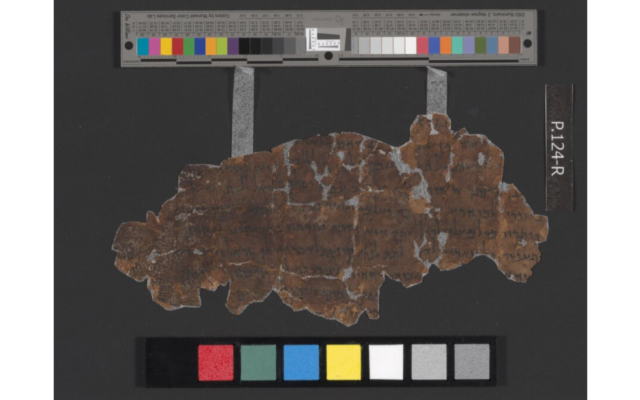
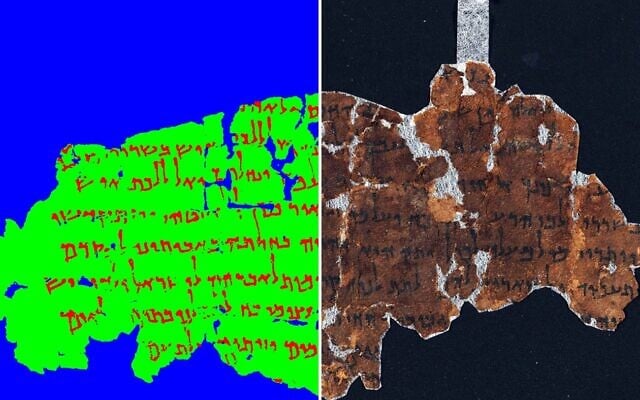
The project’s goal was to teach the computer to distinguish between ink, parchment, and other elements in each image of the scrolls. Computers define images using a horizontal X-axis and a vertical Y-axis, assigning coordinates to every pixel, and the challenge is to classify each pixel correctly.
“We need to know what is ink and what is parchment,” Dershowitz said. These processes are known as ink segmentation and parchment segmentation.
While computers can identify colors, that alone isn’t enough—different elements can look identical. For example, letters and the background are often the same shade of black.
In the past, scholars had to carry out segmentation manually, using editing tools like Photoshop to annotate each individual pixel—a painstakingly slow task.
Recently, a team of European scholars introduced a deep-learning method for ink segmentation. However, they did not publish their trained algorithm, so other researchers cannot access it independently.
Kurar-Barakat and Dershowitz went a different route, developing an open-source approach that highlights both the writing and the parchment in each fragment. By offering open access to the tool, the two are giving a wide range of scholars new ways to explore the scrolls, with the hope that the method will allow the research community to tackle some of the longstanding puzzles contained in the ancient texts.
The method leverages the multispectral images recently captured by the IAA, which appear to offer advantages over standard photographs.
“Multispectral images reveal more than just color,” Dershowitz explained. “Light reflects differently depending on the material—ink, parchment, background—and the computer can use those reflections, rather than color alone, to identify each element.”
The researchers tested their method on a dataset of twenty fragments, including pieces from several notable scrolls. These included 4Q393, containing a liturgical text known as the “communal confessions” from the Herodian period (1st century BCE–1st century CE); 4Q26, featuring sections of Leviticus from the Hellenistic–Roman period (4th century BCE–2nd century CE); and 4Q270, also called the Damascus Document, a key text of the Qumran sect from the Herodian period.
Kurar-Barakat and Dershowitz found that while the computer could tease out all sorts of data, it had trouble distinguishing between written letters and holes in the parchment, due to similarities between the black ink and the black stone background as seen through the tears.
They overcame this challenge by leveraging another observation: the contours of the ink in the multispectral images were distinct from both the surrounding ink regions and the holes.
After carefully separating the parchment from the ink and roughly tracing the edges of the letters, the researchers used a standard computer technique called “energy minimization” to produce a “reverse image” of each fragment. This process removed the blank parchment and background, leaving only the letters clearly visible.
They also manually annotated each pixel in the selected fragments to compare with their model’s results, achieving 98% accuracy for identifying parchment and 75% for the ink.
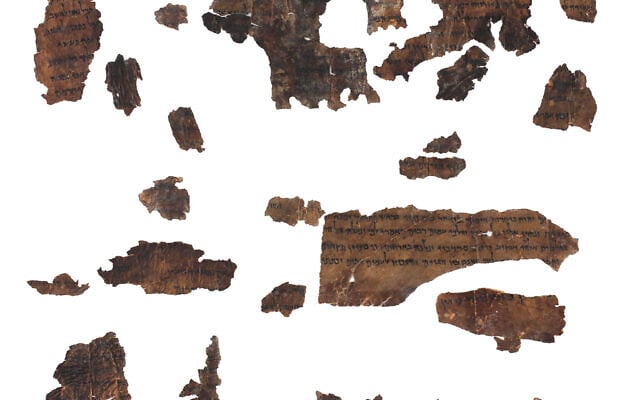
Dershowitz said the project has shown promising results with the 20 fragments tested, but the method will need to be applied to many more scrolls to fully assess its impact.
“It will take time,” Dershowitz said. “With the Dead Sea Scrolls, even reading just one more letter is good.”









The Times of Israel Community.