

Despite criticism, few hopes for change as Egypt votes on extending Sissi’s rule
Groups warns of return to autocratic system as Egyptians go to polls for three days of balloting on letting president stay in power until 2030
 Add ToI as a Preferred Source on Google
CAIRO — Egyptians cast their ballots Saturday on the first of three days of voting on constitutional amendments that would allow President Abdel-Fattah el-Sissi to stay in power until 2030 and broaden the military’s role.
Critics have blasted the proposed changes as another major step toward an authoritarian government perhaps even more severe than that of former President Hosni Mubarak, whose nearly three decades of autocratic rule was ended by a popular uprising in 2011.
The nationwide referendum came amid an unprecedented crackdown on dissent in recent years. Sissi’s government has arrested thousands of people, most of them Islamists but also prominent secular activists, and rolled back freedoms won eight years ago.
Polls closed at 9 p.m. local time. Voting will stretch over a period of three days to allow maximum turnout, which the government is hoping to lend the referendum legitimacy.
Mahmoud el-Sherif, spokesman of the National Elections Authority, said more than 61 million people are eligible to vote. Results were expected within a week, el-Sherif said in a news conference.
Outside a polling center near the Giza Pyramids, around two dozen people, mostly elderly women, lined up waiting to cast their votes. Heavy police and army security was reported at polling stations throughout the country.
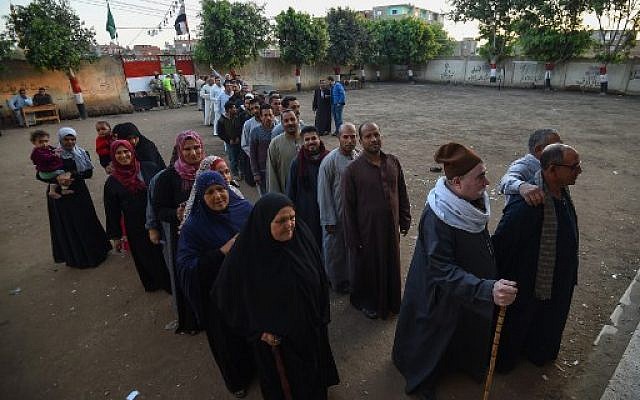
Haja Khadija, a 63-year-old housewife, said she came for the “security and stability” of the country. “We love Sissi. He did lots of things. He raised our pensions.”
At a polling station in Manyal, a Cairo suburb overlooking the Nile, Mohamed Abdel Salam, 45, said he fully supported the changes.
“I don’t care about the presidential terms,” he said. “Sissi could stay forever as long as he’s doing his job… and he has already done a lot.”
The three-day referendum bucks the trend of North Africa’s renewed uprisings, in which mass pro-democracy protests this month swept away veteran presidents in Algeria and Sudan.
Omar Knawy, who writes novels, voted “No” in the referendum. He said he opposes most of the changes, especially those that would enable Sissi to stay in power beyond his current second four-year term. He also opposes articles that declare the military the “guardian and protector” of the Egyptian state, democracy and the constitution.
Casting his ballot on Saturday, Prime Minister Mustafa Madbouly urged voters to turn out in high numbers. He said that voting will reflect “the atmosphere of stability and democracy that we are witnessing now.”

But some voters said they were being instructed to vote and expressed few hopes it would reflect their will.
“We are all staff in the same company and we were instructed by management to go vote,” one voter said.
“I want to say ‘No’… on extending the presidential terms and the amendments related to the judiciary,” he said, declining to give his name for fear of repercussions.
He pointed to his bosses nearby who were making sure employees were voting.
“Even if I say ‘No’, they (the authorities) are still going to do what they want in the end,” he added despondently.
State-run TV said Sissi voted in Cairo’s Heliopolis district, near the presidential palace. Sissi, who has repeatedly said he won’t stay in office any longer than the people want him to, hasn’t commented on the amendments.
In their initial report on the first day of the nationwide electoral process, an international observer team said “there were no hurdles to voting.”
But opposition voices have largely been shut out amid the rush to hold the referendum. Pro-government media have led a campaign for weeks calling a “Yes” vote a patriotic duty.
Since early April, the Egyptian capital has been awash with large posters and banners encouraging people to vote in favor of the changes. Most of the posters were apparently funded by pro-government parties, businessmen and lawmakers.
Out on the streets Saturday, Sissi’s supporters waved flags bearing their campaign motto: “Do the Right” thing, as they pressed passers-by to turn out and vote ‘Yes’.
Pro-Sissi campaign volunteers handed out boxed meals at four different polling stations in Cairo to voters after they had cast their ballots.
A parliamentarian greeted voters and volunteers gave out vouchers the Shubra district for boxes containing staples such as oil, rice, pasta and sugar.

In Manyal, a DJ played loud patriotic music, including a new song by Lebanese diva Nancy Ajram dedicated to Egypt’s leader called “Ragel ibn Ragel” (What a fine man).
The Egyptian leader won his first term as president in 2014, a year after he led the army in overthrowing elected Islamist president Mohamed Morsi following mass protests against his single turbulent year in power.
Standing virtually unopposed after the disqualification or withdrawal of all realistic challengers, he was re-elected in March 2018 with more than 97 percent.
Both elections drew heavy criticism from human rights groups as they were accompanied by harsh crackdowns on dissent — both Islamist and secular.
The amendments extend a president’s term in office from four to six years and allow for a maximum of two terms. But they also include an article specific to Sissi that extends his current second four-year term to six years and allows him to run for another six-year term in 2024 — potentially extending his rule until 2030.
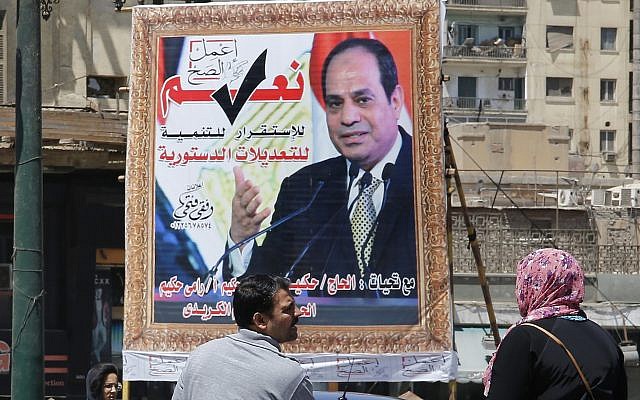
The amendments also allow the president to appoint top judges, while also granting military courts wider jurisdiction in trying civilians.
Parliament, packed with Sissi supporters, overwhelmingly approved the amendments on Tuesday, with only 22 no votes and one abstention from 554 lawmakers in attendance. The national electoral commission announced the following day that voting would begin on Saturday.
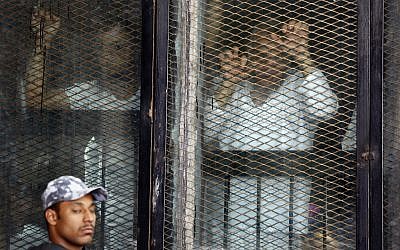
The proposed changes are seen by critics as another step toward authoritarianism. The referendum comes eight years after a pro-democracy uprising ended autocrat Hosni Mubarak’s three-decade rule, and nearly six years after Sissi led a popular military overthrow of the country’s first freely elected but divisive Islamist president, Mohammed Morsi.
Two international advocacy groups — Human Rights Watch and the International Commission of Jurists — on Saturday urged the Egyptian government to withdraw the amendments.
“Egypt’s autocracy is shifting into overdrive to re-establish the ‘President-for-Life’ model, beloved by dictators in the region and despised by their citizens,” said Michael Page, deputy Middle East and North Africa director at Human Rights Watch. “But it’s a model that recent experience in Egypt and neighboring countries has demonstrated is not built to last.”
The Soufan Center think-tank said the main effect of the referendum would be to “solidify Sissi’s grip on the Egyptian political regime” in a country that “has become even more autocratic than it was under Mubarak”.
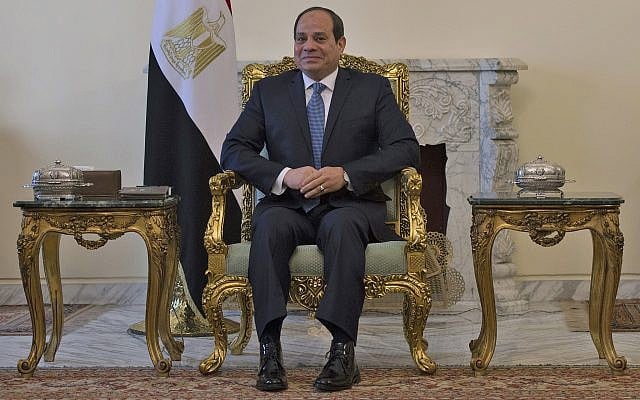
The Civil Democratic Movement, a coalition of liberal and left-leaning parties, urged people to participate in the referendum by voting “No.”
The coalition said it used social media to spread its message, noting that it was banned from hanging banners in the streets to call on voters to reject the amendments.
In the last three years, over 15,000 civilians, including children, have been referred to military prosecution in Egypt, according to Human Rights Watch.
The amendments also introduce one or more vice presidents, revive the senate and enshrine a 25% quota for women in parliament’s lower, legislative chamber. All three had been dropped from Egypt’s constitution after the 2011 revolution.








The Times of Israel Community.