

Finches use the same rulebook as human babies to pick up language, study finds
International team that includes Israeli cognitive scientist adds Bengalese finches to humpback whales in search for animals that learn using same mathematical principles as we do
 Add ToI as a Preferred Source on Google
Sue Surkes is The Times of Israel's environment reporter
Human language, with its grammar and predictability, has long been assumed to be unique.
But an international team of researchers, including Hebrew University cognitive scientist and developmental psychologist Prof. Inbal Arnon, is rewriting that hypothesis.
By applying the mathematical tools used to decode how human babies learn to talk, the team has discovered that the statistical rulebook of learned language is shared by some of the animal kingdom’s most vocal members. After identifying the patterns in humpback whales last year, the researchers have now found them in Bengalese finches.
Humans acquire language by recognizing statistically coherent units, such as words, whose internal structure is relatively predictable. They also learn according to the so-called Zipf’s law, which deals with the frequency of word use in a language. Zipf’s law states that the most common word will occur about twice as often as the second most common word, three times as often as the third, and so on. In English, the most common word is “the,” followed by “of,” and then “and.” Zipf also postulated another law: more frequently used words will be shorter to minimize the user’s effort to produce them. Human infants use statistical tools to pick up language.
Using recordings captured near Australia by Dr. Ellen Garland, a whale song expert at Scotland’s St. Andrew’s University, Arnon and Prof. Simon Kirby of the University of Edinburgh previously applied the human-speech segmentation algorithm they had developed to more than 30 hours of humpback whale recordings.
The results, published last year, showed that humpback whale songs obeyed the same statistical rules and Zipfian distributions as human language.
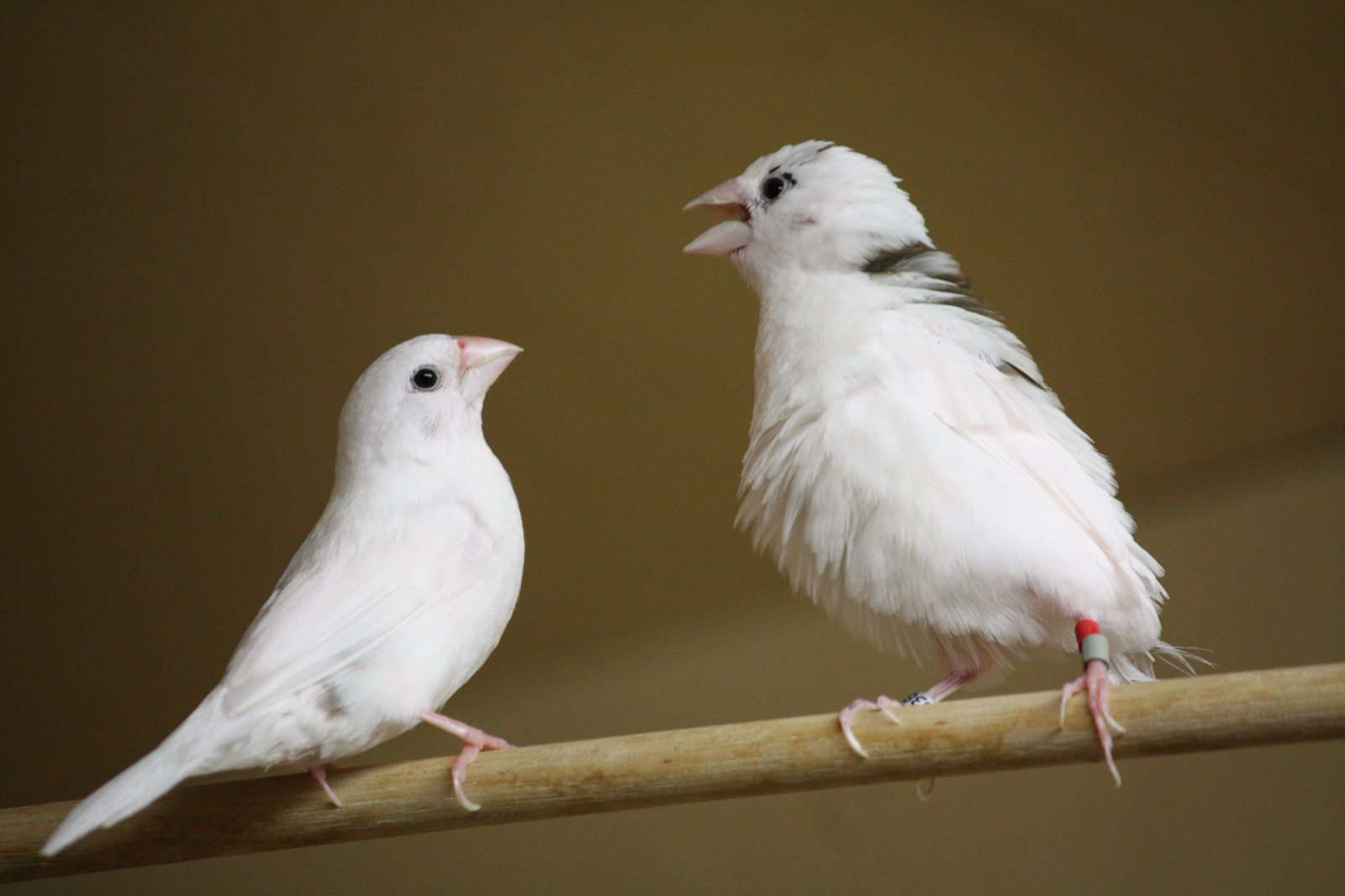
A Bengalese finch father (the bigger bird) teaches his son how to sing. (Kazuo Okanoya)
To test whether this was a broader law of nature, the team then turned to birds, specifically Bengalese finches, a domesticated passerine species whose complex songs are learned during youth. Joining the study were Kazuo Okanoya from Teikyo University and Miki Takahasi from the RIKEN Center for Brain Science, both in Japan.
They analyzed song recordings from six Bengalese finches between 60 and 120 days old (the critical development window when finch-speak is acquired and polished), and, in research published this month, detected the same underlying structures.
Just as human babies piece together a vocabulary from multiple adult tutors, young Bengalese finches stitch together song fragments from different birds.

The researchers caution, however, that language use differs between humans, whales and finches.
Humpback whale songs, which can vary between individuals and groups, are thought to convey identity, fitness, cultural group, and location, rather than the complex and varied ideas and concepts embedded in human language. Bengalese finches, by contrast, develop a specific song that can differ between individuals, and then stick to it, using it solely for mating.
The findings “illustrate that core mathematical patterns of language do not require semantics to thrive,” the paper says. “Instead, they prove the profound power of cultural transmission: whenever complex signals are passed down through generations and shaped by learning constraints, universal mathematical principles emerge naturally through convergent evolution.”










The Times of Israel Community.