

Husband heals during quest to meet wife’s bomber
A new memoir details a journey of recovery from PTSD — and a political awakening
 Add ToI as a Preferred Source on Google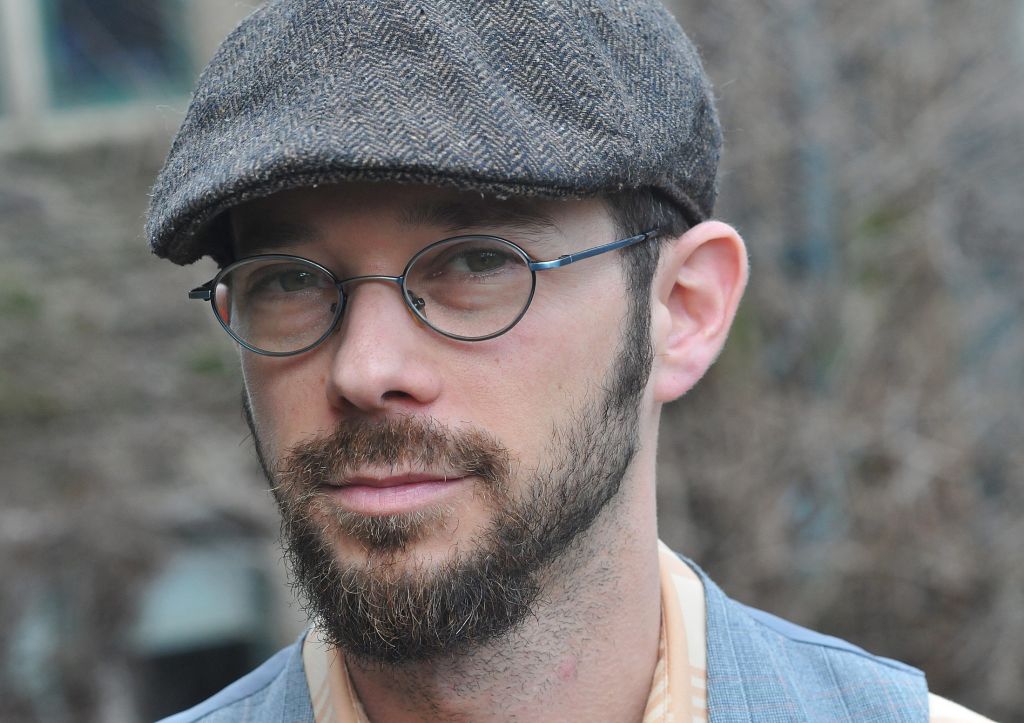
NEW YORK (JTA) — David Harris-Gershon, author of the forthcoming memoir “What Do You Buy the Children of the Terrorist Who Tried to Kill Your Wife?,” is frank about the contradictions in his personality.
An admitted “natural introvert,” Harris-Gershon describes himself as “surprisingly good” at public speaking. In 2013, he won the GrandSLAM Storytelling Championship at the Pittsburgh branch of the Moth, a nationwide storytelling organization, with a tale of using unorthodox tactics to drum up support for Barack Obama by posing as a woman in adult romance chat rooms.
“I love being in front of an audience,” said Harris-Gershon, 39, who works as a Judaic studies teacher in Pittsburgh, “but it drains me.”
Nonetheless, Harris-Gershon maintains a very public profile as a liberal commentator on Middle East politics, blogging for the progressive publications Tikkun magazine and Daily Kos.
But with the publication of his memoir, Harris-Gershon delves into the deeply personal events — some catastrophic, some therapeutic — that have led to his political stance.
The memoir, due in US bookstores on September 10, begins with the Hebrew University bombing in 2002 that killed two of his friends and severely injured his wife, Jamie, who had shrapnel lodged in her body.
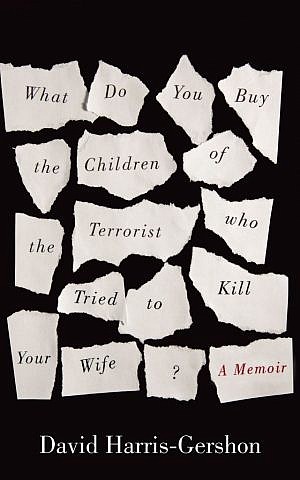
Harris-Gershon says Jamie is a “very private person” who preferred not to have her private ordeal immortalized in a book. So the memoir is not the story of her recovery but his own.
“Despite the fact that the book begins with the attack, her injury and her recovery, she understands that it is primarily a chronicle of my story and my experience — myself as a secondary victim,” Harris-Gershon said.
After the couple left Israel in 2003 after spending three years living in Jerusalem, Harris-Gershon began suffering symptoms of Post Traumatic Stress Disorder, including crippling anxiety attacks. The book delves deeply into his recovery process, including the traditional and innovative forms of therapy he tries.
Harris-Gershon describes watching a piece of shrapnel extracted from his wife’s body, noting the “opaque film of unknown fluids” on the twisted metal.
Much of his struggle is portrayed as extended dialogues between the author and himself, or with his therapist or inanimate objects — a playful literary technique that Harris-Gershon says reveals the influence of postmodern masters like Dave Eggers.
Ultimately, however, Harris-Gershon’s recovery was enabled not by conventional therapy but by an unprecedented encounter — one that led to a political awakening.
Spurred by an article in which the cafe bomber, Mohammed Odeh, expressed remorse for his actions, Harris-Gershon set out on a quixotic quest to meet the terrorist.
Harris-Gershon’s recovery was enabled not by conventional therapy but by an unprecedented encounter — one that led to a political awakening
The memoir details Harris-Gershon’s unsuccessful attempts to meet Odeh, a member of Hamas who is being held in an Israeli prison. Blocked repeatedly by the thorny machinations of Israeli bureaucracy, Harris-Gershon’s search serves as a catalyst for a series of revelations about the Israeli-Palestinian conflict that range from the unjust policies of the British Mandate to the poignancy of Palestinian life under Israeli occupation.
The book culminates in a meeting between the author and Odeh’s family in Silwan, a Palestinian neighborhood in eastern Jerusalem. Harris-Gershon describes the encounter as a “reckoning” that drove home the realization that Palestinians are, as he writes, “not monsters.”
The product of a Conservative Jewish upbringing in America, Harris-Gershon expresses bemusement that it took an act of terror for him to reach this epiphany.
“Growing up, I just thought of Palestinians as another enemy of the Jewish people,” he said. “I thought of them as a caricature of evil. And that is sadly common among American Jews.”
But struggling to understand the motivations of a terrorist and speaking with Odeh’s family, Harris-Gershon said, “made me understand their history and experience, their intense suffering, in ways that I had never understood before.”
Harris-Gershon says that in the wake of the encounter, he feels “transformed” and plans to continue to act on his newfound political beliefs, writing about Middle East politics and America’s role in the region.
“It may take the form of a new book in the near future,” he said. “My writing on this issue is definitely going to continue.”







The Times of Israel Community.