

Jewish legal group tries new line of attack to combat campus antisemitism in US
Lawsuit filed by National Jewish Advocacy Center against California’s Chapman University seeks to apply workplace discrimination law to educational contracts

 Add ToI as a Preferred Source on Google
Luke Tress is The Times of Israel's New York correspondent.

A US Jewish advocacy group has taken a new legal approach to combating campus antisemitism, deploying a law used for workplace discrimination in a lawsuit filed last week against a California university.
“A lot of times, these statutes remain dormant and hidden in plain sight. And then someone is like, ‘Why? You know, I think actually it applies to this situation,'” said Matthew Mainen, a lawyer with the National Jewish Advocacy Center who is representing the plaintiffs.
The case is a class-action lawsuit filed by two Jewish students against Chapman University in Orange, California, near Los Angeles. The suit alleges discrimination against Jewish students, abetted by the campus administration.
The university said it was reviewing the lawsuit and stressed its commitment to supporting Jewish students.
One of the plaintiffs, Eli Schechter, was the president of a pro-Israel group on campus. The other plaintiff, Talya Malka, is an Israeli-American. Both graduated last year and the lawsuit focuses on alleged anti-Jewish discrimination after the October 2023 invasion of Israel.
The lawsuit, filed in a federal court in California, said that, after the Hamas attack, Jewish students set up a memorial to the victims. Activists from the campus chapter of Students for Justice in Palestine targeted the memorial by stealing its flags, putting a Palestinian flag above the exhibit, and posting the vandalism on social media.
Days later, an anti-Israel student yelled “Fuck Jews” at Jewish students mourning the October 7 victims and sent antisemitic death threats to Schechter, the lawsuit said.
The university allowed anti-Israel flyers to be posted around the memorial. Pro-Palestinian students continued stealing Israeli flags from the memorial and ripping down posters of the Israeli hostages, defacing pro-Israel signs, and posting the footage of some of the vandalism online.
The lawsuit said the university did not discipline the anti-Israel students, told the pro-Israel activists a flag in support of the IDF was “upsetting Palestinian students,” and argued that it should be removed. This was on October 18, 2023, before Israel started its counter-offensive in Gaza. The Jewish students removed the IDF flag.
As tensions escalated between the pro- and anti-Israel groups, some pro-Israel students applied to attend a Students for Justice in Palestine event to “learn more about their perspective.” Students with Jewish-sounding last names were denied entry to the meeting, while another pro-Israel student, who was not Jewish, was allowed in.
The dean of students supported the denied entry, telling Schechter, “I frankly cannot condone your right to attend this event,” the lawsuit said. The dean and school security blocked Schechter and another student from entering the event.
In some other incidents, a faculty adviser for Students for Justice in Palestine shouted at Schechter for posting pro-Israel flyers on campus, although it was allowed under university policy and anti-Israel students had posted flyers around campus, including on top of the pro-Israel flyers, the lawsuit said.
An anti-Israel student activist posted online that he wished “death to all Israelis,” and, in an exchange with Malka, said, “I want you and all you zionist trash bags dead,” and said she was “polluting this world.”
Malka sent the threats to administrators and told them she didn’t feel safe. Administrators said the anti-Israel student had “crossed the line,” but the student was not disciplined. Another student made a Nazi salute toward Jewish students, the lawsuit said.

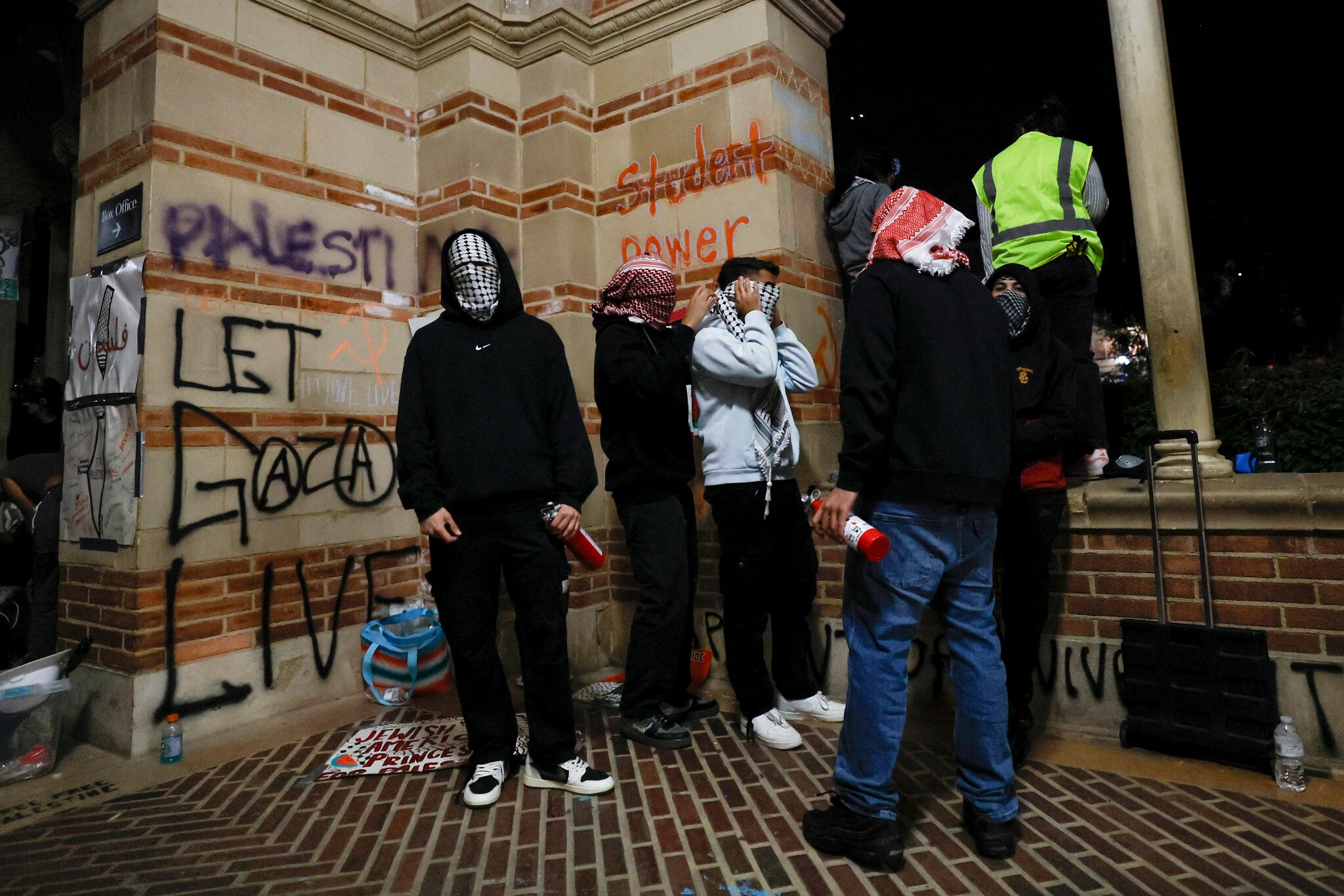
Protesters chanted “Globalize the intifada” through megaphones on campus, which the Jewish students found threatening, and Jewish students were blocked from entering a protest encampment on the campus.
The lawsuit alleges that university administrators took no meaningful action to discipline the anti-Israel student protesters, despite repeated pleas from Jewish students, and in some cases, administrators defended the protesters. At one point, the dean of students arranged an unproductive meeting between the pro- and anti-Israel students.
The lawsuit argued that only Jewish groups and students were targeted, in a “pattern of ethnic and racial intimidation.”
The lawsuit said that Jewish students were subject to both disparate treatment — discrimination due to their identity — and harassment. The university’s support for the student group blocking Jews from meetings and the encampment was evidence of illegal discrimination, even if political differences over Israel were allowed, Mainen said.
A spokesperson for the university said, “We are aware of the matter and are reviewing the filing.”
“We stand by our strong record of supporting Jewish students and continuing to do so is a priority and commitment for us, consistent with our mission and founding,” the spokesperson said.
‘Exploring legal theories that are untested or have mixed results’
The lawsuit is attempting to open a new front in legal challenges to campus antisemitism.
Most lawsuits filed by Jewish students against universities are based on Title VI of the US Civil Rights Act of 1964. The law bars discrimination in entities that receive federal funding, including most universities. The strategy has met with mixed success; last month, MIT beat a discrimination lawsuit filed by Jewish students on Title VI grounds.
The case against Chapman employed a different federal law, 42 US Code section 1981, which bars racial discrimination in making and enforcing contracts. The law has been used widely in lawsuits concerning discrimination in the workplace, but has not been tested for campus antisemitism.

The lawyers representing the Chapman students are seeking to extend the law to campus discrimination, arguing that universities and students are also engaged in a contract under the law, and that the measure is therefore applicable to campuses.
“We’re trying to take from the workplace the concept of racial harassment under 1981 and say, ‘Hey, this actually applies in any contract, given the plain text of the statute, including in educational contracts,’” Mainen said. “My clients paid Chapman tuition. Chapman was supposed to give them an education, and according to 1981, they were supposed to carry out that contract free from harassment.”
The legal team believes that Section 1981 is stricter than Title VI on racial harassment, due to precedents set in workplace discrimination cases, the text of the law, and the law’s basis in combating racism after slavery in the US.
The Supreme Court has ruled that Jews are a race for the purpose of racial discrimination law.
“We have a very, very solid foundation, which is allowing us to explore legal theories that have either been untested or which have mixed results in the courts,” Mainen said.
Also, unlike most lawsuits filed by Jewish students, the case is a class action lawsuit. The legal team believes making it a class action case could benefit more Jewish students at the university, and could send a message to other universities if the court allows the case to proceed as a class action case.
“They’re going to be having to weigh the fact that maybe the next time there’s a tolerance of antisemitism, it’s not just going to be one or two students suing them,” Mainen said.
Legal battles related to antisemitism and anti-Israel activism, on campuses and in other forums, are taking place in courtrooms across the US, with lawsuits filed by both pro- and anti-Israel activists. Some institutions, like Columbia University, are being battered from both sides.
The National Jewish Advocacy Center and other Jewish legal groups have deployed a series of novel approaches to combating antisemitism in recent years, an effort that has gained steam since the start of the Gaza war.
Many of the cases are still making their way through the courts, sometimes setting new legal precedents during the process.










The Times of Israel Community.