

Life-size relief replica stars in Arch of Titus show in New York
Massachusetts sign carver uses 3-D scans and and hi-tech machinery to make striking copy of famous ‘Spoils of Jerusalem’ bas-relief
 Add ToI as a Preferred Source on Google
Renee Ghert-Zand is the health reporter and a feature writer for The Times of Israel.
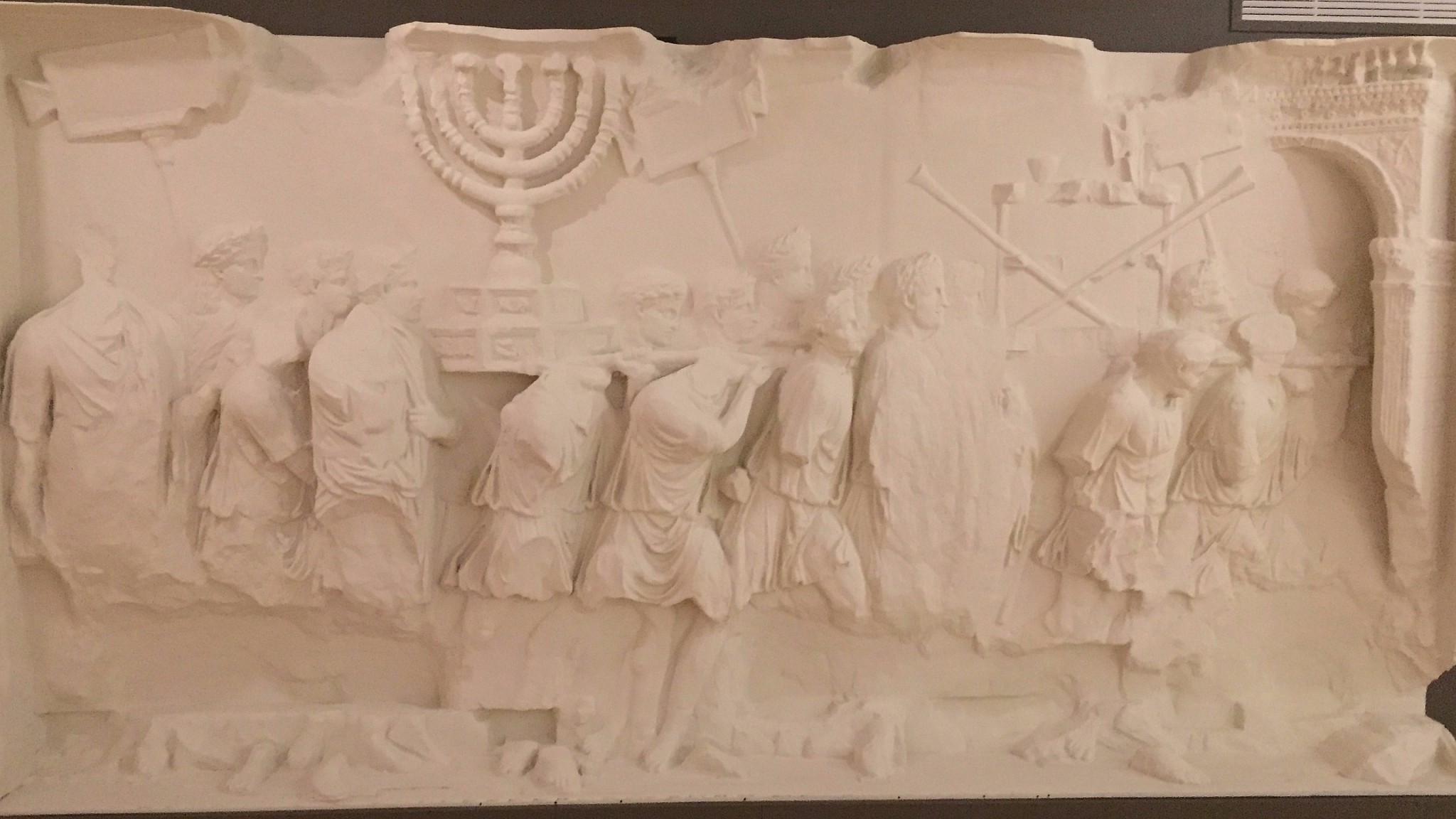
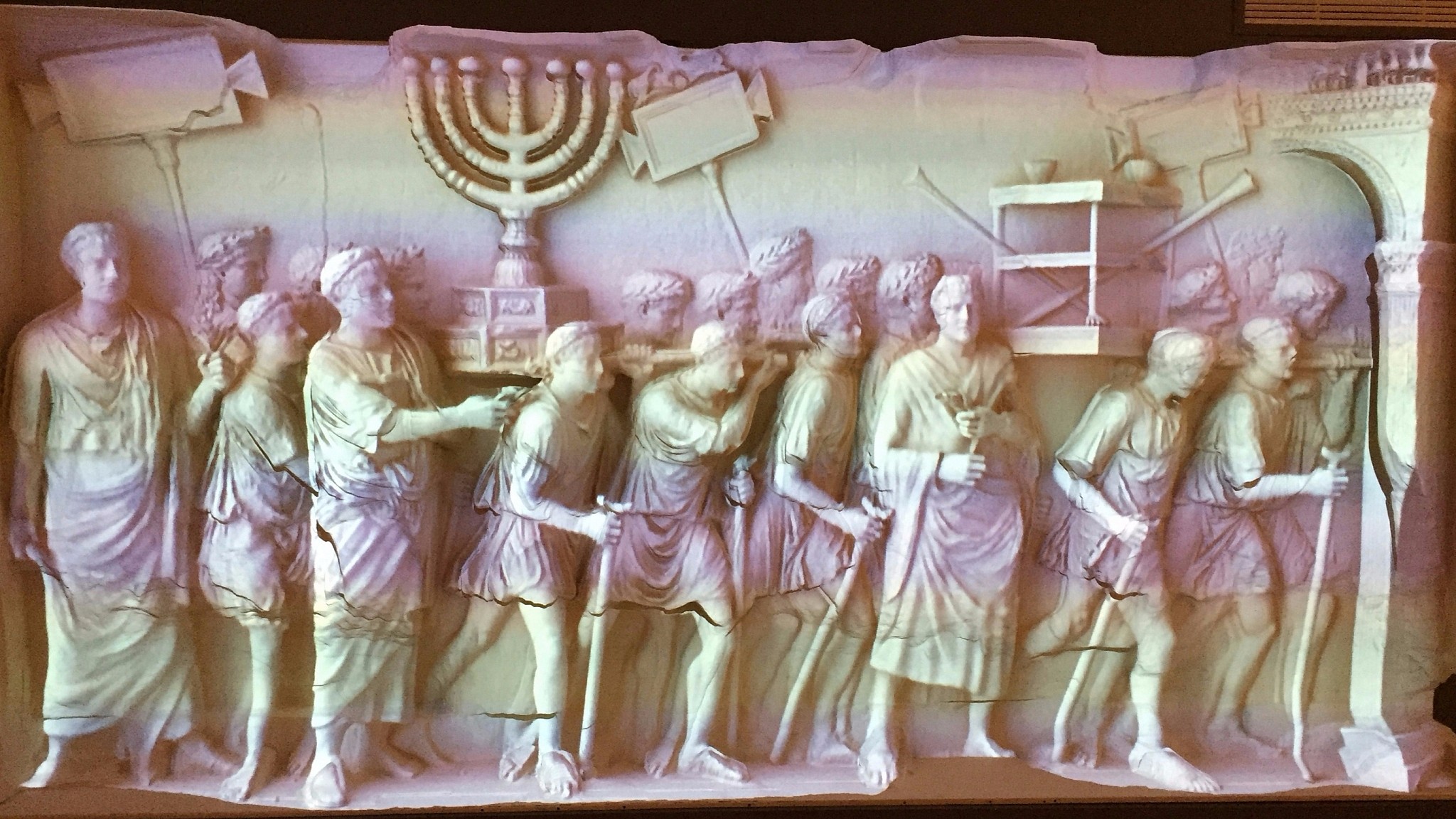
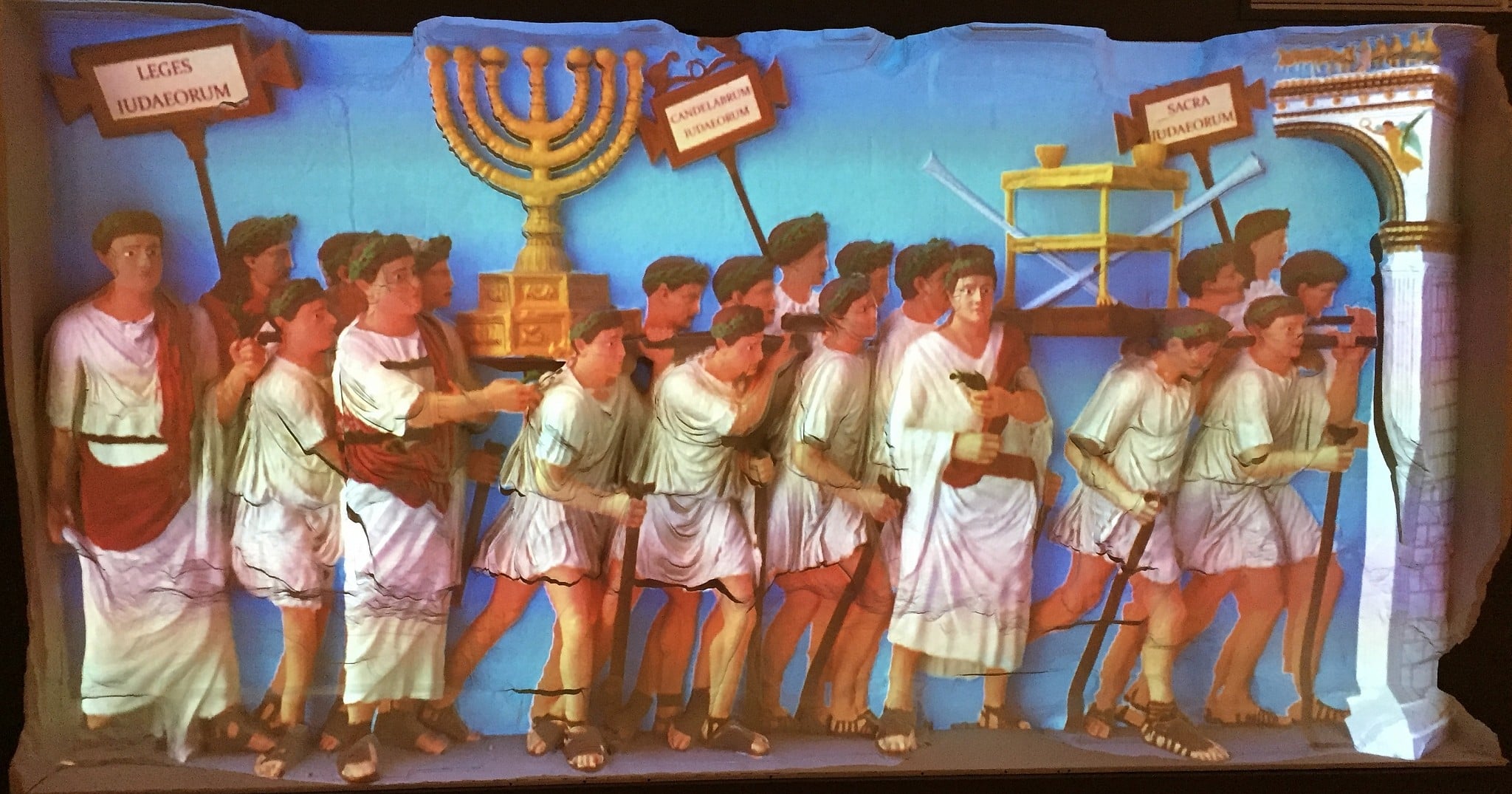
Lindsay Neathawk first saw the Arch of Titus on a visit to Rome in 1998. A teenager at the time, she could not have imagined that two decades later she would make the first hi-tech replica of the ancient monument’s famous “Spoils of Jerusalem” panel commemorating Roman forces’s capture of Jerusalem and destruction of the Holy Temple in 70 CE.
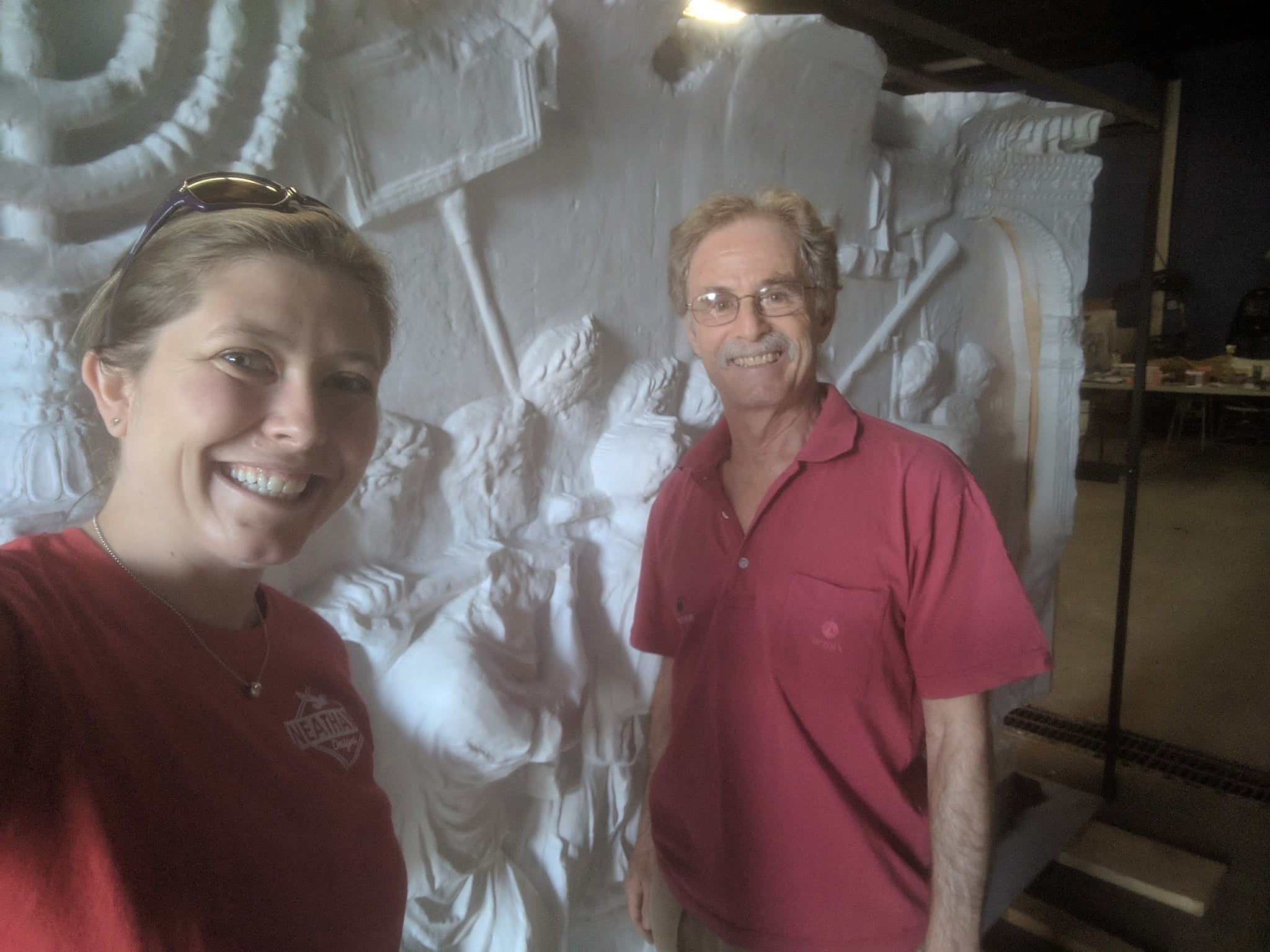
Using cutting-edge digital tools, Neathawk, a graphic designer and owner of a sign carving business in Williamstown, Massachusetts, spent a straight 49 days last summer creating the replica.
It was carefully transported in late August to New York City, becoming the centerpiece of the current “The Arch of Titus – from Jerusalem to Rome, and Back” exhibition at Yeshiva University Museum.
The replica is made of high density urethane foam and weighs around 1,000 pounds. It is a one-to-one copy of the panel on the monumental arch erected on Rome’s Via Sacra, the “Sacred Road,” around 82 CE, shortly after Emperor Titus’s death. One of three interior relief panels on the arch, “Spoils of Jerusalem” depicts Titus’s triumphal procession into the Eternal City in July 71 CE. Roman soldiers are seen carrying sacred vessels of the Jerusalem Temple, and at the center is the seven-branched golden menorah.
The replica produced by Neathawk in collaboration with VIZIN: Institute for the Visualization of History, is based on three-dimensional and polychrome scanning conducted in 2012 by an international team of scholars led by cultural historian Dr. Steven Fine, founding director of the Yeshiva University Center for Israel Studies.
Fine, an expert on the Greco-Roman period, immersed himself in the study of the Arch of Titus, and last year published a book on the Menorah and its evolving symbolic significance over 3,000 years.
Fine’s enthusiasm for the monument rubbed off on Neathawk, 37, who decided to take on the Spoils replica project despite having never carved anything bigger or more complicated than signs for local merchants.
“This project was in a totally different league, both in terms of size and intricacy,” Neathawk said.
“But our motto is, ‘If you can think it, we can do it,’ so we went for it,” she said.
According to Fine, a handful of other replicas of the Spoils panel exist around the world. Some are casts, and one is what Fine described as “an artful reproduction.” This latest one is the first to use advanced digital tools to not only make a copy of the relief as it exists today, but also to project onto it what it would have looked like at the time of its original creation.
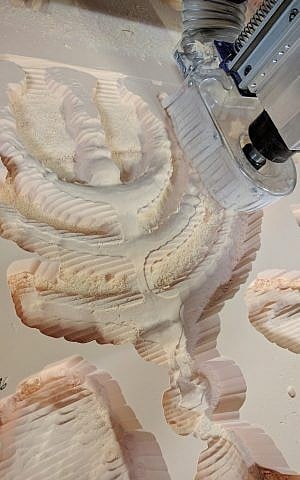
Archeologist Donald Sanders of VIZIN, who oversaw Neathawk’s work, provided her a digital rendering of the panel based on Fine’s scans from Rome. This was converted into code read by Neathawk’s computer numerical control (CNC) carving machine.
Neathawk used her expertise to choose the correct bits for the CNC machine, many of which broke due to intensity and duration of the carving, which on many days went nonstop around the clock.
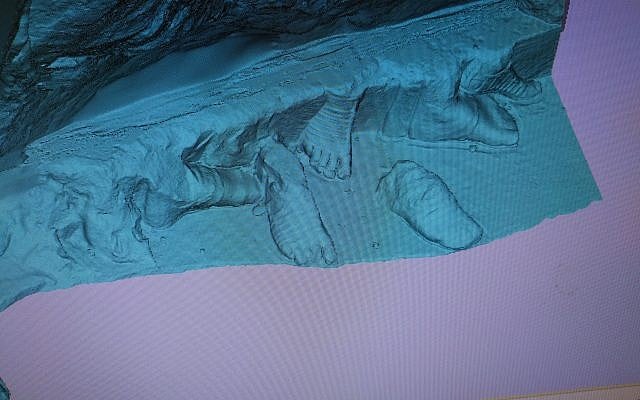
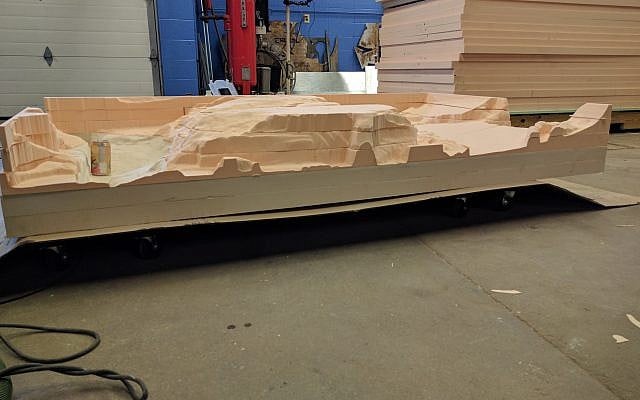
To make the project manageable, Neathawk and Sanders divided the Spoils panel into four vertical sections, each sliced into nine two-inch- thick cross sections. In a bid to keep in check the weight of what would eventually be a piece measuring 12.5 feet wide by 6.5 feet high by 1.5 feet deep, Neathawk used foam of only two- and 15-pound densities.
“It was a balancing act between accuracy and stability. We didn’t want it too fragile,” Neathawk said.
After the more than 30 pieces were complete, Neathawk glued them together using seven pounds of two-part epoxy, before painting the completed replica with a light tan-colored latex paint.
Neathawk said putting all the carved pieces together was like building a puzzle, albeit a very complicated — and sometimes dangerous — one. She badly bruised a bone in her arm when some foam dropped on it. In addition, she broke the tip of a finger by slicing it when a handheld chisel slipped as she worked on a part of the replica that could not be made by the computerized carving machine.
Exhibition co-curator Jacob Wisse noted that although the $50,000 replica is a crucial element of the Yeshiva University Museum exhibition, it is not the only star of the show. Also highlighted are rare artifacts from all eras on loan from more than 20 individual collectors and institutions, ranging from the Library of Congress in Washington, to the Israel State Archives in Jerusalem, to the Istituto Luce Cinecittà Historical Archive in Rome.
“The exhibition is about the changing nature of the Arch of Titus, and not only in terms of physical changes, such as its restoration by Pope Pius VII in the 1820s after its falling into a ruinous state by the 19th century,” Wisse said.
“It also looks at how this monument has been appropriated over the course of history as a symbol by everyone from emperors and popes to Jews and Christians, who re-interpreted the meaning of the arch in modern times,” he continued.
The most notable reinterpretation by Jews in the current era is the State of Israel’s adoption of the Menorah as its official symbol in 1949. Exhibition visitor Bonnie Zaben found this to be of major emphasis, and somewhat at the expense of the Spoils replica.
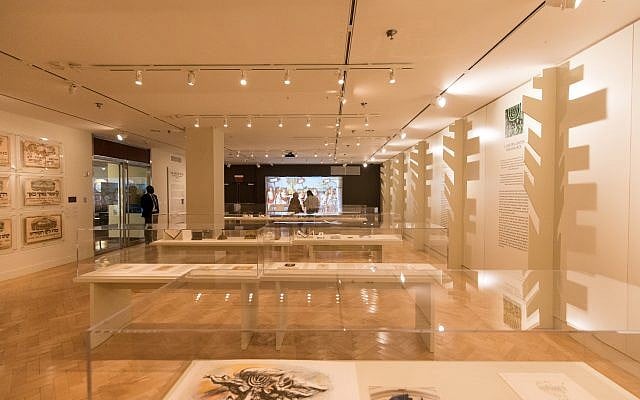
“I really didn’t expect the Menorah as Israel’s symbol to be such a large part of the show. I was actually surprised that the Spoils replica was not more central. It’s the biggest element in the room, but it is at floor level and placed against a wall instead of elevated as a centerpiece,” Zaben said.
“You don’t even see it immediately upon entering the gallery. It’s on a wall to the left of the entrance,” she added.
Wisse said the replica’s placement was deliberate, with it serving as a point of reference, both literally and figuratively, for the entire exhibition. The layout is such that the Spoils panel is repeatedly in visitors’ line of sight as they walk through the various sections of the show.
“The replica gives a sense of size and color of what this 50-60 feet high monument built 2,000 years ago is really like, and it grounds you in the historical context as you move forward in time through the exhibition,” Wisse said.
Neathawk’s replica comes further to life as three different digital projections created by VIZIN overlay it in a continuous loop. The first digitally reconstructs the relief, filling in the pieces that were lost and damaged to time. The second adds onto the restoration full colorization based on ancient pigments found on this and other Roman sculpture. The final projection shows the colorization muted and modulated, as it may have appeared over time.
Fine’s polychrome scanning of the Spoils relief in 2012 discovered only traces of ochre yellow on the Menorah. The rest of the colorization is based on research and best guesses.
“The great thing with today’s technology is that things can be changed and updated as more is discovered. We know we are on the right path. We don’t claim to be right, just more right than wrong,” Fine said.
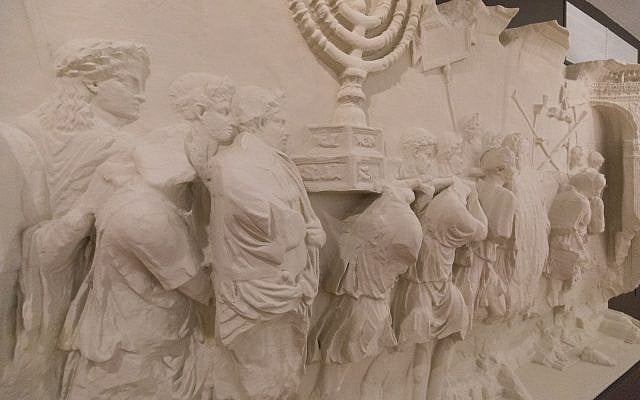
Neathawk came into the picture toward the end of the exhibition’s conception, but the opportunity has broadened her horizons and piqued her interest in working on more museum installations.
She would also like to return again to the real Arch of Titus, this time with a deeper appreciation for it.
“I’ve learned that sculptures and monuments aren’t just art. They are tools for teaching history. It’s not enough to assume you know what something is. You need to really know what you’re looking at,” Neathawk said.
“The Arch of Titus – from Jerusalem to Rome, and Back” exhibition runs at Yeshiva University Museum until January 14, 2018.




The Times of Israel Community.