

Nvidia chief sees advent of robot taxis as soon as 2020
US maker of processors holds its annual developers convention for the first time in Israel, which it sees as an AI hub
 Add ToI as a Preferred Source on Google
Shoshanna Solomon was The Times of Israel's Startups and Business reporter
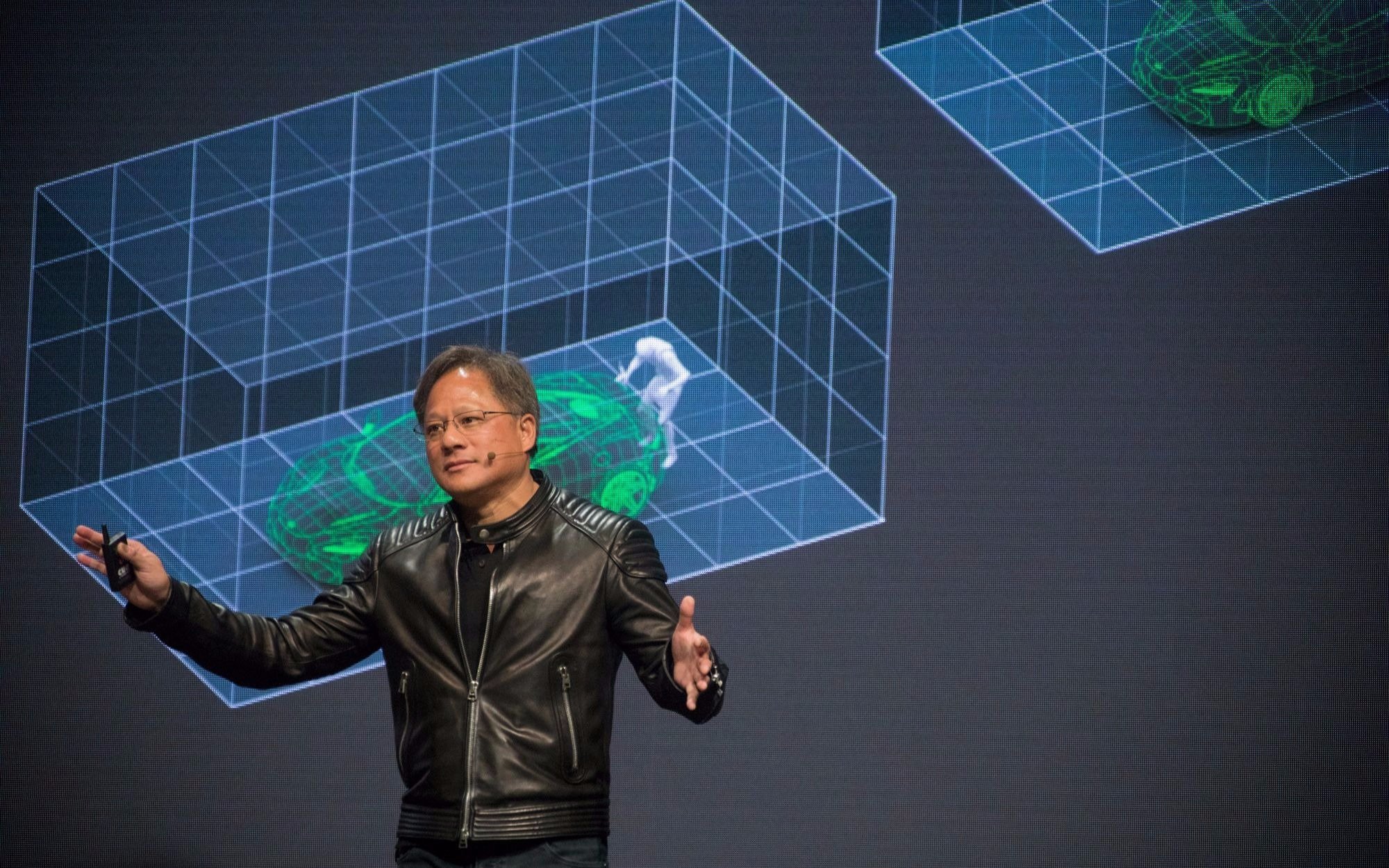
The world will see its first robot taxis as early as 2020, predicted Jensen Huang, the CEO of Santa Clara, California-based Nvidia Corp. whose data processors help develop technologies for self-driving cars.
“There will be a lot of pilot services already in 2019, and level five (fully autonomous) taxis in 2020,” Huang said at a press conference, after holding a keynote speech in Tel Aviv at Nvidia’s GPU Technology Conference (GTC).
The developers’ conference, which focused on artificial intelligence (AI), was held for the first time in Israel. Some 1,500 developers and high-tech officials and entrepreneurs attended the event.
Fully autonomous vehicles will follow in 2021 and 2022, Huang forecast. The self-driving taxis will likely initially operate in large, “gated areas” in cities like San Francisco or New York, which have been fully mapped, to make it easier for the taxis to operate, he said.
Nvidia has developed processors for the autonomous car industry — the Nvidia Drive PX and the Nvidia Drive IX — which will enable the start of the production of fully autonomous cars, he told the gathering of developers.

The US maker of data processors, which are used by a range of industries — from radiology to warehouse automation and self-driving vehicles — is strategically completing its transition from being a maker of processors for gaming and computer graphics to a leader in artificial intelligence and visual computing technologies.
The firm sees Israel and its local talent and innovation as an integral part of its activities based on artificial intelligence.
“Israel has some of the best entrepreneurs,” he told the conference, dressed in a black leather jacket over a black T-shirt and jeans. “We are here for the same reason many other international companies are here: we are seeking for talent, and Israel is a great environment for the creation of innovation.”
“We are only at the start of our activity here,” he added.
At the conference Huang said the computer industry is going through dramatic changes and is at the start of a new era — that of artificial intelligence — which directly stems from previous eras: the PC, mobile, and cloud revolutions.
“In each era, new startups were set up,” he said. “We are at the beginning of a new era, the largest one of all.”
The advent of AI enables the “automation of automation” — where software writes software and machines can learn. All these technologies need huge amounts of data processing, and that is where Nvidia is positioning itself with its GPU processors and with its new AI-based processors, which Huang demonstrated on Wednesday.
These include the Holodeck, which enables the creation of a virtual design lab and new software that creates a virtual environment, in which robots can be trained as if they are in the real world.
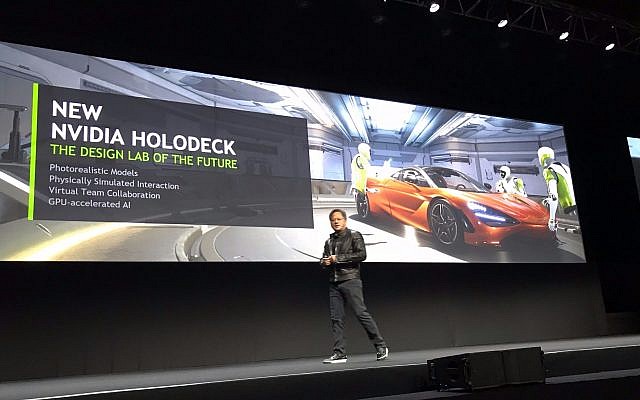
The idea, he said is to create AI development platforms that are open to developers from all industries globally, he said
Nvidia, which has seen its share price surge almost 200 percent in the past 12 months, has been active in Israel for the past eight years, both selling its processors locally and buying stakes in startups. The company has invested some “tens of millions of dollars” in three startups over the past five years, according to company data: Zebra Medical, the maker of a medical imaging insight software using artificial intelligence; Deep Instinct, which uses deep learning to predict cyber-threats; and Rocketick, a simulation and chip testing company which was then bought by Cadence in 2016 for a reported $40 million.
“In the past we have not been very proactive in investing in startups,” Huang said at a press conference after his presentation. That is because the firm tends to develop its own technology. But if it sees that an investment in a startup can speed up the development of a key product or idea, then it makes an investment in the firm, he said.
“There are so many ideas, we would love to see them get their products to the market faster,” he said. “I encourage startups to reach out to us.”
Nvidia this year set up a new 20-person research and development team in Israel and is looking to expand its activities locally, Jeff Herbst, VP of business development at the firm, said in an interview with The Times of Israel in August.
Israel will be the hub, or one of the hubs, for developing artificial intelligence technology that goes into the various verticals the company is working on, said Herbst.










The Times of Israel Community.