

Poll: Netanyahu’s Likud enjoys boost amid Iran war, but bloc he leads is no closer to majority
Likud’s increase from 27 to 31 seats comes at expense of PM’s coalition partners, leaving both major blocs unchanged at 53 seats each, with Arab parties and Gantz holding balance
 Add ToI as a Preferred Source on Google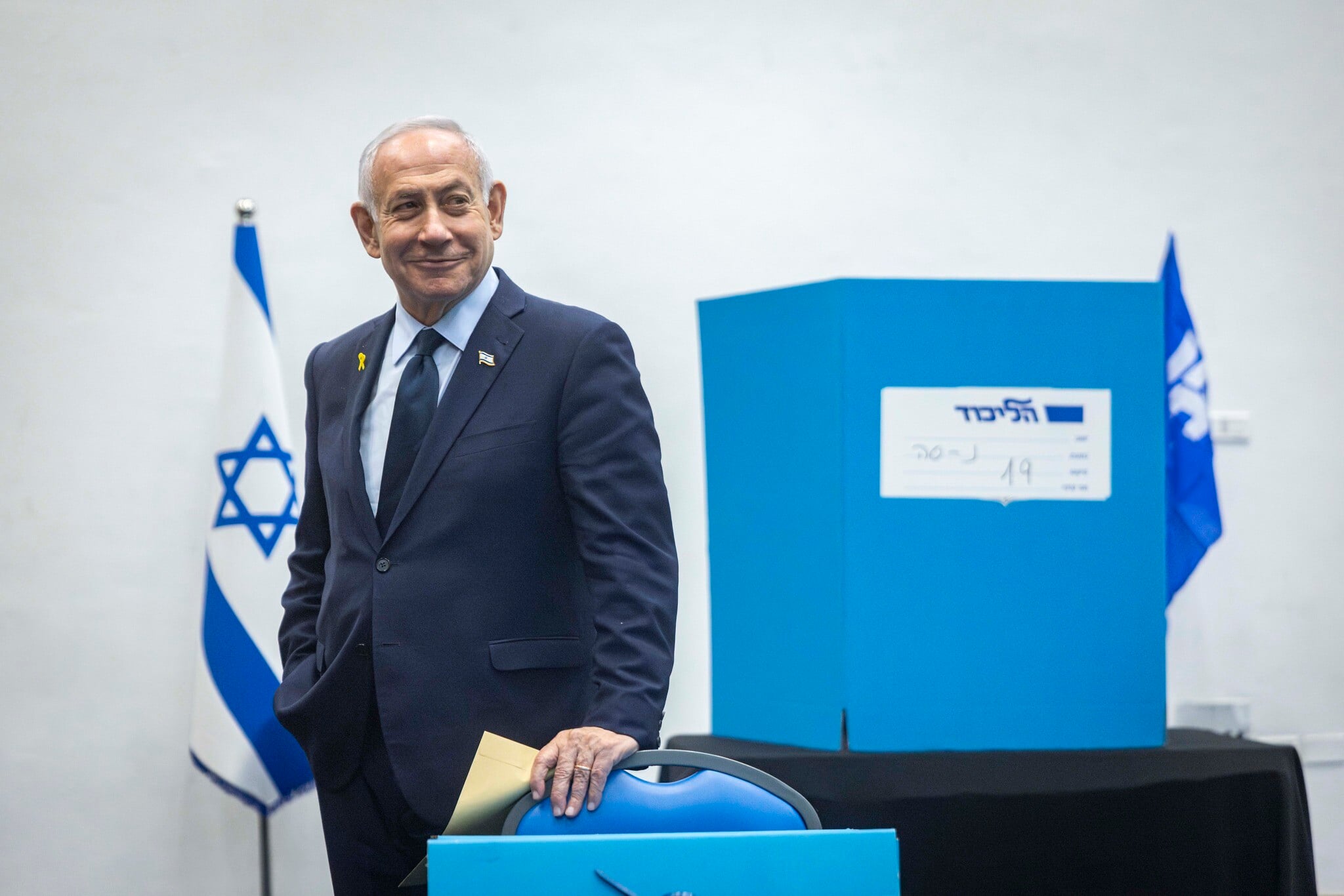
Prime Minister Benjamin Netanyahu’s Likud party is enjoying a boost in popularity amid the US-Israeli war in Iran, but his bloc would not gain seats if elections were held today, as Likud’s rise appeared to come at the expense of other coalition parties, according to a new poll conducted for Zman Yisrael, The Times of Israel’s Hebrew-language sister site.
The pro- and anti-Netanyahu blocs each polled at 53 seats in the 120-member Knesset, with the remaining 14 seats split between two predominantly Arab parties, which scored five each, and Benny Gantz’s non-aligned Blue and White party.
According to the poll, the first since the start of the war on Saturday, Netanyahu’s Likud would receive 31 of the Knesset’s 120 seats if elections were held today, up from 27 in the previous week’s poll.
However, the boost came as Likud’s coalition partners declined in the poll. National Security Minister Itamar Ben Gvir’s far-right Otzma Yehudit, for example, dropped from eight seats last week to six in this week’s poll.
The ultra-Orthodox parties Shas and United Torah Judaism also lost one seat each, falling to nine and seven seats respectively.
As in previous weeks, Finance Minister Bezalel Smotrich’s Religious Zionism party was projected in Thursday’s poll to fall below the minimum electoral threshold, leaving it out of the Knesset.
Among anti-Netanyahu parties, Gadi Eisenkot’s Yashar also enjoyed a boost, rising to a projected 14 seats, up from 12 the week prior and nine two weeks ago.

But similar to Likud, Eisenkot’s gains would appear to come at the expense of his allies, namely the party of former prime minister Naftali Bennett, which dropped to its lowest showing in weeks in Thursday’s poll, winning just 15 seats. Bennett has consistently been seen as Netanyahu’s most credible challenger.
As for the remaining anti-Netanyahu parties, Avigdor Liberman’s Yisrael Beytenu would win 10 seats, Yair Golan’s left-wing Democrats would win eight seats, while Yesh Atid, headed by Opposition leader Yair Lapid, would win six.
The shifts did not appear to make any impact on the overall balance of seats held by the pro- and anti-Netanyahu blocs, with the coalition and opposition camps projected to remain neck and neck with 53 seats each, well short of the minimum 61 needed for a majority.
The current projection of 53 seats per bloc does not include the Arab-majority Hadash-Ta’al and Islamist Ra’am, each projected to win five seats, or Gantz’s Blue and White, which hasn’t aligned with either bloc, which is projected to receive four. The secular Arab nationalist Balad party would fall below the electoral threshold and fail to enter the Knesset.
It also does not take into account that Hadash-Ta’al, Ra’am, and Balad are actively working to revive the Joint List — a merged slate of all four Arab parties that existed from 2015 until 2022. Should the parties run as a collective group, they are likely to benefit from a boost, as Balad’s votes would not be wasted.
While Ra’am was a part of Bennett’s short-lived anti-Netanyahu government in 2021-2022, Bennett, along with Gantz and Liberman, has said it would be untenable to rely on Arab support following the Hamas-led onslaught of October 7, 2023, that sparked the war in Gaza.
The Zman Yisrael poll was conducted on Wednesday and Thursday, March 4 and 5, with a representative sample of 500 Jewish and Arab Israelis. It has a margin of error of 4.4%.
Times of Israel staff contributed to this report.









The Times of Israel Community.