

Western deaths rock Syrian boat
Egyptian ex-president to receive verdict in June and columnist praises Al-Jazeera as vehicle of revolution
 Add ToI as a Preferred Source on Google
Elhanan Miller is the former Arab affairs reporter for The Times of Israel
The deaths of two Western journalists in the Syrian city of Homs on Wednesday occupies the leading headlines in Arab media. Twin photos of journalist Marie Colvin and photographer Remi Ochlik appear on the front pages of all major Arab news outlets.
Liberal daily Al-Hayat, published in London, reports a telephone conversation between Saudi King Abdullah and Russian President Dmitry Medvedev, in which the king said that Saudi Arabia “could not forgo its moral and religious position” toward the Syrian question.
Dubai-based news channel Al-Arabiya reports the final words of Homs citizen Rami Sayid, the most active and well-known amateur journalist who was killed Wednesday in the shelling of the city. According to the news channel, Sayid told his friends that collective extermination was under way in Homs, and rejected Western statements such as “our hearts are with you.” He said that what is needed from the West is mass protests across [Syrian] embassies.
The coverage of Arab news outlets focuses on the rising death toll in Syria, as well as on the American and French condemnation of the journalists’ killing. Much attention is given to the professional achievements of Colvin and Ochlik.
In a scathing opinion piece, an Al-Hayat columnist attacks, among others, US President Barack Obama, who was hosting a blues concert at the White House while American journalist Marie Colvin was killed by the Assad regime.
“While Obama was singing, the Damascus regime was playing on the strings of the Russian tune. Putin displays his muscles, remembering the missile crisis in Cuba’s Bay of Pigs, gambling on his ascendancy to the presidency in a few days. Meanwhile, Obama will not take risks because of the long run in the American election campaign.”
New Palestinian government within 10 days
Al-Jazeera, a Qatar-based news channel, reports that Palestinian leaders Mahmoud Abbas and Khaled Mashaal met in Cairo Wednesday to hash out the final details of the Palestinian unity government. During the first part of the meeting, the chief of Egypt’s intelligence agency (Mukhabarat), Murad Muwafi, was present.
Egyptian analyst Ibrahim Darawi speculates that the unity government will be declared within 10 days.
Hamas leader Izzat Rishq tells Al-Jazeera that Abbas was not the best choice for prime minister, but that his nomination represents a compromise between Fatah and Hamas. Rishq adds that Hamas had displayed “exceptional flexibility” by agreeing to Abbas’s nomination.
Meanwhile, Al-Hayat reports that Hamas agreed to the unity deal as part of its attempts to maintain good relations with Qatar, which brokered it. Hamas sources tell the daily the will insist on the interim government’s limited mandate, allowing it only to reconstruct Gaza and prepare for general elections, but nothing more.
Mubarak judgment on June 2
Arab media are reporting that a court judgment for deposed Egyptian president Hosni Mubarak will be announced on June 2. The court’s final sitting took place on Wednesday.
Government mouthpiece Al-Ahram reports that Mubarak made no attempt to defend himself, quoting an Egyptian poem that reads “my country, even if it was unfair toward me, remains dear. My people, even if they have wronged me, remain dignified.”
A TV report on Al-Arabiya displays a bed-ridden Mubarak stating from inside a metal cage, “I deny all these allegations.”
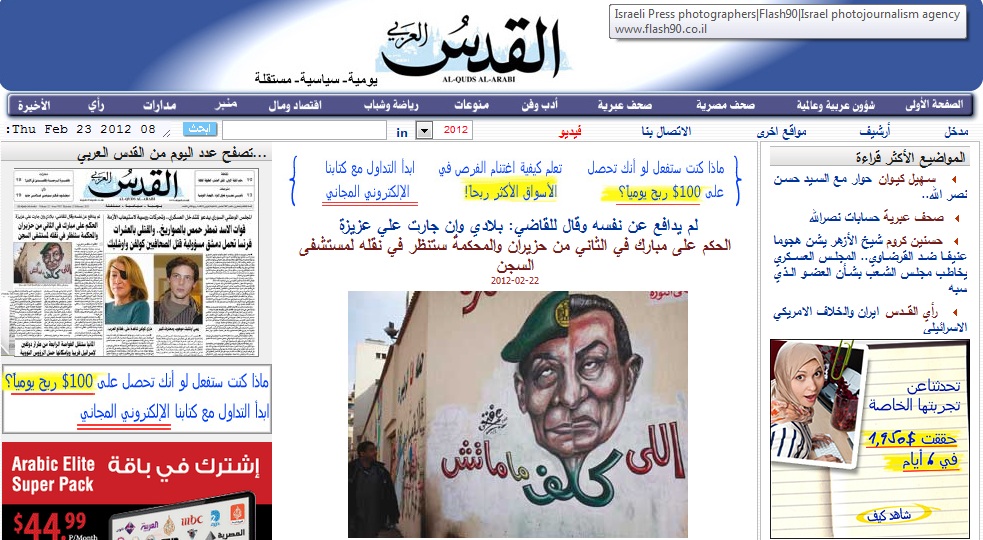
Hard-line daily Al-Quds Al-Arabi reports a play-by-play account of the court proceedings, including a verbal exchange between Mubarak’s lawyers and the prosecution. The daily reports that the verdict reading on June 2 will be broadcast by official Egyptian television only.
Al-Quds Al-Arabi displays a photo of graffiti on an Egyptian wall, depicting General Tantawi, the de facto leader of Egypt, as a direct disciple of Mubarak.
Qatar is nothing without Al-Jazeera
“Can anyone remember political Qatar before Al-Jazeera?” asks Lebanese columnist Harith Hassan in the left-leaning Lebanese daily Al-Akhbar Thursday. “First there was Al-Jazeera and then there was Qatar.”
Hassan asserts that today no one can ignore Qatar’s political role in the region thanks to its world-renowned satellite station.
“Were it not for this station placing cameras in the regions of protest, dedicating its Arabic and English studios to support the protesters, it would not be possible to create an international public opinion and embarrass large states into supporting the protests and calling on Mubarak to step down.”







The Times of Israel Community.